Structural barriers block AI transformation now
Seventy-four percent of professionals call AI necessary, yet their organizations lag behind in implementation.
The 2026 State of AI for Business Report reveals a stark reality where individual adoption outpaces corporate strategy by a wide margin. While Taylor Radey of SmarterX notes this near-consensus among workers, the data confirms that B2B entities are failing to convert personal productivity gains into enterprise value. The thesis is clear: without structural change, individual AI integration remains an isolated efficiency rather than a competitive advantage.
Readers will discover why organizational strategy fails to match the speed of employee experimentation and how structural barriers prevent successful pilots from scaling. The article dissects the specific governance failures that leave nearly half of companies stuck in perpetual testing modes despite clear worker demand. We will outline strategic frameworks designed to bridge this gap through formalized operational roadmaps.
Paul Roetzer emphasizes that the sentiment has shifted from optional experimentation to mandatory expectation, yet infrastructure remains stagnant. This analysis provides the blueprint for aligning governance models with the reality that knowledge workers are already driving the transformation. The time for debating necessity is over; the focus must now shift to building the systems that allow organizations to catch up to their own employees.
The Critical Disconnect Between Individual AI Integration and Organizational Strategy
Defining the Integration Phase Versus Transformation Phase in AI Adoption
Employees embed AI into daily routines while company structures stay frozen. This tactical habit differs from the Transformation phase, where firms redesign roles and infrastructure to run intelligence at scale. Numbers confirm the split. A strong majority view AI as necessary for success over the next 12 months, yet their organizations often lack corresponding strategic frameworks. Specifically, only 25% of their organizations have reached the Scaling phase, and nearly half 47% remain in pilot mode. This gap creates a specific operational risk where individual efficiency gains fail to compound into organizational value because governance lags behind usage. Teams make contradictory budget decisions without a set strategy, simultaneously increasing and decreasing spend across disjointed projects. The constraint is structural; individual experimentation cannot substitute for the centralized governance required to scale safely. Marketing leaders must shift focus from tool access to building the infrastructure that connects isolated workflows to business outcomes. Firms should map current workflow patterns against strategic goals to find where individual adoption exceeds organizational readiness. Aligning these layers allows companies to move beyond superficial content generation to genuine operational change.
How Employees Use AI Independently While Organizations Remain in Pilot Mode
Workers rely on generative workflows daily while corporate infrastructure stays in testing. Data indicates that while individuals operate in integration modes, nearly half of firms remain stuck in pilot purgatory. The people inside these organizations know what AI can do. But the organizations themselves haven't built the infrastructure to operationalize AI. Teams bypass official channels to maintain velocity, creating shadow IT risks that central strategy ignores.
| Dimension | Individual Actor | Organization |
|---|---|---|
| Status | Integration | Pilot Mode |
| Driver | Productivity | Caution |
| Scope | Task-specific | Siloed tests |
This divergence forces a choice between uncontrolled experimentation and stagnant compliance. Technology sectors often lead adoption, yet legacy industries lag due to rigid approval chains that cannot match individual speed. The operational risk lies not in tool usage, but in the absence of standardized evaluation pipelines. Organizations duplicate efforts and fracture data security without formalizing these independent workflows. Auditing unauthorized tool usage helps identify high-value patterns. Mapping these shadow workflows reveals where official policy lags behind practical necessity. Leaders must transition from blocking access to curating approved lists that satisfy safety requirements without stifling utility. Maintaining disjointed systems costs more than investing in unified platforms. Ignoring this misalignment allows technical debt to accumulate in the form of unmanaged API keys and inconsistent data handling. The recognition of employee-led innovation converts accidental efficiency into repeatable business logic.
Why Brand Safety Concerns and Skills Gaps Block Operational AI Integration
Operational AI integration stalls when brand safety fears and skills gaps prevent scaling beyond individual pilots. Individuals adopt tools rapidly, yet organizational strategy lags due to these specific structural blockers. Most leaders cite brand safety and quality control as primary inhibitors to deeper operational shifts. A significant portion of B2B marketers identify training deficits as the leading barrier, surpassing technology availability. Access exists but effective use does not. Although most professionals use AI, only a minority rate their team's execution as high. Strict governance without training creates paralysis, whereas training without governance invites reputational risk.
| Barrier Type | Prevalence | Operational Impact |
|---|---|---|
| Brand Safety Fears | High | Blocks core workflow embedding |
| Skills Gaps | High | Limits output quality and scale |
| Execution Confidence | Low | High access, low effectiveness |
Fear-driven hesitation allows shadow IT to flourish as employees bypass official channels to maintain productivity. This decentralizes risk rather than mitigating it. Organizations must define AI governance not as a prohibition layer but as an enablement framework that standardizes safe usage patterns. Firms remain trapped in low-value experimentation while competitors institutionalize intelligence without resolving these dual deficits. Establishing clear quality gates allows rapid iteration within set safety parameters. Teams should prioritize structured upskilling programs focused specifically on enterprise-grade prompt engineering and risk assessment.
Structural Barriers Preventing AI Pilots from Scaling to Enterprise Value
Defining the Pilot-to-Scale Chasm in Enterprise AI
The pilot-to-scale chasm defines the mechanical failure where individual adoption outpaces organizational infrastructure. While 96% of B2B marketers apply AI tools, only 26% classify their execution quality as high. This discrepancy isolates productivity gains within specific roles while preventing enterprise-wide value realization. The root cause lies in missing governance frameworks that fail to convert personal experimentation into standardized workflows.
| Dimension | Pilot Mode | Scaled Operations |
|---|---|---|
| Scope | Individual Tasks | End-to-End Workflows |
| Control | Ad-hoc Prompts | Guardrailed Agents |
| Output | Variable Quality | Consistent Standards |
| Risk | Shadow IT | Managed Liability |
When workers rely on disparate tools without shared context, data silos deepen rather than dissolve. The consequence is a workforce capable of generating content but unable to coordinate complex, multi-stage campaigns reliably. This structural deficit means that even high-performing individuals cannot compensate for a lack of systemic support. The gap closes when governance matches the velocity of individual usage.
Connecting Roadmap, Governance, and Training to Fix Stagnation
Formalizing these components converts individual experimentation into governed enterprise capability. While 74% of professionals view AI as necessary, organizational infrastructure often lacks the frameworks required to scale beyond isolated pilots.
Addressing this requires a shift from optional access to mandatory operational standards. Data indicates that 60% of marketers identify skills gaps as the primary barrier, surpassing technology availability as a constraint. The competitive window is narrowing; the adoption gap between large enterprises and micro-teams has shrunk from 28 points to 21 points year-over-year as consumer-grade tools reduce entry barriers.
| Component | Function | Outcome |
|---|---|---|
| Roadmap | Aligns use cases to revenue | Prevents fragmented tool sprawl |
| Governance | Enforces brand safety rules | Mitigates quality control risks |
| Training | Closes specific skills gaps | Accelerates scaling phase entry |
A critical tension exists here: accelerating deployment to capture value often conflicts with the need for rigorous quality gates that prevent reputational damage. Waiting until AI is fully embedded makes governance harder, not easier. Embedding compliance checks directly into the content generation pipeline ensures that speed does not compromise brand integrity while allowing teams to move from pilot stagnation to scaled production.
Why Brand Safety Fears and Skills Gaps Block Operational Integration (Mechanics Perspective)
Operational scaling halts when quality control anxieties and capability deficits outweigh the drive for efficiency. The mechanical failure arises because content creation requires only prompt engineering, whereas operational integration demands rigorous validation logic.
| Barrier Type | Pilot Impact | Scale Impact |
|---|---|---|
| Brand Safety | Low Risk | Critical Blocker |
| Skills Gap | Manageable | Systemic Failure |
| Tool Access | Sufficient | Insufficient |
While 100% of leaders apply AI for drafting, only 13% consider it core to operations, revealing a superficial adoption. The tension exists between speed of experimentation and the latency introduced by necessary human-in-the-loop governance. Organizations attempting to bypass this friction often deploy unguarded models that hallucinate brand violations, forcing a retreat to manual processes. The consequence is a permanent ceiling on ROI where tools exist but cannot be trusted with critical paths.
Strategic Frameworks for Building AI Governance and Operational Roadmaps
Defining the Four Pillars of AI Operational Infrastructure
Operationalizing AI demands a connected system built on roadmap, governance, training, and dedicated time. Success depends on connecting key elements: roadmap, governance, training, and dedicated time. Individual adoption rates show 53% of professionals are already integrating tools daily, yet organizational structures often lack the governance frameworks to support this velocity safely. Without set pillars, enterprises risk exposing proprietary data through unapproved prompts while failing to capture measurable business value. Roadmap Alignment: Tie every AI initiative to specific business outcomes like revenue growth or customer experience improvements. 2. Governance Protocols: Establish clear policies on data usage and brand standards before scaling pilots to production environments. 3.4. Dedicated Time: Provide structured support and time for employees to develop AI skills, as workers explicitly want guidance alongside tool access. Neglecting any single pillar creates a bottleneck where tool usage increases but strategic impact remains flat. Teams often mistake access for capability, leading to fragmented workflows that cannot scale. Organizations must move beyond isolated pilots by embedding these elements into core operational rhythms. Register for the AI for B2B Marketers Summit to benchmark your progress against peers navigating similar transitions.
Mapping High-Impact Workflows to Measurable Business Outcomes
Transitioning from isolated pilots requires binding agentic AI workflows to specific revenue and efficiency targets. While individual experimentation is widespread, human-in-the-loop validation remains the operational standard for quality assurance. This constraint dictates a shift from generic tool access to governed workflow architecture where every automation step maps to a business metric.
- Audit current manual processes in research and personalization to identify high-latency bottlenecks.
- Deploy agentic frameworks that coordinate sales and marketing journeys in real-time rather than static drafting.
- Measure output against efficiency gains and customer experience scores, not volume metrics.
Small businesses are already flipping the flexible by using consumer-grade tools for everyday workflows like data analysis, forcing larger enterprises to accelerate their own integration timelines or lose competitive ground.
Anchoring every pilot to a measurable business outcome before allocating additional resources is necessary.
Pre-Scale Governance Checklist for Data Usage and Brand Standards
Establish pre-scale governance policies before expanding pilot programs to production volumes. Without set rules for data usage and brand standards, organizations risk embedding unvetted risks into core workflows.
| Domain | Validation Requirement | Owner |
|---|---|---|
| Data Privacy | Confirm input sanitization rules | Legal |
| Brand Voice | Define tone constraints | Marketing |
| Oversight | Set review thresholds | Ops |
Teams that skip building measurement infrastructure often face costly rework when scaling fails to meet enterprise safety bars. The following configuration outlines a basic policy structure for enforcement:
Defining clear policies around data usage, brand standards, legal considerations, and human oversight is critical before AI becomes fully embedded. Waiting until adoption accelerates makes governance harder, not easier. Start by documenting your current data handling rules today.
Measurable Business Impact of Aligning AI Workflows with Marketing Goals
Defining the Execution Gap Between AI Access and Business Value
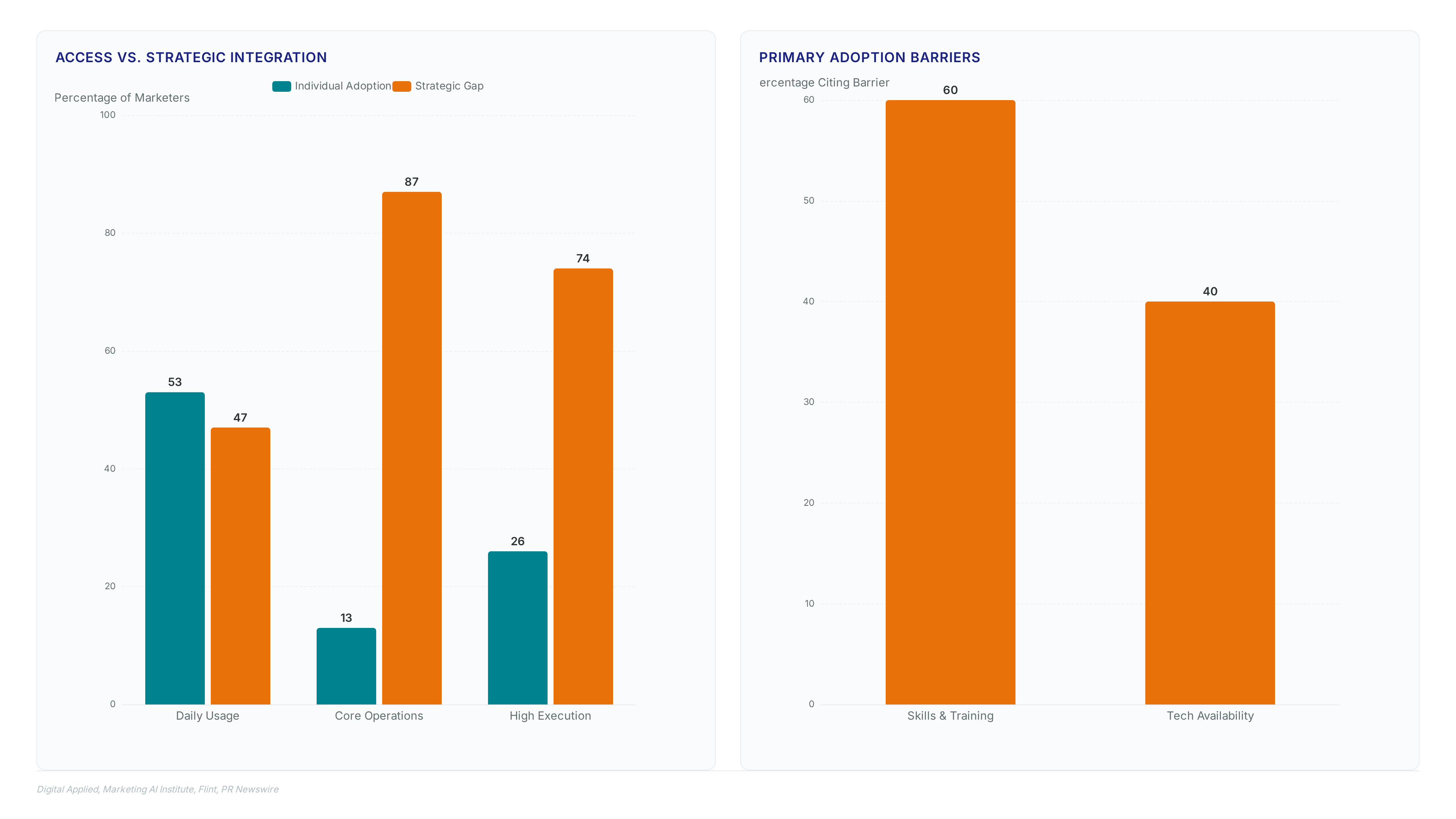
The execution gap emerges when individual tool access fails to translate into organizational ROI because infrastructure lags behind user ambition. This disparity persists not due to tool scarcity, but because enterprises lack the governance frameworks required to scale isolated prompts into repeatable workflows.
| Metric | Status | Implication |
|---|---|---|
| Tool Access | Ubiquitous | No longer a differentiator |
| Execution Score | Low | Indicates process failure |
| Pilot Mode | Prevalent | Blocks revenue impact |
Meanwhile, the primary constraint is no longer technology but the absence of structured enablement that converts ad-hoc usage into governed practice. Without formalizing data policies and quality gates, organizations inadvertently incentivize shadow IT behaviors that increase risk while capping value. The cost of this inertia is measurable: teams remain stuck in low-value content generation rather than advancing to strategic automation. Enterium recommends auditing current workflow integration points to identify where manual handoffs break scalability before investing in additional model capacity. Resolving this requires shifting focus from feature adoption to process re-engineering that embeds AI within existing approval chains.
Application: Mapping High-Impact Workflows to Measurable Business Outcomes
About
Hannah Brooks, Marketing Operations Lead at Enterium, specializes in the precise architecture of AI content pipelines and governance frameworks. Her daily work involves evaluating tooling stacks and designing workflows that move B2B teams from experimental AI usage to production-ready systems. This operational expertise makes her uniquely qualified to analyze why 74% of professionals now deem AI necessary, yet struggle with implementation lag. At Enterium, a brand dedicated to vendor-neutral methodology for scaling content with LLMs, Hannah focuses on the gap between strategic consensus and operational reality. She understands that for B2B organizations, the challenge is no longer recognizing AI's value but engineering the quality gates and measurement protocols required to deploy it reliably. Her insights bridge the divide between high-level survey data and the concrete steps needed to build resilient, automated content operations that deliver measurable ROI without compromising governance.
Conclusion
The disconnect between near-universal tool usage and mature execution reveals a critical breaking point: governance lag now threatens to erase early productivity wins. While North American teams lead in raw adoption, this regional advantage evaporates if organizations cannot transition from individual experimentation to standardized operational patterns. The real cost is not missed pilot targets but the compounding technical debt of uncoordinated automations that accelerate poor decisions rather than revenue.
Leaders must declare a moratorium on expanding pilot programs until flexible guardrails are codified into daily workflows. This shift requires treating AI not as a software purchase but as a governed enterprise capability that demands strict alignment with business metrics. Do not wait for perfect data unification; instead, mandate human sign-off protocols for any output touching customer interactions immediately.
Start this week by auditing your top three revenue-critical paths to identify where latency directly impacts conversion rates. Map these specific workflows against your current quality gates to find where human oversight is missing or inconsistent. By securing these high-value channels first, you build the trust necessary to expand automation safely. This targeted focus ensures that your organization scales confidence alongside capacity, turning fragmented tool usage into a defensible competitive advantage.
Frequently Asked Questions
Nearly half of organizations remain stuck in pilot mode while workers integrate tools daily. Specifically, 47% of firms have not moved past testing, creating a gap where individual efficiency fails to become organizational advantage without structural change.
Only a quarter of organizations have successfully advanced to the scaling phase of adoption. Data shows just 25% reached this level, meaning most firms lack the infrastructure to turn isolated employee experiments into repeatable business logic.
While 74% of professionals consider AI essential, their organizations often lack corresponding strategic frameworks. This disconnect forces workers to rely on personal initiative rather than governed enterprise capability to drive necessary operational changes.
Many marketers identify skills gaps as the primary barrier preventing effective operational integration. Although 84% of respondents work at B2B organizations, the lack of structured training and governance prevents them from leveraging tools for maximum impact.
Employees embed AI into routines while company structures stay frozen in old modes. With 53% of professionals integrating tools daily, this misalignment creates shadow IT risks and prevents isolated efficiency gains from compounding into real enterprise value.