AI agents fail without these four foundations
With 71% of professionals expecting immediate job disruption, AI agents are the dividing line between obsolescence and dominance.
The State of AI for Business Report confirms that while 96% of B2B marketers apply AI, a dangerous "AI Illusion" persists where only 30% possess mature readiness capabilities. Without these structural foundations, organizations are merely accelerating their own inefficiencies rather than achieving the revenue acceleration promised by generative tools.
Readers will learn why automation doubling from 16% to 36% by 2028 demands a complete overhaul of current marketing operations. Finally, the analysis covers implementing specific governance frameworks that allow teams to safely navigate the gap between high executive expectation and low operational reality.
The Critical Role of AI Governance and Training in Modern Marketing
Defining the Four Foundations of AI Governance
Only 13% of organizations have all four governance foundations in place: an AI roadmap, an AI council, generative AI policies, and an AI ethics policy. When these rules remain undefined, scattered data undermines trust in AI-driven results. Proven implementation demands rigorous data orchestration to maintain model reliability as 2025 serves as the year of preparation for agentic AI.
Training availability lags behind professional demand. While 54% of marketers deem generative AI training critical, 70% of employers do not provide it. This deficit prevents the 30% of organizations aiming for AI maturity from reaching their targets. Governance functions as the infrastructure that enables scale rather than serving as mere policy.
Most teams lack the complete set required for acceleration. Half of those with governance in place report accelerating momentum. Operators must implement these controls before scaling agent workflows. Delaying this framework leaves the enterprise exposed to unmanaged automated actions.
Enterprise budget allocation now exceeds workforce readiness by a wide margin. CMOs direct 15.3% of total spend toward AI initiatives while leaving staff without the instruction. Capital investment fails to translate into operational output because of this dangerous efficiency.
Marketing teams specifically request training on workflow integration rather than basic prompting skills. Current curricula fail to address actual deployment barriers since professionals prefer practical application over theoretical knowledge. Staff members seek to embed tools directly into daily tasks instead of learning isolated features.
Stagnant productivity persists despite heavy spending due to this misalignment. Organizations purchase advanced software but lack the internal expertise to configure it for complex business logic. Underutilized licenses and frustrated employees result from the inability to bridge the gap between tool access and value creation. The initial technology investment becomes ineffective when firms fail to fund parallel education tracks.
Governance frameworks must mandate training budgets equal to at least half of software procurement costs. The adoption curve flattens prematurely without this fiscal pairing. Markets will not tolerate prolonged experimentation phases where money flows but skills do not. Firms must treat human capability as a deployable asset requiring the same rigorous funding as the code itself.
The Risks of Accelerated AI Momentum Without Ethical Policies
Rapid deployment without policy controls creates a paradox where operational speed triggers consumer rejection. Half of U. S. Buyers state they would rather give their business to brands that do not use GenAI in consumer-facing content. This sentiment directly conflicts with organizations reporting accelerated momentum since only half of those with governance structures claim such speed.
Internal metrics often disconnect from market reality to generate tangible liability. Companies pursuing aggressive automation risk alienating the exact audience they seek to capture through efficiency gains. Outdated training programs exacerbate this friction by failing to address workflow integration or ethical boundaries. Staff members consequently deploy tools without understanding the reputational cost of synthetic media.
Scaling agentic workflows requires immediate policy insertion to mitigate these threats. Ignoring the preference for human-made signals invites competitive disadvantage regardless of technical sophistication. The cost of delayed governance exceeds the resource investment required for compliance frameworks.
How Agentic AI and Systems Thinking Change Marketing Workflows
Defining Agentic AI and Systems Thinking Competency
Agentic AI differs from static automation by executing task-specific autonomy without constant human prompting. This shift drives market projections exceeding $52 billion by 2030, a massive surge from the $7.8 billion baseline of the mid-2020s. Static tools wait for input; agents actively pursue set goals within set boundaries.
Operating these systems demands systems thinking to reconstruct entire workflows rather than merely speeding up isolated tasks. Taylor Radey identifies this cognitive shift as a core competency for rebuilding how work gets done. Marketers must design the architecture where agents interact, not write the prompts they consume.
| Feature | Static Automation | Agentic AI |
|---|---|---|
| Trigger | Pre-set schedule or event | Flexible goal state |
| Execution | Linear, rigid path | Adaptive, non-linear |
| Orchestration | Single tool focus | Multi-agent orchestration teams |
| Failure Mode | Process stops on error | Agent attempts re-routing |
The technical reality involves multi-agent orchestration, where coordinated teams of specialized agents solve complex problems together. This structure mirrors human team dynamics more closely than monolithic models ever could. However, deploying such fluid systems without strong governance creates unpredictable feedback loops that static rules cannot catch.
Training programs must pivot immediately from basic prompting to workflow integration design. Professionals requesting agent training now face a narrow window to establish authority before the technology matures beyond manual oversight. Those who master the governance of autonomous loops will define the next era of marketing operations.
Deploying Task-Specific Agents in Enterprise Workflows
Adoption of task-specific AI agents jumps from less than 5% in 2025 to a projected 40% of enterprise applications by late 2026. This surge reflects a shift from static scripts to multi-agent orchestration, where coordinated teams of specialized agents solve complex problems rather than relying on monolithic models. Unlike traditional automation that follows rigid if-then logic, agentic workflows dynamically adjust based on real-time data inputs.
Lowe's exemplifies this architectural shift by deploying distinct systems for customers and associates to scale expertise across 1,700 stores. Such deployments require operators to master systems thinking to rebuild entire workflows instead of merely accelerating isolated tasks. The technical distinction lies in autonomy; agents pursue set goals within boundaries, whereas legacy tools wait for explicit input.
API usage grows five times year-over-year as enterprises scale these external, customer-facing applications. However, this velocity creates a governance gap where operational speed outpaces policy creation. Without an AI roadmap, rapid agent deployment introduces uncontrolled variables into critical marketing funnels. Teams must prioritize workflow integration training over basic prompting skills to manage these autonomous systems effectively. The cost of ignoring this architectural change is obsolescence, as agents redefine the baseline for operational efficiency. Success depends on embedding human oversight directly into the agent interaction loop. This valuation surge contrasts with traditional automation, which relies on fixed rules rather than the flexible goal-seeking behavior defining agentic workflows. Market analysis suggests marketing leaders expect AI-driven work automation to reach 36% by 2028, more than doubling the 16% baseline observed in 2026. Such acceleration demands a shift from linear if-then logic to multi-agent orchestration, where coordinated teams solve complex problems autonomously.
The primary limitation remains that current governance frameworks often lack the flexibility to audit non-deterministic agent decisions effectively. Operators must implement systems thinking to redesign entire processes, as noted by Taylor Radey, rather than simply overlaying agents onto legacy structures. Failure to adopt this architectural mindset risks creating unmanageable feedback loops where agents optimize for incorrect metrics. Enterprises should consult Enterium guidance to align infrastructure with these emerging operational models before scaling deployments. This structural deficit separates ad-hoc experimentation from scalable enterprise deployment.
- Define a strategic AI roadmap aligned with specific business outcomes rather than general efficiency.
- Audit existing martech stacks to identify high-volume data exchange points suitable for task-specific agents.
- Select tools where cost aligns with budget constraints, a priority for the majority of brands.
- Configure no-code environments to trigger agent actions based on specific workflow events rather than manual prompts.
This approach avoids the trap of building monolithic models that fail to adapt when market conditions shift. The limitation lies in the complexity of multi-agent orchestration, where coordinated teams of specialized agents must resolve conflicts without human intervention. Unlike simple automation, these systems require continuous monitoring to prevent goal misalignment during autonomous execution. Operators must balance the speed of deployment against the risk of uncontrolled agent behavior in production environments. Establishing strict governance boundaries before enabling autonomous decision loops mitigates operational volatility.
Navigating Consumer Resistance to GenAI in Brand Content
Half of U. S. Buyers reject synthetic messaging, creating immediate friction for the 96% This conflict forces a choice between operational speed and brand trust. Governance frameworks must explicitly address this consumer sentiment
- Audit all public-facing copy for generative markers that trigger buyer skepticism.
- Define strict disclosure policies within the ethics charter to mandate human attribution.
- Route high-value proposals through manual review gates before agent dispatch.
| Strategy | Risk Level | Implementation Cost |
|---|---|---|
| Full Automation | High | Low |
| Hybrid Review | Medium | Medium |
| Human-Only | Low | High |
Cost drives 60% Organizations ignoring this tension face accelerated churn despite efficiency gains.
Treat brand perception as a hard constraint in agent logic. The limitation is clear: unchecked automation destroys the very trust it seeks to scale. Operators must balance algorithmic output with human verification to survive this market correction.
Strategic ROI from Advanced AI Training and Agent-Driven Workflows
Defining the AI Training Gap and Workflow Integration Demand
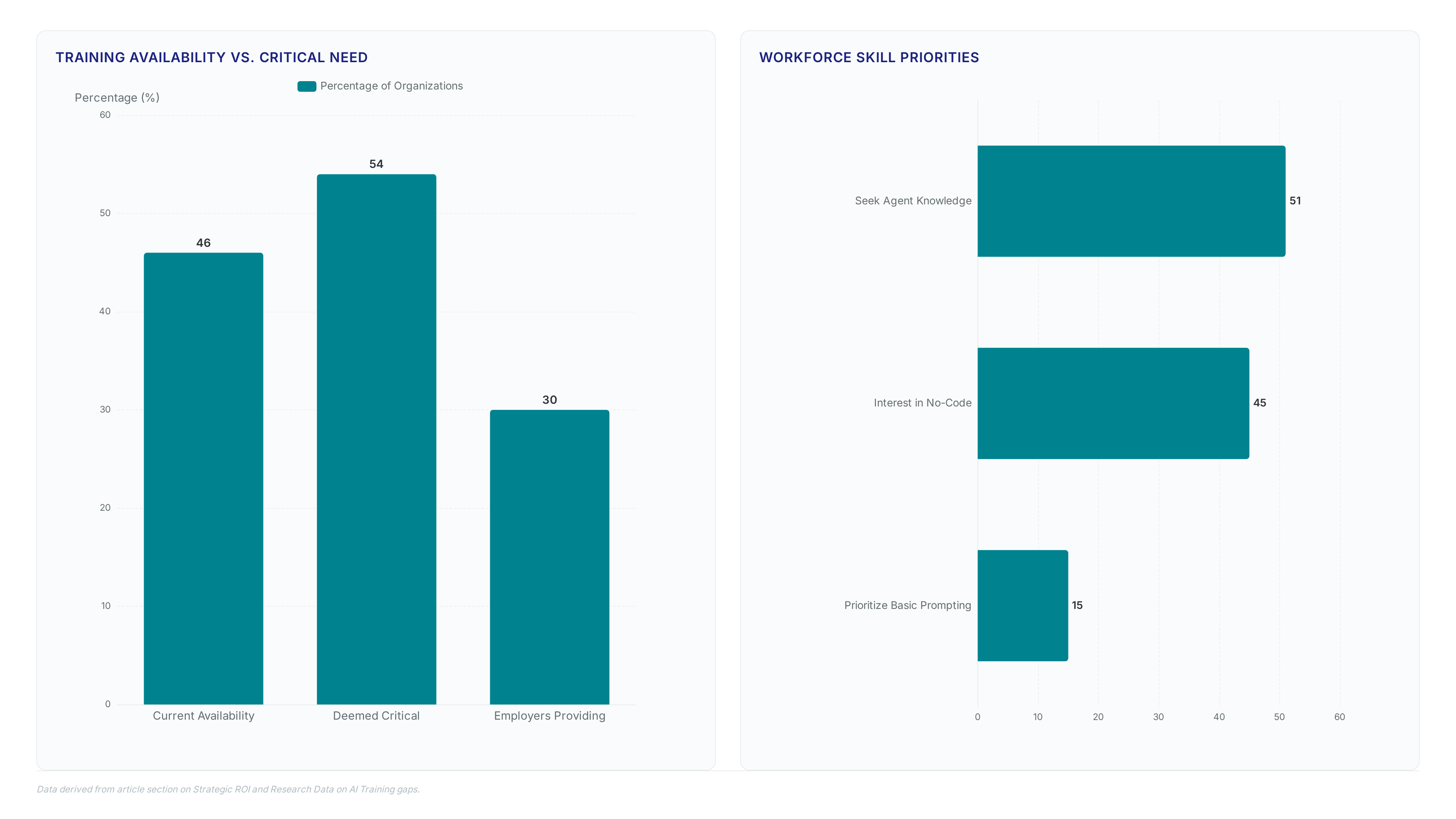
Training availability reached 46% of organizations this year, yet most marketers still lack access to the instruction. This discrepancy creates a dangerous void where strategic investment in tools outpaces the human capability required to operate them. The deficit prevents the transition from isolated experiments to production-ready systems. Professionals specifically request education on workflow integration rather than basic prompting, signaling a maturity shift in workforce expectations. Current programs often ignore the complexity of managing autonomous agents. Marketing leaders anticipate AI-driven automation of work will more than double by 2028, a pace that untrained teams cannot sustain. Without targeted upskilling, organizations risk deploying agentic workflows that fail due to operator error rather than technical flaws.
Aligning curricula with actual operational needs instead of generic AI overviews is essential. The cost of inaction exceeds the price of advanced training programs. Teams lacking systems thinking competencies will struggle to rebuild processes for an autonomous future. Bridging this gap requires immediate intervention to prevent workflow collapse under increased automation loads.
Investing in Strategic AI Leaders Workshops and API-First Scaling
High-cost Strategic AI Leaders Workshops starting at $75,000 target the specific business problem analysis required for scalable agent deployment. The investment buys more than theory; it forces a confrontation with legacy workflow constraints that basic prompting courses ignore. The financial barrier excludes all but the most capitalized enterprises, leaving smaller firms to rely on fragmented self-education. This disparity creates a two-tier market where only wealthy organizations can afford the systems thinking necessary to rebuild processes from scratch. Scaling beyond pilot programs demands a shift toward API-first. This acceleration requires task-specific agents rather than general chatbots to handle distinct operational functions. Organizations failing to adopt API governance now will face insurmountable technical debt when attempting to connect disparate agent workflows later. Without standardized interfaces, agents become siloed curiosities rather than productivity multipliers.
Prioritizing workflow integration skills over tool-specific tutorials maximizes long-term adaptability. Competitors automate complex decision loops while others hesitate.
No-Code Tool Preferences Versus Prompting Tips in Workforce Development
Training budgets targeting basic prompting tips ignore that only 15% of professionals prioritize this skill over workflow automation. Organizations allocating funds to elementary prompt engineering waste resources on a capability the majority of the workforce already deprioritizes. Data indicates 51% of staff seek agent knowledge, while interest in no-code environments reaches 45%. This disparity forces a choice between teaching single-turn text generation or enabling multi-step orchestration. Prompting skills do not translate to building autonomous systems that execute complex business logic without human intervention. Leaders must redirect curricula toward systems thinking rather than syntax memorization.
While 78% of firms use AI in some function, scaling requires moving beyond chat interfaces to integrated platforms. High performers distinguish themselves by deploying agents at scale rather than experimenting with prompts. The cost of ignoring this shift is stagnation, as manual prompting cannot match the throughput of automated workflows. Auditing current training modules to eliminate basic prompting courses entirely is necessary. Investment should flow exclusively to no-code orchestration and agent governance frameworks. This realignment addresses the gap where tool adoption outpaces operational maturity. Without this pivot, organizations remain stuck in the experimental phase while competitors automate core revenue functions.
About
Daniel Reyes, Head of Content Engineering at Enterium, operates at the intersection of marketing strategy and technical execution. His daily work involves architecting production-grade AI content pipelines, managing ingestion, retrieval, generation, and rigorous QA gates, which positions him uniquely to dissect the "AI Illusion" plaguing B2B teams. At Enterium, a vendor-neutral publication dedicated to documenting how modern teams build with LLMs, he translates complex system failures into reproducible solutions. This article bridges the gap between high-level CMO enthusiasm and the ground-level reality of deploying reliable agents. By using data from over 2,100 professionals, Reyes connects broad industry trends to the specific architectural trade-offs necessary for turning AI excitement into operational capability.
Conclusion
Scaling AI agents reveals a critical fracture point: governance latency. While organizations rush to deploy autonomous workflows, the lack of standardized policies creates immediate operational drag that manual oversight cannot fix. As agent complexity grows, the risk shifts from incorrect outputs to unchecked actions that erode brand trust before leadership notices. The current gap between high-level ambition and grounded ethical frameworks means that without strict guardrails, speed becomes a liability rather than an asset. You must treat governance not as a compliance checkbox but as the fundamental architecture for scalable autonomy.
Organizations should mandate a governance-first deployment model by the end of Q2, halting any agent rollout that lacks set failure modes and audit trails. This approach ensures that as you scale from pilot to production, your control mechanisms evolve quicker than your agent capabilities. Do not wait for a regulatory incident to force your hand; proactive structure is the only way to sustain long-term velocity without incurring massive technical or reputational debt.
Start this week by auditing your top three active agent workflows specifically for undefined decision boundaries. Map exactly where human intervention is currently required when the agent encounters ambiguity, and document these gaps as your primary governance backlog. This immediate inventory provides the concrete data needed to build the reliable frameworks that will separate market leaders from those stuck in experimental purgatory.
Frequently Asked Questions
Only a small fraction of organizations possess all four required governance foundations today. Specifically, just 13% of organizations have implemented the full set of roadmap, council, policies, and ethics guidelines.
Professionals overwhelmingly prefer learning practical workflow integration rather than simple prompting techniques. In fact, 58% of respondents identify workflow integration as their primary learning request to improve daily operational effectiveness.
A significant lack of formal employer-provided training prevents teams from reaching maturity goals. Although 54% view training as critical, 70% of employers do not provide it, creating a severe skills gap.
Establishing clear governance infrastructure directly correlates with faster and more effective AI adoption rates. Among organizations with governance in place, 50% describe their current AI momentum as accelerating compared to peers.
Interest in autonomous agents significantly outpaces all other emerging artificial intelligence trends in the market. Currently, 51% of professionals cite agent training as one of their top requests for development.