Marketing task units cut campaign time to 3 days
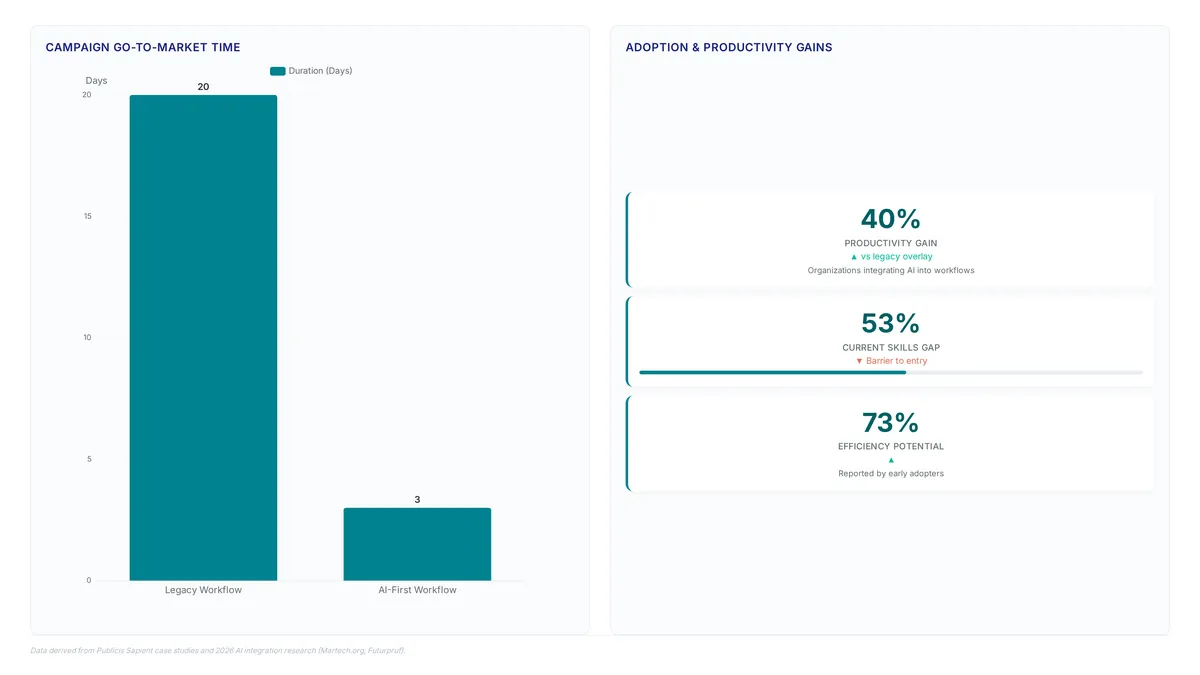
Reducing campaign go-to-market times from 20 days to just three proves that AI-first workflows deliver immediate operational velocity.
The industry narrative treats artificial intelligence as a blunt instrument for cost reduction. Publicis Sapient proves otherwise. True transformation requires redefining the task as the fundamental unit of change. While broader enterprise AI adoption remains superficial with only 10% of organizations considering it core to operations, this marketing organization bypassed incrementalism to automate 80% of activities without eliminating human roles. The thesis is binary: deploying technology atop broken systems fails, whereas empowering marketers as custom assistant builders reinvents work itself.
This article dissects the architectural shift from rigid job descriptions to fluid, task-level atomic units that enable rapid scaling. Human domain experts remain indispensable for training custom assistants to achieve rigorous quality standards through feedback loops. We examine the measurable ROI from empowerment when teams move beyond simple prompt engineering to become active architects of their own SaaS environments. The future belongs to those who build.
The Role of Task-Level Atomic Units in Modern Marketing Workflow Redesign
Defining the Task as the Atomic Unit of Transformation
Marketing transformation begins when the task replaces the job title as the fundamental unit of work. Traditional structures group people by role, creating silos that block automated execution across disconnected systems. An AI-first approach breaks operations into discrete units that intelligent agents process independently. This redesign isolates specific actions so custom assistants handle routine execution while humans manage complex judgment calls.
Data indicates only 10% of enterprises currently treat AI as core to operations, leaving most organizations stuck in legacy role-based models that cannot scale. While 42% of organizations admit they are not built to capture the value AI offers due to structural barriers, shifting focus to tasks allows for the automation of routine execution. Marketing teams must rethink workflows from the ground up rather than deploying technology to fix broken systems. Without this granular focus, organizations merely layer AI onto broken processes, yielding minimal capacity improvements. True transformation demands treating every marketing activity as a programmatic unit subject to optimization and automated feedback loops.
Deploying Custom AI Assistants to Automate 80% of Activities
Shifting from roles to tasks overcomes rigid job descriptions that prevent automating routine execution. By treating the task as the primary unit of work, marketing teams deploy custom assistants to handle specific workflow segments rather than entire job functions. This architectural change allows firms to automate a significant majority of marketing activities while retaining human oversight for complex decisions.
Teresa Barreira and her team shifted their focus from roles to tasks, redesigning workflows with an "AI-first" approach. Publicis Sapient operationalized this by empowering every marketer to become a "builder," resulting in the creation of more than 100 custom AI assistants tailored to distinct operational needs. The transition requires rethinking workflows from the ground up instead of layering new tools onto broken systems. A concrete outcome of this AI-first methodology was a reduction in campaign go-to-market times from 20 days down to just three.
However, speed introduces risk. Without rigorous feedback loops, decentralized assistant creation leads to brand fragmentation. The implication for network and marketing operators is clear: simply adding AI to existing role structures yields diminishing returns because the underlying workflow remains fragmented. Organizations that successfully integrate AI into marketing workflows are reporting productivity gains of up to 40%, notably outperforming those that merely overlay tools on existing processes. Organizations should audit their current workflow definitions to identify tasks suitable for immediate agent delegation before attempting broader role restructuring.
Why Deploying Technology on Broken Systems Fails
Layering automation onto disjointed processes increases existing inefficiencies rather than resolving them. Organizations attempting to fix broken systems with technology often find that workflow redesign must occur before tool deployment. Publicis Sapient's 2026 Global Enterprise AI Report indicates that AI currently supports a majority of enterprise work, yet full integration remains elusive because legacy structures persist. Simply adding agents to fragmented workflows yields diminishing returns compared to rebuilding the underlying operational logic.
The constraint is clear: without decomposing roles into executable tasks, intelligent agents inherit the same bottlenecks as human predecessors. This approach requires rethinking how work gets done, moving away from rigid job descriptions toward fluid, task-based execution units. The cost involves upfront structural pain for long-term velocity. Teams must dismantle established silos to allow custom assistants to function across traditional boundaries. Inefficient AI adoption, described as "random acts of AI," represents a sunk cost where technology is added to broken workflows without solving underlying process problems.
Inside the AI-First Architecture Where Humans Train Custom Assistants
The Feedback Loop Mechanism for Human Domain Expert Training
The feedback loop mechanism requires human domain experts to provide iterative evaluations that train custom AI assistants beyond simple prompt engineering. Unlike "random acts of AI" where technology masks broken workflows, this architecture mandates a fundamental redesign where intelligent agents handle execution while humans focus on judgment.
- Generation: The custom assistant drafts content based on predefined task parameters.
- Evaluation: A human domain expert scores the output against quality benchmarks.
- Refinement: The model incorporates this feedback to adjust future generations.
Without explicit human feedback loops, systems cannot distinguish between plausible text and brand-accurate content. Enterium solutions embed these validation gates directly into the workflow, ensuring that every automated action carries the imprint of expert oversight. The cost of skipping this step is the deployment of agents that scale errors rather than efficiency. Organizations must prioritize building these feedback mechanisms to avoid the trap of superficial gains. The immediate next step is auditing current workflows to identify where human judgment is currently bypassed rather than integrated.
Operationalizing the Builder Mindset Across 100 Custom Assistants
Scaling from pilot to production requires every marketer to function as a builder capable of deploying over 100 distinct custom AI assistants. This architectural shift replaces rigid role definitions with fluid task execution, allowing teams to automate complex workflows previously bound by manual bottlenecks.
- Decomposition: Teams isolate specific campaign tasks as atomic units rather than broad functional roles.
- Configuration: Marketers configure autonomous agents to handle content generation and data analysis dynamically.
- Orchestration: Systems coordinate these agents to adapt recommendations in real-time based on customer behavior.
Technology deployments fail when organizations apply them to broken systems without rethinking workflows from the ground up. This structural gap defines the difference between random acts of AI and operational transformation. Teams must decompose broad roles into the atomic unit of transformation, ensuring every task is standardized before automation begins. Without this rigor, legacy workflow models merely accelerate existing inefficiencies rather than resolving them.
Isolate the specific task independent of the human role currently executing it. Map decision points where human judgment remains non-negotiable. Define success metrics that measure output quality, not generation speed.
| Legacy Approach | AI-First Validation |
|---|---|
| Automates entire job functions | Targets discrete task-level units |
| Ignores underlying process debt | Redesigns work before tool selection |
| Yields inconsistent campaign quality | Ensures 100% human oversight on outputs |
The critical insight often missed is that workflow redesign consumes more initial time than model training, yet skipping it guarantees failure. Organizations attempting to bypass this step often find their new tools replicating old errors at scale. Enterium advises pausing technology procurement until the task architecture proves stable without it. This discipline prevents the common pitfall where inefficient AI adoption becomes a sunk cost. Validating the human-in-the-loop requirements early ensures that subsequent automation scales quality rather than chaos.
Measurable ROI from Empowering Marketers as Builders in SaaS Environments
Defining the Builder Mindset in AI-First Marketing
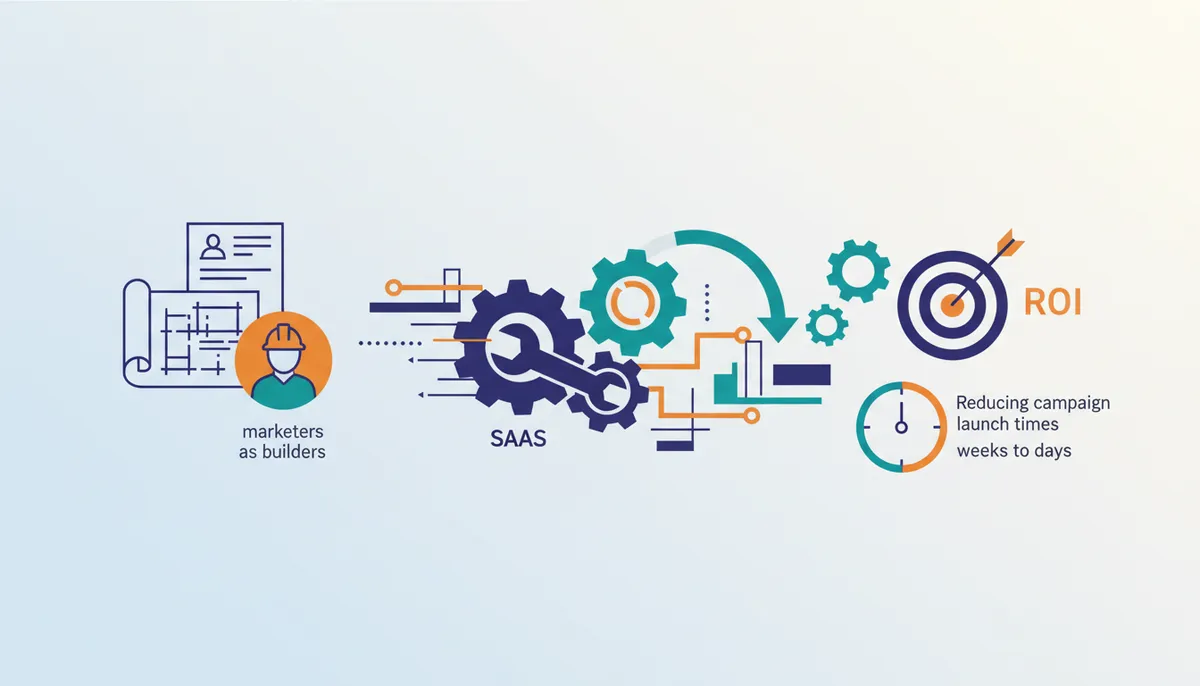
The builder mindset replaces static job descriptions with task-level atomic units that marketers assemble into custom workflows. Teresa Barreira and her team shifted the focus from roles to tasks, redesigning workflows with an "AI-first" approach to reinvent work itself. Marketers become builders by creating custom AI assistants that handle execution while humans focus on judgment and critical impact activities. The model relies on continuous human domain expertise for training AI to achieve high quality through feedback and evaluations.
Unlike legacy structures where technology layers onto broken processes, this architecture requires rethinking workflows from the ground up to avoid random acts of automation. The implication for operators is clear: growth without increased headcount requires fundamentally changing the nature of work rather than just adding tools. Organizations maintaining rigid role-based hierarchies risk leaving value trapped in legacy workflows that fail to use AI effectively. This transition is supported by governance frameworks necessary to scale task-level automation while maintaining quality standards. The next step is auditing current workflows to identify high-volume, low-judgment tasks suitable for atomic reconstruction.
Reducing Go-to-Market Time from 20 Days to 3
Campaign launch cycles contracted from 20 days to just three by treating tasks as atomic units of execution. This compression occurs because custom AI assistants handle the heavy lifting of content assembly while human experts validate outputs. The mechanism relies on an agent-first approach where intelligent systems manage orchestration rather than simply generating text.
| Workflow Stage | Legacy Duration | AI-First Duration |
|---|---|---|
| Concept to Draft | 8 days | 1 day |
| Review Cycles | 9 days | 1 day |
| Final Approval | 3 days | <1 day |
However, this velocity introduces risk if oversight is not maintained during the initial rollout phase. The implication for operators is clear: capacity gains are immediate, but governance models must evolve alongside the tools. Without set guardrails, speed can become a liability rather than an asset. Enterprises seeking to replicate this architecture should consult solutions for building secure, task-level automation pipelines that maintain brand integrity.
Application: Validating AI-First Workflow Redesign Before Deployment
Deploying technology to fix broken systems does not work; workflows must be rethought from the ground up. Organizations engaging in random acts of AI layer tools onto inefficient processes, creating sunk costs without structural resolution. Experts advise validating task-level atomic units before deployment to prevent automating failure modes. Unlike generic deployments where AI functions as a standalone utility, successful architectures integrate intelligence as connective tissue across the entire value stream source. This distinction separates superficial efficiency from genuine operational transformation.
The cost of ignoring workflow redesign is measurable in wasted compute cycles and entrenched technical debt. Teams should map handoffs before selecting automation tools. Providers offer the validation framework necessary to audit these paths rigorously. This gate prevents the amplification of existing process debt through new technology stacks.
Migrating to an AI-First Marketing Workflow in Five Steps
Rethinking Workflows From the Ground Up
Placing new software atop fractured processes rarely yields results because inefficient AI adoption becomes a sunk cost where tools merely increases existing process failures. Operators must treat the task as the atomic unit of transformation rather than attempting to automate rigid, role-based hierarchies.
- Identify repetitive process bottlenecks where legacy handoffs delay campaign launches.
- Deconstruct roles into discrete atomic tasks suitable for agent execution.
- Deploy custom builders that allow domain experts to train AI on specific quality gates.
Speed often clashes with control in these scenarios. Rushing to implement agents on undefined workflows produces random outputs instead of scaled efficiency. Defining these atomic units before selecting any automation vendor ensures the architecture supports genuine agility. Additional technology layers only compound technical debt without this core rethinking.
Empowering Marketers as Builders With Custom Assistants
Building over 100 custom AI assistants allows every marketer to function as a technical builder rather than a passive consumer of tools. This structural shift reduces campaign go-to-market times from 20 days to just three by automating execution w while preserving human judgment. Operators must treat the task as the atomic unit of transformation, allowing intelligent agents to handle repetitive workflows without eliminating human roles.
- Deconstruct existing roles into discrete atomic tasks suitable for autonomous agent delegation.
- Deploy custom assistants configured to specific workflow constraints rather than generic prompts.
- Legacy models often deploy technology to fix broken systems, yet this method rethinks workflows from the ground up to prevent amplifying process failures.
Organizations must address this skills gap so agents optimize output rather than execute errors at scale. Architectural guidance is necessary to implement these quality gates and align agents with broader business objectives. The immediate next step involves auditing current marketing tasks to identify high-volume, low-judgment activities ripe for assistant delegation.
Implementation: Validating Quality Through Human Domain Expert Feedback
Validating AI output requires human domain experts to train models through rigorous feedback loops rather than passive review. This mechanism ensures that automated agents adhere to brand standards before publication. Evidence suggests that treating the task as the atomic unit of transformation allows teams to automate significant portions of workflow while maintaining strict quality control workflow redesign. Operators must implement a gated validation checklist where human domain experts are necessary for training AI to achieve quality through feedback.
- Configure feedback interfaces that allow experts to score output relevance.
- Embed evaluation metrics directly into the assistant prompt to align with specific campaign goals.
- Require iterative retraining cycles where the model ingests corrected versions of rejected drafts.
Organizations fixing AI adoption in marketing must recognize that human oversight remains the primary variable in achieving consistent results. Scale presents a limitation; without a structured training protocol, expert time becomes the bottleneck for campaign velocity. Governance frameworks are necessary to scale these human-in-the-loop systems efficiently.
About
Hannah Brooks, Marketing Operations Lead at Enterium, analyzes the structural shifts required to move marketing organizations from manual execution to automated scale. Her daily work involves auditing martech stacks and designing governance frameworks that allow teams to treat AI as a workflow engine rather than a simple cost-cutting tool. While the Publicis Sapient case study illustrates the strategic value of an "AI-first" task redesign, Brooks brings the practitioner's perspective on implementing these architectures in production environments. At Enterium, she focuses on the specific mechanics of content pipelines, research, generation, QA, and publication, ensuring that speed gains do not compromise quality or measurement. This article connects high-level organizational transformation to the tangible reality of building reliable, vendor-neutral automation systems. By grounding the discussion in reproducible steps and concrete metrics, Brooks provides the technical roadmap B2B leaders need to reinvent their own work, moving beyond theory to operationalize AI content strategies effectively.
Conclusion
Scaling AI beyond pilot programs reveals that human expertise becomes the primary bottleneck when validation protocols remain manual. While atomizing tasks accelerates drafts, the operational cost shifts to the review phase where unstructured feedback loops stall velocity. Organizations treating AI as a standalone utility rather than connective tissue across their workflow will find their campaign quality degrading as volume increases. The window for disjointed experimentation is closing; teams must integrate governance directly into the creation pipeline to sustain gains.
Marketing leaders should mandate a unified validation architecture within the next quarter that binds ideation, creation, and distribution into a single operational stream. This approach prevents the fragmentation where speed gains in drafting are lost during disjointed review cycles. Do not wait for perfect models; instead, restructure how your team interacts with current tools to enforce consistent quality gates.
Start this week by mapping your current feedback interfaces to identify exactly where expert time stalls during the review cycle. Pinpoint the specific stage where human judgment is most frequently required to correct automated outputs, then prioritize building a structured training protocol for that specific friction point. This targeted audit ensures your human oversight scales effectively without requiring exponential increases in staff hours.
Frequently Asked Questions
Layering technology on broken systems increases inefficiencies rather than fixing them.
Teams can automate 80% of marketing activities by treating tasks as atomic units. This approach allows custom assistants to handle execution while humans remain essential for complex judgment calls and maintaining quality standards.
Campaign launch cycles contracted from 20 days to just three by treating tasks as atoms. Organizations reporting this shift see productivity gains of up to 40% compared to those merely overlaying tools.
Only 10% of enterprises treat AI as core because they lack structural readiness. While 42% admit they are not built to capture AI value, success requires empowering marketers as builders of custom assistants.
Ensuring 100% human oversight on outputs prevents brand fragmentation during rapid deployment. Human domain experts must train custom assistants through rigorous feedback loops to maintain quality while achieving massive velocity gains.
References