AI content strategy: Cut production time by 65%
With only 40% to 47% of marketers holding a documented plan, most teams are just guessing at scale. The modern competitive advantage in 2026 relies not on simply deploying generative tools, but on embedding them within a rigorous, systematic workflow that evolves with performance data. A true AI content strategy defines exactly where algorithms accelerate production while preserving human oversight for brand integrity and strategic direction.
You will learn how to construct data-driven briefs that prioritize search demand over hunches, ensuring every piece of content serves a measurable business goal.
Finally, we will outline a nine-step workflow to build a scalable system that turns single assets into multi-channel distributions without fracturing your brand voice. By integrating performance measurement directly into the creation loop, teams can extract actionable patterns from analytics rather than just generating more noise. This approach transforms content operations from a chaotic cost center into a precision engine for growth, proving that the real value lies in the repeatable system, not the software itself.
The Role of AI Content Strategy in Modern Marketing
Defining AI Content Methodology Beyond Traditional Workflows
Roughly 40% to 47% of marketing teams operate without a documented strategy, leaving them vulnerable to ad-hoc tool usage. An AI content approach fixes this by functioning as a systematic plan integrating artificial intelligence to research, create, and distribute assets. This definition extends beyond simple generation tools to encompass a structured workflow where multimodal AI workflows reduce campaign production time by 65% while preserving output quality. The core distinction lies in shifting from ad-hoc tool usage to a data-driven roadmap that explicitly answers where automation improves speed or accuracy without sacrificing brand alignment. In 2026, competitive differentiation depends on this integration rather than mere access to generative models. Operationalizing this approach requires rethinking content ideation as a machine-readable process where visibility depends on structured, clear data rather than traditional keyword rankings alone. Teams ignoring this shift risk obsolescence as consumers increasingly purchase directly through AI interfaces that bypass brand websites entirely. The limitation remains that without a documented plan, organizations cannot effectively measure the productivity boost or identify when human oversight is required to correct algorithmic drift.
Speed creates a dangerous vacuum if narrative control vanishes. Without strict governance, the 70/30 model of machine-to-human contribution degrades into unverified noise. Auditing existing documentation gaps before deploying autonomous agents ensures the underlying strategy supports rather than hinders the new velocity.
Productivity Gains from Multimodal AI Workflows
Multimodal AI content agents execute text, image, and video tasks simultaneously to slash campaign timelines. This efficiency stems from parallel processing where generative models draft copy while image synthesis engines render assets, eliminating sequential bottlenecks. Organizations save 5.4% of work hours weekly by automating these repetitive cross-format conversions. The 70/30 model governs proven deployment, allocating the majority of production volume to autonomous agents while reserving human expertise for strategic direction and quality assurance.
Speed means nothing if the output sounds like a robot. Unlike single-mode tools, multimodal agents require complex prompting structures to maintain consistency across text and visual outputs. Speed gains vanish if human reviewers spend excessive time correcting hallucinated facts or tonal mismatches. Embedding validation loops directly into the agent workflow beats post-hoc editing every time. This architectural shift transforms the operator role from creator to conductor, focusing effort on high-value curation instead of raw production volume.
AI-Driven Insights Versus Traditional Topic Planning
Static topic lists are dead. AI-driven insights dynamically identify search demand gaps using real-time data, whereas traditional planning relies on predetermined channels and KPIs that often miss emerging intent signals. Traditional methods lack the agility to detect when consumers bypass brand websites to purchase directly through AI interfaces, a shift that renders fixed calendars obsolete. Strategic planning tools now emphasize entity clarity to ensure machine readability for algorithmic answers rather than human scanning alone.
Optimizing specific sections like FAQs drives measurable traffic from AI search agents, proving the value of concise, structured answers over verbose narratives. Bailey demonstrated this by targeting FAQ sections to capture automated query responses effectively. High-volume generation without strategic filtering dilutes brand distinctiveness, forcing teams to choose between scale and specificity. Operators must implement strict governance to prevent model drift while using speed.
Mechanics of AI-Driven Content Planning and SEO Optimization
How AI Search Optimization Replaces Guesswork with Data
Shifting visibility from traditional rankings to direct AI-generated answers requires machines to parse unstructured text into readable data. This mechanism discards editorial intuition in favor of structured data that assistants parse instantly. Marketers who use AI are 25% more likely to report success with their content compared to peers ignoring these tools. The process depends on concise formatting instead of mere keyword density. Bailey's optimization of FAQ sections proves this point.
Specific structural inputs drive the technical workflow:
- Identify high-volume queries using historical performance data.
- Draft concise answers under 50 words for immediate consumption.
- Apply schema markup to signal answer boundaries to crawlers.
- Refresh older articles with updated statistics to maintain relevance.
HubSpot found that refreshing older articles with updated statistics and new sections produced a 106% average increase wellows.com in monthly organic traffic. Maintenance offers compounding value over creating fresh assets. Ambiguous phrasing causes agents to ignore sources entirely because algorithms demand explicit entity clarity to attribute facts correctly. Content must serve the machine first to reach the human second. High-quality writing remains invisible to modern search interfaces without this structured approach.
Implementing Brand Voice Detection in AI Content Workflows
Demanding strict tone consistency prevents brand dilution when social media content generation at 86% usage rates dominates production. Embedding style vectors into the generation pipeline works better than post-hoc editing. Operators configure agents to reference a centralized style guide before drafting, ensuring social media outputs match established persona constraints. This approach addresses the significant share of teams lacking governance by hardcoding rules into workflow logic.
Consumer trust erodes when voice inconsistency appears, especially as a significant majority of users claim they can identify synthetic text.
| Mode | Mechanism | Limitation |
|---|---|---|
| Post-Generation Scan | Analyzes finished drafts against style rules | High rework latency |
| Real-Time Constraint | Blocks non-compliant token generation | Increased compute overhead |
| Hybrid Agent Review | Human-in-the-loop validation step | Slows throughput speed |
Shortform articles, comprising 82% of current AI use cases, benefit most from real-time constraint mechanisms. Unilever uses such systems to maintain voice fidelity while scaling production globally. Defining brand voice parameters mathematically requires significant upfront engineering effort. Agents drift toward generic phrasing that fails to differentiate the brand in crowded markets without this structural rigidity.
Prioritizing real-time constraint models for high-volume channels mitigates drift risks immediately. Latency introduced by voice validation must be budgeted within total response time SLAs for network operators managing these workflows. Missed delivery windows occur during peak traffic bursts if engineers fail to account for this processing overhead. Uncontrolled data egress and brand dilution threaten networks when autonomous agents operate without guardrails. Output volume outpaces quality verification when scaling generation without policy, leading to significant engagement drops.
Financial impacts of unregulated usage vary by pricing model, ranging from usage-based costs per word to fixed enterprise contracts. Teams often default to expensive ad-hoc subscriptions rather than optimized subscriptions.
| Deployment Mode | Cost Structure | Governance Risk |
|---|---|---|
| Ad-hoc Tools | Variable per-word | High data leak |
| Managed Workflow | Fixed monthly | Moderate drift |
| Governed Agent | Tiered volume | Low compliance |
Defining strict policy boundaries before agent deployment mitigates these risks. Current tools focus on speed over compliance, forcing operators to choose between velocity and control. Unchecked automation generates noise that confuses search algorithms and erodes user trust quicker than manual errors.
Building a Scalable AI Content Workflow in Nine Steps
Activating William requires a URL scan to expose pages with impressions but zero clicks and missing competitor topics. This free AI content agent supports the full workflow of research, planning, creation, and distribution while keeping the user in control. Operators input a domain to generate a traffic baseline, identifying content ranking on page two that demands immediate optimization. The process reveals specific gaps where competitors cover necessary topics that the current site ignores. Teams execute this foundation through a strict sequence:
- Activate the William agent within the dashboard.
- Enter the target website URL to initiate the crawl.
- Review the generated list of zero-click pages.
- Export missing topic clusters for strategic planning.
the provider focuses on strategic content planning and building topical authority through gap analysis, a function William replicates during the initial scan phase. Unlike static audits, this flexible baseline updates as search intent shifts, preventing reliance on stale data. A critical limitation exists: the scan only detects visible HTML content, meaning hidden API-driven text remains unanalyzed until indexed. Organizations must manually verify technical rendering to ensure complete coverage. The financial barrier for advanced workflow automation is low, with some platforms offering a free tier for chat suitable for unpredictable content volumes despite higher costs for GEO features required. Pairing this activation with immediate policy definition prevents ungoverned data usage during the analysis phase.
Executing Content Pillars and Audience Intent Mapping
Defining authority clusters requires mapping specific search intents to survive the pattern where sites addressing user needs precisely endure substantial Google Core Updates from 2024 through early 2026. Operators must construct topic clusters that demonstrate thorough exploration rather than isolated keyword targeting. AI-driven clusters win rankings by signaling depth, whereas scattered posts fail to establish domain authority. The limitation is that broad pillars without granular intent mapping dilute relevance scores. Networks ignoring this distinction risk visibility loss as algorithms prioritize thorough answers over partial matches. Execution follows a strict sequence to align content with query semantics:
- Identify core themes where the organization holds unique data or expertise.
- Map specific intents like comparisons or procedural steps to each theme.
- Generate a balanced backlog of quick wins and deep-dive authority posts.
- Create short briefs containing exact keyword recommendations and structure guidelines.
Refreshing legacy content with updated statistics produces significant traffic increases, validating the need for continuous iteration. Sites failing to update search intent mappings face obsolescence as Google's 2025 guidance establishes higher quality bars. The resource intensity required for deep gap analysis outweighs superficial generation. Tools like the provider assist by identifying strategic gaps that pure generation tools miss. Prioritizing intent accuracy over volume sustains long-term organic growth.
Validating Brand Voice Profiles and Company Descriptions
Confirming brand voice accuracy requires validating that the generated summary explicitly answers who you help and why you are different. William executes this by scanning existing assets to capture sentence style and formatting nuances, ensuring outputs match human expectations. This step prevents the disconnect seen when teams skip profiling, as consumers increasingly bypass brand sites to purchase directly through AI interfaces. Without this validation, generated text fails to establish the entity clarity required for algorithms to link brands with specific topics correctly. Operators must verify two distinct profiles before proceeding to pillar definition:
| Profile Type | Validation Check | Failure Mode |
|---|---|---|
| Company Summary | States specific audience and unique mechanism | Generic industry platitudes |
| Voice Profile | Matches tone, sentence length, and formatting | Robotic or inconsistent phrasing |
Hardcoding these constraints into the generation pipeline beats editing post-hoc. Relying solely on generic prompts without this validation loop dilutes messaging control. Automated profiling cannot invent unique value propositions that do not exist.
Deconstructing Enterprise AI Pricing Tiers and Usage Models
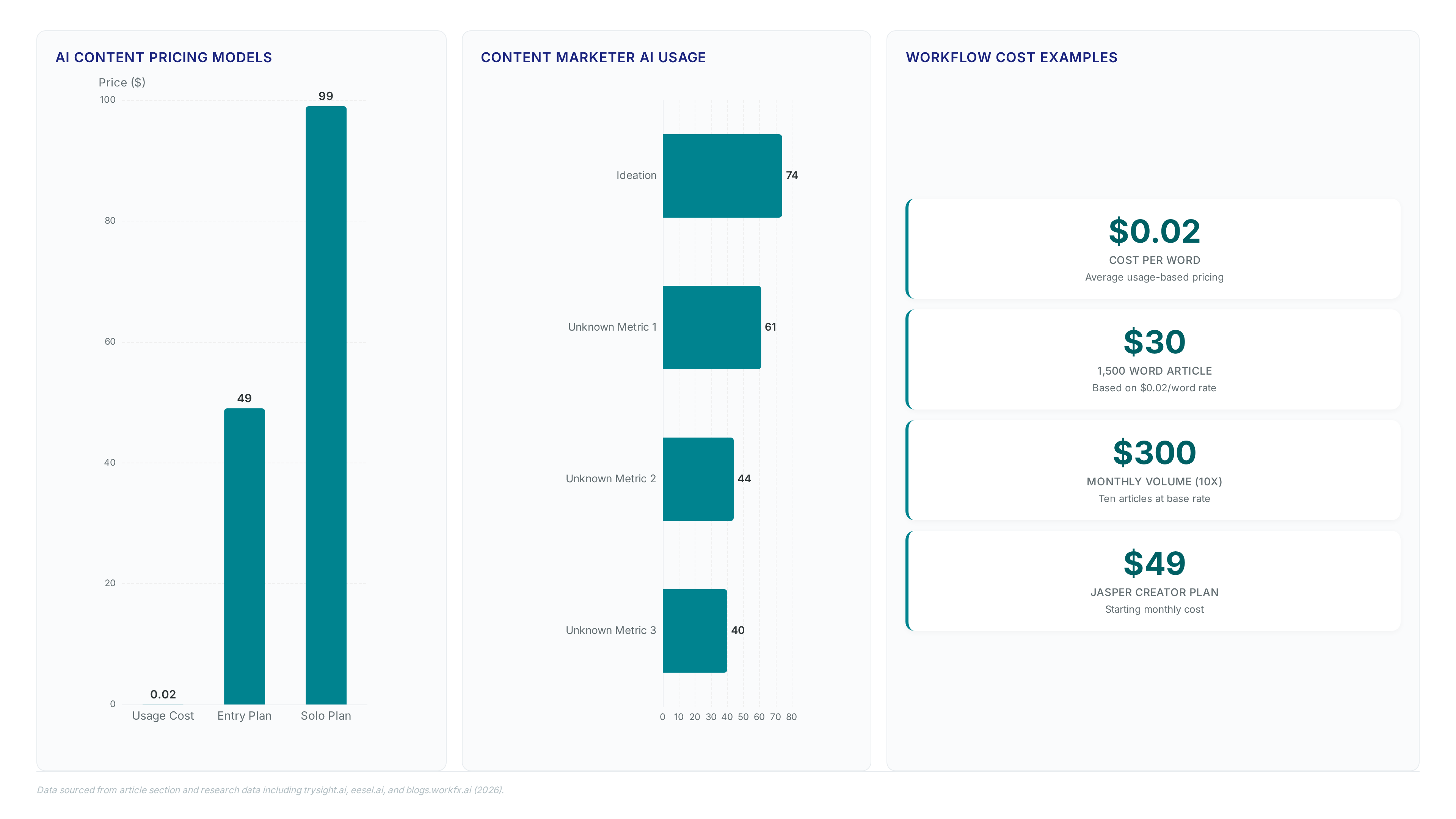
Enterprise AI pricing structures diverge sharply between variable usage-based models charging $0.02 and $0.15 per word. This dichotomy forces operators to choose between predictable budgeting and granular cost control. High-volume producers risk exponential expense spikes under per-word schemes, whereas flat-rate agreements impose rigid capacity ceilings that stifle experimental campaigns.
| Model Type | Cost Structure | Operational Risk | Best Fit Scenario |
|---|---|---|---|
| Usage-Based | Variable per token | Unpredictable monthly spend | Sporadic, high-value drafts |
| Entry Tier | Fixed low monthly fee | Severe volume caps | Individual contributors |
| Mid-Tier | Moderate fixed fee | Feature gating | Dedicated marketing squads |
| Enterprise | High fixed fee | Underutilization waste | Organization-wide deployment |
The Entry Tier plans ranging from $15 to $19 monthly suit isolated users but fail scaling teams due to document limits. Mid-Tier options near $99 introduce dual SEO scoring yet often separate analytics into premium add-ons. Scaling output on usage models inflates unit costs beyond fixed enterprise contracts, yet locking into flat fees before validating workflow integration creates stranded capital. Organizations must calculate break-even points where variable costs exceed fixed premiums to avoid inefficient spend. The market, valued at several billion, demands auditing current token generation rates before committing to multi-year enterprise contracts.
Averi distinguishes its $99/month Solo plan by including dual SEO and GEO scoring, whereas competitors often charge separately for these features. This integration addresses the fragmentation found in mid-tier tools where optimization metrics remain siloed from generation workflows.
| Feature | Averi Solo | the provider Creator |
|---|---|---|
| Base Price | $99/mo | a monthly fee |
| SEO Scoring | Integrated | Requires add-on |
| GEO Scoring | Integrated | Not available |
| Workflow Scope | End-to-end | Creation only |
the provider's Creator plan starts at a monthly fee but requires separate tools for SEO and analytics, increasing total operational costs. The mechanism here involves purchasing distinct subscriptions to achieve what Averi bundles, forcing operators to manage multiple dashboards for a single campaign. However, the cost of consolidated scoring is a higher entry price point that may deter solo creators with limited budgets. The implication for network operators evaluating these platforms is that apparent savings on base subscriptions vanish when accounting for the necessary ancillary services required to match feature parity. Auditing the total cost of ownership rather than headline pricing avoids unexpected expenditure gaps in production environments.
About
Arjun Patel, an Applied LLM Engineer at Enterium, brings rigorous empirical analysis to the development of proven AI content strategies. His daily work involves benchmarking LLM providers and RAG architectures specifically for content workloads, directly addressing the critical need for systematic AI integration outlined in this article. Unlike theoretical approaches, Patel's methodology evaluates cost, latency, and quality in unison, ensuring that strategic plans are grounded in reproducible data rather than hype. At Enterium, a B2B publication dedicated to vendor-neutral content automation, he documents how modern teams can build scalable pipelines without losing sight of business goals. This practical experience allows him to define precisely where AI makes workflows "improved, quicker, or smarter." By connecting deep technical expertise with strategic oversight, Patel provides the concrete framework necessary for marketers to evolve from ad-hoc AI usage to a disciplined, competitive advantage in 2026.
Conclusion
Scaling AI content production breaks when teams rely on fragmented toolchains that separate generation from optimization metrics. The hidden operational cost is not the subscription fee, but the cognitive load of reconciling disjointed data across multiple dashboards, which erodes the very efficiency gains automation promises. By 2027, competitive differentiation will depend entirely on systematic workflow integration rather than raw access to generative models. Organizations must transition from ad-hoc experimentation to governed, end-to-end pipelines within the next two quarters to avoid falling behind peers who have already standardized their hybrid human-AI operations.
Deploying a unified platform that bundles creation with real-time scoring is the only viable path forward for teams aiming to sustain high-velocity output without sacrificing quality control. Do not wait for a crisis in content consistency; start by auditing your current tool stack this week to identify where SEO and GEO metrics are siloed from your primary generation environment. Calculate the total hours lost switching between interfaces and compare that against the cost of a consolidated solution. This immediate inventory reveals whether your current savings are genuine or merely shifting expenses into unpaid labor hours. Only by closing these workflow gaps can marketing teams convert isolated speed boosts into durable operational use.
This time recovery enables human operators to act as conductors rather than creators, focusing on curation instead of raw volume.
Q: Which content format comprises the majority of current AI use cases?
A: Shortform articles comprise 82% of current AI use cases and benefit most from speed optimization. These formats allow teams to rapidly generate drafts while reserving human expertise for strategic direction and final quality assurance.
Q: What usage rate does social media content generation currently demand?
A: Social media content generation demands strict tone consistency at 86% usage rates. Without documented governance, this high volume of automated output risks diluting brand voice and creating unverified noise across various digital channels.
Frequently Asked Questions
Approximately 40% to 47% of marketing teams operate without a documented strategy. This lack of planning forces most organizations to guess at scale rather than executing a systematic, data-driven roadmap for content creation.
Multimodal AI workflows reduce campaign production time by 65% while preserving output quality. This efficiency allows teams to shift focus from manual drafting to high-level strategic direction and quality control measures.
Organizations save 5.4% of work hours weekly by automating repetitive cross-format conversions. This time recovery enables human operators to act as conductors rather than creators, focusing on curation instead of raw volume.
Shortform articles comprise 82% of current AI use cases and benefit most from speed optimization. These formats allow teams to rapidly generate drafts while reserving human expertise for strategic direction and final quality assurance.
Social media content generation demands strict tone consistency at 86% usage rates. Without documented governance, this high volume of automated output risks diluting brand voice and creating unverified noise across various digital channels.