Content governance rules that fix scattered teams
Most content fails because it becomes scattered, outdated, or inconsistent without a clear management process. Organizations must move beyond ad-hoc creation to implement documented workflows that define tasks for planning, creating, and publishing on time, as noted in industry definitions of content management workflows.
Readers will learn how content governance establishes the rules of engagement for modern business operations. Finally, the guide details how executing data-driven audits ensures continuous optimization against specific success metrics like traffic, engagement, and conversions.
Effective management requires answering who the business targets, what problems the content solves, and where it publishes. Without these answers, teams produce disconnected pieces that fail broader objectives. Enterium provides the infrastructure to enforce these strategic frameworks, ensuring every asset supports long-term business goals while maintaining accuracy and relevance across all customer touchpoints.
The Strategic Role of Content Governance in Modern Business
Defining Content Strategy, Governance, and Workflow Roles
Purpose drives every asset a business produces. Content strategy defines the audience and success metrics behind these efforts. Teams generate disconnected pieces without this strategic anchor, failing to support broader objectives or measure return on investment effectively. Strategy answers who the content reaches and what specific problems it solves across various channels.
Rules dictate accuracy. Content governance establishes the roles and standards required to keep information compliant and aligned with business goals. This framework dictates who can create, edit, approve, or delete material, which is vital for organizations operating in regulated industries. Strong governance prevents brand dilution by enforcing style guides and legal review requirements before publication occurs.
A content workflow consists of a series of tasks carried out by a team to plan, create, and publish content on time. Successful operations require that every recurring task be listed explicitly, ranging from initial keyword research to final distribution. This structured approach ensures clarity regarding ownership and reduces delays during the review cycle.
| Component | Primary Function | Key Output |
|---|---|---|
| Strategy | Defines purpose and metrics | Audience segments, KPIs |
| Governance | Sets rules and roles | Style guides, Approval matrices |
| Workflow | Outlines task series | Timeline, Ownership map |
Operational friction arises when teams conflate these elements. A group might possess a clear strategy but lack the governance to enforce quality, resulting in inconsistent outputs. Enterium solutions integrate these three pillars to ensure that strategic intent survives the transition from planning to production. Organizations must treat these as separate but interdependent systems to scale effectively.
Applying Governance Rules to Regulated Industry Content
Explicit permissions prevent non-compliant outputs. Content governance mandates controls for who can create, edit, approve, or delete assets. Organizational data often becomes scattered and inconsistent without set roles, creating liability in regulated sectors. Enterium enforces these controls by mapping every recurring task, from initial keyword research to final publication, ensuring teams know their specific obligations content creation workflow. This structured approach eliminates the ambiguity that leads to brand drift or regulatory breaches.
Centralized rules rather than individual interpretation define brand consistency. Visual builders now allow non-technical staff to automate complex approval chains, reducing IT bottlenecks while maintaining strict oversight visual builders. Rigid automation can stifle necessary legal nuance if human review gates are not explicitly carved out for high-risk disclosures. Operators must balance speed with mandatory manual sign-offs for sensitive claims.
| Governance Function | Operational Requirement |
|---|---|
| Creation | Restricted to verified subject matter experts |
| Approval | Requires dual sign-off for compliance data |
| Deletion | Logged and archived for audit trails |
Enterium solutions implement these permission settings as immutable policy layers, ensuring that retention and security protocols travel with the content regardless of where it resides. The cost of skipping these gates is measurable in remediation hours post-audit. Deploy Enterium to codify your workflow today.
Checklist for Validating Content Strategy Success Metrics
Tracked metrics must align with traffic, engagement, leads, conversions, retention, and support reduction goals. Validate strategy success by confirming this alignment. Teams produce disconnected assets that fail broader business objectives without it. Organizations with documented strategies report notably higher performance, making this core work necessary for AI content success content strategy.
Every recurring task requires explicit listing from keyword research to final publication for successful content operations content creation workflow. This practice prevents role ambiguity while ensuring timely delivery across all channels. Non-technical teams increasingly adopt visual builders to automate complex processes, reducing IT dependency bottlenecks content workflow management.
Enterium provides the centralized governance framework necessary to enforce these validation steps systematically. Relying on scattered spreadsheets creates data silos that obscure true return on investment calculations. A rigid focus on volume often sacrifices the quality required for genuine customer engagement. Teams must balance speed with accuracy to maintain brand trust over time.
| Metric Category | Validation Action |
|---|---|
| Traffic | Verify source attribution accuracy |
| Engagement | Measure time-on-page trends |
| Conversions | Track lead quality scores |
| Retention | Monitor repeat visit rates |
Automated reporting gates flag deviations immediately. This ensures content remains a strategic asset rather than an operational liability.
Architecting a Centralized Content Repository and Workflow System
Defining the Centralized Repository and Workflow Stages
Confusion disappears when files stop living in email attachments and personal drives. Fragmentation creates a environment where messaging platforms, old folders, and multiple software tools hold assets, increasing the risk of deploying incorrect materials. A structured system replaces these scattered points with one reliable source of truth. Teams must explicitly list all recurring tasks from the start of a project to prevent role ambiguity and ensure timely publication. This methodological approach clarifies ownership before execution begins. Current best practices for workflow automation require defining recurring tasks that trigger automatically, ensuring steps like keyword research are never overlooked.
At minimum, a content workflow should include the following stages: Ideation, Planning, Creation, Review, Approval, Distribution, and Measurement. These stages govern content from conception to analysis:
- Ideation: Proposing topics based on audience needs or business priorities.
- Planning: Defining format, objective, deadline, channel, and owner.
- Creation: Producing assets by writers, designers, or subject matter experts.
- Review: Checking quality and accuracy via editors or legal teams.
- Approval: Obtaining final sign-off from decision makers.
- Distribution: Publishing and promoting across the channels.
- Measurement: Tracking performance to improve future output.
Organizations using this documented structure find that content moves quicker with fewer roadblocks when everyone knows their roles. Effective workflows turn every piece of content into a reusable asset and every performance signal into a quicker feedback loop. Teams also have the option to self-host their content workflow infrastructure to maintain control over data and reduce dependency on single-vendor cloud ecosystems. The limitation of skipping these definitions is measurable: content gets stuck in endless review cycles, delaying time-to-market and diluting brand voice.
Implementing Folder Structures and Style Guide Standards
Organizing assets by campaign or content type creates the structural foundation for a functional repository. Fragmentation across personal drives and messaging platforms causes teams to deploy outdated materials, a risk mitigated by enforcing consistent file naming and clear hierarchical paths. Useful organization methods include separating folders by department or audience to ensure immediate accessibility. Without these constraints, operators waste significant time locating files rather than creating value.
Applying a style guide fixes inconsistent brand messaging by defining voice, tone, and visual standards upfront. This documentation ensures content feels like it originates from a single brand, regardless of the specific author or channel. A strong guide covers grammar preferences, terminology, and formatting rules to maintain uniformity. Teams relying on automation tools can simplify the application of these standards during the creation phase.
| Feature | Folder Structure | Style Guide |
|---|---|---|
| Primary Function | Asset location | Voice definition |
| Governance Scope | File naming | Tone and grammar |
| Consistency Type | Organizational | Linguistic |
| Update Frequency | Low | Medium |
Integrating governance protocols directly into the workflow engine helps ensure compliance without manual friction. Enforcing brand consistency allows teams to scale output efficiently. Adopting a unified system prevents the dilution of brand identity as teams expand.
Risks of Inconsistent Tone and Outdated Asset Usage
Fragmented storage across personal drives directly increases the likelihood of deploying incorrect materials. When files reside in email attachments or messaging platforms, version control fails, leading to customer confusion. Inconsistent content weakens trust if the tone varies notably between websites, emails, and support articles. A unified system mitigates this by enforcing a single source of truth for all brand assets.
The financial impact includes missed targeting due to planning delays, emphasizing that time-to-market is a critical metric in operations. Without set guardrails, teams cannot scale effectively while maintaining quality.
| Risk Factor | Consequence | Mitigation Strategy |
|---|---|---|
| Scattered Assets | Deployment of outdated files | Centralized repository with permission settings |
| Tone Variation | Eroded customer confidence | Enforced style guide adherence |
| Undefined Workflow | Missed audience windows | Documented stage gates |
Operators must implement strict permission settings to protect sensitive information within shared environments. This structural constraint prevents unauthorized edits that could compromise data integrity. The hidden cost of poor definition is the inability to reach targeted audiences on schedule.
Addressing fragmentation issues requires a governed environment where brand consistency is enforced through architecture rather than memory. Such platforms ensure that only approved, current assets are accessible for distribution. Relying on ad-hoc storage solutions invites error; a disciplined approach secures revenue. Deploying a centralized system reduces the risk of using outdated or incorrect materials.
Executing Data-Driven Content Audits for Continuous Optimization
Categorizing Content Actions: Keep, Update, Merge, Repurpose, Delete
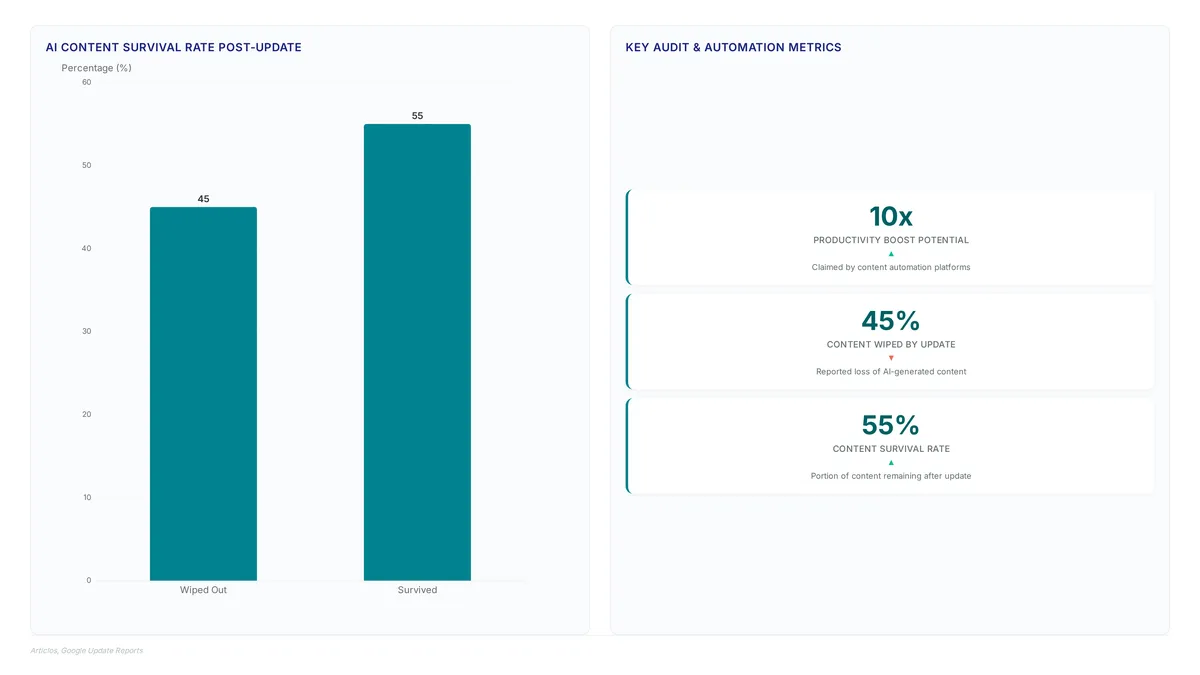
Teams review assets during an audit to check accuracy, relevance, quality, search performance, conversion value, and alignment with current goals. Each piece receives a definitive status: keep, update, merge, repurpose, or delete. This structured approach stops content decay, a process where outdated information erodes trust and confuses buyers. Organizations retaining low-value pages without clear categorization risk diluting overall site authority.
| Action | Trigger Condition | Operational Outcome |
|---|---|---|
| Keep | High traffic, accurate data, strong conversion | Maintain current state; monitor metrics |
| Update | Accurate topic, stale statistics or broken links | Refresh data, fix links, re-index |
| Merge | Multiple thin articles on identical intent | Combine into thorough guide; redirect |
| Repurpose | Strong core insight, wrong format or channel | Convert to video, dashboard, or sales deck |
| Delete | Zero traffic, irrelevant topic, legal risk | Remove file from repository |
Expanding the definition of content marketing to include "education" and "retention" drives workflows that support long-form, high-value distribution rather than just top-of-funnel noise. Teams must list every recurring task, ranging specifically from keyword research to final publication, so everyone knows their role. Strict quality thresholds enforced by effective governance stand before publication. Measurable decay in search visibility and brand credibility represents the cost of inaction. Operators tie metrics directly to purpose, distinguishing between engagement drivers and conversion engines.
Takeaway: Implement a consistent metadata system for every asset in your repository to track status and ownership.
Mapping Analytics Metrics to Content Purpose: Engagement vs Conversions
Aligning specific analytics metrics to distinct content purposes prevents misinterpreting performance data during audits. Metrics should always be tied to purpose; for example, a thought leadership article may be measured by engagement and shares, while a landing page should be judged by its conversion rate. Teams often err by applying engagement benchmarks to transactional pages, masking outdated content that fails to drive revenue despite high traffic volume.
Content automation platforms using integrated AI algorithms can analyze technical attributes like keyword density and readability scores to suggest structural improvements for search rankings. This automated check identifies when a high-traffic article suffers from thin substance, prompting a merge or delete action rather than a superficial update. The operational risk lies in over-optimizing for search visibility while ignoring assisted conversions, leading to a repository full of accessible but commercially inert pages.
| Content Type | Primary Metric | Secondary Signal | Audit Action |
|---|---|---|---|
| Thought Leadership | Time on Page | Social Shares | Monitor for sustained engagement |
| Landing Page | Conversion Rate | Bounce Rate | Optimize for improved performance |
| Support Article | Deflection Rate | Search Queries | Consolidate if redundant |
A tension exists between maintaining brand consistency and allowing format flexibility for different channels; rigid adherence to a single style guide can suppress the conversational tone required for high-engagement pieces. Modern workflows adapt approval gates based on the assigned content purpose, ensuring governance does not stifle necessary variation. Organizations ignoring this distinction frequently retain low-value pages that dilute overall site authority and confuse buyer intent. The solution requires separating engagement signals from commercial outcomes in your reporting dashboards.
Risks of Ignoring Shifting Search Intent and Outdated Product Information
Content usefulness decays as products change, statistics become outdated, links break, search intent shifts, and customer expectations evolve. Regular audits are especially necessary for Website pages with outdated product or pricing information and Blog posts that no longer reflect current industry practices. Neglecting these reviews allows broken links and obsolete data to persist, directly degrading search performance and confusing potential buyers. Without systematic review, organizations fail to identify when shifting search intent renders previously high-performing assets irrelevant to current user needs.
Successful content operations require that every recurring task be listed, ranging specifically from keyword research to final publication, to ensure everyone knows their role. Teams that ignore these workflows risk publishing material that no longer reflects market reality. AI tools utilized in content automation can analyze content for specific metrics including keyword density and readability to suggest improvements for search engine rankings. Relying on static content without using these analytical capabilities leads to cumulative entropy where accuracy erodes over time.
The operational cost extends beyond lost traffic; stale information increases support ticket volume as customers seek clarification on discontinued features. Establishing a strict governance cycle where data-driven audits trigger immediate updates or removal of decaying assets is necessary for long-term success. Ignoring this maintenance creates a compound negative effect where trust diminishes quicker than it can be rebuilt through new publications.
Implementing a Sustainable Content Lifecycle Framework
Implementation: Defining Content Strategy Purpose and Success Metrics
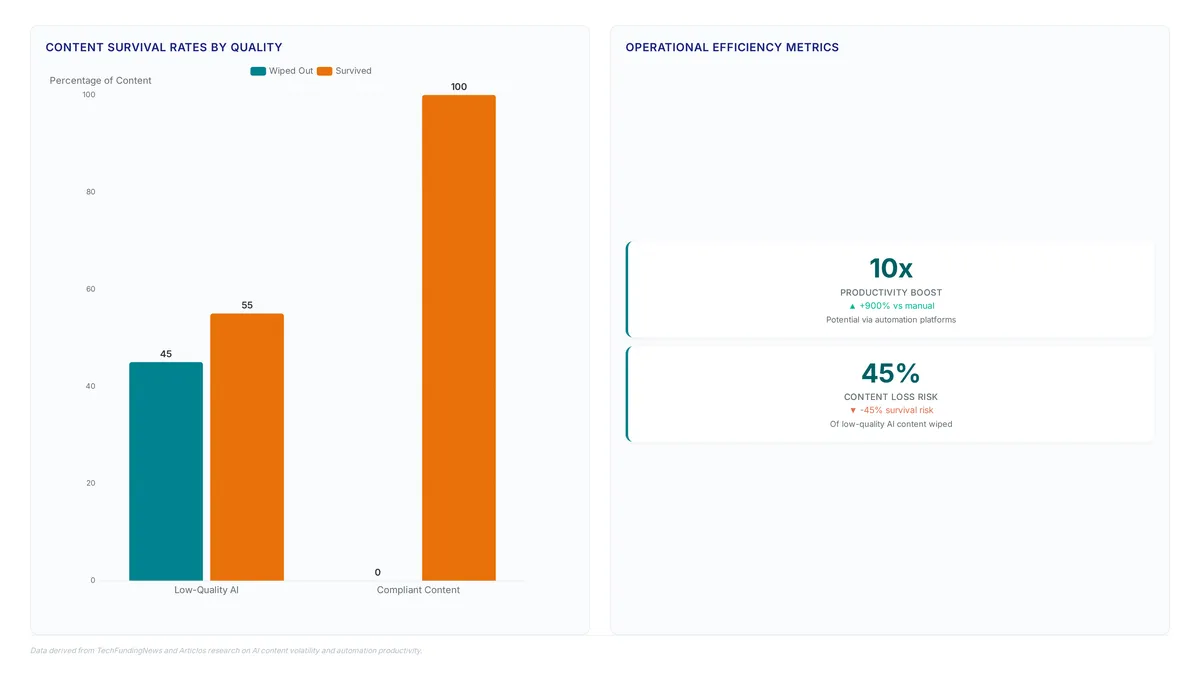
A content strategy defines the purpose, audience, message, channels, and success metrics behind content efforts. Teams produce disconnected assets that fail broader business objectives without this definition. The strategy must answer four specific questions before production begins.
- Audience: Who are we trying to reach?
- Problem: What problems does the content help solve?
- Channel: Where will the content be published?
- Metric: How will success be measured?
Enterium recommends tracking traffic, engagement, leads, conversions, retention, and support reduction as primary indicators. Successful teams adopt the practice of explicitly listing all recurring tasks from the start of a project to prevent role ambiguity task listing implementation. This methodological approach ensures every recurring task is listed, ranging specifically from keyword research to final publication.
| Phase | Key Output | Owner |
|---|---|---|
| Ideation | Topic List | Strategy Lead |
| Planning | Format & Channel | Project Manager |
| Creation | Draft Asset | Content Team |
| Review | Approved Copy | Editor |
Missing targeted audiences due to delays in planning and publishing creates a tangible cost for poor workflow definition time-to-market. Defining too many metrics dilutes focus while tracking only vanity metrics like traffic ignores retention value. Teams often skip defining the "problem" statement. Content ranks but does not convert when this happens. Enterium solutions enforce these definitions at the workflow level. No asset moves to creation without a linked business objective.
Executing the Seven-Stage Content Workflow Process
Enterium enforces the seven mandatory stages through automated state transitions that lock assets until specific criteria are met. This structured approach prevents content from stalling in review cycles and clarifies ownership for every task.
- Ideation and Planning require set objectives and channels before any draft is created.
- Creation assigns specific writers or designers to produce the asset within set parameters.
- Review routes the draft to legal or product specialists for accuracy checks.
- Approval secures final sign-off from decision-makers to authorize publication.
- Distribution pushes the finalized content to all the channels simultaneously.
- Measurement tracks performance data to inform future strategy adjustments.
Organizations adopting these "content operations" frameworks move beyond ad-hoc creation to ensure consistency across large teams content operations. Technical implementation involves defining recurring tasks that trigger automatically, ensuring steps like keyword research are never overlooked in the production cycle recurring tasks. Modern SEO best practices now include automated analysis of keyword density as a standard step rather than a post-production check automated analysis.
Rigid workflows can slow down urgent updates if exception paths are not pre-set for crisis communication. Teams must balance strict governance with the agility to bypass non-critical steps during emergencies. A documented process reduces confusion about deadlines and ownership. Enterprises scale content creation with confidence while maintaining brand consistency. This operational discipline transforms scattered assets into a strategic engine for business growth.
Implementation: Checklist for Establishing Content Governance Rules
Define explicit permissions for creation, editing, and deletion to prevent unauthorized changes. Teams risk publishing non-compliant material that triggers algorithmic penalties without clear boundaries. Recent volatility saw updates wipe out a significant share of low-quality AI content, punishing those lacking strict human oversight survivors. Governance ensures every asset meets quality thresholds before reaching public channels.
- Assign specific roles for authors, editors, and final approvers.
- Mandate legal reviews for regulated industry claims.
- Schedule recurring audits to archive outdated information.
- Enforce style guides across all departments.
- Document escalation paths for disputed edits.
| Role | Responsibility | Access Level |
|---|---|---|
| Author | Drafting initial content | Create, Edit |
| Editor | Quality and tone check | Edit, Comment |
| Approver | Final sign-off | Publish |
| Admin | System configuration | Delete, Archive |
Enterium configures these rules directly into the platform lifecycle, locking stages until criteria are met.
Clear rules accelerate movement by removing ambiguity. Governance is not bureaucracy. The constraint is initial setup time versus long-term risk reduction. Defining recurring tasks early marks a shift from ad-hoc methods to sustainable operations automation rules. Your next step is mapping current staff to these four distinct permission levels.
About
Arjun Patel is an Applied LLM Engineer at Enterium, where he benchmarks LLM providers and RAG architectures specifically for content workloads. His expertise in evaluating inference economics and model quality makes him uniquely qualified to address the complexities of managing content assets in an automated era. At Enterium, a B2B publication dedicated to AI content automation and reliable content pipelines, Arjun's daily work involves dissecting the trade-offs between cost, latency, and output fidelity. This article connects those technical realities to the strategic necessity of organized content management. By applying rigorous, vendor-neutral evaluation methods to content operations, Arjun demonstrates how businesses can prevent asset fragmentation and ensure consistency. His insights bridge the gap between raw LLM capabilities and the disciplined governance required to scale effectively. Through Enterium's methodology, readers gain actionable frameworks for building resilient systems where content assets remain accurate, searchable, and aligned with core business objectives without relying on unproven hype.
Conclusion
Scaling content operations without rigid governance invites catastrophic loss, as recent algorithmic shifts eliminated nearly half of unverified assets. The operational cost of ad-hoc creation now exceeds the investment in structured oversight. Organizations must transition from manual patching to integrated content workflow management systems that automate enforcement rather than relying on human memory. This shift ensures that quality control happens before publication, not as a reactionary measure after penalties occur.
Enterium recommends implementing a strict four-tier permission model immediately to secure your digital estate. Do not wait for the next volatility event to define boundaries between authors, editors, and approvers. Your specific first action this week is mapping current staff members to these distinct access levels within your existing infrastructure. This exercise reveals gaps where unauthorized edits could trigger compliance failures. By anchoring these roles in a system like Enterium, you lock stages until criteria are met, preventing non-compliant material from reaching public channels.
Sustainable growth requires treating content assets as governed inventory rather than disposable output. The window for relying on disjointed processes has closed, making centralized orchestration necessary for survival. Start by auditing your current team structure against the set roles of author, editor, approver, and admin to establish a baseline for your new governance protocol.
Frequently Asked Questions
Fragmentation causes teams to waste time searching scattered files. A centralized content repository ensures everyone finds approved assets quickly, reducing the risk of using outdated materials.
Unclear roles create bottlenecks during the review and approval stages. Defining every recurring task from keyword research to distribution ensures team members know their specific obligations and deadlines.
Missing controls lead to non-compliant outputs and potential legal liability. Strong content governance mandates strict permissions for creating or deleting assets to maintain audit trails.
Audits must measure traffic, engagement, and conversions to prove value.
Strategy defines the audience while workflow outlines the task series.
References