Stripe Projects lets agents buy infrastructure directly
Stripe Projects launched April 30, 2026, to let AI agents provision infrastructure rather than just buy retail goods. This protocol marks a definitive shift from retail-shaped interactions to capability-based commerce, where the transaction outcome is a deployed resource instead of a shipped package. While the first wave of agentic activity saw AI-driven traffic to retailers like Etsy and Walmart surge 805% year-over-year during Black Friday 2025, that model merely digitized the human shopper. Stripe Projects fundamentally alters the architecture by positioning cloud platforms like Cloudflare, Vercel, and Netlify as merchants selling plans and domains directly to authorized software agents.
Infrastructure buying demands a distinct commerce protocol separate from retail, focusing on four specific flows: account creation, plan purchase, resource configuration, and subscription management. Unlike previous iterations where agents browsed catalogs, this system uses Shared Payment Tokens scoped to specific vendors and time windows to execute complex provisioning tasks. Agent-driven provisioning allows software to configure DNS records and deploy workers immediately after purchase, effectively closing the loop between payment and utility. By distinguishing between buying things via the Agentic Commerce Protocol and buying capabilities through Projects, Stripe establishes the fundamental layer for the next phase of the agentic web. This evolution moves beyond simple checkout automation to full lifecycle management of cloud resources, demanding new audit standards for vendors.
The Role of Capability-Based Commerce in Modern Infrastructure
Stripe Projects launched April 30, 2026, as a commerce protocol enabling AI agents to provision infrastructure capabilities rather than retail goods. This definition separates capability-based buying from the retail-shaped interactions dominating the agentic commerce system. Launch partners Cloudflare, Vercel, and Netlify expose plan catalogs where agents match resource limits to workload requirements. The protocol executes four distinct flows: account creation, plan purchase, resource configuration, and subscription management. Unlike retail agents that stop at checkout, infrastructure agents complete the lifecycle by deploying Workers or configuring DNS records post-transaction.
Operationalizing this shift requires wider user-side authorization grants to manage subscriptions over time. Azure Marketplace relies on enterprise relationships, whereas Stripe Projects targets the modern developer demographic with a "vibe deploying" approach. Vendors must expose specs in a machine-readable structure rather than human-facing pricing pages. Retailers need only verify payment, but cloud providers must validate that an agent's configuration change aligns with the owner's intent. Failure to distinguish these scopes invites unauthorized resource provisioning under the guise of routine maintenance.
Inside the Architecture of Agent-Driven Provisioning
Stripe Projects CLI Plugin as Isolated Billing Container
Executing the stripe plugin install projects command creates an isolated billing and API environment inside a parent account. This setup functions as a scoped container holding distinct permissions. Such architecture separates agent identity from the human owner by issuing restricted API keys. These keys limit autonomous actions to specific resource quotas rather than granting full account control. Installation via the CLI integrates directly into developer workflows. Agents can initialize projects and attach services like Supabase through simple commands.
Broader fulfillment channels such as the AWS Marketplace serve different purposes. This tool focuses specifically on agent credential management and granular budget enforcement. The separation ensures that a compromised agent cannot exhaust the parent account's credit line. Global payment settings remain untouched. Granting agents broad access simplifies initial setup but increases the blast radius of a logic error. Damage remains confined to the container's specific budget cap if an autonomous loop triggers excessive provisioning. The entire organization's financial standing stays safe. This containment strategy shifts the risk model from total account compromise to manageable, localized expenditure anomalies.
Agent-Driven Infrastructure Provisioning with Cloudflare and Vercel
Cloudflare's launch description frames the protocol as producing a working setup rather than completing a checkout. This distinction shifts the provisioning flow from transactional to operational. Agents must execute post-purchase configuration steps automatically. An agent purchasing a Cloudflare account configures DNS records, deploys a Worker, and attaches a domain within a single authorized sequence. The CLI plugin installs as an isolated environment. It issues restricted API keys that limit autonomous actions to specific resource quotas instead of granting full account control. Vercel published a changelog entry supporting Pro plan purchases. The entry specifically covers the upgrade path from the free tier.
Security Constraints of Restricted API Keys in Agent Workflows
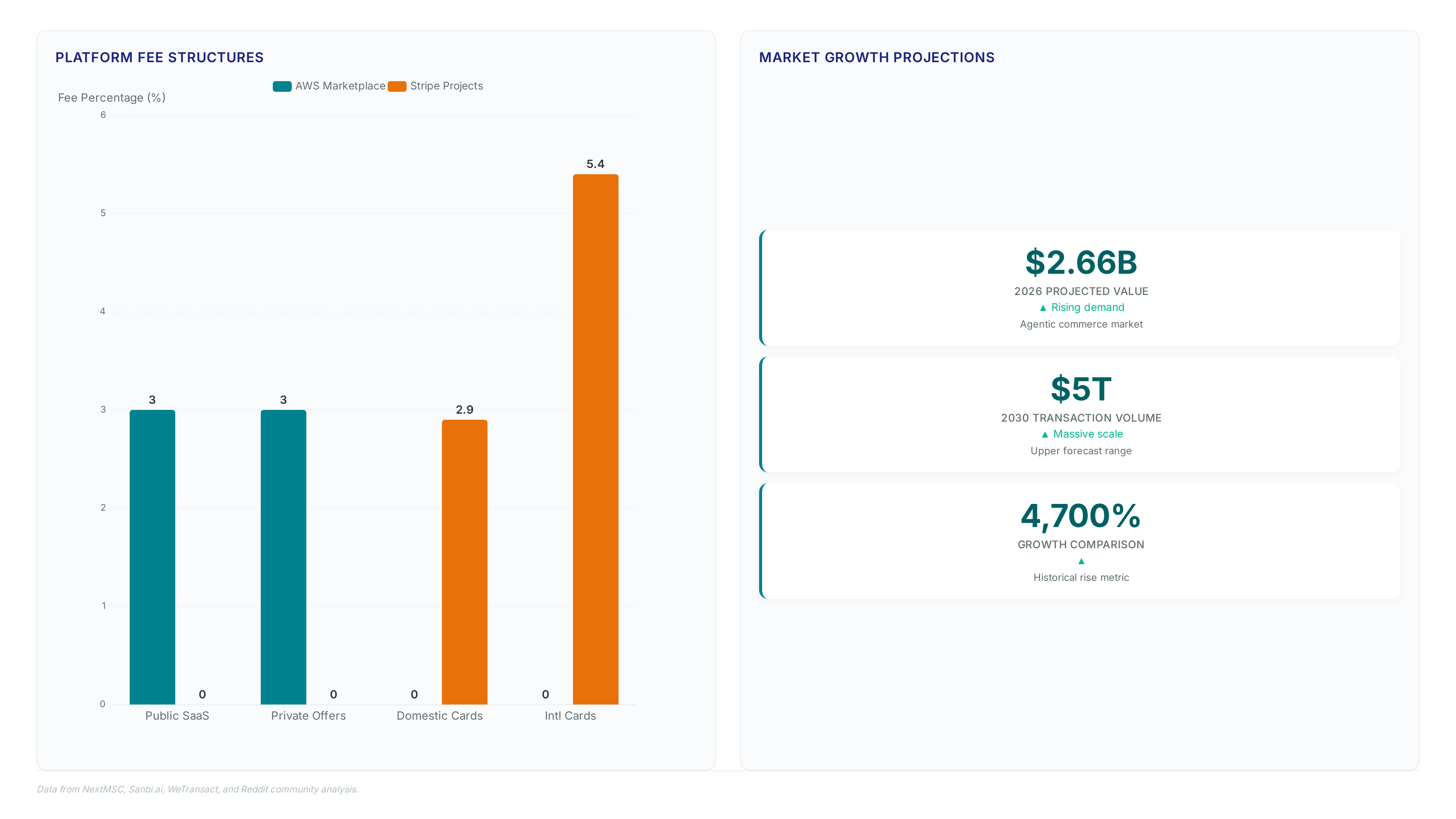
Autonomous provisioning relies on restricted API keys to limit blast radius if credentials leak during execution. The vendor receives a structured signup request containing the owner's identity, the agent's identity, and the authorization scope. This design isolates the agent within a scoped container. Lateral movement across the parent account becomes impossible if the key is exposed. Generative AI traffic rose 4,700% year-over-year in July 2025, creating a massive attack surface that demands such granular permissioning.
Developers must manage more complex credential lifecycles compared to static admin tokens. The AWS Marketplace This model specifically targets agent-native credential management. The security model uses these keys to enforce strict boundaries on what an agent can purchase or configure. A compromised key cannot drain the entire billing account. Only the specific project budget faces risk. Agent autonomy suffers when pitted against absolute operational freedom. Costs rise when implementing these safeguards. Limitations appear in workflow flexibility. Drawbacks include increased complexity for development teams. Constraints define the modern agent economy.
Implementing Agent Subscription Management and Authorization
Defining the Structured Signup Request Payload
Vendors receive a structured signup request containing the owner's identity, the agent's identity, and the authorization scope. This Account Creation flow requires three distinct fields to establish a valid scoped container for autonomous operations. Implementation follows a strict sequence to validate these identities before resource allocation occurs.
- The agent submits the human owner's verified identity token alongside its own cryptographic signature.
- The system validates the request against the Hermes AI agent skill definitions to confirm permitted actions.
- The vendor issues restricted API keys that limit the agent to specific project resources rather than the parent account.
- Billing defaults to domestic rates of 2.9% + $0.30 unless international cards trigger the 5.4% + $0.30 fee tier.
This payload structure prevents agents from exceeding their assigned authority during instant database creation or configuration tasks. A key tension exists between broad access for flexibility and narrow scopes for security; wider scopes increase automation utility but expand the blast radius of compromised credentials. Operators must balance these constraints based on the specific risk profile of the agent's intended workflow. Enterium recommends strict scoping for initial deployments to mitigate unauthorized lateral movement within the billing environment.
The autonomous system submits a structured upgrade request containing the owner's identity and the target plan limits. Validation occurs against the authorization scope set during the initial Account Creation flow, ensuring the agent cannot exceed permitted resource quotas. Upon approval, the vendor updates the Subscription Management state and syncs new credentials to the local environment. This process eliminates manual API key copying but introduces complexity in managing restricted API keys for transient agent sessions. The security model relies on these keys to limit blast radius if an agent is compromised during a high-volume provisioning window. With the market for agent-initiated transactions projected to reach $50 billion by 2030, the volume of these automated upgrades will stress traditional rate-limited billing APIs. A failure in the validation logic allows an agent to bypass human approval gates, creating immediate financial liability. Enterium recommends implementing strict idempotency keys on every upgrade request to prevent duplicate billing during network retries. The cost is increased latency for the agent while the vendor verifies the Shared Payment Tokens against the new plan pricing. Unlike retail checkouts, these infrastructure upgrades often trigger downstream configuration changes that must complete atomically with the billing event.
Vendor Audit Checklist for Programmatic Onboarding
Developers must verify that the account-creation surface accepts a structured signup endpoint rather than relying on human email verification wizards. Without this capability, agents cannot resolve agent authorization failure during initial provisioning sequences.
- Confirm the vendor exposes a machine-readable catalog, avoiding the need to parse feature-comparison tables found on legacy AWS Marketplace pages.
- Validate that domain attachment occurs automatically within the provisioning flow, eliminating the manual steps common in traditional Azure Marketplace deployments.
- Ensure the system syncs restricted API keys directly to local environments or CI tools instead of requiring dashboard navigation.
| Check | Legacy Flow | Agent-Ready Flow |
|---|---|---|
| Catalog | HTML Tables | Structured JSON |
| Auth | Email Wizard | Verified Identity |
| Keys | Manual Copy | Auto-Synced |
Operations stall if the vendor requires session-level authentication for Subscription Management upgrades. Retailers with AI integrations saw roughly 7x better sales growth during Cyber Week 2025, highlighting the cost of non-compliance. Legacy vendors often lack the API depth to support credential management without human intervention. A Projects-readable catalog differs fundamentally from human-facing pricing pages by exposing machine-interpretable capability specs rather than marketing copy. Vendors relying on static HTML tables force agents to guess at resource limits, causing workflow abandonment in favor of competitors within the Projects-readable catalog.
Transitioning Infrastructure Vendors from Manual Configuration to Agent Workflows
Betting customers will continue manual configuration is plausible today for hosting and DNS vendors but becomes less plausible each quarter through the rest of 2026. Infrastructure Adjacents must expose structured catalogs that agents can read rather than relying on human-facing pricing pages. Merchants failing to provide machine-interpretable specs force autonomous systems to guess at resource limits, causing workflow abandonment. The cost of this friction grows as market dynamics shift toward automation. Vendors ignoring this signal risk losing workflows to competitors who appear in the Projects-readable catalog. Security implementations must also evolve; systems now sync agent-ready credentials directly to local environments to eliminate manual key copying. This transition requires vendors to validate authorization scopes without human intervention. Legacy dashboards cannot support these autonomous operations. Vendors must choose between building structured endpoints or accepting obsolescence in an automated market.
Catalog Structure Divergence: Retail Attributes Versus Capability Resource Limits
ACP catalogs expose retail attributes like size and color, whereas Stripe Projects requires vendors to define strict capability resource limits for workload matching. The shift moves procurement from selecting static SKUs to matching flexible compute constraints against an agent's declared intent. Vendors must restructure data models to expose machine-readable plan specifications rather than human-centric marketing copy found on legacy pricing pages.
| Feature | Retail Model (ACP) | Capability Model (Projects) |
|---|---|---|
| Selection Basis | Visual attributes, reviews | Resource limits, API quotas |
| Transaction Type | One-time purchase | Ongoing subscription relationship |
| Catalog Format | Human-readable HTML tables | Structured JSON definitions |
| Agent Action | Add to cart | Match workload to plan specs |
Infrastructure providers ignoring this divergence risk obsolescence as autonomous systems bypass non-compliant surfaces. Market data indicates AI-driven traffic surges are migrating from retail to infrastructure, validating the need for structured catalogs that agents can parse without ambiguity. Unlike retail, where a wrong size choice results in a return, a mismatched resource limit in cloud environments causes immediate runtime failures or cost overruns. The technical debt of maintaining parallel human and agent catalogs creates a bottleneck for SaaS Vendors attempting rapid integration. Organizations should adopt Stripe Projects early to capture agent-mediated demand before competitors lock in workflow dominance. Enterium advises validating that subscription surfaces handle programmatic upgrades without requiring human session authentication. Failure to expose resource limits structurally forces agents to guess, leading to procurement errors that manual reviews cannot scale to prevent.
About
Sofia Marchetti is a B2B Content Strategist specializing in how automated content systems directly influence pipeline growth and search visibility. Her daily work involves engineering reliable content pipelines where AI agents must autonomously manage infrastructure costs and deployment cycles. This practical experience makes her uniquely qualified to analyze Stripe Projects, a protocol that fundamentally shifts how agents purchase cloud capabilities. Unlike retail-focused agentic commerce, Stripe Projects addresses the specific operational need for AI to upgrade plans and provision domains without human intervention. At Enterium, a publication dedicated to documenting how modern teams scale content with LLMs, Sofia bridges the gap between theoretical AI automation and revenue-generating execution. Her analysis connects the technical mechanics of this new protocol to the real-world demands of content engineers and marketing operations leaders who require reliable, self-service infrastructure to maintain topical authority in an AI-driven search environment.
Conclusion
Scaling agent-mediated transactions to the projected trillions reveals a critical breaking point: runtime failures caused by ambiguous billing structures. When autonomous systems interpret domestic rate defaults as universal standards, the resulting payload mismatches trigger disproportionate international fees that erode margins instantly. This is not merely a pricing issue but a structural incompatibility between human-centric billing models and machine-speed procurement. Organizations relying on legacy configuration will face compounding operational costs as transaction volumes surge without proportional oversight.
Vendors must migrate to structured JSON definitions for all capability limits by Q2 2026 to remain viable in this shifting environment. Waiting for manual review processes to catch these errors is unsustainable; the volume of initiated transactions will overwhelm any human-in-the-loop safety net. The window to define these machine-readable specifications before market standards harden is closing rapidly.
Start by auditing your current billing payload structure this week to identify where domestic rate defaults might incorrectly apply to international agent traffic. Map these specific fields against your expected global agent workload to prevent immediate financial leakage. This targeted inspection reveals the exact friction points where autonomous procurement will fail without explicit, structured guardrails.
Frequently Asked Questions
Infrastructure agents require persistent grants to manage ongoing subscriptions rather than single purchases. This expanded scope is necessary because forecasts suggest 40% of Global 2000 roles will engage directly with AI agents by 2026.
Agents can configure DNS records, deploy Workers, and attach domains immediately after purchase. This capability supports the massive market expansion projected to reach a $5 trillion annual value by the year 2030.
Cloudflare, Vercel, and Netlify serve as the initial launch partners for Stripe Projects. These developer-platform providers were chosen to handle the 805% year-over-year surge in AI-driven traffic seen during Black Friday 2025.
Yes, agents can execute upgrades, downgrades, and cancellations through authenticated subscription management flows. This automation addresses the needs of the 40% of Global 2000 roles expected to utilize AI agents for direct engagement soon.
Retail agents stop at checkout, while infrastructure agents complete resource deployment and configuration. This shift enables the economy to grow toward its projected $5 trillion annual valuation by the end of the decade.