n8n AI Agent: Cut Manual Work 80%
Implementing AI generation workflows can reduce manual work by 80% according to research from n8n.io. The core thesis is that n8n AI agents function as a deterministic orchestration layer rather than a mechanism for hands-free publishing. Teams gain the most value when these systems handle bounded tasks with clear inputs while humans retain control over final approvals and strategic direction.
Readers will learn how the AI Agent Node serves as the automation core to connect tools, process information from earlier nodes, and return structured JSON outputs for easier auditing. The discussion covers architecting workflows that maintain source links and brand rules across planning, research, production, publishing, and reporting stages. We also examine why starting with a single bottleneck and expanding only after building trust yields improved operational results than attempting full-scale autonomy immediately.
This approach ensures that agents classify requests and gather sources without becoming the unauthorized owner of the editorial calendar. By enforcing a human-in-the-loop review process before changing CMS records or sending outreach, organizations prevent unverified claims from reaching publication. The result is a content operation where staff spend less time moving data between systems and more time improving work quality through targeted workflow automation.
The Role of n8n AI Agents as an Intelligent Orchestration Layer
The n8n AI Agent Node as an Intelligent Orchestration Layer
The AI Agent Node functions as a deterministic middle layer that stitches together disparate tools rather than operating as a standalone silo. Unlike generic chat interfaces, this node receives context from upstream triggers, executes specific tool calls, and returns structured output for downstream processing. Research describes these agents as replacing manual coordination between multiple teams by acting as an intelligent middle layer across the content stack. This architecture prevents data fragmentation. A single workflow can pull product specifications from Notion, verify assets in Google Drive, and instantiate tasks in Asana without human copying. The agent's primary constraint is its reliance on explicit tool definitions; it cannot access resources outside its configured scope. This limitation enforces safety but requires operators to define clear boundaries for every action. This ensures that downstream nodes receive predictable data types, reducing pipeline failures caused by hallucinated fields. The trade-off is increased initial setup time compared to unstructured prompt engineering.
| Component | Function | Constraint |
|---|---|---|
| Trigger | Initiates workflow | Requires explicit event source |
| AI Agent Node | Processes logic | Limited to connected tools |
| Validation | Checks output format | Rejects non-compliant data |
Operators must treat the agent as a bounded executor, not an autonomous decision-maker. The system fails if the human operator does not define the source of truth. Content teams should map their existing data silos before deploying agents to ensure all necessary APIs are accessible within the workflow definition.
Executing Bounded Content Operations with Human-in-the-Loop Review
Deterministic human-in-the-loop workflows replace manual coordination by enforcing strict review gates before any public action. A campaign request arriving via form can pull product details from Notion, verify assets in Google Drive, and generate an Asana task automatically. This orchestration reduces manual work by 80% when agents handle repeatable decisions while humans retain final approval authority. The AI Agent Node executes these bounded tasks by adhering to a set sequence: trigger, data retrieval, generation, validation, and human sign-off. Unlike siloed tools, this approach stitches together disparate systems into a single visible history for auditing. Implementing such automated publishing workflows allows teams to shift focus from data entry to strategic improvement.
| Stage | Agent Action | Human Requirement |
|---|---|---|
| Planning | Classify requests, prepare briefs | Set priorities, approve direction |
| Research | Gather sources, flag gaps | Validate claims, check quality |
| Production | Draft variants, format output | Edit voice, ensure accuracy |
| Publishing | Prepare CMS fields, schedule | Approve publication, metadata |
| Reporting | Collect signals, draft insights | Decide scale, stop, or update |
A critical limitation arises when agents lack explicit boundaries; without JSON schema validation, outputs may drift from brand guidelines or invent unverified statistics. Operators must configure model routing to send sensitive brand copy to stronger models while reserving lighter models for simple tagging. Teams should start with a single bottleneck, such as brief generation, before expanding to full pipeline orchestration. This measured approach ensures the content record remains accurate while building trust in the automation layer.
Preventing Unverified Claims Through Structured Output Constraints
Autonomous agents must operate within bounded tasks to prevent the propagation of unverified data into production content systems. Without strict output constraints, language models may hallucinate statistics or fabricate sources, requiring a human-in-the-loop review process before any CMS record changes or public outreach occurs. N8n autonomous agents function effectively only when restricted to clear inputs, approved tools, and set outputs rather than open-ended generation. This architectural constraint addresses the risk of agents acting as unchecked coordinators across multiple platforms. While research describes these systems as an intelligent middle layer that stitches together disparate workflows, the operator must enforce validation gates.
RAG Systems Using Vector Stores for Approved Documentation
Retrieval-Augmented Generation (RAG) improves research accuracy by grounding responses in a vector store of approved documentation rather than relying on parametric memory. This architecture prevents hallucinations by forcing the AI Agent to retrieve specific context chunks before generation begins. These agents act as intelligent middle layers that stitch together tools, data, and workflows to execute automated tasks. The mechanism operates through a set sequence:
- The system ingests trusted sources like product manuals or policy docs into a vector database.
- A user query triggers a semantic search to retrieve the text segments.
- The LLM receives the query plus retrieved context as its sole source of truth.
- The agent generates output based on the retrieved context.
The agent ingests an approved outline to retrieve supporting evidence from a vector store, grounding every claim in verified documentation rather than parametric memory. This RAG architecture forces the system to locate specific text segments before generating responses, a method shown to significantly reduce hallucination rates in technical writing. By restricting the AI Agent to supplied contexts, operators prevent the synthesis of plausible but false statistics that often plague unguided generation. Execution follows a logical sequence to ensure data integrity:
- Ingest product manuals and release notes into the retrieval index.
- Map outline points to retrieved source chunks using semantic similarity.
- Extract title, URL, publication date, author, and specific quote data.
- Format the aggregate into a structured output for the planning system.
| Validation Field | Data Type | Purpose |
|---|---|---|
publication_date |
ISO 8601 | Tracks source recency |
source_url |
String | Enables direct auditor verification |
quote_text |
String | Isolates exact claims for review |
Operators must note that semantic retrieval can surface conflicting definitions if the underlying knowledge base lacks version tagging. The solution involves flagging ambiguous matches for human review rather than forcing a selection. This workflow transforms disjointed research into a structured research pack ready for expert validation. Teams implementing these gated processes report a significant shift in how they handle multilingual technical documentation, ensuring consistency across languages. Deploying this citation grouping pattern serves as a core step for any high-volume content operation requiring auditability.
Validation Checks for Output Format and Confidence Levels
Validation gates must immediately parse the AI Agent response for valid JSON syntax before downstream nodes attempt data extraction. Malformed structures break the pipeline, requiring a retry loop that isolates format errors from content hallucinations. If the schema fails, the workflow rejects the malformed output before it reaches the planning system. This deterministic boundary separates syntax failures from semantic risks. Operators should validate outputs against set requirements before triggering publication actions. Low-confidence claims require a human-in-the-loop review step to verify source integrity. This approach aligns with architectural patterns where quality controls are embedded directly into the process flow. Without these gates, unverified data propagates silently through the content stack.
| Failure Mode | Detection Method | Remediation Action |
|---|---|---|
| Malformed JSON | Schema validator node | Route to error handler |
| Low Confidence | Score threshold check | Trigger human review |
| Duplicate Topic | Vector similarity search | Merge or pause request |
Duplicate detection prevents resource waste on overlapping topics. A lighter model can scan new requests against existing vectors to flag redundancy before generation begins. For example, an agent can detect if briefs target the same search intent and flag the overlap, allowing a content lead to decide whether to merge, reposition, or pause the work. This strategy optimizes spend by reserving expensive synthesis models for novel content tasks. The operational risk lies in false negatives during format validation. Overly strict schemas may reject valid but unconventional phrasing, creating bottlenecks that require manual override. Solutions configure these thresholds dynamically, balancing strictness with throughput to maintain workflow velocity without sacrificing data integrity.
Implementing Human-in-the-Loop Workflows for Content Briefs and Reviews
Defining the Human-in-the-Loop Trigger in n8n Workflows
The human-in-the-loop trigger in n8n activates when an automated sequence pauses at a specific node, requiring explicit strategist validation before proceeding. This mechanism distinguishes deterministic orchestration from risky full automation by enforcing a manual checkpoint after the AI agent processes data but before it executes downstream actions.
- Trigger Event: A new row appears in Airtable or Google Sheets, initiating the workflow.
- Automated Preparation: The agent compiles campaign goals and draft angles into a structured brief.
- Mandatory Pause: The workflow halts execution, waiting for the strategist to approve the audience, angle, and outline. 4.
Meanwhile, the workflow initiates when a new row enters an Airtable queue, pulling campaign goals and brand voice guides to construct a structured brief. This process eliminates manual data aggregation by feeding product notes and performance metrics directly into the agent context.
- Trigger: A form submission via Typeform or a spreadsheet update activates the sequence.
- Context Assembly: The agent retrieves target customer profiles and existing URLs to ground the output.
- Brief Generation: The system produces a Notion page containing the angle, outline, and research requirements.
- Assignment: The draft attaches to a task assigned specifically to a strategist for review. A critical tension exists between speed and accuracy; while end-to-end agents now handle full lifecycle tasks including research, skipping human validation risks propagating hallucinated claims. The limitation here is that the agent cannot verify factual accuracy without explicit Retrieval-Augmented Generation (RAG) constraints or human oversight. Consequently, the strategist must approve the audience and angle before the status transitions to "Assigned." This ensures the deterministic workflow enforces quality gates rather than bypassing them. Enterium recommends configuring these triggers to pause automatically, guaranteeing that no brief reaches a writer without verified context.
Checklist for Routing Drafts Through Brand and Fact Review Gates
Execute the review gate by comparing the draft against the approved brief to flag unsupported claims before editorial acceptance. This deterministic check prevents unverified data from reaching publication stages where legal or reputational risk increases.
- Validate Claims: The agent task compares draft assertions against the brief to identify missing citations or inconsistent terminology.
- Severity Tagging: Output creates a review report with severity labels like blocker, editorial review, and optional improvement.
- Human Decision: An editor accepts, rejects, or revises recommendations based on the structured report.
| Check Type | Agent Action | Human Role |
|---|---|---|
| Fact Verification | Flags numerical claims lacking source URLs | Validates evidence quality |
| Brand Compliance | Detects banned terms or tone deviations | Approves voice alignment |
| Disclosure | Identifies missing legal or product disclaimers | Confirms regulatory accuracy |
Quality controls built into the process ensure that efficiency gains do not compromise accuracy standards. While automation handles initial detection, the system cannot adjudicate complex nuance without explicit rules. Teams must define specific brand parameters, as vague instructions like "friendly" yield inconsistent filtering results. The limitation is that agents require exact boolean logic or approved example sets to function reliably. Operators should implement Enterium solutions to configure these validation nodes with enterprise-grade precision. This approach guarantees that every automated handoff maintains strict adherence to organizational governance policies.
Operationalizing Publishing Pipelines and Cross-Platform Integrations
Defining the Production Trigger and Agent Context Scope
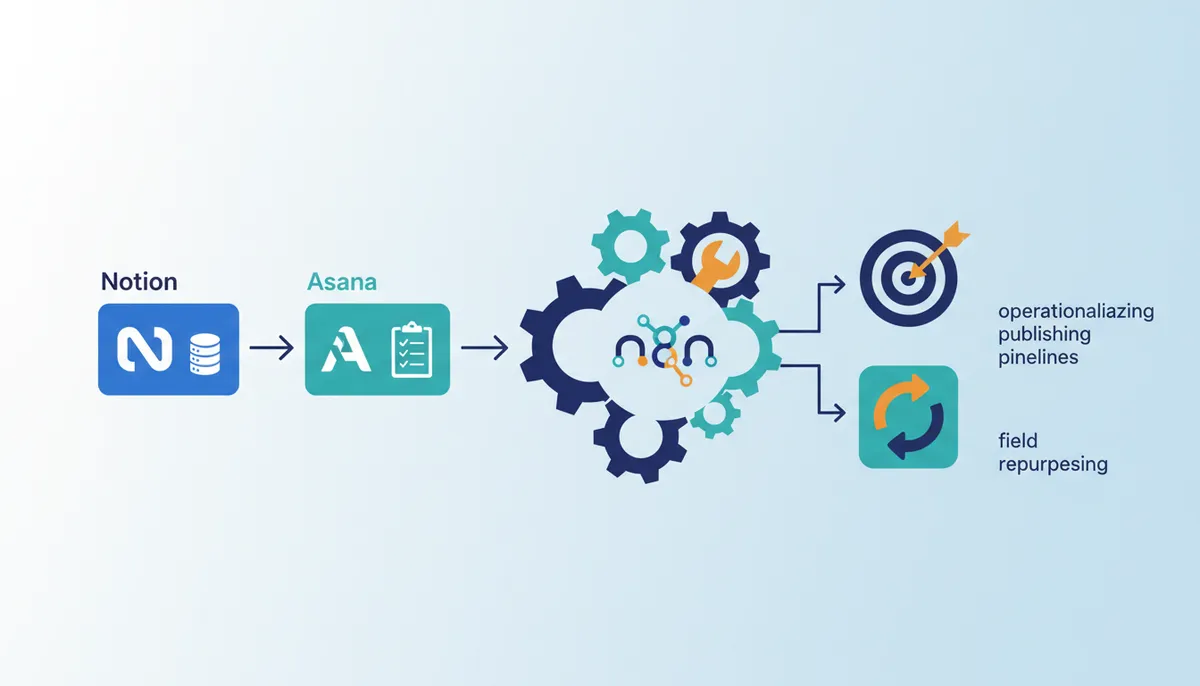
Deterministic triggers must fire before the AI Agent node acts. This manual gate prevents premature execution. The AI Agent Node functions as a precise intelligent middle layer rather than an autonomous publisher. A single, auditable signal replaces coordination efforts across multiple teams or platforms. Publishing pipelines stay stable even when upstream planning documents hold conflicting instructions. Incomplete data cannot derail the process. Stability comes from strict entry requirements.
Executing Multi-Platform Draft Creation from a Single Approval
The Agent completes one set task after receiving the approval trigger. Preparing CMS fields, creating content variants, or generating briefs happens in this single pass. Deterministic extraction populates a CMS draft, creates social and email drafts, and writes assets to the content record while leaving the post unpublished. Malformed metadata corrupts the content record if the workflow fails to validate the extracted JSON schema. Validation checks must test output format, missing fields, and confidence before results write back to the project system. Standalone SaaS tools often hide their internal logic. This approach maintains full visibility into every field mapping and transformation step. A final validation gate lets the agent flag missing source gaps or incomplete recommended formats. Human review then focuses on voice and accuracy instead of basic structural integrity. Any action with public, legal, financial, or brand impact requires human approval. Partial data stays out of the production environment.
Enforcing Least-Privilege Access and Data Minimization Rules
Production security starts by defining accessible tools and permitted actions. Self-hosted orchestration differs from monolithic platforms. Operators can audit every data pass between nodes. Restricted access limits potential damage from errors. Data minimization rules reduce the attack surface. Only necessary information moves through the workflow.
About
Hannah Brooks, Marketing Operations Lead at Enterium, specializes in the architecture of reliable AI content pipelines. Her daily work involves evaluating tooling stacks and designing workflow orchestration systems that prioritize governance over unchecked automation. This specific expertise makes her uniquely qualified to analyze the n8n AI Agent Node, a component central to building bounded, repeatable content operations. At Enterium, the editorial front for enterium.ai, Hannah focuses on how teams can move from research to publication without losing context or quality. She approaches the n8n agent not as a standalone fix, but as a connective layer within a broader, human-supervised methodology. Her analysis stems from real-world implementation challenges where clear inputs and set outputs are critical for success. By connecting her experience in martech stack design to the technical realities of autonomous agents, she provides a factual assessment of where these tools fit into production environments. The goal remains consistent with Enterium's mission: enabling teams to spend less time moving data and more time improving work through structured, measurable automation.
Conclusion
Scaling this architecture reveals that operational fragility shifts from execution speed to the rigor of input validation. When agents handle repeatable decisions, the cost of failure compounds if malformed metadata corrupts the content record before human review. Teams often overlook that deterministic extraction requires strict schema enforcement at every node, not just the final output. The real challenge lies in maintaining least-privilege access as workflows expand across multiple platforms, ensuring data minimization remains intact rather than becoming an afterthought.
Organizations should mandate schema validation gates for all AI-generated JSON before it touches production systems within the next sprint cycle. This prevents structural errors from propagating through downstream channels. Start this week by auditing your current workflow triggers to ensure every agent action requires a verified upstream signal rather than operating on assumption. While n8n Technical teams note the platform supports self-hosted control, the burden of defining those security boundaries rests entirely on your operational design. Success depends on treating the agent as a precise tool requiring explicit constraints, not an autonomous decision-maker. By anchoring your strategy in auditable signals and restricted tool access, you secure the pipeline against both data corruption and unauthorized actions without sacrificing the efficiency gains of automation.
Frequently Asked Questions
Implementing these workflows can reduce manual work by 80%. This significant drop allows teams to stop moving data between systems and focus entirely on improving content quality instead.
The node acts as an intelligent middle layer connecting tools. It replaces manual coordination efforts across multiple teams by stitching together disparate data sources into one unified workflow.
This low entry cost enables technical teams to build high-volume automations without requiring large upfront budget approvals.
Without JSON schema validation, outputs may drift from brand guidelines. This risk requires operators to define clear boundaries so agents do not invent unverified statistics or break formatting rules.
Humans must approve actions before publishing or changing CMS records. This human-in-the-loop step prevents unverified claims from reaching publication while agents handle only bounded, repeatable decision tasks.
References