Topical clusters stop AI agents ignoring your site
A topical cluster framework can cut content production costs by 80% while automating repetitive tasks. Organizations ignoring this architectural shift face obsolescence as specialized AI agents begin prioritizing structured, authoritative data over generic volume.
Stop treating specialized AI agents like general chatbots. They process domain-specific queries differently, demanding content libraries built for machine retrieval, not just human reading. This isn't about keyword density; it's about satisfying SEO and GEO protocols simultaneously through intent-driven clustering.
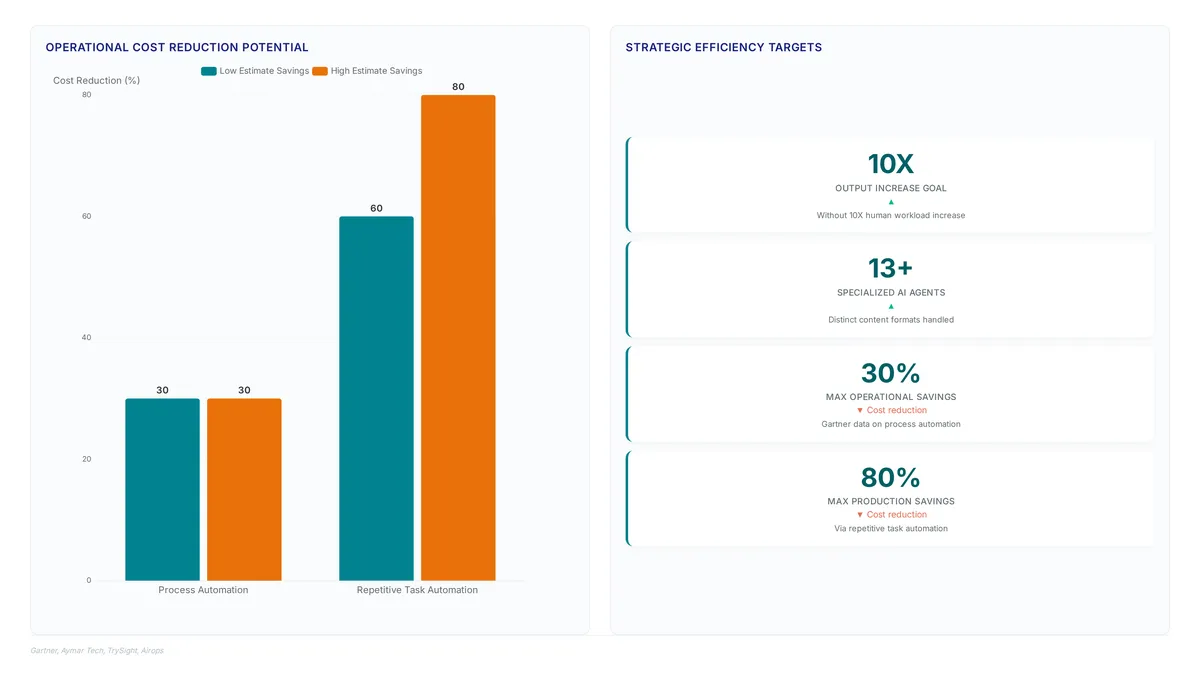
The financial case is binary. Gartner data indicates that organizations successfully automating content processes reduce operational costs by up to 30% (content assets). Implementing these strategies yields production cost savings between a significant portion and 80% by removing manual labor from the equation. The following sections dissect the measurable ROI from integrated operations and the specific mechanics of modern AI content strategy.
The Role of Topical Authority in Modern Search and AI Discovery
Defining Generative Engine Optimization and Topical Clusters
Generative Engine Optimization structures content so language models parse and cite entities with precision. Unlike traditional keyword matching, this practice requires semantic depth that signals topical authority to retrieval systems. Think of the framework as a knowledge network where pillar pages act as thoroughfares for supporting articles. Many writers ignore forward-looking questions, yet including future perspectives increases relevance and citation opportunities. The strategic foundation ensures that AI-generated content serves specific business objectives rather than creating content for content's sake. However, isolated articles fail to build the density required for AI citation, regardless of individual quality.
Building a Topical Cluster Framework with Pillar Pages
A topical cluster functions as a structured graph where a single pillar page links to multiple supporting articles to establish semantic density. Most teams using AI content generation produce articles reactively, creating isolated pages that compete with each other and fail to build topical authority. This fragmentation prevents retrieval systems from identifying the site as a thorough source. A functional framework uses a structure such as one pillar article and six supporting pieces, all interlinked, so AI sees the site as the thorough source it is looking.
Priority scoring must align with search intent rather than production ease. Implementing this structure allows organizations to use specialized workflows where distinct agents handle research and formatting separately. Specialized architectures for SEO and GEO optimization apply a workforce of 13+ specialized AI agents to handle distinct content formats. This division of labor reduces the editing burden on human operators while maintaining technical accuracy. The alternative is a disjointed library of content that AI models cannot efficiently traverse or cite.
| Component | Count | Function |
|---|---|---|
| Core Pillars | 1+ | Define primary domain entities |
| Supporting Articles | 6+ | Expand on specific sub-topics |
| Specialized Agents | 13+ | Execute distinct formatting tasks |
Mapping these clusters before generating any draft ensures logical connectivity. The cost of skipping this architectural phase is high; without a central pillar, supporting articles lack the context needed for high-value citations. A competitor with seven interlinked articles covering the definition, strategy, measurement, tools, common mistakes, and industry-specific applications establishes an authority that AI systems prioritize. Isolated content pieces rarely achieve this status. Practitioners must shift from viewing content as individual assets to managing them as an interconnected system. This approach satisfies both traditional indexing requirements and the structural needs of generative engines.
The Risk of Isolated Articles Failing AI Citation Checks
Publishing generic output without strategic clustering creates forgettable content that retrieval systems ignore. Generative Engine Optimization requires structured semantic depth rather than reactive drafting to secure citations. When articles lack interlinked context, AI models cannot verify the source as a thorough authority on the topic. This isolation prevents the system from recognizing the site as a credible entity for forward-looking questions or complex queries.
Most teams produce reactive pages that compete internally instead of reinforcing a central knowledge graph. A competitor with seven interlinked articles establishes the density required for citation, whereas single posts do not. The strategic goal of AI content generation is identified as a "10X" increase in content output without a corresponding "10X" increase in human workload. Isolated drafting wastes this potential efficiency by generating data points rather than connected arguments.
Rapidly published, unconnected pieces dilute topical signals, confusing the indexing algorithms designed to reward cluster density. Prioritizing the construction of a connected knowledge network over raw volume ensures long-term visibility. Without this architecture, content remains invisible to both traditional search and generative answer engines.
Build interlinked clusters before scaling output volume to guarantee citation eligibility. Organizations that successfully automate content processes can reduce operational costs by up to 30% according to Gartner data.
Inside the Architecture of Specialized AI Content Agents
Specialized AI Agents vs General Prompting Mechanics
Broad prompts force a single model to guess at structure, often yielding messy drafts needing heavy human revision. Specialized AI agents follow strict structural rules built for specific formats like listicles or technical guides. This design lets purpose-built tools create stronger first drafts than generic prompts, closing the gap between raw text and publish-ready files. Measurable cost differences appear in the workflow. A structured system using distinct agents handles a large share of production, leaving humans to refine tone and check facts.
| Feature | General Prompting | Specialized Agents |
|---|---|---|
| Constraint Adherence | Low; requires iterative refinement | High; enforces format rules |
| Draft Quality | Variable; often generic | Consistent; structurally sound |
| Human Review Load | High; focuses on structure and facts | Low; focuses on nuance and voice |
Managing multiple agents adds orchestration complexity that single-prompt flows avoid. Teams must coordinate context handoffs between research, drafting, and formatting stages to stop factual drift.
Deploying Parallel Agent Swarms for Format Optimization
Parallel execution replaces linear drafting by assigning distinct specialized AI agents to simultaneous optimization tasks. This architecture shifts away from a manual chain of steps toward parallel systems using specialized AI agents, allowing separate swarms to handle research, formatting, and citation checks at once. Comparing operational modes shows clear efficiency gains when separating concerns:
| Workflow Mode | Agent Type | Primary Bottleneck | Output Consistency |
|---|---|---|---|
| Linear Chain | General Prompt | Human revision time | Low |
| Parallel Swarm | Specialized Agents | Initial setup complexity | High |
This method supports a workflow covering most of the content process, saving final refinement for human oversight. Remaining effort focuses on tone verification and removing artificial patterns, a step where tools following a step-by-step breakdown prove necessary for quality control. Deploying multiple agents introduces coordination overhead; without strict format optimization rules, parallel outputs may diverge in voice or entity handling. Integrating GEO requirements into writer briefings and editorial guidelines ensures that question-first structuring and authority signals appear in the initial draft. The constraint is increased configuration complexity upfront, which demands precise definition of structural constraints for each agent role.
Validation Steps for Specialized Agent Efficiency Testing
Audit the current content mix to isolate repetitive formatting patterns before configuring agent parameters. Operators must identify high-volume formats where structural consistency directly impacts downstream editing loads.
- Configure distinct specialized agents for each dominant format type identified in the audit.
This comparative approach quantifies efficiency differences that generic benchmarking misses. Specialization reduces the gap between raw output and publish-ready content, lowering the true cost per article by reducing editing time.
| Test Variable | General Prompt Output | Specialized Agent Output |
|---|---|---|
| Structural Adherence | Variable, requires manual fix | High, follows schema |
| Editing Time | Significant | Minimal |
| Format Consistency | Low across batches | High across batches |
Tension exists between agent granularity and maintenance overhead; creating too many narrow agents fragments the workflow. Starting with core formats helps balance specificity with manageability. Establishing accurate time-to-publish metrics requires documented content strategies, as organizations with such foundations report notably higher performance.
Measurable ROI from Integrated SEO and GEO Content Operations
Defining the ROI Shift from Variable Labor to Fixed Technology Costs
Scaling AI content production moves the financial model away from variable labor costs tied to drafting and toward scalable fixed technology costs. Organizations documenting this strategic shift report notably higher performance than those relying on ad hoc automation. Performance tracking setups reveal that thorough frameworks help create high-quality, brand-aligned content at unusual scale. AI accelerates research, drafting, and optimization workflows. Human editors then focus on technical accuracy and search experience optimization. This efficiency enables marketing teams to scale production while staying competitive in both traditional search and answer engines. A constraint exists: AI-generated content requires teams to understand its limitations before relying on it for high-stakes marketing, SEO, or brand messaging. The initial design phase becomes vital. Operators must prioritize specific business objectives so AI-generated content serves strategic goals rather than creating material for its own sake. This approach transforms content operations from a linear expense into a leverageable asset. Establishing these metrics before increasing generation volume helps ensure AI tools function as a performance engine rather than just a creation tool.
Repurposing Top Ten Articles into Derivative Formats with Specialized Agents
| Agent Role | Function | Output Format |
|---|---|---|
| Research Agent | Extracts entities and quotes | Structured JSON |
| Drafting Agent | Synthesizes new narratives | Blog post, Guide |
| Formatting Agent | Applies GEO structures | Listicle, FAQ |
Updating the source article with internal links to these new derivative pieces creates a connected knowledge network that AI can easily interpret. This structural change signals relevance to indexing systems more effectively than isolated content updates. A drawback of this approach is its reliance on strategic planning; organizations must first generate baseline content through traditional means if they lack an existing library. For teams evaluating whether to use specialized agents versus general prompting, the decision hinges on the cost of human editing hours versus infrastructure subscriptions. Implementing SEO and GEO together requires that optimization constraints, such as question-first structuring, are baked into the agent prompts rather than applied as a post-processing step. Training content creators on question-first structuring, entity identification, and authority signal placement ensures that optimization becomes a native output of the generation pipeline. Including these elements in writer briefings and editorial guidelines helps prevent errors regarding specific product entities. Manual remediation needs drop.
Checklist for Allocating Budget to Close High-Value AI Visibility Gaps
Tracking citation share across substantial assistant platforms measures current visibility against competitor benchmarks. Implementation steps include setting up tracking to measure which content formats, answer lengths, and entity patterns generate consistent citations versus being ignored by AI systems. This targeted approach ensures budget closes genuine gaps rather than inflating volume blindly. Integrating SEO and GEO operations prevents the common failure of optimizing for crawlers while missing generative models. Tension exists between broad coverage and deep authority; spreading resources too thin dilutes topical signals required for citation. This strategy uses fixed technology costs to outproduce manual labor models efficiently. Content teams using structured workflows report that automation turns raw data into draft-ready copy within minutes. Marketers concentrate on strategy. The operational consequence of ignoring this shift is an inability to match the velocity of competitors using specialized agents.
Executing a Scalable Cluster Strategy in Five Steps
Implementation: Defining the Topical Cluster Structure Structure
Mapping a broad pillar topic precedes any drafting of supporting text when constructing a valid topical cluster. Strategic planning defines pillars as central topics capable of supporting multiple connected cluster articles. This structural depth allows a competitor with seven interlinked articles covering definition, strategy, and tools to establish immediate authority. AI systems evaluate whether a site acts as a thorough source before citing it.
- Identify a core pillar broad enough to sustain multiple subtopics.
- Plan supporting cluster articles that address specific user intents.
- Interlink all pieces to create a connected knowledge infrastructure.
A single pillar article paired with six supporting pieces signals to retrieval systems that the domain owns the subject. Neglecting forward-looking questions within these clusters reduces citation opportunities in generative engines. Breadth without sufficient semantic richness fails to signal topical authority effectively. Organizations must prioritize search intent over keyword repetition so AI models interpret the content correctly. Ignoring this hierarchy results in isolated pages that fail to compound value.
Automating Indexing with CMS Integration
Integrating protocols that allow publishers to push content updates directly to supported crawlers enables immediate search engine notification. IndexNow is a publicly documented protocol supported by Microsoft Bing, Yandex, and other search engines that allows publishers to notify search engines of new content. This mechanism ensures AI visibility by accelerating the time between publication and discovery.
- Verify that your current CMS integration supports native plugins or API hooks for instant notification.
- Implementation steps include verifying CMS support for IndexNow integration via native features, plugins, or API.
- Configure automated sitemap regeneration to trigger a ping upon every successful publication.
- Connect generation workflows so that finalized drafts automatically submit their URLs for indexing.
Content must reach indexing queues before model re-crawling cycles begin to optimize for AI discovery. High-frequency publishing carries the risk of submitting unfinished drafts, and technical errors in URL formatting can invalidate batch requests. Unlike manual submission, this approach scales linearly with output volume, a necessity when managing large topical clusters. Reliance on this push model means that if the CMS fails to trigger the hook, the content remains invisible until the next scheduled deep crawl. Most modern platforms handle the handshake automatically, but custom setups require strict error logging to catch failed submissions. Teams using tools with real-time SEO scoring should ensure their indexing agent waits for a passing score before triggering the URL submission. This gate prevents low-quality pages from consuming crawl budget or diluting site authority signals. Validating API keys in the site root immediately after installation is a necessary step. Search engines may reject incoming notifications regardless of payload accuracy without proper verification.
Checklist for Embedding Internal Links in Workflows
Generation agents configured to suggest specific internal connections before drafting begins prevent link debt from accumulating across large content batches. Internal linking should support topic clusters rather than random connections, a fact operators often overlook. Prioritizing the sources maximizes the topical cluster signal strength.
- Maintain a live content index accessible to all writing agents.
- Set agent parameters to propose the internal links per article based on the content index.
- Validate suggestions against the live index to prevent broken paths.
- Route established pillar pages as primary linking sources for new cluster content.
A link from a page that already receives substantial organic traffic passes more authority than a link from a page that's still building its own ranking. Neglecting this step forces expensive manual remediation later. Operational tension exists between generation speed and structural integrity because rushing output often breaks the knowledge network required for AI citation. Experts advise embedding these checks directly into the prompt chain rather than treating them as post-production edits. This approach ensures every new piece immediately strengthens the broader SEO and GEO framework without requiring retrospective fixes.
About
Sofia Marchetti is a B2B content and demand-generation strategist whose decade of experience in SaaS directly informs this analysis of the topical cluster blueprint. Her daily work involves auditing how automated workflows impact topical authority and GEO optimization, making her uniquely qualified to dissect the trade-offs between general and specialized tools. At Enterium, a publication dedicated to AI content automation and vendor-neutral methodology, Sofia documents how modern teams build scalable content pipelines that prioritize search intent over volume. This article reflects Enterium's core mission: providing practitioner-led insights on constructing AI content strategies that withstand algorithmic shifts while maintaining rigorous quality gates. Her approach ensures that discussions on Generative Engine Optimization remain grounded in reproducible steps rather than hype, offering a clear path for teams aiming to optimize content scaling without sacrificing ranking.
Conclusion
Speed without structural integrity creates link debt that manual audits cannot fix. Potential cost reductions vanish if teams ignore the operational drag of broken internal paths. The industry is moving past viewing AI as a mere replacement for writers; it is becoming the necessary mechanism for maintaining technical accuracy across massive content assets. You must treat your content library not as a static archive but as a flexible index that agents query before drafting begins.
Implement a strict workflow where generation agents propose internal connections based on a live index before any text is written. This prevents the accumulation of orphaned pages and ensures every new article immediately strengthens your topical cluster signals. Do not wait for post-production edits to fix structural gaps, as this retroactive approach consumes the very budget automation aims to save.
Start this week by auditing your current prompt chains to ensure they require a valid internal link target from your live index before allowing draft generation. This single constraint forces the system to prioritize structural integrity over raw output volume, aligning your production velocity with long-term ranking sustainability.
Frequently Asked Questions
Implementing a topical cluster framework can cut content production costs by 80%. This significant reduction occurs because the system automates repetitive tasks and removes manual labor from the equation entirely.
Organizations successfully automating content processes reduce operational costs by up to 30%. This efficiency gain allows teams to redirect budget toward strategic initiatives rather than basic content maintenance duties.
Effective architectures utilize a workforce of 13+ specialized AI agents to handle distinct content formats. This division of labor reduces the editing burden on human operators while maintaining high technical accuracy levels.
The goal is achieving a tenfold increase in content output without a matching rise in human workload. This approach enables massive scaling while keeping production cost savings between 60% and 80%.
Isolated articles fail because they lack the structural density required for AI citation and retrieval. Without a connected cluster, models cannot identify the site as a thorough source for specific domain queries.
References