AI workflow automation: stop the 10-hour drain
Fewer than 6% of organizations have fully embedded AI, yet marketing teams face relentless pressure to automate. The disconnect isn't a lack of tools; it's a failure of infrastructure.
Traditional rule-based logic collapses when faced with unstructured inputs. Intelligent agents survive here because they interpret context and adapt workflows dynamically. Modern marketing infrastructure leverages these agents to process campaign data across siloed platforms without constant human hand-holding. We must also address the specific trade-offs between Supermetrics and Zapier. While generalist tools offer broad connectivity, specialized platforms often provide the depth required for true revenue impact.
Research indicates that AI workflow automation turns hours of manual work into decisions made in seconds. Yet an AI gap persists: 80% of marketers face adoption pressure without the necessary technical foundation. As Zach Bricker from Supermetrics notes, the goal is removing friction to focus on growth rather than spreadsheet formatting. One study highlights that a significant share of SEO professionals already save over 10 hours weekly by using AI for execution, proving the efficiency gains are tangible when implemented correctly. This guide cuts through the hype to show how data activation actually works in 2026.
The Role of AI Workflow Automation in Modern Marketing Infrastructure
Defining AI Workflow Automation as Intelligent Data Activation
AI workflow automation executes multi-step business processes to reduce manual effort and accelerate decision velocity. This technology shifts operations from static data aggregation to intelligent data activation, where systems interpret unstructured inputs and trigger downstream actions without human intervention. By using agentic decision-making capabilities, these architectures allow models to autonomously determine the next logical step based on previous outputs rather than following rigid linear scripts. The rational gap remains significant: while 80% of marketers face pressure to adopt the technology, fewer than 6% of organizations have fully embedded them due to infrastructure limitations.
Replacing Manual Data Exports with Seconds-Level Marketing Decisions
Latency kills strategy. Manual data exports prevent real-time campaign adjustments and strategic pivots. Reformatting spreadsheets consumes hours that teams could otherwise dedicate to high-value analysis and growth planning. AI workflow automation eliminates this friction by ingesting raw signals from disparate platforms and generating immediate, actionable intelligence without human middleware. Instead of waiting for weekly reports, operators access live performance metrics through natural language queries that bypass traditional SQL bottlenecks. One study found that a notable share of SEO professionals saved over 10 hours per week on execution tasks by using AI tools for content generation and research.
Single-Provider Traps Versus Multi-Provider AI Cost Architectures
Single-provider dependency forces uniform pricing across diverse tasks, inflating operational costs compared to decomposed, multi-provider strategies. This disparity drives a strategic shift where businesses avoid the "one provider for everything" approach to prevent higher costs associated with rigid vendor lock-in. By using a mix of Frontier models and specialized LLMs, companies optimize the cost-to-performance ratio for specific decomposition tasks rather than paying premium rates for simple logic.
How Intelligent Agents Process Campaign Data Across Siloed Platforms
How the AI Insights Agent Interprets Unstructured Marketing Data
The AI Insights Agent translates raw campaign signals into structured queries by mapping natural language to schema definitions without requiring SQL knowledge. This mechanism allows marketers to ask plain-language questions about performance metrics while the system handles the underlying data aggregation logic. By connecting 150+ marketing sources, the agent centralizes siloed inputs before applying prompt decomposition to isolate specific variables like cost-per-acquisition spikes.
Effective deployment requires significant effort in structuring these inquiries, as large language models do not automatically resolve complex business problems without guided hinting strategies. The agent parses user intent against a normalized data layer, converting vague requests into precise database calls that retrieve exact figures from BigQuery or Snowflake.
| Component | Function | Constraint |
|---|---|---|
| Natural Language Parser | Converts text to query logic | Requires clear metric definitions |
| Data Connector | Fetches from 150+ sources | Latency depends on source API limits |
| Insight Generator | Formats data into narrative | Dependent on prompt quality |
However, relying on unstructured input introduces risk if the underlying data taxonomy is inconsistent across channels. A common failure mode involves the agent misinterpreting campaign hierarchies when source naming conventions diverge, leading to inaccurate aggregations. Operators must maintain strict naming protocols to prevent semantic drift in automated reporting. This approach ensures that generated insights remain grounded in verified data structures rather than model hallucinations. Teams should prioritize schema standardization before deploying natural language querying at scale.
Automating Cross-Channel Data Pulls to Eliminate Manual Reporting
Marketers now possess 230% more data than five years ago, yet 45% of CMOs still cannot confidently measure marketing impact due to fragmented ingestion pipelines. Reporting agents automatically pull and structure cross-channel data to eliminate manual data tasks. The mechanism relies on automated connectors that query platform APIs on fixed intervals, normalizing disparate schemas into a unified warehouse format before any analysis occurs. This architecture removes the latency inherent in human-led exports, allowing teams to address the gap where most organizations struggle to activate intelligence. A significant limitation emerges when credential rotation breaks silent background jobs, requiring strong alerting systems to maintain pipeline integrity.
Enterium deploys these workflows to ensure data consistency across the entire marketing stack without manual intervention.
| Feature | Manual Aggregation | Automated Reporting Agents |
|---|---|---|
| Update Frequency | Weekly or Monthly | Real-time or Hourly |
| Error Rate | High | near-zero |
| Scalability | Linear cost increase | Marginal cost increase |
Operators evaluating infrastructure must weigh the cost of flexible, multi-provider strategies against the simplicity of single-vendor locks, as decomposing problems often reduces total spend. The trade-off for this efficiency is the initial engineering overhead required to map source fields to a canonical data model. Without this core mapping, automated pulls merely accelerate the distribution of incorrect metrics. Teams implementing these systems should prioritize schema validation gates over raw ingestion speed to prevent downstream analytical corruption. The immediate next step is auditing current API access tokens to ensure they support the necessary read permissions for automated extraction.
Validating GDPR Compliance and Encrypted Transfers in Data Pipelines
Direct integration with BigQuery and Snowflake requires verifying that encrypted data transfers persist end-to-end. Operators must confirm the pipeline maintains GDPR/CCPA-compliant status during both ingestion and query phases.
- Validate TLS 1.3 enforcement on all warehouse connectors.
- Confirm data residency settings match regional legal requirements.
- Audit access logs for unauthorized cross-border movement.
| Feature | Manual Export | Automated Pipeline |
|---|---|---|
| Encryption State | Variable | Enforced |
| Compliance Audit | Retrospective | Real-time |
| Error Handling | Silent | Logged |
A common failure mode involves credential rotation breaking silent background jobs, leaving datasets stale while appearing active. This latency creates a compliance gap where reported figures do not reflect current liability exposure. Unlike static spreadsheets, automated agents require continuous validation of their connection security posture. Teams often overlook that troubleshoot procedures must include re-verifying encryption handshakes after every upstream API update. Selecting a platform with native warehouse support reduces this surface area significantly. Enterium recommends configuring strict egress policies to prevent unverified data flows. The trade-off is increased initial configuration time versus the risk of unregulated data leakage. Operators should prioritize tools that log every transfer attempt for forensic readiness.
Supermetrics vs Zapier for Specialized Marketing Data Orchestration
Supermetrics vs Zapier: Marketing Intelligence vs General SaaS Automation
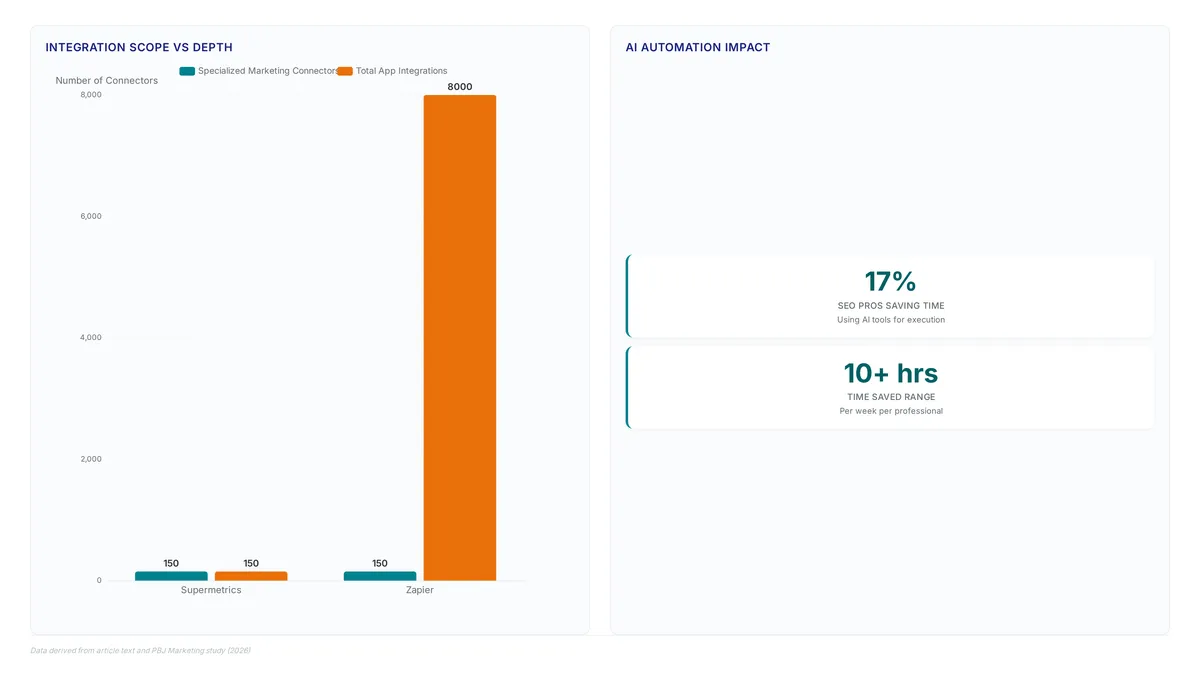
Supermetrics ranks #1 for marketing intelligence because it provides purpose-built data activation rather than generic app connectivity. While Zapier connects 8,000+ integrations for broad SaaS orchestration, Supermetrics focuses on 150+ deep marketing connectors to support campaign reporting. This architectural distinction determines whether non-technical teams spend time managing connections or analyzing performance trends. Specialized tools deliver pre-validated schemas ready for AI-assisted strategic planning.
The trade-off is scope versus depth. Teams needing to route leads between a CRM and email service benefit from Zapier's breadth. However, marketers requiring granular metric breakdowns across channels may face challenges when forcing general connectors to mimic native API responses.
| Feature | Supermetrics | Zapier |
|---|---|---|
| Primary Architecture | Marketing Data Warehouse | General SaaS Orchestrator |
| Connector Count | 150+ | 8,000+ |
| Data Depth | Native API Metrics | Trigger/Action Pairs |
| Starting Price | $44/month | Free tier available |
The immediate next step is auditing your current data pipeline for fields that require manual reformatting before analysis.
Deploying Supermetrics for Centralized Data vs Zapier for Task Execution
Supermetrics centralizes marketing data for analysis while Zapier executes immediate cross-app actions. This architectural split dictates whether a team builds intelligence or moves tickets. Supermetrics aggregates 150+ connectors into a unified schema, enabling the AI Insights Agent to answer plain-language queries about campaign performance without SQL. Conversely, Zapier uses 8,000+ integrations to route leads or post notifications, prioritizing breadth over depth. However, relying solely on general-purpose triggers often requires significant manual effort to normalize data, which can erode time savings. Teams must avoid the trap of connecting disjointed apps without a central truth layer.
Deploying Supermetrics as the core data warehouse connector helps ensure analytical accuracy before layering Zapier for peripheral notifications. Without this hierarchy, organizations risk automating errors rather than processes. Marketing teams should audit their current stack to identify where data aggregation ends and action begins, ensuring the chosen tool matches the specific workflow stage rather than forcing a single platform to do both poorly.
The Cost Risk of Single-Provider AI Strategies in Marketing Workflows
Relying on a single AI provider for all workflow tasks almost always incurs higher operational costs compared to flexible, multi-provider architectures. Research indicates that decomposing problems across different models optimizes the cost-to-performance ratio by matching task complexity with appropriate pricing tiers. This disparity forces teams to choose between expensive over-engineering or fragmented tooling without a unified strategy. Consequently, organizations adopting a "one provider for everything" stance face inflated bills without gaining proportional value from every interaction. Strategic workflow design addresses this by orchestrating logic that directs queries to the most economical viable model based on task requirements. This architectural choice prevents budget leakage on simple data lookups while maintaining access to powerful reasoning when necessary. Teams gain financial efficiency without sacrificing the depth of analysis required for strategic decisions. The result is a sustainable automation pipeline that scales linearly with value rather than usage volume alone.
Zapier is best for non-technical teams connecting a broad SaaS stack with free usage up to 100 tasks/month.
Building No-Code AI Workflows to Eliminate Manual Reporting Tasks
Mapping Friction Points Before Selecting AI Automation Tools

Selecting an effective tool depends on identifying where a team loses time rather than just comparing feature lists. Choosing the best AI workflow automation tool means evaluating current processes for roadblocks to determine what your team needs. This diagnostic phase prevents the deployment of complex orchestration on broken foundations.
- Audit current workflows to locate manual data aggregation bottlenecks.
- Quantify the latency between data generation and strategic decision-making.
- Isolate repetitive tasks where manual processes traditionally took weeks, compressing metadata generation and asset understanding into hours or minutes.
Marketers now manage significantly more data than in previous years, yet many struggle to confidently measure impact. The cost is measurable: agents trained on fragmented inputs produce compounding errors.
Configuring Reporting Agents to Pull Cross-Channel Campaign Data
Reporting agents automatically pull and structure cross-channel data to replace manual spreadsheet aggregation. Marketing teams use automation to eliminate manual data tasks like pulling campaign performance from multiple ad platforms. This configuration shifts the operational model from reactive data collection to continuous intelligence gathering.
- Define the specific data sources required for your performance dashboard.
- Map behavioral signals to trigger automated lead routing and notifications.
- Use AI capabilities to interpret unstructured inputs and adapt as conditions change.
A critical limitation exists in cost architecture; cost-based pricing models for AI agents must account for the specific mode of the API used, as pricing modes within the same provider can differ significantly. Raw data volume does not guarantee insight quality without proper semantic layering. Shifting from manual research to AI-assisted planning requires clean input structures.
Validating Behavioral Signals for Lead Scoring and Anomaly Detection
Lead scoring and routing tools qualify leads based on behavioral signals, yet weak data foundations generate false positives that waste sales capacity.
- Isolate specific behavioral signals intended for trigger logic.
- Cross-reference flagged anomalies against raw source logs.
- Adjust sensitivity thresholds to minimize noise.
- Deploy reporting agents to audit decision paths continuously.
Adopting a "one provider for everything" strategy for AI models generally leads to increased costs, whereas decomposing workflows to apply different providers offers a more cost-effective approach for complex marketing stacks. The operational risk lies in over-reliance on default configurations; without explicit validation gates, anomaly detection systems may ignore subtle drift until revenue impact is severe.
About
Daniel Reyes is Head of Content Engineering at Enterium, where he architects production-grade AI content pipelines from ingestion to publication. His decade of experience in data platform engineering and RAG systems directly informs this analysis of AI workflow automation tools. Unlike theoretical overviews, this article evaluates infrastructure realities that determine whether teams can bridge the gap between data access and activated intelligence. Reyes daily navigates the trade-offs between latency, cost, and quality in vector stores and orchestration layers, providing the technical grounding necessary to assess these eleven tools critically. At Enterium, a B2B publication dedicated to vendor-neutral methodology for scaling content with LLMs, the focus remains on reproducible pipeline architecture rather than hype. This piece dissects how specific automation platforms handle multi-step processes, identifying where current market solutions succeed or fail in reducing manual effort. By connecting deep engineering practice to operational needs, Reyes offers actionable insights for marketing-ops leaders seeking to embed AI into their actual workflows.
Conclusion
Scaling AI workflows reveals that the primary bottleneck is no longer technology access but the operational discipline required to manage variable cost architectures. When premium model outputs reach $25 per unit while basic modes cost mere cents, blindly automating complex tasks without semantic validation creates unsustainable financial leakage. Organizations must move beyond the initial pressure to adopt and instead focus on decomposing workflows to match task complexity with appropriate pricing tiers. This strategic shift prevents the common failure mode where increased data volume leads to decreased confidence in measurement.
You should implement a tiered validation framework immediately, reserving high-cost premium models only for unstructured interpretation while routing standardized data aggregation to economical API modes. Do not rely on a single provider for every function, as this monolithic approach inflates expenses and introduces single points of failure. Start by auditing your current reporting agents this week to identify which specific data sources are triggering expensive premium API calls unnecessarily. Replace those high-cost triggers with cheaper alternatives for routine checks, ensuring your AI workflow automation strategy prioritizes margin preservation alongside efficiency gains. This targeted adjustment secures long-term viability without sacrificing the speed of execution that modern marketing demands.
Frequently Asked Questions
Infrastructure gaps block adoption even though 80% of marketers face pressure to implement these tools. Without centralized data systems, organizations cannot move beyond manual exports to activate intelligence effectively.
One study shows 17% of SEO professionals saved over 10 hours weekly by utilizing AI for execution tasks. This time recovery allows teams to shift focus from data aggregation to strategic growth planning.
Entry-level API modes can cost as little as $0.05 per unit while premium outputs may reach $25. This wide variance means teams must carefully select model tiers to balance operational costs with performance needs.
Adopting a one-provider approach almost always results in higher costs compared to flexible multi-provider strategies. Modular architectures allow teams to avoid inflated pricing by selecting best-of-breed components for specific workflow stages.
Specialized platforms like Supermetrics offer starting prices around $44 per month for marketing intelligence features. This investment provides centralized data connectivity that generalist tools often lack for deep revenue impact analysis.
References