SEO content agents: replacing manual editing
SEO content agents replace manual editing by scoring draft quality on a 0 to 100 scale as users type. This shift marks the end of static keyword stuffing and the rise of the multi-agent system designed for generative engine optimization. Traditional workflows fail because they rely on human intuition rather than the continuous, data-driven feedback loops that define modern AI content orchestration.
Readers will learn how autonomous agents (autonomous agents) dismantle siloed production models to create a unified structured content pipeline. The analysis details the mechanics of SERP intent analysis and entity coverage optimization, showing how these systems prioritize semantic depth over simple term frequency. We also examine the integration of the IndexNow protocol to ensure immediate visibility across search interfaces without manual submission.
The article further dissects the gap between standard SEO vs GEO optimization, proving that legacy tools cannot match the adaptive nature of agent-driven stacks. By using AI crawler signals, organizations can align output with the specific requirements of algorithmic answer engines. This is not merely an upgrade to existing software but a fundamental rearchitecture of how digital assets are created, validated, and deployed in an automated environment.
Defining SEO Content Agent Technology and the Shift from Single Prompts
Coordinated Systems Replacing the Smarter Typewriter Workflow
Treating AI as a "smarter typewriter" works for drafts but collapses at enterprise scale. You type a prompt, tweak the output, and publish. That linear loop breaks when volume meets the need for precision. SEO content agent technology discards this fragile habit in favor of coordinated systems where specialized agents research, plan, write, and publish without human hand-holding. Digital leaders now prioritize optimization for AI-generated answers over simple ranking positions.
Basic generators lack the structure these multi-agent systems provide through distinct functional pipelines. One agent analyzes SERP intent while another validates entity coverage, locking in technical accuracy before finalizing drafts. Such orchestration frees teams to pursue high-value strategy instead of manual drafting. Architectural complexity rises alongside this autonomy, demanding strict attention to E-E-A-T, governance, and measurable content ROI. Scaling production without these governance layers invites technical errors and quality drops that enterprise teams cannot accept.
Enterium deploys these coordinated architectures so content satisfies both search engine criteria and the rigorous standards of generative answer engines. The outcome is a reproducible workflow preserving brand voice while accelerating time-to-publish. Teams adopting this model manage a flexible content supply chain rather than generating simple text. This structural shift separates organizations dominating visibility in an algorithmic discovery environment from those left behind.
Orchestration Layers Connecting Research Agents to CMS Publishing
An orchestration layer sequences agent actions, passes structured outputs, and triggers indexing protocols without manual intervention. This architecture replaces the fragile "smarter typewriter" model where users manually edit drafts, a workflow now obsolete for scale. A dedicated research agent performs SERP intent analysis while a separate writing unit drafts content based on those findings. The system loops back for refinement if entity coverage gaps appear during generation.
Publishing agents connect to a content management system to execute deployment and signal search engines via protocols like IndexNow. This modular approach makes generative engine optimization an integral part of the workflow rather than an afterthought. Coordinated systems validate technical requirements automatically, unlike single-prompt attempts that often miss detailed ranking signals.
| Component | Function | Output Type |
|---|---|---|
| Research Agent | Analyzes SERP intent | Structured data |
| Writing Agent | Drafts entity-rich text | Markdown/HTML |
| Publishing Agent | Deploys to CMS | API call |
Enterium builds these automated workflows to handle complex handoffs between research and deployment stages. Speed conflicts with accuracy; rushing the orchestration sequence creates outputs needing costly human rework to verify facts and strip out AI writing patterns. Implementing strict quality gates within the loop prevents low-quality drafts from reaching the publication stage. Only verified, optimized content enters the index, maintaining domain authority while scaling volume.
Volatility Risks When Single Models Optimize for Nothing in One
Single AI models optimizing for nothing in one generate unstructured text vulnerable to algorithmic filtering. This volatility defines the SEO vs GEO debate, where static keyword matching fails against flexible answer engine requirements.
| Workflow Type | Optimization Target | Survival Rate Post-Update |
|---|---|---|
| Single Prompt | General coherence | Vulnerable |
| Agent System | Structured intent | Resilient |
SEO content agent technology answers what is SEO content agent technology by deploying specialized units for research and validation rather than relying on one model to guess user needs. A single prompt attempts to satisfy conflicting goals like creativity and factual density simultaneously, often resulting in hallucinated entities or thin coverage. Modular agents enforce quality gates before publication, ensuring each segment meets specific entity coverage standards. Ignoring this architectural shift causes significant visibility loss, as search engines increasingly de-rank content lacking clear topical authority. Enterium architectures mitigate this risk by separating research, drafting, and technical validation into distinct, auditable processes. Operators must transition from hoping a model guesses correctly to engineering systems that verify correctness before indexation.
Inside the Agent Stack Architecture and Orchestration Mechanics
Defining the Four-Layer Agent Stack for SEO
Autonomous software systems analyze situations, decide on actions, and execute multi-step workflows without constant human direction. These agents automate research, outlines, and on-page SEO within a structured content pipeline while maintaining governance and measurable ROI. Teams focus on strategy, storytelling, and strengthening E-E-A-T signals that build trust and visibility because repetitive tasks are automated. Writing agents generate drafts while technical optimization addresses metadata completeness, schema markup opportunities, and internal linking recommendations before content reaches a CMS. This structured data passing eliminates the fragile chain of human handoffs typical in legacy workflows.
| Agent Layer | Primary Function | Output Artifact |
|---|---|---|
| Research | Intent mapping & gap analysis | Clustered opportunity list |
| Strategy | Entity planning & structure | Optimized content outline |
| Writing | Draft generation & tone matching | Raw article text |
| Technical SEO | Schema, links & metadata | Publication-ready HTML |
Teams automate a significant portion of the content process through this stack implementation, leaving the remainder for human refinement of tone and fact verification. Dependency on upstream data quality is the cost; if initial research misidentifies intent, downstream agents may propagate the error rather than correcting it. Effective orchestration validates data integrity at each layer to prevent garbage-in-garbage-out scenarios. Properly structured, these systems improve content consistency while optimizing specifically for AI-generated answers.
Applying Structured Briefs to Eliminate Handoff Friction
Conventional content production operates as a fragile chain of handoffs involving separate tools for keyword research, competitive analysis, and manual metadata entry. Semantic intent dilution occurs before the drafting phase begins due to this fragmentation. The writing agent resolves this by consuming structured briefs rather than raw prompts to generate text with necessary authority. Agent stacks preserve entity relationships set in the initial research layer even as traditional workflows often lose contextual nuance during tool transitions.
Strict dependency on upstream data fidelity limits this approach; a malformed brief yields off-target drafts regardless of model capability. Operators must configure the orchestration layer to validate brief completeness before invoking the writer. Implementing these validation gates guarantees that only verified constraints reach the generation stage.
| Workflow Stage | Traditional Tooling | Agent Stack |
|---|---|---|
| Input Format | Raw keyword list | Entity-mapped brief |
| Context Retention | Low (manual transfer) | High (structured data) |
| Optimization Gate | Post-draft check | Pre-draft constraint |
Content volume requiring parallel execution without sacrificing topical depth necessitates multi-agent systems. Intelligence moves from the prompt engineer to the data structure itself through this architectural shift. The system reduces the need for iterative rewriting by enforcing rigid input schemas. AI-assisted content workflows maintain consistent quality standards across large-scale deployments because of this structural rigidity. Friction exists only at the design layer, not during execution, in the resulting pipeline.
Binary Selection Risks in AI Search Visibility
AI search platforms have compressed the timeline for brand visibility, making the selection process much more binary where content either has the characteristics for citation or it does not. These platforms synthesize knowledge into complete answers to queries rather than returning keyword-based links. This selection mechanism creates volatility for non-compliant automated content that lacks the specific entity density required for citation. A coordinated stack becomes necessary when single-prompt workflows fail to meet these rigid inclusion thresholds.
Conventional drafting often misses the detailed signals necessary for generative engine optimization. A coordinated stack improves output by enforcing structured briefs that align narrative structure with model constraints before generation begins.
| Workflow Type | Signal Fidelity | Citation Probability |
|---|---|---|
| Single Prompt | Low | Variable |
| Multi-Agent | High | Consistent |
Algorithmic selection carries an all-or-nothing nature; missing key topical opportunities can exclude an asset from the answer set. How AI agents improve content quality depends on preserving semantic intent across handoffs rather than simply increasing volume, a fact operators must recognize. Orchestrating these specialized agents maintains the fidelity required for visibility while avoiding the fragility of manual chains. Potential exclusion from emerging search interfaces is the consequence of ignoring this architecture. Content teams should audit their current pipelines for handoff friction that dilutes these critical signals before deployment.
Deploying Automated Workflows for GEO and Instant Indexing
Defining Generative Engine Optimization for Agent Workflows
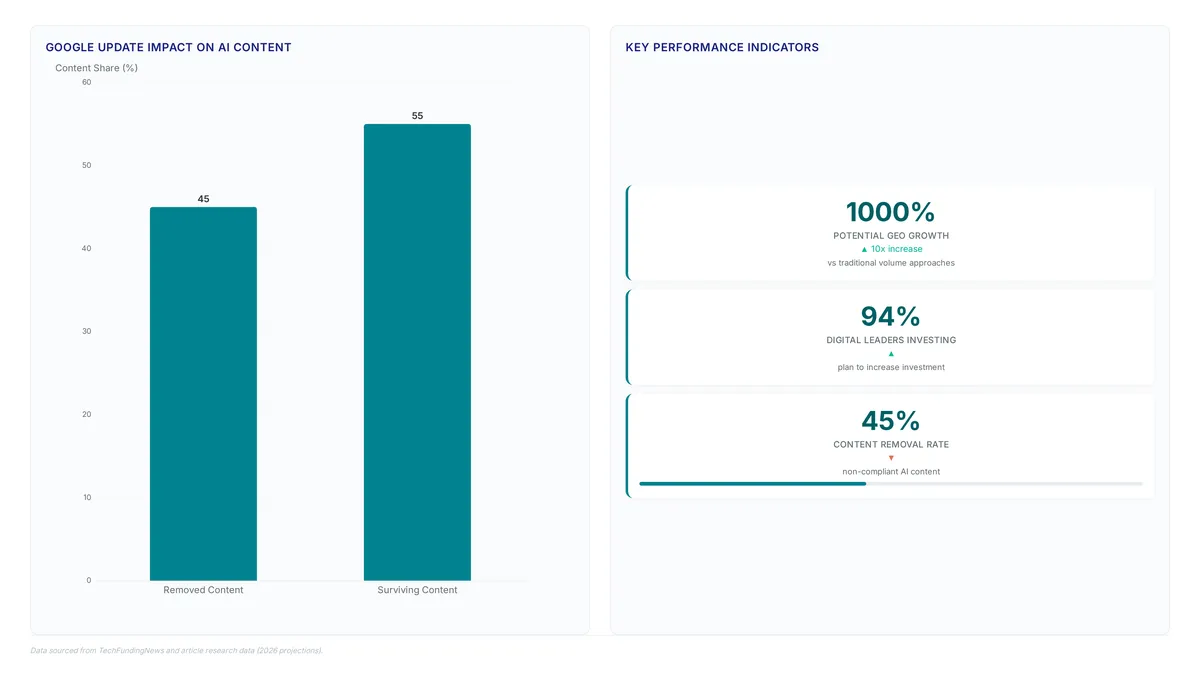
Generative Engine Optimization structures content so large language models cite it as a primary source. Unlike traditional SEO, which targets keyword matching algorithms, GEO prioritizes factual density and entity clarity to satisfy conversational query resolution. AI models like ChatGPT and Claude select sources based on authoritative tone and structural coherence rather than simple term frequency. This shift requires agents to synthesize information into high-confidence assertions rather than optimizing for click-through rates.
Autonomous workflows can be configured to maximize these specific signals, ensuring content meets the strict evidentiary standards of generative answers. While traditional SEO focuses on ranking positions, GEO emphasizes earning citations within synthesized responses. The cost is often volume; an agent stack optimized for GEO may produce fewer, higher-density articles that withstand adversarial fact-checking by LLMs.
Practitioners building an AI content agent stack must distinguish between generating text and engineering citable knowledge units. A pipeline that ignores entity resolution risks producing fluent but uncitable hallucinations that search engines discard. Operational workflows increasingly incorporate deeper research phases where agents verify claims against trusted corpora before drafting begins to ensure technical accuracy.
| Feature | Traditional SEO Focus | GEO Focus |
|---|---|---|
| Primary Goal | Rank position | Citation inclusion |
| Key Metric | Click-through rate | Attribution frequency |
| Content Structure | Keyword density | Factual density |
| Tone | Engaging/Persuasive | Authoritative/Neutral |
The future-ready framework blending these strategies ensures visibility as search evolves from keywords to conversations. Teams deploying these systems focus on strengthening E-E-A-T signals to build trust and visibility in generative interfaces.
Configuring Autopilot Mode for Compounding Content Returns
Autopilot Mode functions as a continuous loop where agents identify gaps, generate drafts, and manage publishing protocols with minimal human direction. This configuration shifts the operator's role from manual execution to strategic oversight of the content automation pipeline. Teams implementing this stack move beyond single-prompt interactions to orchestrated systems that validate entity coverage before publication.
A brand publishing well-optimized, indexed articles per month builds a content system with deeper topical authority and denser internal linking over time. Data indicates that 94% of digital leaders plan to increase investment in Answer Engine Optimization this year as discovery shifts toward AI-generated responses increase investment. This statistical trend shows the urgency of deploying scalable workflows now.
Full autonomy introduces risk if quality gates remain porous. Without strict validation layers, automated systems can propagate factual errors or drift from brand voice at scale. The constraint lies not in generation speed but in the robustness of the pre-publish checks.
Operators must balance throughput with precision to avoid diluting domain authority. The strategic imperative involves tuning agent parameters to prioritize factual density over sheer volume. Content teams should audit their current stacks to ensure they support this compounding model rather than hindering it with manual bottlenecks.
Integrating IndexNow and AI Visibility Tracking Protocols
Operators must configure their publishing pipeline to trigger HTTP requests the moment an article reaches a terminal state. This approach bypasses traditional discovery queues, ensuring generative engines access fresh data without waiting for scheduled crawls.
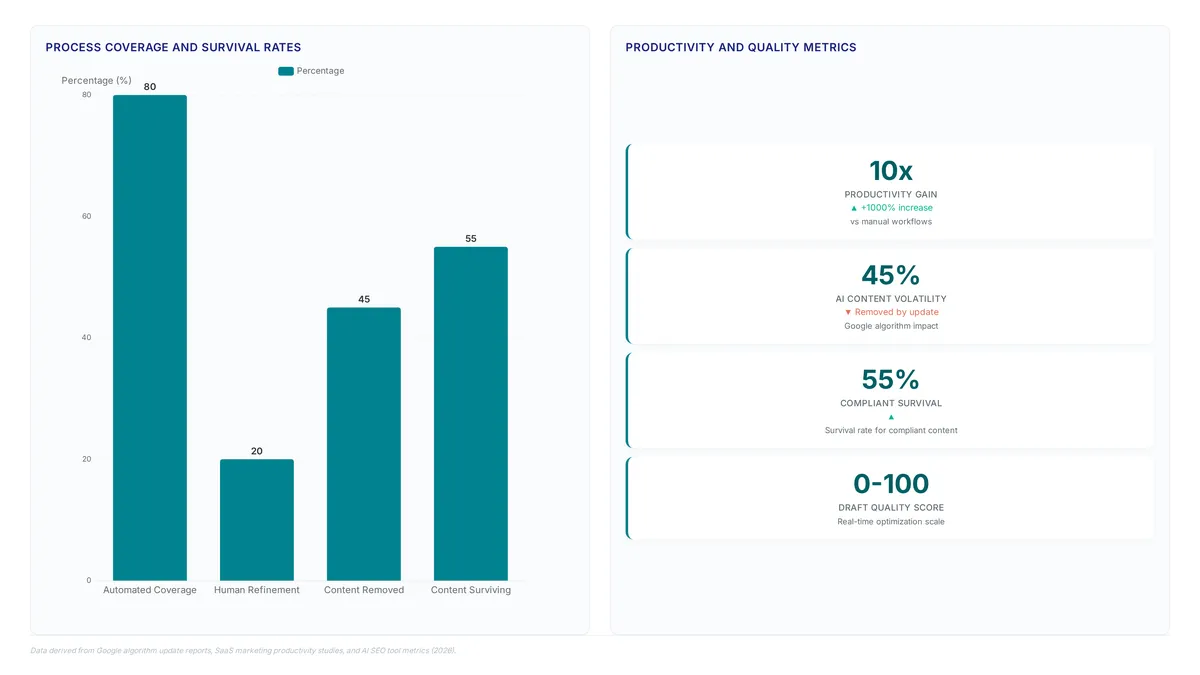
Monitoring visibility demands a distinct layer that systematically queries platforms to analyze brand appearance. Unlike traditional rank tracking, this process measures citation frequency and sentiment within synthesized answers. Some automation platforms claim to boost marketing productivity for SaaS companies by up to 10 times through such workflow integration. Implementing this dual-layer architecture helps secure both immediate discovery and long-term AI visibility.
A critical tension exists between publication velocity and the risk of propagating unverified claims to AI models. Rapid indexing increases errors just as quickly as it distributes facts. This ensures that speed does not compromise the factual density required for high-confidence citations. By 2027, organizations failing to adopt these rigorous verification standards may find their content excluded from synthetic answer engines entirely. The window for establishing these protocols remains open, but the timeline for implementation is compressing as substantial search interfaces evolve.
Evaluating the Strategic ROI and Quality Risks of Agent-Based Content
Defining the Engineered Pipeline for Content Production
Coordinated agent stacks now research, write, optimize, publish, and index material continuously for brands seeking compounding advantages. This architecture treats content as a compounding asset rather than a linear output to fundamentally alter production velocity approaches. Manual editing creates bottlenecks while multi-agent systems execute Generative Engine Optimization tasks in parallel, ensuring entity coverage and SERP intent alignment without human handoffs. Critics argue automation sacrifices quality for speed, yet adoption continues as discovery shifts toward AI-generated answers. The limitation remains the initial complexity of orchestrating these agents, requiring precise definition of roles within the stack. Relying on ad-hoc creation fails to scale against modern search demands.
Hidden costs of avoiding this shift include:
- Inability to maintain consistent entity coverage across large topic clusters.
- Slower reaction times to shifting SERP intent signals.
- Fragmented workflows that prevent continuous indexing via protocols like IndexNow.
- Operational gaps arising from isolated tools lacking integrated feedback loops.
- Technical debt accumulation in publishing workflows.
Organizations often rely on isolated tools that lack the integrated feedback loops necessary for true compounding growth. The decision to switch depends on whether an organization views content as a disposable commodity or a permanent infrastructure layer. Teams asking if they should switch must evaluate their tolerance for technical debt in their publishing workflow. Those prioritizing long-term visibility require the structural integrity of an automated, agent-driven system.
Algorithmic Volatility and Content Quality Risks
Unsupervised automation triggers organic traffic collapse because search algorithms may treat mass-produced text as spam rather than asset. Operators deploying multi-agent systems without human oversight face significant risks regarding content visibility and trust. The core problem with AI-generated content quality lies in the absence of verification layers. Automated stacks can theoretically cover around 80% of the content process, the remaining 20% still relies on human input to refine the tone, verify the facts, and strip out AI writing patterns. Neglecting this human oversight can compromise the technical accuracy and search experience optimization required for high-stakes marketing.
Hidden costs of ungoverned deployment include:
- Increased manual remediation time post-penalty.
- Permanent exclusion from emerging Generative Engine Optimization slots.
- Loss of brand trust due to factual errors.
- Wasted computational resources on low-quality outputs.
The window to establish an advantage is not permanent since the baseline for appearing in AI-generated answers will rise with adoption. Brands relying solely on speed rather than engineered precision will find their content excluded from these high-value surfaces. Enterprise teams must implement strict quality gates before scaling production volume. This hybrid approach mitigates the risk of algorithmic rejection while maintaining production velocity. Teams should prioritize signal integrity over raw output volume to sustain long-term search presence.
Checklist for Validating Agent Specialization and IndexNow Integration
Validating platform capability requires verifying distinct agents for research, strategy, writing, technical SEO, and publishing. Deploying orchestrated stacks where each node handles a specific pipeline stage helps maintain necessary quality gates.
| Capability | Single-Prompt Workflow | Multi-Agent Stack |
|---|---|---|
| Role Separation | None (Monolithic) | Distinct Research, Writing, SEO |
| CMS Connection | Manual Upload | Native Publishing |
| Indexing Signal | Delayed Crawl | Automatic IndexNow Trigger |
Organizations asking should I switch to agent-based content must audit for native CMS publishing and automatic IndexNow integration. Understanding what is IndexNow matters here: it is a protocol allowing content owners to notify search engines of changes instantly, bypassing standard crawl delays. A critical oversight in many deployments is the failure to link publishing events directly to indexing signals. This gap leaves fresh content invisible during peak relevance windows. The cost of ignoring this architecture is measurable delay in recognition by answer engines. True orchestration means the writing agent hands off to the publishing agent, which triggers the indexing protocol without human intervention. Failure to connect these steps results in lost opportunities for immediate visibility.
About
Daniel Reyes, Head of Content Engineering at Enterium, architects the exact multi-agent systems discussed in this analysis. With over a decade in data and ML platform engineering, he specializes in building production-grade RAG systems and orchestration layers that replace manual editing with automated, structured pipelines. His daily work involves designing the quality gates and evaluation harnesses necessary to scale generative engine optimization without sacrificing accuracy. At Enterium, a B2B publication dedicated to documenting how modern teams operationalize AI content, Daniel translates complex infrastructure challenges into reproducible methodologies. He does not theorize about AI content workflows; he engineers them, focusing on the tangible trade-offs between latency, cost, and output quality. This article reflects Enterium's core mission: providing vendor-neutral, practitioner-led guidance on constructing reliable content automation architectures. By grounding these concepts in real-world pipeline mechanics, Daniel offers technical marketers and content engineers a clear path to implementing reliable multi-agent content systems that function effectively in live production environments.
Conclusion
Scaling multi-agent systems reveals a critical fracture point: the disconnect between content generation and immediate discoverability. While automated stacks handle the majority of production, the operational cost of delayed indexing erodes the value of speed. As the industry pivots from simple automation to full autonomy, where agents independently trigger retention campaigns, any lag in search engine notification becomes a structural failure. Brands must recognize that high-velocity output without instant protocol signaling renders fresh content invisible during its most valuable window.
Enterium recommends implementing strict architectural validation for native publishing and automatic IndexNow triggers before expanding agent counts. Do not scale your fleet until your pipeline guarantees that a completed draft instantly notifies search engines without human handoffs. This shift from volume-based metrics to signal-integrity metrics is necessary for sustaining presence in AI-generated answer surfaces. The window for competitive advantage narrows as baseline expectations for precision rise.
Start this week by auditing your current workflow to confirm whether your publishing step automatically fires an indexing signal or relies on standard crawl cycles. If your team manually uploads files or waits for crawler visits, you are operating with a latency defect that undermines your entire automation investment. Fix this synchronization gap first to ensure your engineered precision actually reaches the user.
Frequently Asked Questions
Skipping orchestration causes costly human rework to verify facts and remove AI patterns. Rushing the sequence creates outputs that fail strict quality gates, preventing unverified drafts from entering the index.
Automated stacks theoretically cover around 80% of the content process, leaving 20% for human refinement. This remaining portion is essential for ensuring high-value strategy and maintaining brand voice consistency.
Single-prompt models generate unstructured text vulnerable to algorithmic volatility and ranking failures. Unlike coordinated systems, they lack distinct functional pipelines to validate entity coverage before finalizing drafts.
Publishing agents connect to your CMS to execute deployment and signal search engines via protocols like IndexNow. This automation ensures immediate visibility across search interfaces without requiring manual submission steps.
Systems analyze structural metrics including word counts, heading volume, and image ratios against top-ranking pages. This data-driven approach replaces human intuition with continuous feedback loops for better draft quality.
References