AI agents need playbooks: A B2B execution plan
Gartner predicts 40% of enterprise applications will soon include task-specific AI agents. This statistic forces an immediate shift from experimentation to execution. For B2B organizations, the bottleneck is no longer acquiring technology. It is mastering the strategic playbooks required to deploy these agents safely. While the market floods with new tools, success depends on designing workflows around business problems instead of software capabilities.
The 2026 State of AI for Business Report reveals that 58% of professionals specifically request training on integrating AI into existing workflows, while 51% seek guidance on using AI agents directly. The industry has moved past theoretical interest. It now demands practical methods for operationalizing automation. Readers will learn how to architect human-in-the-loop systems that build trust before granting autonomy, ensuring that every correction improves the underlying instructions.
Rachel Woods, founder of The AI Momentum Protocols, argues that teams must own the playbook while treating technology as a rental asset. This article details a three-step plan to execute this vision, starting with simple expert-reviewed processes and progressing toward scalable independence. By prioritizing momentum over perfection, marketing teams can compound small wins into reliable, agent-powered infrastructures that withstand rapid technological changes.
The Strategic Role of AI Playbooks in Modern B2B Marketing
Defining AI Agents and the Operational Gap in B2B Marketing
An AI agent executes autonomous marketing tasks, yet only 13% of leaders treat these systems as core operations. While 100% of marketing leaders apply artificial intelligence for content creation, a significant disconnect remains between isolated tool usage and deep workflow integration. An AI playbook defines the specific rules, human oversight checkpoints, and escalation paths that govern agent behavior, distinguishing it from simple prompt engineering. Without this structured approach, teams risk deploying unverified outputs that damage brand integrity.
The data reveals that 58% of professionals specifically request training on integrating these tools into existing workflows rather than learning new models. Organizations possess the technology but lack the procedural architecture to scale it safely. Most teams attempt to automate complex processes immediately, ignoring the need for initial human-in-the-loop validation.
| Feature | Isolated Tool Use | Operational Playbook |
|---|---|---|
| Trigger | Manual user prompt | Event-driven workflow |
| Oversight | Post-hoc review | Pre-flight guardrails |
| Asset Value | Temporary output | Recurring process logic |
Applying Rachel Woods' Protocol: Owning the Playbook Before Renting Tech
Design from business problems rather than tool capabilities to secure durable operational gains. Rachel Woods mandates that teams own the playbook while treating software as a temporary rental, ensuring strategy survives vendor churn. This approach addresses the specific execution gap where 51% of professionals seek training on using AI agents but lack a governing structure. Without a set process, deploying autonomous systems creates fragmented workflows instead of unified growth.
The implementation requires an expert in the loop before granting full autonomy to any algorithm. Operators must build the simplest version where AI handles initial drafting while humans review every output, feeding corrections back into instructions to earn trust progressively. This manual oversight transforms raw model output into a reliable content system over time.
| Phase | Human Role | AI Role |
|---|---|---|
| Initialization | Define rules, review all outputs | Draft content, suggest options |
| Calibration | Correct errors, update instructions | Execute set tasks |
| Automation | Monitor exceptions, refine strategy | Autonomous execution of playbooks |
Teams that prioritize momentum over perfection deploy small, functional playbooks that compound value like Lego blocks. Waiting for a perfect, fully automated system prevents teams from building anything useful today. The structural risk lies in renting expensive technology without owning the underlying logic that makes it effective.
AI Tools vs AI Playbooks: Distinguishing Temporary Rentals from Owned Assets
An AI agent performs discrete tasks, whereas an AI playbook codifies the governing logic for autonomous execution. Gartner projects that 40% of enterprise applications will soon embed these task-specific agents. Tools function as transient rentals subject to vendor churn, while playbooks represent owned strategic assets that persist across technology cycles.
| Feature | AI Tools (Rentals) | AI Playbooks (Assets) |
|---|---|---|
| Durability | Vendor-dependent lifespan | Organization-owned logic |
| Primary Value | Task execution speed | Workflow reproducibility |
| Migration Cost | High data lock-in risk | Low portability friction |
| Strategic Role | Tactical utility | Compounding advantage |
Automating undefined processes merely accelerates disorder rather than resolving it. Teams must start with an expert in the loop to validate outputs before earning the right to remove human oversight. This constraint prevents the scaling of errors that often occurs when autonomy is granted prematurely. Large enterprises are now establishing internal Agent Factories to design these multi-agent workflows systematically.
Architecting Human-in-the-Loop Systems for Safe Automation
Defining the Expert-in-the-Loop Baseline for AI Workflows
Human review at the start builds a safety net you can measure. This expert-in-the-loop setup stops brand damage while the system learns operational constraints. A significant 60% of marketing leaders cite brand safety and quality control as their primary blockers. Strict oversight makes sense before granting any freedom. The model writes drafts. A person checks them against brand rules.
- AI generates content based on current playbooks.
- Human expert reviews the output for accuracy.
- Corrections update the central instruction set.
Speed drops when teams first deploy. That cost buys the trust needed for future independence. Mistakes spread fast across distributed workflows without this gate. Operators should view the governance layer as the main prize, not how fast text appears. Removing steps from the cycle happens only after consistent human validation. Execution rests on logic that checks out. The pipeline moves slower at first but scales with reliability.
Operationalizing Feedback Loops by Feeding Corrections Back into Instructions
Taking every human fix and putting it back into system instructions creates the pressure needed to cut manual work safely. Sporadic edits become a compounding instructional asset that stops the same mistakes from happening again. Operators must follow a strict rule: do not fix the output, but update the governing logic for the next run.
- Identify the specific deviation in the generated content.
- Rewrite the base instruction to prevent recurrence.
- Re-run the task to verify the correction holds.
Initial speed suffers so teams can build a verifiable baseline for later autonomy. Agentic AI handles multi-stage processes alone, yet giving it the reins too soon invites trouble. Many groups stall because they remove the human before instructions handle edge cases. Earning automation starts with an expert reviewing output. You progressively step out of the loop only after the feedback loop shows stability.
Treat these updated instructions like permanent code, not temporary notes. Discipline is the constraint here. Without a rigorous commit history for prompt changes, tracing why a specific behavior emerged becomes impossible. Real momentum comes from owning this evolving logic while treating underlying models as transient rentals. A critical failure mode appears when teams automate drafting but manualize integration, creating fragile handoffs between generation and deployment.
| Dimension | Experimental Usage | Core Integration |
|---|---|---|
| Oversight | Ad-hoc human review | Structured governance |
| Asset | Disconnected prompts | Owned playbooks |
| Outcome | Isolated efficiency | Compounding velocity |
Missing structured governance leads to technical debt from disconnected prompts lacking institutional memory. Shifting focus from tool capabilities to process definition keeps the playbook permanent while software acts as a rental. Experts suggest establishing a baseline where every correction feeds back into system instructions before scaling autonomy. This approach turns sporadic edits into a hardened instructional asset that survives vendor churn. Operators must recognize that true operationalization demands earning automation through verified reliability rather than assuming it via feature availability.
Executing a Three-Step Plan to Operationalize AI Agents
Defining the Three-Step AI Integration Protocol
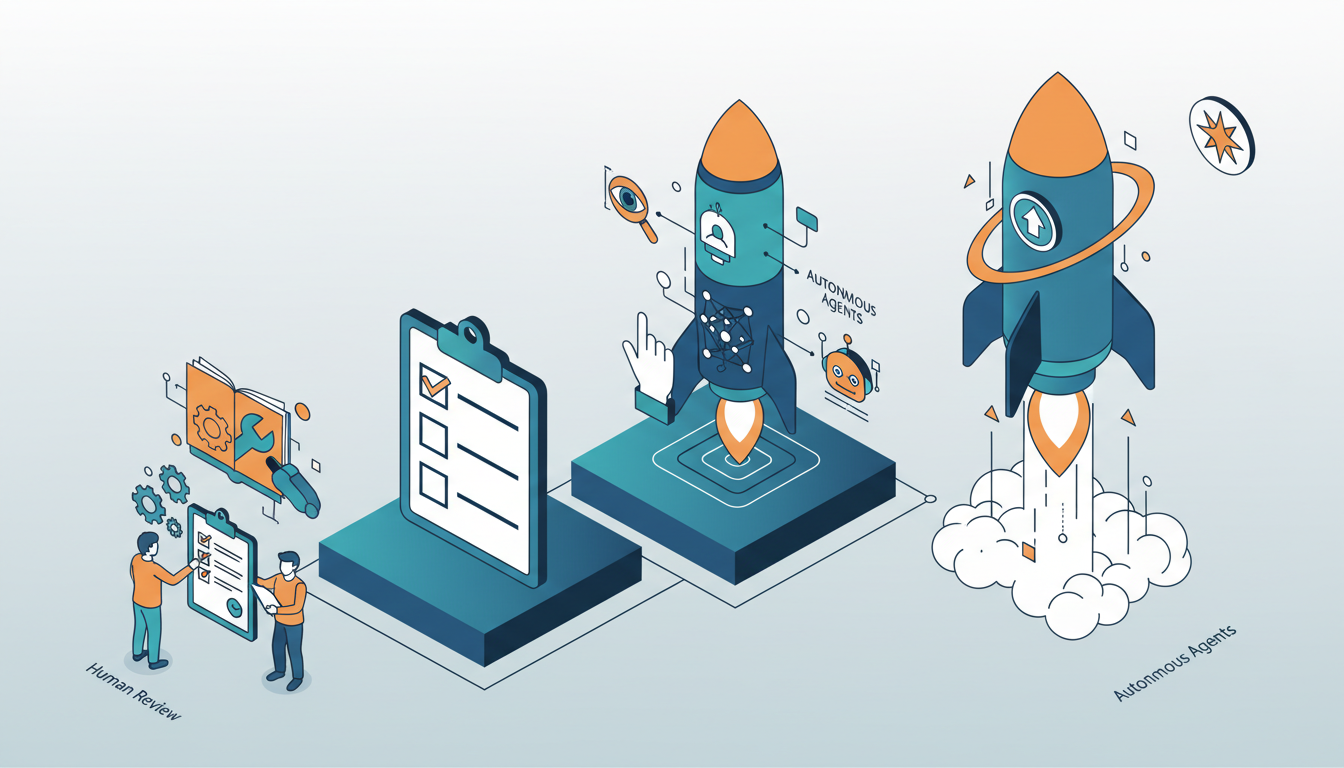
Operationalizing agents demands a repeatable sequence set long before any software vendor enters the conversation. Successful teams own the playbook while treating specific technologies as temporary rentals that swap out without breaking the underlying process. This distinction keeps institutional knowledge intact even when underlying models change or providers pivot their pricing structures.
- Design workflows around business problems rather than tool capabilities.
- Start with an expert in the loop to review every generated output.
- Prioritize momentum over perfection by deploying small, functional units first.
Such discipline contrasts sharply with autonomous execution claims found in agentic AI literature, which often overlook the initial trust-building phase required for safe deployment. A common failure mode occurs when organizations skip the manual review stage, assuming that standard integrations automatically guarantee output quality without human verification. The constraint is clear: trust has to be built before autonomy is granted. Teams should configure their initial workflow with human review before attempting full autonomy. Register for the AI for B2B Marketers Summit on June 25 to observe these protocols in action.
Applying Human Review Loops to Scale AI Agents
Start by configuring a strict human-in-the-loop gate where agents generate drafts but cannot publish without explicit approval. This setup addresses the demand from professionals seeking workflow integration training by forcing direct engagement with AI logic rather than passive consumption. The mechanism functions as a serial validation chain: the agent proposes, the expert critiques, and the system logs the delta between output and correction.
- Deploy the agent to handle initial segmentation or drafting tasks.
- Require manual sign-off on every single output before distribution.
- Feed every human edit back into the system instructions to update the baseline.
This approach transforms sporadic corrections into a compounding instructional asset that hardens the playbook against recurring errors. Unlike isolated tool experimentation, this method builds a verifiable trust baseline required for future autonomy. The drawback is significant; teams sacrifice immediate velocity to establish long-term reliability. As the industry shifts toward agentic workflows, the ability to coordinate multi-step processes depends entirely on the quality of these initial human feedback loops. Teams should document corrections to refine instructions. Only after the agent consistently matches expert output should you remove the manual review step. This disciplined progression ensures that autonomy is earned through data, not assumed through hype. Register for the AI for B2B Marketers Summit to see this protocol in action.
Checklist for Transitioning AI from Content Creation to Core Operations
Verify operational maturity by confirming AI drives decisions rather than just drafting text. True integration requires shifting focus from isolated experiments to unified workflow architecture.
- Map business problems before selecting any specific software vendor.
- Implement expert review gates for every automated output initially.
- Codify corrections into static instructions to compound knowledge.
| Phase | Focus | Asset Type |
|---|---|---|
| Creation | Tool capabilities | Rented tech |
| Operations | Business process | Owned playbook |
A common failure mode involves automating the draft while manualizing the handoff, creating fragile bottlenecks that scale errors. Teams should treat playbooks as permanent assets while viewing models as disposable rentals. This approach ensures that when tools change, the institutional logic remains intact. Teams waiting for perfect autonomy often fail to capture the incremental wins necessary for trust. Start with a human reviewing every line, then earn the right to remove them only after the system consistently predicts their edits. The goal is not speed alone, but the creation of a self-correcting instructional loop that grows more accurate with each iteration.
Measuring ROI and Scaling AI Workflows in Enterprise Environments
Defining the Execution Gap in B2B AI Training Demands
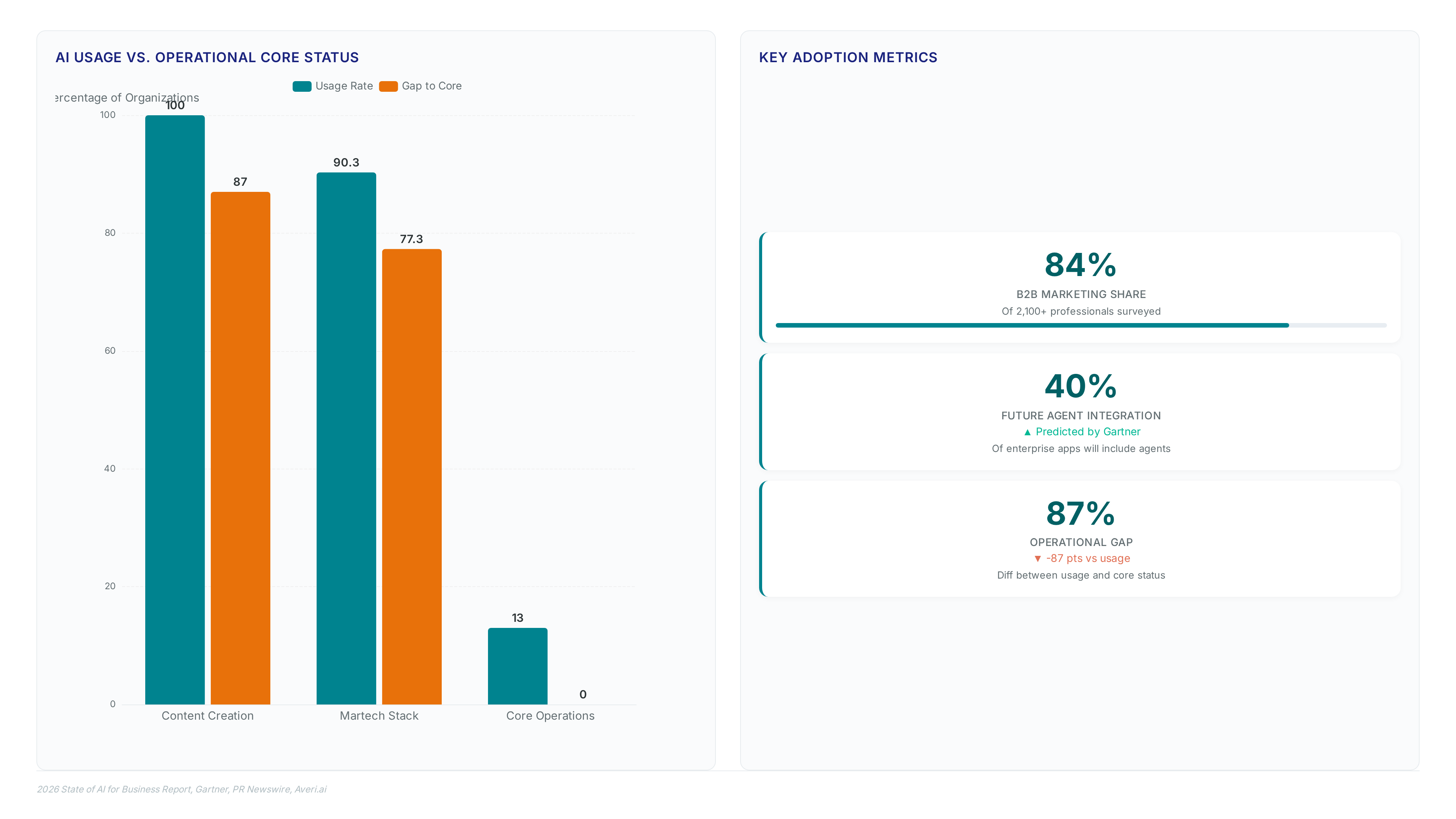
The primary barrier to scaling AI is no longer model access but the inability to embed agents into daily B2B operations. Survey data from the 2026 State of AI for Business Report, which surveyed more than 2,100 business professionals with 84% working at B2B marketing organizations, reveals that while most professionals apply generative tools, the majority lack structured methods for operational deployment. This disconnect defines the execution gap: teams possess high-performing models but lack the workflow integration skills to make them reliable. Consequently, organizations face a paradox where individual productivity increases while systemic output remains fragmented.
| Barrier Type | Symptom | Root Cause |
|---|---|---|
| Technical | Data silos prevent agent action | Lack of centralized access |
| Operational | Manual review bottlenecks | Missing expert-in-the-loop protocols |
| Strategic | Isolated experiments | Absence of owned playbooks |
Without clear paths to embed AI, teams struggle to move beyond isolated experiments. A critical tension exists between the desire for autonomous agents and the reality of siloed data architectures that cannot support them. Enterprises must shift focus from tool experimentation to building playbooks where workflows are designed around business problems. Teams should design from business processes rather than tool capabilities, ensuring the playbook remains the owned asset while tools are treated as rentals. The immediate next step is identifying the smallest useful playbook to get working, allowing momentum to drive progress. The mechanism involves defining explicit handoff points where an expert in the loop validates output before system propagation. Automating too early locks in errors, whereas excessive manual review stifles the momentum needed for scale. Teams must treat the playbook as a permanent asset while viewing specific technologies as temporary rentals.
| Phase | Action | Outcome |
|---|---|---|
| Design | Map business problems before tool selection | Clear workflow architecture |
| Deploy | Run agent with full human review | Validated output logs |
| Refine | Feed corrections back to instructions | Reduced error rates |
Skipping this structure creates fragile automation that breaks when models update. Teams should build the simplest version where AI handles what it can and a human reviews everything. You earn autonomy by progressively removing reviewers only after the system instructions prove reliable. This disciplined path converts experimental usage into core operational capacity, ensuring trust is built before autonomy is granted.
Application: Risk of Scaling Unverified Agents Without Human Review Loops
Rapid integration of unverified AI agent implementation creates operational fragility when standard stacks lack human oversight protocols. The mechanism fails because teams that wait for the perfect system never build anything, yet rushing without validation gates leads to compounding errors. A key limitation is that early pilot phases often lack the iterative refinement required for scale, leaving workflow automation vulnerable to drift. Consequently, organizations risk amplifying minor prompt errors into larger incidents before detection. Teams must treat the playbook as the permanent asset while viewing tools as temporary rentals. Teams should start by building the simplest version with human review, using corrections to refine instructions before attempting full automation.
About
Sofia Marchetti is a B2B Content Strategist with 12 years of experience driving demand generation in SaaS. Her expertise lies in bridging the gap between automated content systems and tangible revenue outcomes, making her uniquely qualified to address the integration of AI agents into marketing workflows. While many practitioners chase novel tools, Sofia's daily work focuses on pipeline architecture and topical authority, ensuring that automation serves strategic business goals rather than generating volume alone. At Enterium, a publication dedicated to vendor-neutral content automation, she applies this rigorous, data-driven approach to dissect how teams can effectively deploy AI agents without compromising quality. By grounding AI agent adoption in real-world funnel metrics and governance, Sofia provides the concrete framework necessary for modern content teams to scale responsibly.
Conclusion
Scaling autonomous agents without verified handoff protocols creates a fragile operational layer where minor prompt drift amplifies into systemic brand failures. The real cost emerges not from the initial deployment but from the compounding effort required to untangle unverified outputs that have already propagated across channels. Organizations must recognize that trust is an engineered output, not a default setting of the underlying model. You should implement a strict "human-in-the-loop" mandate for all agent actions involving external communication until error rates stabilize below acceptable thresholds over a sustained thirty-day period. This approach treats the instruction playbook as your primary infrastructure while viewing specific agent versions as temporary components.
Do not attempt to remove human reviewers until the system demonstrates consistent reliability through documented correction logs. The industry shift toward coordinated agentic workflows demands this discipline because interconnected agents can cascade errors quicker than any single team can manually correct them. Start this week by mapping one existing multi-step marketing process and inserting a mandatory human validation gate at the final output stage before any public release. This single control point provides the data necessary to refine instructions safely. By anchoring your strategy in verified execution rather than theoretical speed, you convert experimental fragility into durable operational capacity.
Without expert-reviewed processes and human oversight, organizations fear deploying unverified outputs that could damage their brand integrity.
Q: What specific training do most marketing professionals currently need most?
A: Research shows 58% of professionals request training on integrating AI into existing workflows. Teams must shift focus from learning new models to designing event-driven workflows that solve specific business problems effectively.
Q: How should teams structure human oversight when starting with AI agents?
A: You must start with an expert in the loop to review every output before granting autonomy. This approach builds trust progressively, ensuring 51% of seekers gain the practical guidance needed for safe agent deployment.
Q: What adoption rate do experts predict for task-specific AI agents soon?
A: Gartner projects that 40% of enterprise applications will soon include task-specific AI agents. Organizations must own their strategic playbooks now, treating software as a rental asset to survive future vendor changes.
Frequently Asked Questions
Only 13% of leaders treat AI agents as core operations despite universal tool usage. This gap exists because teams lack structured playbooks to govern agent behavior and ensure safe, scalable workflow integration.
A significant 60% of marketing leaders cite brand safety and quality control as primary blockers. Without expert-reviewed processes and human oversight, organizations fear deploying unverified outputs that could damage their brand integrity.
Research shows 58% of professionals request training on integrating AI into existing workflows. Teams must shift focus from learning new models to designing event-driven workflows that solve specific business problems effectively.
You must start with an expert in the loop to review every output before granting autonomy. This approach builds trust progressively, ensuring 51% of seekers gain the practical guidance needed for safe agent deployment.
Gartner projects that 40% of enterprise applications will soon include task-specific AI agents. Organizations must own their strategic playbooks now, treating software as a rental asset to survive future vendor changes.