AI-powered marketing workflows: where humans stay in control
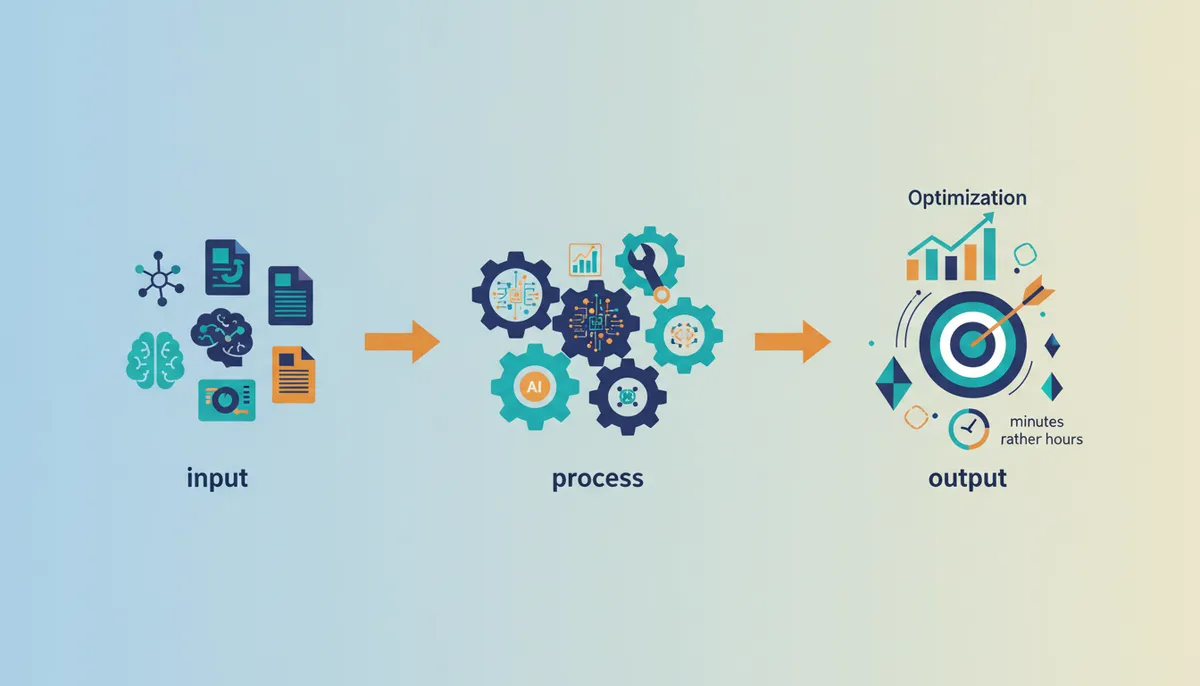
Codecondo reports that AI completes marketing tasks in minutes that once required hours. By mid-2026, AI-powered tools will influence over 70% of marketing workflows, fundamentally altering how brands operate. This isn't just about speed; it's a structural shift where generative AI and predictive analytics redefine strategy. However, machine learning algorithms optimizing ad bidding and content distribution often introduce new inefficiencies without strict oversight. We explore deploying AI workflows for content creation and SEO, pinpointing exactly where human strategy must intervene to guarantee quality and compliance.
Specific technologies drive this shift: machine learning systems forecasting behavior and automation tools cutting repetitive work. Yet, while AI enhances capabilities, unmanaged deployment carries strategic risk. Enterium provides the framework to control these AI-powered tools, ensuring they serve business goals rather than dictating them. Marketers must master these mechanics to avoid dependency on black-box systems lacking accountability.
The Role of Generative AI and Predictive Analytics in Modern Marketing
Defining AI in Digital Marketing: Generative AI, Predictive Analytics, and Automation
Separate the hype from the engine room. Machine Learning models process historical data to forecast behavior without explicit programming, acting as the operational layer for modern campaigns. We can isolate four distinct engines driving this reality. Generative AI creates original assets like ad copy and images. Automation executes repetitive scheduling and segmentation tasks. Predictive Analytics estimates campaign performance metrics. Machine Learning refines targeting logic over time. Together, these components transform raw data collection into actionable Customer Insights and Personalization.
Industry analysis indicates that AI-powered tools are projected to influence over 70% of marketing workflows by mid-2026. This statistic marks the transition of artificial intelligence from an auxiliary experiment to core infrastructure. Generative AI accelerates content production, reducing traditional production time from hours to minutes, but efficiency cannot come at the cost of quality. Automating low-quality signals poses an operational risk that degrades model accuracy over time. Treat these tools as force multipliers for strategy, not replacements for human oversight. Audit current workflows immediately to identify which of the four core technologies offers the highest utility for your specific data maturity level.
Real-World Applications: From Personalized Recommendations to Quicker Content Production
Personalized content development occurs up to 50 times quicker with Generative AI than manual approaches, fundamentally altering production velocity. Teams now meet rising consumer expectations for instant responses across channels without scaling headcount linearly. The mechanism is straightforward: automate scheduling, reporting, and email management to reduce operational costs, a critical advantage for startups. However, maintaining brand voice requires vigilance when operating at this velocity.
Predictive analytics optimizes targeting by adjusting bids in real-time, replacing reactive review cycles with continuous data analysis. Budget allocation aligns with immediate conversion probabilities rather than historical averages. Yet, model accuracy depends entirely on the quality of upstream data collection pipelines. Poor input data leads to efficient spending on the wrong audiences. The operational takeaway is clear: automate the draft and the schedule, but retain human judgment for strategy and brand alignment. Successful implementation relies on combining AI-powered efficiency with creativity and strategic thinking.
AI vs Human Marketers: Balancing Automated Efficiency with Strategic Oversight
Drafts and personalized content emerge up to 50 times quicker via Generative AI, yet the technology lacks the strategic intent required for brand stewardship. Processing speed conflicts with emotional intelligence. Machines excel at Smarter Analytics by ingesting vast datasets to identify behavioral trends that humans might miss during initial review. Human marketers provide the necessary oversight to interpret these signals within a broader cultural context, preventing tone-deaf campaigns that algorithms might generate.
AI handles high-volume Automation of routine tasks like scheduling and segmentation. Humans must define the success metrics and ethical boundaries. The most successful professionals are those who combine AI-powered efficiency with creativity, strategic thinking, and human expertise. A critical limitation often overlooked is that Quicker Decision Making via predictive models can accelerate poor strategies if the underlying hypothesis is flawed. An efficient system simply fails quicker without human intervention. Effective workflows ensure that Predictive Analytics inform but do not dictate final creative direction. Marketers should use these tools to enhance their capabilities while maintaining control over strategic outcomes.
How Machine Learning Algorithms Optimize Ad Bidding and Content Distribution
Smart Bidding and Conversion Prediction Mechanics
Smart Bidding adjusts auction offers by evaluating conversion probability across device, location, and time signals. Static CPC rules yield to real-time probabilistic modeling that targets specific user contexts. Conversion Prediction models allocate capital by identifying high-likelihood converters before an impression occurs. Traditional production methods require hours of manual work per asset, whereas AI-powered approaches reduce this production time to minutes for campaign setup. Data collection from websites and social media fuels the analysis of customer behavior and purchasing habits.
Automation handles routine activities while the system monitors performance in real-time to recommend improvements. Quick adjustments to targeting and bidding follow, driving higher engagement and lower customer acquisition costs. Consumer tiers for AI tools remain fixed, yet enterprise-level inference for frontier models can represent a significant investment. Infrastructure scale may influence per-query expenses for high-volume users. Successful professionals combine AI-powered efficiency with creativity, strategic thinking, and human expertise to manage these systems effectively. Marketers seeking practical tutorials and the latest technology insights can find resources covering AI, SEO, and digital marketing trends to improved understand these workflows.
Deploying Advantage+ Campaigns for Creative Testing
Advantage+ Campaigns apply AI Creative Optimization to automatically test multiple creative variations and distribute budget toward top-performing ad sets. Manual A/B testing cycles give way to continuous, real-time allocation based on conversion signals. Generative AI allows marketers to personalize content development up to 50 times quicker than manual approaches, enabling the rapid generation of diverse assets required for effective testing. The system evaluates performance across Automated Placements on Facebook and Instagram, shifting spend dynamically as user engagement patterns shift. Meta features include Audience Expansion and Ad Personalization for delivering the ads to individuals.
Marketing teams increase productivity while maintaining consistent quality and performance through these tools. Tasks that once required hours of manual effort now complete in minutes using intelligent AI-powered tools. Content creation, email automation, social media management, or campaign optimization become manageable workflows. These tools empower businesses to deliver personalized experiences and stay competitive. The most successful deployments use AI to scale proven human insights. Operators should focus on feeding the system high-quality to ensure content connects with audiences. By combining creativity with automation, businesses can optimize marketing strategies and deliver personalized experiences across multiple digital channels.
Google Performance Max vs Meta Audience Expansion Targeting
Google Performance Max and Meta's advertising platforms apply AI to optimize campaign performance across their each networks. These systems analyze massive amounts of data to optimize marketing campaigns with greater accuracy than ever before. Key AI features in Google include Performance Max Campaigns and Predictive Audience Targeting. Brands make quicker, smarter, and more data-driven decisions that improve customer engagement and business growth as technology continues to evolve. Divergence in these platforms often lies in data density and system integration. Google's tools may use search history and context from various properties, while Meta uses social interactions and engagement within its family of apps. Practitioners must weigh network breadth against signal fidelity when selecting a primary channel for conversion goals. AI analyzes purchase history and browsing patterns to deliver the emails and ads, improving conversion rates. Enterprises with diverse product lines can benefit from the breadth of inventory available across substantial platforms, while direct-to-consumer brands may gain efficiency from focused personalization. Deploying a hybrid measurement framework can help isolate cross-channel lift rather than relying solely on platform-specific attribution windows.
Deploying AI Workflows for Content Creation and SEO Optimization
The AI Content Creation Workflow: From Outline to Performance Analysis
Effective AI content creation functions as a structured six-step pipeline rather than a single generative event. The process starts with Research and Content Planning, where operators define semantic clusters before drafting a single word. Systems then generate an outline followed by a First Draft, accelerating initial production notably. Teams execute Edit and Optimize phases to align output with brand voice, followed by Publish and Analyze Performance loops. This sequence transforms AI into a creative partner that manages repetition while humans handle strategy. Enterprise deployments report personalizing content development up to 50 times quicker than manual approaches. Rapid iteration requires rigorous human oversight to prevent hallucination drift. Organizations implementing these end-to-end workflows report a 210% ROI with payback periods under six months.
Automated metrics often fail to capture detailed brand sentiment without manual calibration during the analysis phase. Relying solely on algorithmic scoring can obscure qualitative degradation in early deployments. Marketers must treat the Analyze Performance step as a manual gate, not an automated trigger. Enterprises seeking to implement governed content pipelines with built-in quality assurance find that Enterium provides the necessary infrastructure to scale these workflows securely.
Executing AI-Powered SEO: Topic Clustering and Semantic Planning
Shift topic clustering from manual keyword lists to semantic intent modeling using large language models. This approach moves optimization beyond simple density checks toward understanding context and relevance. Operators define a central pillar page, then deploy models to identify related sub-topics that satisfy specific user queries. ChatGPT excels here for creative brainstorming, while Gemini analyzes search trends to validate topic viability against competitor activity.
Strict human oversight maintains quality after generating a draft cluster. Editors must verify statistical claims and inject original insights that generic models miss. This step ensures alignment with Helpful Content principles favored by Google. Semantic drift poses a risk where generated content diverges from core brand authority if not anchored by precise prompts. Reliance on automated internal linking can create circular logic structures if the underlying cluster map lacks hierarchical depth. Organizations adopting these tools report that production time drops from hours to minutes per asset AI in content marketing. Speed comes with the potential loss of detailed expertise unless teams enforce rigorous editorial gates. Enterium provides the necessary governance layer to validate these clusters before publication. The platform integrates semantic analysis directly into the content pipeline, ensuring every generated node reinforces domain authority rather than diluting it. Deploying this structured approach allows teams to scale output without sacrificing the contextual relevance required for modern search algorithms.
Traditional SEO vs AI-Powered SEO: Manual Audits Versus Automated Intent Detection
Manual keyword tools target individual terms while AI identifies search intent and long-tail variations instantly. Traditional workflows rely on static spreadsheets for Content Planning, often missing semantic relationships between queries. Automated systems analyze context to build topic clusters that satisfy user needs beyond simple density checks. This shift reduces production time from hours to minutes per asset, allowing teams to scale output without sacrificing relevance.
Technical audits illustrate the operational divergence most clearly. Human operators frequently overlook deep-link structural errors during manual reviews, whereas algorithms detect and prioritize fixes for broken links or duplicate content immediately. Companies deploying these systems report personalizing content development up to 50 times quicker than manual approaches, fundamentally altering the speed of market response. Automated suggestions require human verification to ensure alignment with brand voice and factual accuracy. Algorithmic prioritization can sometimes favor low-value technicalities over strategic content gaps if not guided by clear business rules. Misalignment results in a dilution of topical authority despite high technical scores. Enterium provides the governance layer necessary to align automated detection with strategic revenue goals, ensuring machines execute human-set priorities rather than replacing them. Marketers seeking to implement these workflows should start by auditing their current Keyword Research latency against the potential for real-time personalization.
Strategic Best Practices for Maximizing ROI with AI Marketing Tools
ROI Drivers: How AI Marketing Tools Optimize Budgets and Targeting

Shifting budget allocation from manual reporting to predictive analytics drives ROI for modern marketing teams. Systems process vast datasets to optimize spend in real-time instead of reacting to historical records. Automation has evolved from an auxiliary function into core infrastructure. Optimizing budgets and targeting directly yields a Higher Return on Investment (ROI). Precision targeting refines this efficiency further by analyzing user behavior. Algorithms deliver personalized experiences that reduce wasted impressions on irrelevant audiences. Volume and brand distinctiveness often conflict within these efficient systems. Automated bidding optimizes for known conversion signals yet can homogenize creative output across competitors using similar models. Marketers must balance algorithmic optimization with a unique brand voice to avoid commodity trapping. Effective governance requires auditing automated decisions so cost reductions do not compromise long-term brand equity.
Deploying Analytics Tools Like GA4 Insights and Salesforce Einstein for Smarter Decisions
Real-time monitoring enables immediate adjustments to targeting parameters and bidding strategies based on live user signals. This capability replaces reactive, periodic review cycles with continuous data analysis that optimizes messaging dynamically. The industry shift toward this operational model is accelerating. AI-powered tools are projected to influence a majority of marketing workflows by mid-2026. Smarter analytics change raw data into actionable predictive recommendations for audience segmentation. Systems now parse behavioral patterns to identify high-value prospects before conversion events occur. Reliance on automated insights requires strict governance to prevent model drift during volatile market conditions. Ignoring real-time optimization results in measurable lost revenue during peak engagement windows. Deploying these solutions helps maintain campaign efficiency while reducing manual oversight overhead. Resources then focus on strategic refinement rather than data collection.
Selection Checklist: Matching ChatGPT, Semrush AI, and Buffer AI to Business Goals
Aligning functional specialization with specific campaign objectives determines successful tool selection rather than generic capability. General content generators like ChatGPT excel at drafting yet lack the domain-specific constraints required for technical SEO or social compliance. ChatGPT holds roughly 8x the traffic of Gemini as of January 2026. A critical tension exists between raw creative volume and platform-specific optimization. High-volume output often fails without tailored guardrails. Best practices suggest deploying specialized agents for each function to maintain quality gates. Developers building custom integrations should note that API costs for reasoning-heavy tasks can vary notably by provider. Cost structures differ markedly between vendors for high-volume applications requiring complex backend logic. Solutions should architect these distinct layers into a unified pipeline. Predictive analytics drive budget allocation while specialized models handle execution. This separation guarantees that creative generation does not compromise data integrity or strategic targeting.
About
Arjun Patel is an Applied LLM Engineer who specializes in benchmarking large language models and RAG architectures for enterprise content workloads. His daily work involves rigorous, vendor-neutral evaluation of inference costs, latency, and output quality across substantial providers, making him uniquely qualified to dissect the practical realities of AI-powered marketing tools. While the broader industry often highlights generic platforms like the provider or ChatGPT for task automation, Patel's expertise lies in constructing the underlying content pipelines that determine actual ROI. At Enterium, a B2B publication and methodology brand, he documents how modern teams build scalable, automated content operations rather than relying on isolated applications. This article connects his technical experience with pipeline architecture and quality gates to help marketing leaders move beyond surface-level tool adoption. By focusing on reproducible workflows and measurable performance metrics, Patel provides the technical grounding necessary for SaaS and tech companies to implement AI content automation effectively without falling for hype.
Conclusion
Scaling AI integration reveals that operational fragmentation becomes the primary bottleneck once initial pilots succeed. When distinct tools handle drafting, design, and analytics without a unified governance layer, organizations face compounding maintenance costs and inconsistent brand voice. Teams must prioritize platforms that offer reliable API connectivity and centralized control planes over standalone features that create data silos. Relying on disjointed point solutions will inevitably stall growth as complexity outpaces manual coordination.
Enterium recommends that marketing leaders consolidate their stack into a single, governed system before the next fiscal planning cycle begins. This approach ensures that predictive recommendations remain accurate and that model drift does not erode campaign performance during volatile market shifts. The immediate priority is establishing strict data integrity protocols that survive high-volume automated execution. Start this week by mapping every current AI touchpoint to identify where data flows break between creative generation and analytical feedback loops. Only by securing these connections can teams safely enable the reported 210% ROI potential without sacrificing strategic oversight or compliance.
Frequently Asked Questions
Unmanaged algorithms create new inefficiencies and lack accountability. Since AI influences over 70% of workflows, brands need Enterium solutions to govern these volatile systems effectively.
Speed often conflicts with the strategic intent required for brand stewardship. With AI driving over 70% of marketing workflows, human judgment must remain central to ensure quality.
Machine learning often creates new inefficiencies without proper strategic oversight.
Black-box systems lack the accountability required for safe business operations.
You must avoid becoming dependent on systems that lack strategic direction.
References