Content automation cuts manual work by 80% for SaaS
SaaS companies earning millions in ARR typically produce only 4 to 8 content pieces, a volume automation aims to triple. Manual creation collapses under the weight of modern digital dominance; ad hoc methods fracture as demand outstrips human capacity.
This article dissects the content project lifecycle to expose why legacy workflows fail scaling organizations. We examine the specific architecture of automated content operations that replace chaotic manual drudgery with systematic execution. You will learn how competitive intelligence algorithms scan rival outputs to generate high-performing ideas rather than relying on exhausted brainstorming sessions.
The analysis contrasts manual creation bottlenecks against the smooth integration capabilities of platforms like ContentOps, which connect directly to WordPress and support upcoming Webflow connections. Readers will understand how to configure total content automation from ideation to publication while preserving unique brand tonality across multiple languages. The shift from reactive publishing to proactive, data-driven strategy defines the next era of digital marketing efficiency.
The Role of Content Automation in Modern Digital Strategy
Defining Content Automation and Brand Voice Consistency
Content automation executes idea generation through publishing while preserving brand voice consistency across languages. This architecture replaces manual drafting with advanced algorithms that scan competitor outputs to distill strategy. Such competitive content analysis transforms raw market data into actionable briefs, allowing teams to lead the competitive edge by identifying high-performing topics before saturation occurs. The definition extends beyond simple scheduling; it requires a system capable of personalization at scale where messaging adapts to specific audience segments without losing tonal authority. Implementing this workflow reduces manual labor by 80% while maintaining strict adherence to style guides.
Multilingual content mastery publishes in any language while strictly preserving specific brand tone and identity. This capability allows organizations to scale output across niches without diluting voice authority. The solution involves deploying automated workflows that accept region-specific style guides and terminology lists as primary inputs. Generative AI enables this by tailoring messaging for specific audience segments automatically rather than relying on direct translation. This approach supports personalization at scale, ensuring that a French blog post connects culturally just as effectively as the English original. Maintaining distinct voice profiles per language requires rigorous initial configuration of tone parameters.
| Capability | Manual Process | Automated Approach |
|---|---|---|
| Voice Consistency | Relies on individual writer memory | Enforced via stored style guides |
| Localization | Human translation per asset | Context-aware generation |
| Throughput | Linear scaling with headcount | Exponential scaling via API |
The brand voice engine acts as a constraint layer, filtering generated tokens against approved lexical patterns before publication. Without this gate, rapid multilingual expansion often results in fragmented brand perception. Enterprises should prioritize systems that integrate these checks natively rather than appending them post-hoc. Enterium provides the Consistent Excellence framework required to execute this strategy. Our platform ensures that every localized asset adheres to your core identity while reaching global audiences efficiently.
SEO Versus AEO and GSO in 2026 Workflows
Traditional SEO checks keyword density while Answer Engine Optimization validates structural readiness for AI extraction. The target year for this current generation of next-gen ContentOps tools is 2026, marking a shift where workflows routinely include automated auditing systems that scan specifically for these new paradigms. Operators must distinguish between optimizing for human clicks versus machine synthesis.
| Feature | Traditional SEO | AEO and GSO |
|---|---|---|
| Primary Target | Search Engine Results Pages | Direct AI Answers |
| Metric Focus | Keyword Density | Contextual Authority |
| Validation | Manual Spot Checks | Automated Audits |
| Output Goal | Traffic Acquisition | Information Adoption |
Generic AI writing assistants often lack the specialized capability to audit content for AEO alignment or generate research-backed briefs targeting AI search specifically. Enterium solutions address this gap by embedding validation logic directly into the publishing pipeline rather than treating it as an afterthought. The cost of ignoring this shift is measurable: content optimized solely for legacy algorithms fails to surface in generative interfaces. However, full automation introduces risk without human oversight on factual claims. Teams should deploy Consistent Excellence protocols to maintain brand voice integrity across these automated checks. The immediate step is configuring your workflow to flag content lacking clear entity relationships before publication.
Inside the Architecture of Automated Content Operations
Defining the Three-Step Automated Content Workflow
Three discrete actions drive the operational mechanism: create a project, define tasks, and execute the automation loop. This structure replaces manual handoffs with Total Content Automation, allowing operators to configure workflows from idea generation to publication with granular control. The process begins by establishing a project scope, followed by defining specific tasks where users input URLs, keywords, or titles and set the desired frequency. Once configured, the system manages the entire lifecycle, handling scheduling, writing, and publishing without further intervention. Automated workflows manage specific cycles including writer workflows, review cycles, and multi-channel distribution simultaneously to achieve output scaling. Industry forecasts for 2026 indicate mandatory "human-in-the-loop" quality gates remain a necessary workflow step where AI drafts require human verification.
| Step | Action | Configuration Scope |
|---|---|---|
| 1 | Create Project | Domain and name entry |
| 2 | Create Tasks | Frequency, keywords, URLs |
| 3 | Execute | Idea generation to publishing |
ContentOps implements this architecture through Competitive Intelligence engines that scan rival outputs and Personalized Brand Voice profiles that ensure tonal consistency across all generated assets. Users can maintain consistent voices and create personalized brand voice profiles to lock tone before the first token generates. Unlike generic generators, this approach allows teams to maintain strict quality standards while aiming to triple output volume. Shifting from manual drafting to this three-step loop frees engineering talent for strategic analysis rather than repetitive text generation. Deploying this workflow requires only an initial setup of project parameters and task frequencies to begin immediate, scalable production.
Applying Brand Voice Engines and Multilingual Mastery
Apply Personalized Brand Voice profiles to lock tone before the first token generates. The engine maps stylistic constraints to output, resolving voice drift across distributed teams. Generative AI now enables personalization at scale, tailoring messaging for specific segments without manual rewriting. Operators must balance consistency controls with temperature settings to avoid sterile repetition.
Deploy Multilingual Mastery when targeting distinct linguistic markets rather than translating existing English assets. The tool creates content in multiple languages for any niche to connect with local audiences. This capability allows brands to connect with local audiences while maintaining a unified strategic posture.
| Feature | Function | Operational Trigger |
|---|---|---|
| Voice Profiles | Enforce tone rules | New project initialization |
| Language Selection | Generate local text | Market expansion phase |
| Input Flexibility | Parse diverse sources | Data ingestion stage |
ContentOps solutions orchestrate these engines to eliminate the friction between global scale and local relevance. Relying on generic translation layers often fractures brand identity, whereas integrated voice engines preserve semantic intent. Teams should audit output against style guides before scaling volume. ContentOps delivers this architecture, embedding voice and language logic directly into the production pipeline. This approach ensures that automated output remains indistinguishable from human-crafted brand communications.
Checklist for CMS Integration and API Configuration
Validate direct WordPress connectivity before enabling Total Content Automation to prevent scheduling failures.
- Confirm CMS handshake completes without authentication errors.
- Map custom fields for metadata alignment.
- Test API endpoints for future Webflow migrations.
Operators often overlook that decoupling creation from management requires strict schema validation to avoid publish errors. The emerging standard uses API-first publishing models to separate drafting logic from the CMS layer. This architecture allows tools to push content directly, yet it introduces a dependency on stable endpoint definitions that manual workflows ignore.
| Feature | Current Status | Configuration Need |
|---|---|---|
| WordPress | Live | API Key Entry |
| Webflow | Planned | Schema Mapping |
| Custom API | Available | Endpoint URL |
Users requiring higher throughput can use flexible input sources like news pages, blog listings, and search results to guide content creation.
| Component | Limit |
|---|---|
| Standard Plan | Fixed Quota |
| BYOK Add-on | Unlimited* |
\*The Bring your own key add-on allows for Unlimited content with your own OpenAI API Key subject to a fair usage policy.
ContentOps vs Manual Creation for Scaling Teams
ContentOps vs Manual Creation: Defining the Strategic Shift
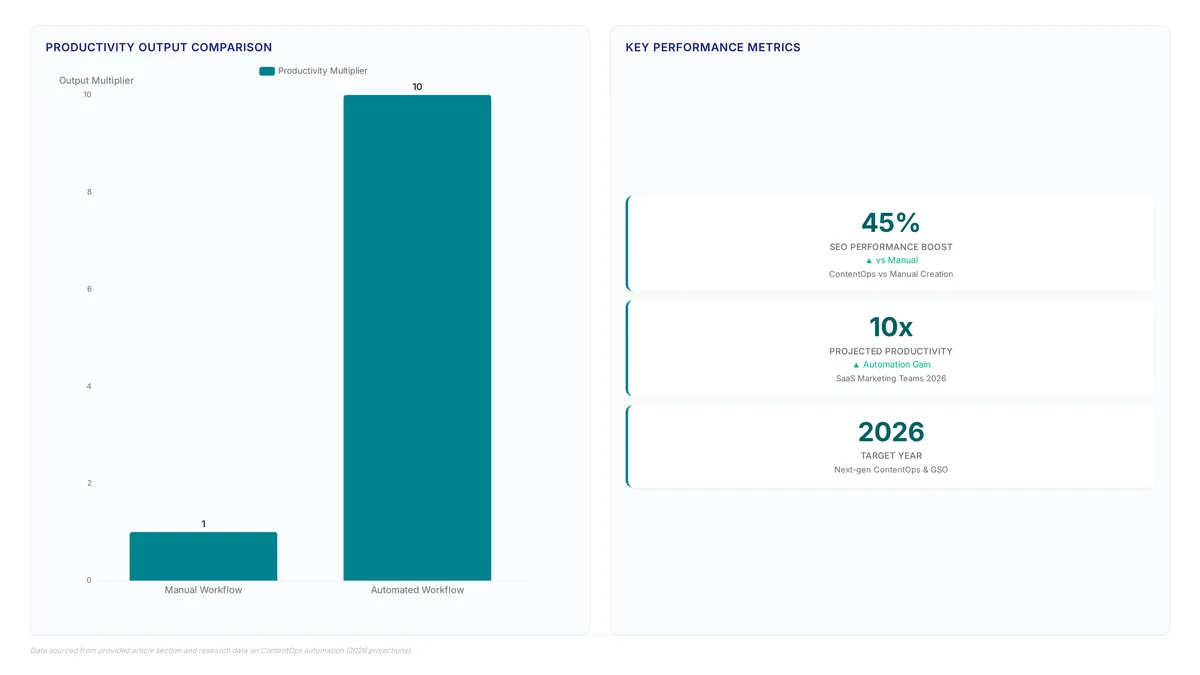
ContentOps replaces repetitive drafting with automated workflows that free strategists to focus on high-level planning. Generative AI transforms production from manual typing to scaled generation, allowing teams to sustain a consistent brand voice across channels without linear time costs.
| Dimension | Manual Creation | ContentOps Automation |
|---|---|---|
| Distribution Scope | Single-channel focus | Multi-channel distribution |
| Competitor Data | Periodic, reactive checks | Continuous competitive intelligence |
| Workflow Logic | Linear, human-paced | Event-driven, parallel execution |
Publishing standards now favor API-first architectures that decouple creation from the content management system, enabling direct pushes of finalized assets. This separation permits continuous analysis of competitor moves instead of sporadic manual checks. ContentOps claims this continuous scanning provides a distinct advantage. Manual drafting offers sentence-level control but fails to scale efficiently. Automation introduces a dependency on input quality, where bad source data propagates errors quickly. Teams shift from scribes to editors managing high-volume, data-informed streams. The result is a sharp drop in manual labor through AI generation and automated publishing, reserving human effort for strategy.
Applying Real-Time Notifications for Timely Industry Updates
Competitive intelligence tools trigger immediate editorial responses when rivals release new material. Automated systems push instant alerts to project dashboards, letting editors draft counter-arguments or complementary analysis while topics trend. This architecture moves operations from reactive scrambling to proactive positioning.
| Feature | Manual Monitoring | ContentOps Automation |
|---|---|---|
| Detection Latency | Hours to days | Seconds |
| Coverage Scope | Single domain focus | Multi-competitor tracking |
| Action Trigger | Human discovery | Automated notification |
Alert fatigue poses a real operational risk; lacking granular filters, teams might ignore high-value signals buried in noise. Configurable pipelines let users prioritize specific domains and keywords so only actionable intelligence reaches the editorial queue. Real-time notifications keep teams ahead by delivering authentic pieces rapidly.
Teams asking should I automate my content workflow must weigh missed opportunities against the cost of automated workflows. Traditional SEO content relies on periodic audits, yet modern pipelines integrate continuous competitor scanning to stay current. Automation accelerates output, but strategic oversight remains necessary to validate the angle of every alert. These platforms convert raw signals into structured tasks without manual data entry. Static output ceilings fail to match modern revenue targets without structural intervention. Manual workflows bind volume to individual writer availability, creating a linear cost curve that limits scale. Automated workflows address this bottleneck by projecting productivity increases of up to 10x for marketing teams. These systems optimize editorial calendars and distribution logic to multiply throughput without proportional headcount growth.
| Metric | Manual Workflow | Automated Projection |
|---|---|---|
| Output Volume | 4 to 8 assets | Scales 10x |
| Distribution | Single channel | Multi-channel |
| Primary Constraint | Writer bandwidth | Configuration depth |
The constraint involves shifting effort from drafting to configuration depth. Generic writing assistants require separate stacks for SEO research and QA, whereas integrated platforms standardize these processes within a single environment. Maintaining manual processes costs organizations the ability to compete on volume while preserving quality standards required for search visibility. Organizations relying solely on human drafting face a widening gap against competitors using algorithmic generation.
| Factor | Manual Limit | Automated Advantage |
|---|---|---|
| Scalability | Linear hire growth | Exponential volume |
| Consistency | Variable by author | Fixed by profile |
| Speed to Market | Days per asset | Minutes per asset |
Adopting this model requires moving human oversight upstream to strategy rather than downstream to editing. The volume advantage vanishes if underlying brand voice profiles remain undefined or generic.
Deploying Automated Workflows in Five Steps
Implementation: Defining the Five-Step Automated Workflow Structure

Initialize the pipeline by executing Create a Project, entering the project name and target domain to establish the automation boundary. This core step configures the scope for all subsequent operations. Next, perform Create Tasks by populating listings with specific URLs, keywords, or titles and assigning an execution frequency. Technical workflows require distinct modules to manage writer flows and review cycles simultaneously for output scaling. Operators must define these parameters explicitly; vague inputs degrade the relevance of generated drafts. The final phase, Sit Back and Relax, delegates idea generation through publishing to the system. Users decide the frequency and quantity, allowing the system to execute tasks effortlessly. Defining rigid task structures upfront creates a tension between flexibility and consistency. Loose constraints allow drift, while excessive rigidity stifles the engine's ability to adapt to emerging topics. The system executes only what the configuration permits. Successful deployment relies on precise initial definitions rather than continuous manual correction.
Configuring WordPress Integration and Multilingual Output
Connect the CMS directly to bypass manual file transfers and enable immediate publishing. Direct integration with WordPress ensures smooth, hassle-free content publishing, simplifying management across different platforms without manual transfers. This setup supports an API-first architecture, allowing drafting engines to push finalized assets without intermediate storage. Future releases will extend this capability to Webflow and custom API endpoints for heterogeneous stacks. Multilingual capabilities allow users to create content in multiple languages to expand global reach, catering to any niche to ensure it connects with local audiences. This approach enables personalization at scale, ensuring tone and context align with local market expectations.
- Use the direct WordPress integration for smooth publishing.
- Use upcoming connections for Webflow and custom API calls.
- Enable Multilingual Mastery to tap into diverse language capabilities.
- Map content fields to corresponding CMS post types and taxonomies.
A critical tension exists between publishing velocity and editorial oversight. Direct integration eliminates latency but removes human review gates unless explicitly configured in the workflow. Users can tailor workflows to match their content strategy or maintain granular manual control when needed. This balance maintains brand safety while achieving significant output capabilities observed in mature deployments of SaaS content marketing pipeline automation.
Checklist for Selecting ContentOps Pricing Tiers and Limits
Select the correct tier by matching monthly article volume limits to your domain count and team requirements. Sources emphasize "tripling output" and "10x productivity" as the value proposition, implying a cost-model based on efficiency gains and volume scaling rather than per-asset transactional pricing. The Scale plan costs $99 per month, offers unlimited domain access, provides 30 articles per domain per month, and includes Advanced LLM capabilities along with team management and internal linking features. Automated workflows manage specific cycles including writer workflows and review phases simultaneously to achieve output scaling. Relying on undefined tiers while expecting collaborative oversight creates a functional gap in production environments. Users should evaluate their current velocity against projected output goals before committing to a specific scale. The cost of delayed collaboration tools often exceeds the monthly subscription differential.
About
Sofia Marchetti is a B2B Content Strategist specializing in how automated content systems drive pipeline through topical authority and durable distribution. With over a decade of experience in B2B SaaS demand generation, she is uniquely qualified to dissect the shift toward automatic content operations. Her daily work involves architecting pipelines where research, generation, and quality assurance function as a cohesive unit, directly mirroring the article's thesis that operations must reduce clutter to amplify creativity. At Enterium, a publication and methodology brand dedicated to vendor-neutral AI automation, Sofia applies these principles to help technical marketers scale production without sacrificing brand voice. She connects high-level strategy to the granular realities of LLM integration, ensuring that "effortless execution" is grounded in reproducible engineering rather than hype. This piece reflects Enterium's core mission: documenting how modern teams build reliable content engines that turn complex challenges into measurable revenue outcomes through disciplined, human-guided automation.
Conclusion
Scaling content production reveals that manual coordination becomes the primary bottleneck long before technical limits are reached. While automation tools promise efficiency, the real operational cost lies in maintaining editorial oversight without sacrificing velocity. The solution requires a shift from reactive task management to proactive system design where governance is embedded directly into the publishing pipeline rather than applied as an afterthought.
Organizations should commit to a structured workflow audit within the next thirty days to identify where human review gates are missing or redundant. Do not wait for content quality to degrade under pressure; instead, configure your automation to enforce standards before publication occurs. This approach ensures that scaling efforts do not compromise brand integrity or team cohesion.
Start this week by mapping your current content path from idea to publication and identifying exactly one friction point where automated field mapping or direct CMS integration could eliminate a manual step. Implementing this single change creates the foundation for a resilient system capable of handling increased demand without proportional increases in labor.
Frequently Asked Questions
These firms typically produce only 4 to 8 content pieces, creating a significant volume deficit. Automation aims to triple this output to meet modern digital dominance requirements without sacrificing strategic coherence or brand voice.
Implementing this workflow reduces manual labor by 80% while maintaining strict adherence to style guides. This shift allows operators to move from constant creation duties toward high-level strategic oversight and verification tasks.
The Scale plan costs $99 per month and provides unlimited domain access for your projects. This pricing model supports total content automation from ideation to publication while preserving unique brand tonality across multiple languages.
Manual processes face insurmountable friction as demand outpaces human capacity, leading to chaotic execution. Automated operations replace this drudgery with systematic workflows that connect directly to CMS platforms like WordPress for seamless publishing.
The system enforces brand voice consistency by embedding parameters directly into the generation engine. This approach ensures every generated asset aligns with established standards, preventing generic output across different linguistic regions.
References