Marketing LLMs: 4 Models Tested for Sales Transcripts
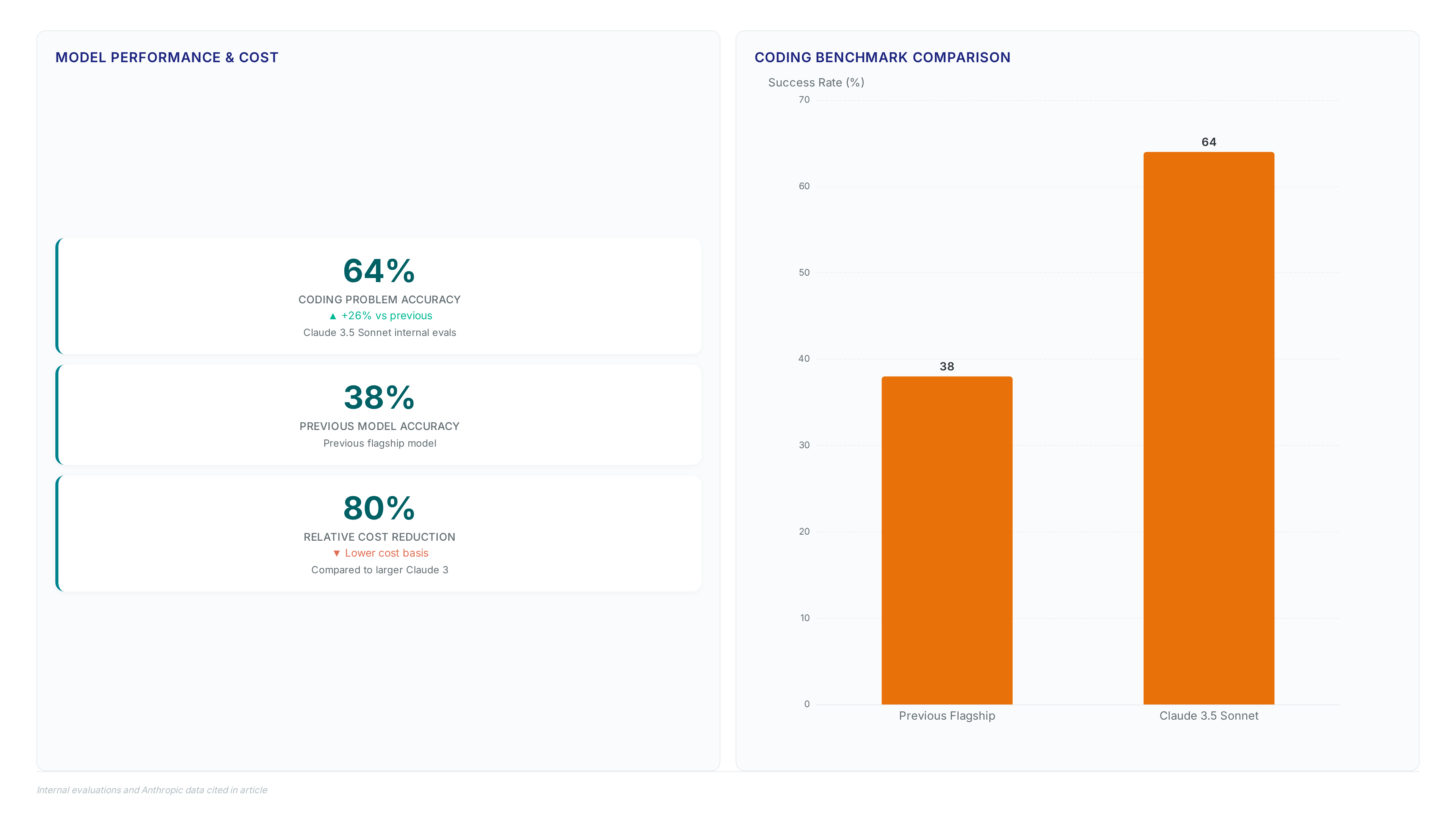
Claude 3.5 Sonnet solved a majority of coding problems in internal agentic evaluations, outpacing its predecessor significantly. This technical edge translates directly to marketing workflows, where large language models now dictate the efficiency of data extraction and strategic planning. The thesis is simple: selecting the right LLM provider depends entirely on the specific marketing task rather than brand loyalty alone.
Marin Software evaluated four leading platforms, including ChatGPT 4.0, Google Gemini 2.0, and Meta Llama, against identical prompts to determine true utility. The analysis reveals that while Claude 3.5 Sonnet excels in deriving detailed insights from sales call transcripts and campaign optimization data, ChatGPT 4.0 dominates keyword intent analysis and content strategy generation. Conversely, the free version of Google Gemini 2.0 showed promise but suffered from occasional inaccuracies, while Meta Llama lagged in advanced capabilities.
This article dissects these performance gaps to help marketers allocate resources effectively. You will learn how to define precise performance metrics for your specific workflows, review a comparative analysis of these four models across critical marketing tasks, and discover methods for applying LLMs to extract actionable insights from raw sales transcripts. Understanding these distinctions ensures you do not rely on a single tool for every complex problem in your digital stack.
Defining LLM Performance Metrics for Digital Marketing Workflows
LLM Performance Metrics: Usability, Accuracy, Depth, and Relevance
Marketing teams score models on usability, accuracy, depth, and relevance to quantify output quality. These four pillars form the baseline for evaluating AI in production workflows. Usability measures the friction between prompt and actionable result, while accuracy validates factual grounding against source transcripts. Depth assesses whether the model generates surface-level summaries or extracts detailed customer motivators. Relevance ensures recommendations align strictly with the assigned campaign constraints. Performance claims rely on rigorous benchmarks like HumanEval for coding and MMLU for general knowledge rather than anecdotal evidence. Models failing these checks often require excessive human revision, negating efficiency gains. Reducing revision cycles is critical because budget impact stems from attempt frequency, not token costs budget impact. A model might offer low per-token pricing but incur higher total costs if its accuracy deficit demands threefold manual verification. Enterium recommends prioritizing accuracy gates over raw generation speed for sales intelligence tasks. The limitation is initial setup time; the cost of ignoring it is corrupted customer data entering the.
Three Marketing Scenarios: Sales Call Transcripts and Campaign Data
Sales call analysis extracts unfiltered customer pain points from raw audio transcripts to refine messaging strategy. When processing these documents, Claude 3.5 Sonnet outperforms peers by grounding insights in specific quotes rather than generating generic summaries. Hallucinated details, such as misidentifying a client's industry, destroy campaign credibility immediately. Relying solely on automated extraction risks missing non-verbal context that human analysts catch during live calls. Traffic from generative AI sources surged 4,700% between July 2024 and July 2025, forcing brands to adapt their discovery strategies rapidly.
Campaign data optimization requires models to interpret complex metrics and suggest actionable adjustments without fabricating trends. ChatGPT 4.0 excels at creative content ideation yet often needs explicit follow-up prompts to generate multi-channel ad copy examples. Google Gemini 2.0 demonstrates capability in data tasks but suffers from occasional reliability gaps that necessitate strict human review gates. The shift toward agentic AI allows systems to execute multi-step workflows independently. Most marketing teams still lack the governance frameworks to manage autonomous agents safely.
Marketers must balance speed against verification rigor when deploying these tools for keyword intent analysis. High-volume automation tempts teams to skip validation steps. Inaccurate intent mapping leads to wasted ad spend and confused audiences. Enterium recommends establishing a human-in-the-loop workflow where AI handles initial drafting and data synthesis while senior strategists validate final outputs against raw source files. This hybrid approach maximizes the efficiency gains of large language models while maintaining the accuracy required for enterprise campaigns.
ChatGPT 4.0 vs Claude 3.5 Sonnet: Context Windows and Coding Success Rates
Claude 3.5 Sonnet processes 200,000 tokens, enabling full campaign history analysis within a single prompt window. This context capacity allows marketers to ingest entire sales transcripts without truncation errors common in smaller models. ChatGPT 4.0 often requires chunking strategies that fragment narrative continuity across long customer conversations. The architectural difference directly impacts data integrity during intent extraction workflows.
Internal agentic evaluations show the model solved a majority of coding problems. This result notably outperforms the success rate of previous flagship iterations. Such coding proficiency matters because modern marketing operations increasingly rely on Python scripts for data cleaning and API orchestration. Teams building custom connectors for CRM systems benefit from this higher success rate in generating valid syntax. This advantage assumes the operator possesses sufficient technical literacy to validate and deploy generated code safely.
Raw reasoning power does not eliminate the need for human oversight on factual accuracy. The model excels at structural tasks yet still requires clear prompts to avoid hallucinating customer details. Enterium recommends pairing high-context models with strict validation gates for production use.
Comparative Analysis of ChatGPT, Claude, Gemini, and Llama Across Marketing Tasks
Comparison: LLM Evaluation Criteria: Usability, Accuracy, Depth, and Relevance
Operational scoring separates surface-level text generation from actionable marketing intelligence. Usability measures the friction between prompt input and final output, while accuracy validates factual grounding against source transcripts. Depth of insight diverges from simple accuracy by extracting detailed customer motivators rather than summarizing surface facts. Relevance ensures recommendations align strictly with assigned campaign constraints without hallucinating client industries. Teams relying on unverified outputs risk deploying campaigns based on fabricated data points. The cost of ignoring depth is measurable: models scoring low on nuance require excessive human revision cycles.
Standard benchmarks like HumanEval provide a baseline, yet marketing contexts demand specific evaluative frameworks. A model might achieve high coding scores but fail to interpret subtle sales objections correctly. This gap creates a tension where technical proficiency does not guarantee marketing utility. However, without rigorous scoring on these four pillars, teams cannot objectively route tasks to the optimal model. Internal agentic evaluations demonstrate that performance varies notably across different capability domains. Marketing operations teams must implement these gates before scaling automation. Enterium recommends establishing these four metrics as mandatory quality gates for any production AI pipeline.
Executing Sales Call Analysis and Campaign Data Interpretation
Claude 3.5 Sonnet extracts precise customer pain points from raw transcripts without hallucinating industry details. Processing a single sales transcript reveals that messaging insights require strict adherence to source text to avoid credibility failures seen in lower-scoring models. Gemini often invents customer backgrounds, whereas Claude validates findings using specific quotes from the audio file. The limitation is that unstructured transcripts still demand manual speaker identification before ingestion to maximize model accuracy. Marketers must prioritize models that resist fabricating context over those offering creative but ungrounded expansions.
Campaign data interpretation shifts focus to optimizing CTR and CPC metrics across Paid Search and Social channels. Uploading a month of performance data allows the model to identify underperforming segments that manual review might miss. Unlike ChatGPT 4.0, which often requires a second prompt to generate specific ad copy examples, Claude delivers channel-specific recommendations immediately. This efficiency reduces the operational friction between data analysis and campaign deployment. However, relying on automated optimization suggestions without human oversight can lead to generic messaging that fails to connect with niche audiences. Large language models now influence how 58 percent of consumers discover products, making accurate intent interpretation critical for brand visibility. Enterium recommends using Claude 3.5 Sonnet for initial transcript digestion to secure accurate baselines before expanding into creative variations.
Comparison: Claude 3.5 Sonnet vs Competitors: Context Windows and Coding Success Rates
Claude 3.5 Sonnet outperforms competitors in agentic workflows by combining a 200,000-token context window with superior code generation capabilities. This architectural capacity allows the model to ingest full sales transcripts and campaign histories without the truncation errors that fragment narrative continuity in smaller models. While ChatGPT 4.0 often requires chunking strategies that lose cross-document references, Claude maintains data integrity across the entire prompt window. This coding proficiency translates directly to marketing operations, where complex data transformation scripts must execute flawlessly to optimize campaign metrics. However, the cost of this performance is higher token consumption, which impacts budget allocation for high-volume processing tasks. Teams must weigh the need for deep context against the operational expense of running large prompts repeatedly. Unlike simpler models that fail on multi-step logic, Claude's ability to handle agentic evaluations ensures reliable execution of automated marketing workflows. Enterium recommends prioritizing context depth for analysis-heavy tasks while reserving lighter models for high-volume, low-complexity generation.
Applying LLMs to Extract Actionable Insights from Sales Transcripts and Campaign Data
Defining Actionable Messaging Insights from Sales Transcripts
Raw sales transcripts hold the specific pain points, motivators, and goals needed to define actionable messaging insights. Evaluation criteria prioritized distilling these elements into tailored marketing copy without inventing customer details. The prompt instructed the model to review the transcript and summarize how the customer describes their challenges, goals, and desired outcomes. Claude 3.5 Sonnet excels here by grounding findings in specific transcript quotes, keeping audience-specific recommendations tethered to reality. This approach minimizes the risk of fabricating industry contexts, a common failure mode in lower-scoring models. Unstructured audio data still demands manual speaker identification before ingestion to maximize accuracy. Models lacking strict adherence to source text often invent customer backgrounds, rendering the resulting messaging irrelevant. Marketers must prioritize data integrity over creative expansion when analyzing voice-of-customer records. Ignoring this constraint leads to deploying campaigns based on fabricated client industries rather than actual market needs. Enterium recommends validating model outputs against original transcript segments to prevent narrative drift.
Application: Executing Campaign Data Analysis for Optimization Recommendations
Uploading raw campaign metrics enables LLMs to function as junior analysts by identifying causality between spend and conversion rates. When provided with columns including Spend, Impressions, Clicks, CTR, Conversions, Avg CPC, and Avg CPM, the model interprets cross-channel performance across Paid Search, Social, and Programmatic Display. Unlike Gemini, which previously hallucinated client industries, Claude 3.5 Sonnet maintains data integrity while generating specific optimization recommendations without requiring iterative prompting. The system identifies that high Avg CPM coupled with low CTR signals creative fatigue rather than audience mismatch. Operators must validate that the optimization recommendations strictly adhere to the uploaded date ranges to prevent temporal leakage in the analysis. Speed of insight creates tension with the necessity of human verification for outlier detection. Claude 3.5 Sonnet solves complex analytical problems with higher proficiency than previous iterations, yet it cannot access real-time publisher data outside the prompt context. Marketers should treat the output as a hypothesis generator requiring final validation against live dashboards. Enterium recommends implementing a quality gate where humans verify causality claims before adjusting budget allocation.
Model Selection Checklist for Digital Marketing and Data Analysis
Selecting the right LLM requires matching specific model strengths to distinct marketing workflows rather than defaulting to a single provider. For sales call analysis, Claude 3.5 Sonnet delivers the most consistent performance by grounding insights in transcript quotes without hallucinating customer details. Retail sectors have observed a massive surge in traffic from generative AI sources, highlighting the need for accurate data interpretation over creative flair. SEO specialists should choose ChatGPT 4.0 for keyword intent breakdowns and thorough content strategy planning where creative breadth outweighs strict factual adherence. Choosing lower-accuracy models accumulates manual verification time that erodes initial efficiency gains. Marketers optimizing for campaign data must prioritize models that resist fabricating context, as even minor hallucinations can skew budget allocation decisions. High-accuracy models like Claude 3.5 Sonnet are positioned to cost notably less than flagship predecessors while delivering superior performance, effectively reducing the need for iterative prompting to correct factual errors. Enterium recommends auditing your current error rates before locking into a long-term vendor contract.
Implementing Consistent Prompting Strategies to Mitigate Hallucinations and Ensure Reliability
Defining Consistent Prompting Baselines for Fair LLM Testing
Establishing reliable performance data requires running identical prompts across all models without specialized GPTs or pre-trained context layers. The evaluation tested these tools against three marketing scenarios using this strict baseline to measure performance accurately. Providing extra context before testing creates an uneven playing field that masks true model capabilities. Most comparative analyses fail because they allow vendors' default optimizations to skew the results.
- Upload text-based files, ensuring basic maintenance like speaker identification is completed beforehand.
- Input the exact same prompt text into every model interface.
- Evaluate outputs based on usability, accuracy, depth of insight, and relevance.
ChatGPT 4.0 stands out for keyword intent and content strategy, offering thorough intent breakdowns and creative content suggestions. This capability allows the model to generate rich insights and offer creative marketing message examples across multiple channels.
- Define the specific user intent category for each target keyword.
- Upload raw search query reports for analysis.
- Instruct the model to analyze search intent behind keywords.
- Request specific ad copy and content messaging examples for multiple marketing channels via follow-up prompts if needed.
Retail sectors have observed a massive surge in traffic from generative AI sources, making accurate intent mapping necessary for visibility. ChatGPT 4.
Select the correct model by matching task complexity to specific reasoning capabilities rather than defaulting to a single provider.
- Deploy Claude 3.5 Sonnet for sales call assessment where accurate data interpretation prevents hallucinated customer details.
- Assign ChatGPT 4.0 to keyword intent scenarios requiring creative content strategy planning.
- Use Google Gemini 2.0 for straightforward tasks when operating under strict budget constraints, noting occasional inaccuracies.
| Use Case | Primary Model | Constraint |
|---|---|---|
| Data Optimization | Claude 3.5 Sonnet | Paid Tier |
| Content Strategy | ChatGPT 4.0 | Paid Tier |
| Simple Tasks | Google Gemini 2.0 | Free Tier |
The pricing structure allows flagship-level reasoning to compete directly with mid-tier offerings, balancing cost against performance needs. Cost efficiency improves because higher accuracy reduces the number of revision attempts required in agentic workflows. However, relying on free versions for complex data analysis introduces reliability risks, as occasional inaccuracies affected Gemini's reliability in testing. Meta Llama lagged behind in advanced capabilities, making it suitable only for simpler tasks. Marketers should be aware that free versions may lack the depth required for complex analysis. Regular auditing of model outputs is necessary to ensure alignment with evolving campaign goals and to catch inconsistencies like broad messaging or hallucinated details.
About
Sofia Marchetti, a B2B Content Strategist with 12 years of experience in SaaS demand generation, brings a revenue-focused lens to the evaluation of Large Language Models. Unlike generic tech reviews, her analysis prioritizes how LLM outputs directly impact topical authority and pipeline growth. At Enterium, where the editorial mission is to document scalable, vendor-neutral content automation, Sofia daily tests these exact models against real-world marketing scenarios. Her work bridges the gap between theoretical AI capability and production-ready content operations. This specific scorecard reflects her routine rigorousness: she does not accept hype, but rather demands reproducible results in keyword intent assessment and campaign optimization. By connecting model performance to measurable business outcomes, Sofia ensures that content leaders can select tools that enhance, rather than dilute, their brand's trust and search visibility in an AI-driven environment.
Conclusion
The surge in generative traffic exposes a critical fracture: agentic workflows fail when models cannot distinguish between creative strategy and factual verification. As organizations scale, the operational cost shifts from token consumption to the manual labor required to fix hallucinated customer details and flawed data interpretation. Relying on a single model for all tasks creates a bottleneck where high-level reasoning is wasted on simple queries while complex analysis suffers from accuracy gaps. You must segregate tasks by capability rather than vendor loyalty to maintain efficiency.
Implement a strict routing protocol immediately where data-heavy analysis defaults to models with superior verification stats, reserving creative planning for systems optimized for strategic breadth. Do not attempt to force a single interface to handle both high-stakes data synthesis and bulk content generation. This week, audit your current prompt chains to identify any instance where a free-tier or general-purpose model handles sensitive customer data or complex industry synthesis. Replace those specific nodes with higher-reliability alternatives dedicated to data optimization. This targeted swap reduces revision cycles and prevents the propagation of errors before they reach your audience.
Frequently Asked Questions
Claude 3.5 Sonnet excels at extracting nuanced insights from sales transcripts. Its superior accuracy prevents hallucinated details that destroy campaign credibility, ensuring your messaging strategy relies on verified customer pain points rather than generic summaries.
The model solved a portion of coding problems in internal agentic evaluations. This significant leap over previous flagships means marketing teams can trust it for complex data extraction workflows without requiring excessive human revision cycles.
Traffic from generative AI sources surged 4,700% between July 2024 and July 2025. This massive shift forces brands to rapidly adapt discovery strategies or risk losing visibility as audiences increasingly rely on AI-driven search results.
No single model dominates every category, as ChatGPT 4.0 leads in keyword intent while Claude excels in data analysis. Relying on one tool creates blind spots, so teams must allocate specific models to distinct marketing scenarios.
Skipping validation steps often leads to inaccurate intent mapping and wasted ad spend. While automation offers speed, the cost of ignoring human review gates is corrupted customer data entering your CRM system permanently.