Automated content workflows: cut production time 80%
AI-driven workflows can reduce content production time by up to 80%, drastically accelerating digital asset deployment. This efficiency gain defines the modern imperative for automated content workflows, transforming them from optional luxuries into critical infrastructure for survival in an AI-saturated search environment. The era of manual drafting and disjointed optimization is ending, replaced by systems that demand precision and speed.
The discussion extends to the mechanics of CMS integration for AI, ensuring that generated assets flow smoothly into existing marketing stacks.
Readers will learn to construct measurable ROI models through automated internal linking strategies that reinforce site authority without manual grafting. We examine the specific technical requirements for post-draft SEO audit processes that validate content against evolving search algorithms. Finally, the analysis covers content performance tracking mechanisms that close the loop between creation and results, ensuring that speed never compromises strategic alignment.
The Role of Automated Content Workflows in AI-Driven Search
Automated Content Workflows and GEO Structuring Set
An automated content workflow connects research, creation, optimization, publishing, and performance tracking into a single engine. This architecture removes manual handoffs that typically introduce latency between keyword identification and final publication. The system functions as a continuous loop where output data immediately informs the next research cycle.
Generative Engine Optimization (GEO) is set as structuring content so AI models can extract, cite, and surface it effectively. Unlike traditional SEO, which targets string-matching algorithms, GEO prioritizes semantic clarity and authoritative sourcing for large language model ingestion. Content must be formatted with explicit entity relationships to satisfy extraction criteria used by modern search interfaces.
Prompt audits validate how AI models extract and structure answers from source content. Operators must analyze the heading formats and answer placement in returned results to identify structural gaps. While manual review is possible, automation tools can accelerate the analysis of search patterns and competitor rankings.
The core mechanism involves intent classification, which maps user queries to specific content segments. Broad keyword coverage often clashes with the precise semantic clarity required for direct citation. Content optimized for string matching frequently fails when models synthesize answers from multiple sources.
| Audit Phase | Action | Target Outcome |
|---|---|---|
| Question Selection | Identify 20, 30 category queries | Representative query set |
| Cross-Model Testing | Run queries on ChatGPT, Claude, Perplexity | Structural variance data |
| Gap Analysis | Compare cited sources against own content | Missing semantic hooks |
Model behaviors shift frequently, requiring iterative re-testing rather than one-time fixes. Organizations relying on static briefs risk rapid obsolescence as inference patterns evolve. Embedding continuous prompt auditing directly into the content workflow ensures that AI visibility remains stable even as underlying model weights update. Structure content for machine extraction first, then optimize for human readability.
Validating AI Visibility Through Direct Answer Placement
Brands get cited when they publish authoritative, well-structured content frequently. AI visibility benefits from placing direct answers in the opening paragraph of sections to satisfy extraction constraints.
Intent classification maps user queries to specific answer segments within the text. If the system fails to classify the query intent, the content may remain invisible to the answering engine. This mechanism demands precise semantic alignment rather than broad keyword coverage. Operators must validate that heading formats match the syntactic structures preferred by inference engines.
| Validation Step | Requirement | Outcome |
|---|---|---|
| Answer Location | Opening sentences | Enables immediate extraction |
| Source Authority | Consistent publication | Increases citation frequency |
| Structure | Clear hierarchy | Supports intent mapping |
Narrative depth often conflicts with answer brevity. Deep context pushes the direct answer below the token window used for snippet generation. The cost is losing the citation despite having superior information. Placing the definitive answer in the first sentence, then expanding with evidence, satisfies both the extraction algorithm and the human reader.
Contentful's AI Actions feature specifically automates distinct SEO-focused optimization tools to assist this process, including keyword optimization and document outlining. However, automation cannot fix missing semantic structures. The operator must define the answer location explicitly.
Inside Multi-Agent AI Systems and Keyword-to-Brief Architecture
Single-Prompt AI vs Multi-Agent Drafting Architecture
Generic output plagues single-prompt drafting because one model must simultaneously research, outline, write, and optimize. This architectural bottleneck arises when a system lacks specialized separation of concerns. Multi-agent AI systems resolve this friction by dividing tasks across distinct execution units to manage complexity effectively. A typical pipeline deploys agents for research, outlining, drafting, and review, often connecting ideation, programmatic SEO, drafting, review, publishing, and distribution loops.
Specialized agents working in sequence handle structural formatting within automated workflows. This segmentation allows the drafting agent to focus purely on narrative flow while a separate validator checks keyword density. Individual creators produce more content without sacrificing quality when organizations implement end-to-end AI workflows.
| Feature | Single-Prompt Model | Multi-Agent Pipeline |
|---|---|---|
| Task Scope | Research, write, optimize simultaneously | Segmented by specialized function |
| Output Consistency | Low; prone to hallucination | High; governed by validation gates |
| Optimization Depth | Superficial keyword matching | Deep structural alignment |
The single-prompt approach fails to self-correct against SEO deficiency without external intervention. Operators must configure guardrails, such as citation tags and fact-check tasks, to ensure accuracy if an upstream step fails.
This design prevents the "average" voice common in monolithic models. Content briefs emerge from structured analysis rather than iterative prompting as a consequence. Teams gain reproducibility but lose the illusion of instant, one-shot generation.
Effective solutions enforce these boundaries to maintain data integrity throughout the generation cycle, treating content as a build pipeline with versioned artifacts and acceptance tests.
Building a Keyword-to-Brief Pipeline with Make or Zapier
Manual transcription errors frequently corrupt downstream drafting stages, yet this architecture removes them entirely. Operators configure the pipeline to ingest a flagged keyword and immediately return a structured document containing search intent, target word count, and suggested headings.
Automation platforms like Make or Zapier execute the logic chain that connects the trigger to the final template. These tools route data between the keyword database and the brief repository without custom code. The process clusters related keywords and topics while suggesting logical flow for the writer. AI creates structured content outlines by generating frameworks based on top-performing content to help optimize content briefs. This step is distinct from writing; it defines the boundaries within which the narrative agent operates.
| Component | Function | Failure Mode |
|---|---|---|
| Trigger | Detects new approved keyword | Misses flag if status field mismatched |
| Aggregator | Pulls SERP data and intent | Returns empty set if API quota exceeded |
| Templater | Formats JSON into brief | Omits fields if schema drifts |
Speed conflicts with validation because quicker pipelines risk propagating bad keywords before human review. This constraint prevents the system from scaling low-quality inputs. Automation accelerates volume for production teams, but only if the initial brief structure enforces strict adherence to structural rules. The pipeline merely produces generic drafts quicker without this architectural guardrail. Defining the specific schema fields your drafting agents require to maintain tone and accuracy becomes the next necessary step.
Checklist for Defining Brief Templates and Agent Stages
Inconsistent AI content output typical of single-prompt systems disappears when defining a brief template with standardized fields. Large Language Models generate engaging headlines by incorporating these target keywords into structured frameworks. This approach clusters related topics while suggesting logical flow to optimize the final brief.
| Feature | Manual Brief Creation | Automated Brief Pipeline |
|---|---|---|
| Consistency | Variable across writers | Standardized fields |
| Speed | Hours per document | Seconds per keyword |
| Data Depth | Limited by human time | Full competitor analysis |
| Error Rate | High transcription risk | Near-zero logic errors |
Rigid templating conflicts with creative flexibility; overly strict schemas can stifle unique voice, yet loose guidelines invite hallucination. The system clusters related keywords and topics while suggesting logical flow to optimize content briefs effectively.
| Stage | Primary Responsibility | Output Artifact |
|---|---|---|
| Research | Data aggregation | Fact sheet |
| Outline | Structural logic | H2/H3 map |
| Draft | Narrative generation | First full draft |
| Review | Constraint validation | SEO scorecard |
One model inevitably lowers quality when forced to juggle conflicting objectives without this separation.
Measurable ROI from Automated Internal Linking and CMS Integration
Automated Internal Linking Rules and CMS Triggers Set
Technical foundations determine whether creative work gains visibility or remains obscure. Workflows insert target keywords at specified densities while suggesting internal links to related content during broader SEO checks. Manual processes consume significant time compared to automated systems that connect ideation, drafting, review, and publishing into a cohesive unit.
Strict rules risk under-linking necessary pages. Loose rules generate excessive noise. High-value target pages receive maximum equity distribution when prioritized correctly. Logic gates embedded within these systems turn erratic publishing into a consistent engine. Teams eliminate manual bottlenecks this way. Visibility scales without constant human intervention.
Implementing IndexNow Pings for Instant Search Discovery
Keyword-to-brief output changes from a static draft into an instantly indexable asset through this integration. Perfectly optimized content stays invisible until the next crawl cycle without such a trigger. Timely topics lose momentum during these delays. Deployment pipelines containing direct verification steps maintain high fidelity in content performance tracking. Every published article activates this check automatically. Reduced publishing latency translates directly to quicker ranking potential when validation happens automatically. Content availability aligns precisely with publication time. Organic crawling loses its stochastic nature within this framework.
Checklist for Threshold-Based Performance Alerts and Refresh Tasks
Unified dashboards aggregate analytics platforms alongside visibility trackers for continuous content health monitoring. Static content performance tracking becomes an active maintenance loop preventing organic decay.
| Alert Trigger | System Action | Operator Benefit |
|---|---|---|
| Ranking Drop | Create Task | Prioritizes high-value updates |
| Traffic Decline | Notify Team | Reduces manual monitoring time |
| Visibility Loss | Schedule Refresh | Maintains search presence |
Threshold-based alerts require careful configuration to catch genuine performance dips without causing alert fatigue. Rigid thresholds miss necessary context. Algorithms sometimes flag seasonal dips as failures. Human oversight distinguishes noise from signal effectively. Teams wasting resources on stable pages miss actual structural declines in visibility when ignoring this nuance.
Migrating to a Quality-Gated Auto-Publishing Workflow in Five Steps
Conditional Logic Triggers for Quality-Gated Publishing
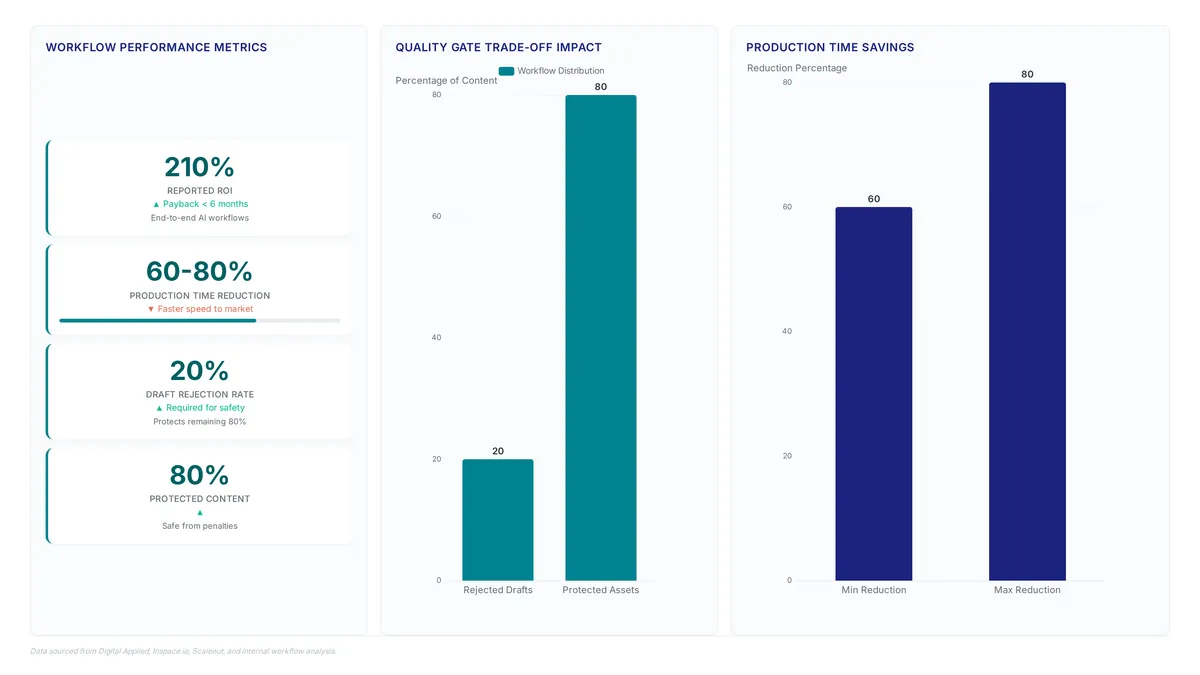
Draft content moves toward immediate publication or human review queues depending on strict SEO score thresholds and metadata completeness. This routing mechanism stops low-quality outputs from reaching production environments before any user interaction occurs. Administrators configure rules so articles failing specific readability metrics or missing internal link counts bypass the publish step entirely. Defining clear pass/fail criteria allows content marketing systems to evaluate drafts automatically:
- Verify target keyword density matches the initial brief specifications.
- Confirm meta description generation meets length and relevance constraints.
- Validate that minimum internal link counts are present within the body.
- Route failures to a staging environment for manual SEO content optimization.
Organizations implementing these end-to-end AI workflows report 210% ROI with payback periods under six months, largely by eliminating rework on published errors. Automating publication without these gates accelerates reputation damage rather than scale. High-volume systems dilute domain authority with unoptimized text when conditional checks remain absent. Enterium solutions enforce these logic gates natively, ensuring only compliant content enters the index. Skipping this validation layer leaves a corpus filled with unstructured, low-performing assets that require costly manual remediation later.
Five-Step Implementation Roadmap for CMS Quality Gates
Defining quality gate criteria involves enforcing minimum SEO scores and validating required fields like meta titles before any content moves downstream. Low-value drafts consume review capacity and dilute site authority without these hard stops.
- Establish conditional routing rules where passing content enters the publish queue while failing items trigger review tasks with specific failure flags.
- Configure schedule triggers to align publication with peak engagement windows rather than relying on manual timing.
- Integrate internal linking checks that verify connections to related assets, a practice shown to maximize ROI in end-to-end workflows workflows.
- Embed brand voice validation to prevent tonal drift across high-volume outputs.
- Deploy the full pipeline to eliminate the bottlenecks typical of fragmented content marketing systems.
| Criteria | Action on Pass | Action on Fail |
|---|---|---|
| SEO Score | Publish | Route to Review |
| Meta Data | Publish | Flag Missing Fields |
| Link Count | Publish | Request Edits |
Rigid adherence to these gates creates tension between velocity and volume. Operators must accept that rejecting 20% of drafts protects the remaining 80% from algorithmic penalties. This tradeoff ensures that only high-fidelity content reaches the index. Enterium engineers recommend treating these gates as non-negotiable infrastructure components rather than optional filters. Configuring the failure state to notify specific editors based on the error type serves as the immediate next step.
Scaling Brand Citations Through Consistent Automated Pipelines
Consistent execution of automated pipelines generates the volume required for brands to earn citations and organic traffic. Sporadic publishing fails to compound authority, whereas continuous output establishes a reliable signal for search algorithms. Teams asking if they should use multi-agent AI for content must recognize that speed alone is insufficient without structural guardrails. This velocity enables teams to maintain the frequency necessary for SEO content optimization without sacrificing depth. Rapid iteration introduces risk if quality checks are not embedded within the generation step. High-velocity systems increases errors just as fast as they increases success when feedback loops are absent. Enterium recommends configuring conditional logic that blocks publication when keyword density or internal link counts fall below set thresholds. This approach ensures that only vetted material enters the public index, protecting domain reputation while scaling output.
- Define quality gate criteria including minimum readability scores and mandatory metadata fields.
- Route failing drafts to a review queue rather than publishing them immediately.
- Schedule releases during peak engagement windows identified through historical traffic analysis.
- Build SEO checks directly into the workflow rather than treating optimization as a separate step workflows.
Maximizing throughput while maintaining editorial standards requires automated rejection of sub-par drafts before human review begins. Brands that enforce these constraints see their citation networks grow denser over time.
About
Arjun Patel is an Applied LLM Engineer who benchmarks LLM providers, models, and RAG architectures specifically for content workloads. His expertise in vendor-neutral evaluation across cost, latency, and quality makes him uniquely qualified to dissect the mechanics of automated content workflows. Unlike theoretical strategists, Arjun's daily work involves stress-testing multi-agent AI drafting systems and optimizing keyword-to-brief pipelines under real production constraints. At Enterium, a B2B publication dedicated to documenting how teams actually scale content with LLMs, he translates complex inference economics into reproducible pipeline architectures. This article reflects Enterium's core methodology: moving beyond hype to engineer reliable content marketing systems where humans remain on critical quality gates. By grounding AI content optimization in hard data rather than promises, Arjun provides the technical clarity needed to build reliable AI-driven search strategies that function effectively in enterprise environments.
Conclusion
Scaling automated content workflows inevitably exposes the friction between raw velocity and domain integrity. When output volume spikes, the operational cost shifts from generation to the remediation of algorithmic penalties caused by unvetted drafts. Teams must recognize that rejecting a portion of AI-generated material is not a failure of the system but a necessary function to protect the viability of the remaining assets. Without embedded quality gate criteria, rapid iteration simply accelerates reputation decay rather than compounding authority.
Organizations should mandate that all SEO checks occur within the generation pipeline before any human editor views a draft. This structural shift ensures that only compliant material enters the review queue, drastically reducing waste. We recommend implementing this conditional logic immediately to secure your current production lines against future search algorithm updates. Relying on post-production fixes creates a bottleneck that negates the speed advantages of multi-agent AI systems.
Start this week by defining the specific metadata fields and readability scores that constitute an automatic failure for your drafts. Configure your existing infrastructure to route any content missing these elements directly to a holding queue rather than a publishing schedule. This single adjustment enforces the discipline required to sustain high-volume output without compromising brand safety. True efficiency comes from preventing errors at the source, not filtering them after the fact.
Frequently Asked Questions
This speed allows teams to deploy digital assets rapidly while maintaining the structural clarity required for modern generative engine optimization standards.
Operators must reject 20% of drafts to protect the remaining 80% from penalties. This quality gate ensures that high-velocity publishing does not dilute brand authority or propagate factual errors at scale.
Emerging agentic workflows deliver comprehensive SEO audits within a 72-hour timeframe. This rapid turnaround enables organizations to perform iterative re-testing as model behaviors shift, preventing static briefs from becoming obsolete quickly.
Teams should begin with a two-step generation flow to minimize initial complexity. This lean setup establishes a baseline for intent classification before scaling to multi-agent systems capable of complex keyword-to-brief architecture.
Automated internal linking strategies reinforce site authority without manual grafting. By consolidating multiple checks into single processes, these systems ensure every draft meets visibility standards before reaching the publication queue efficiently.
References