Frontier models: Vellum leaderboard data
Claude Mythos 5 leads the Vellum leaderboard with a 64.5% score, proving that saturation-resistant benchmarks are the only metric that matters in 2026. As frontier AI models now demand evaluation frameworks that accurately reflect rapid reasoning acceleration. Readers will learn why Humanity's Last Exam has become the definitive standard for measuring true intelligence, highlighting a massive 30 percentage point performance jump across the industry in just one year according to Stanford HAI data. We dissect the architecture of frontier models to reveal why specific providers dominate specialized tasks like agentic coding and computer use while others lag behind. Finally, the analysis covers how deploying low-latency models within automation stacks delivers measurable ROI by reducing error rates in production environments.
The data from Vellum shows that top performers like Claude Sonnet 5 and GLM 5.2 are redefining expectations for AI provider performance. Understanding these distinctions is critical for engineers building systems that require genuine problem-solving skills over pattern matching.
The Role of Saturation-Resistant Benchmarks in Modern AI Evaluation
Humanity's Last Exam as the New Frontier Benchmark
Humanity's Last Exam functions as a crowd-sourced evaluation of extremely hard questions spanning every academic discipline, designed as the final test before superhuman AI. This metric replaces saturated benchmarks like MMLU because frontier models achieved a 30 percentage point increase in performance within a single year, rendering older datasets obsolete for tracking progress. The Vellum LLM Leaderboard sources data directly from providers and independent runs to populate these rankings, ensuring the evaluation data reflects current capabilities rather than historical ceilings. Unlike static datasets, this approach captures the rapid saturation curve where evaluations intended to be challenging for years are now saturated in months.
SWE-Bench Verified evaluates models on real GitHub issues from popular Python repos that require end-to-end resolution. This benchmark specifically measures agentic software engineering ability rather than simple code completion capacity. Unlike static completion tasks, the model must navigate a codebase, identify the root cause of a reported bug, and implement a fix that passes existing test suites. The definition of terminal use in this context implies executing commands, reading file systems, and iterating on solutions without human intervention. Recent analysis indicates a strong convergence between coding performance and general reasoning, where reaching high scores on verified tasks serves as a technical proxy for broader cognitive improvements performance. The limitation is computational cost; running full repository evaluations requires significant latency compared to single-turn prompt responses. For enterprise teams, this distinction dictates that high-throughput completion models may fail complex maintenance workflows requiring stateful context. Operators must prioritize benchmarks that enforce full execution cycles over static accuracy metrics.
Claude Mythos 5 vs GPT-5.5 on Saturation-Resistant Metrics
Raw parameter scaling no longer guarantees reasoning supremacy. Claude Mythos 5 currently leads the Humanity's Last Exam metric with a score of 64.5%, demonstrating a distinct advantage in non-saturated environments. By contrast, GPT-5.5 records 41.4%, while the previous generation GPT-5 lags at 35.2%. This 23-point gap indicates that specialized architectural tuning now outweighs brute force scaling. The cost of this gap is measurable: deploying GPT-5.5 for complex research tasks requires significantly more human oversight to verify outputs compared to the top performer. Enterprises relying on older benchmarks like MMLU risk selecting models that fail under novel cognitive loads. Content automation pipelines built on lower-scoring models will exhibit higher failure rates in agentic workflows requiring multi-step deduction. Teams must prioritize live pricing data alongside these scores to balance cost against the probability of reasoning errors.
Inside the Architecture of Frontier Models and Agentic Workflows
Claude Mythos 5 Context Window and Output Limits
The Claude Mythos 5 architecture defines its operational boundary with a 1,000,000 token context window and a hard 128,000 token maximum output limit. This configuration establishes a January 2026 knowledge cutoff, creating a fixed temporal horizon for all reasoning tasks. When compared to GPT-5.5 Pro, which shares the same context capacity but uses an April 2026 cutoff, the differential in training data recency becomes a primary selection variable for time-sensitive domains. The input and output costs sit at $10 and $50 respectively per million tokens, positioning the model against lower-latency alternatives in the agentic coding space. Operators requiring the most current regulatory or financial data may find the January cutoff introduces factual drift that newer models avoid. This limitation necessitates a hybrid architecture where retrieval-augmented generation supplements the base model's frozen weights.
Deploying Claude Fable 5 for Browsing and OSWorld Tasks
Claude Fable 5 leads browser-based automation with an 88% score on BrowseComp, outperforming the 85.9% achieved by DeepSeek V4 Flash. This margin matters when agents navigate flexible DOMs where minor rendering shifts break brittle selectors. The model's 85% on OSWorld confirms its capacity for multi-step computer use, handling window management and file system interactions that simpler chat interfaces cannot. Operators choosing between Claude Fable 5 and Gemini 3.1 Pro for browsing tasks face a trade-off between raw navigation accuracy and the broader system integration of closed weights. A model with superior reasoning may timeout during long-horizon tasks if the underlying infrastructure cannot sustain the session. Teams must validate that the chosen agent maintains context stability over extended execution windows.
Latency and Speed Trade-offs: GLM 5.2 vs Claude Sonnet 5
GLM 5.2 delivers a 1.14s latency that drastically undercuts the 20.69s response time recorded for Claude Sonnet 5. This eighteen-fold difference in time-to-first-token defines the boundary between synchronous user interaction and background batch processing. Throughput metrics reinforce this divergence, with GLM 5.2 generating 347 t/s compared to 56.3 t/s for the Sonnet variant. Modern evaluation dimensions now prioritize this speed alongside intelligence, recognizing that raw benchmark scores often fail to predict utility in real-time agentic loops. Notably, GLM-5.2 holds the leading position among open-weights Large Language Models with a score of 91.2% on the GPQA Diamond benchmark.
| Metric | GLM 5.2 | Claude Sonnet 5 |
|---|---|---|
| Latency | 1.14s | 20.69s |
| Speed | 347 t/s | 56.3 t/s |
| I/O Cost | $0.95 / $3 | $3 / $15 |
| Primary Use | Real-time agents | Deep reasoning |
The architectural cost of high throughput is often reduced chain-of-thought depth per token, creating a failure mode where rapid generation may struggle with complex multi-step logic requiring deep internal verification. Operators deploying GLM 5.2 for rapid iteration must implement strict output validation gates to catch reasoning errors that slower models might resolve internally. While Claude Sonnet 5 remains viable for non-interactive analysis where latency is secondary to accuracy, its token generation speed creates a bottleneck for high-volume automation pipelines. Enterprises requiring both speed and complex reasoning should route queries through an adaptive orchestration layer, which dynamically selects the optimal model based on task complexity rather than static configuration. This approach mitigates the risk of deploying a single high-latency model across all workflow stages.
Measurable ROI from Low-Latency Models in Automation Stacks
Defining Low-Latency Metrics: TTFT and Token Throughput
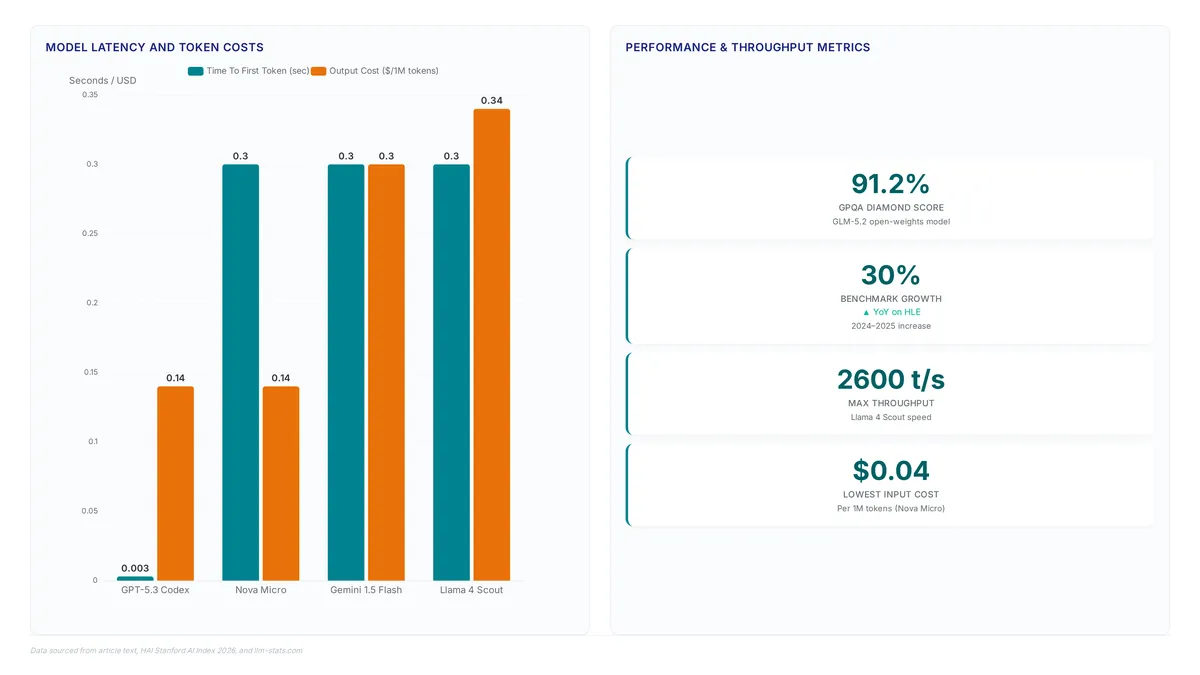
Time To First Token measures the initial delay before a model begins generation, a critical window for interactive agent responsiveness. GPT-5.3 Codex achieves a TTFT of 0.003 seconds, establishing a near-instant baseline for command-line tools where user perception of lag must remain below human reaction thresholds. In contrast, Nova Micro records a TTFT of 0.3 seconds, a value acceptable for batch processing but potentially noticeable in real-time conversational interfaces requiring immediate acknowledgment.
Token throughput quantifies sustained generation speed, determining how quickly an agent completes long-form reasoning or code synthesis tasks. Llama 4 Scout delivers the highest throughput at 2600 tokens per second, enabling rapid iteration cycles for automated coding agents that must output entire files within seconds. Standardizing these measurements requires consistent test payloads, such as the 550 input and 150 output token configuration used in open-source performance comparisons to ensure reproducibility across different API endpoints.
| Metric | Model | Value | Operational Impact |
|---|---|---|---|
| TTFT | GPT-5.3 Codex | 0.003 s | Instant CLI feedback |
| TTFT | Nova Micro | 0.3 s | Acceptable chat latency |
| Throughput | Llama 4 Scout | 2600 t/s | Rapid code generation |
| Throughput | Llama 3.1 405b | 969 t/s | Standard document drafting |
The trade-off for extreme speed is often context window limitation or reduced reasoning depth on complex agentic tasks. Enterprises deploying automation stacks must balance these latency metrics against task complexity to avoid over-provisioning high-speed models for deep reasoning workloads. Leaderboards now allow for multi-dimensional comparison where users can weigh "intelligence" (benchmark scores) against "speed" (latency), recognizing that the highest GPQA scorer may not be the optimal choice for latency-sensitive applications.
Calculating Cost-Per-Task for High-Volume Automation
Selecting a model for high-frequency automation requires converting token rates into specific cost-per-task metrics rather than relying on raw intelligence scores. Nova Micro offers the lowest entry point at $0.04 per million input tokens and $0.14 per million output tokens, making it the default arithmetic choice for simple browsing loops where context fitting is minimal. Gemini 1.5 Flash sits at $0.075 input and a moderate output rate, providing a mid-range option for tasks demanding slightly larger context windows without the premium of frontier reasoning models. Llama 4 Scout costs $0.11 input and $0.34 output, a price increase that teams must justify through its superior throughput of 2600 tokens per second when latency impacts user retention.
Choosing an automation use requires validating hosting constraints against your team's capacity for infrastructure maintenance. Provider variance significantly alters latency and throughput, meaning identical models perform differently across API endpoints. Teams must weigh managed convenience against the operational burden of self-hosted deployments.
| Feature | Managed Option | Self-Hosted Option |
|---|---|---|
| Setup Complexity | Easy | Moderate to Difficult |
| Memory Stack | Managed memory | SQLite + markdown (DIY) |
| Security Model | Built-in security | DIY implementation |
| Connectivity | Managed OAuth | No managed connectors |
| Channels | iOS, Slack, Web | CLI / TUI only |
Platforms like Hermes offer built-in security and managed memory stacks suitable for teams lacking dedicated DevOps resources. In contrast, OpenClaw demands users construct their own memory stack using SQLite and markdown, a approach that increases flexibility but raises integration complexity. The limitation is clear: self-hosted paths often support only CLI and TUI channels with no managed connectors, restricting deployment to terminal-centric workflows. This trade-off forces a decision between rapid channel integration and total control over data residency. Organizations with strict data sovereignty mandates may accept the overhead of building custom interfaces. Strategic oversight is necessary to align these technical constraints with business objectives, ensuring your automation stack scales without compromising security posture. Select the architecture that matches your operational maturity, not your budget.
Steps for Evaluating Model Cost Efficiency Against Performance Metrics
Implementation: Defining Cost Efficiency Metrics: TTFT and Token Throughput
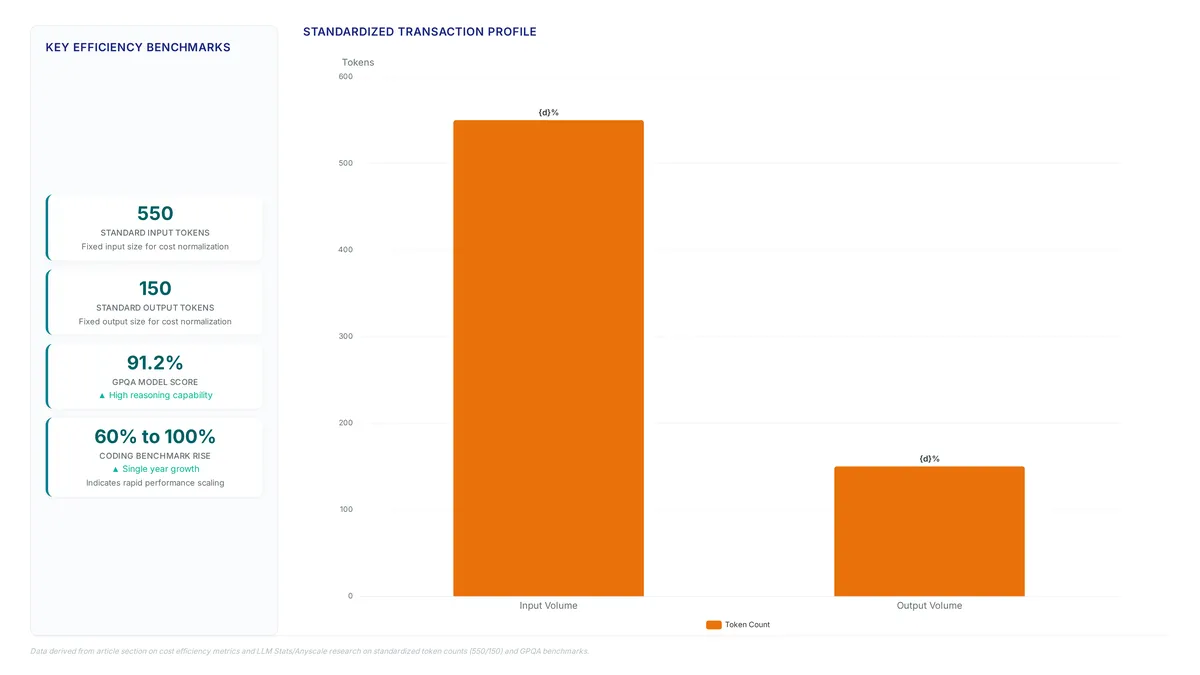
Measure Time To First Token (TTFT) alongside sustained throughput to distinguish cold-start latency from streaming performance. These disparate metrics define the operational envelope for agentic workflows where interaction patterns dictate infrastructure costs. Providers now track cost as a primary metric alongside quality and latency, reflecting the market's shift toward economic efficiency in high-performance reasoning tasks.
Evaluate models using standardized transaction sizes rather than estimated averages to ensure reproducible price comparisons. The industry uses specific token counts, such as 550 input and 150 output tokens, to normalize cost measurements across different API endpoints.
- Measure initial latency under load to capture true user-perceived delay.
- Record sustained token generation rates over extended contexts.
- Calculate effective cost per successful task completion.
Focusing solely on raw speed can be misleading, as performance varies by task type. Optimizing for the wrong metric inflates infrastructure spend without improving user experience. Select the latency threshold that matches your specific use case constraints.
Calculating Real-World Costs Using Nova Micro and Gemini Flash Pricing
Multiply token counts by unit rates to derive accurate task expenses before deployment. These base rates obscure total cost when retry logic or large context windows inflate volume. A standardized measurement scenario using 550 input and 150 output tokens enables reproducible price comparisons across providers. Define the transaction profile by counting average input and output tokens for your specific workflow. Apply the unit pricing to calculate a baseline cost per successful completion.
List prices may not reflect final costs due to architectural optimizations like prompt caching available in production systems. Tracking spend by transaction rather than token volume provides clearer visibility into operational expenses. Select models based on total task expense, not the cheapest token.
Validating Model Selection Against Latency and Context Requirements
Validate context window capacity before measuring latency to prevent truncation errors during long-document processing.
- Establish latency targets appropriate for interactive agents to maintain conversational flow.
- Verify model context limits against average document sizes in your specific dataset.
- Calculate total cost using current input rates for high-volume retrieval tasks.
Provider performance varies significantly even for identical models, requiring granular tracking of uptime characteristics across different API endpoints. Configuring these gates dynamically helps balance cost against user experience constraints. Selection logic must prioritize the specific constraints of the retrieval pipeline over raw benchmark scores.
About
Hannah Brooks, Marketing Operations Lead at Enterium, evaluates the structural integrity of AI content pipelines through rigorous benchmark analysis. Her daily work orchestrating workflow automation and governance frameworks positions her to critically assess LLM Leaderboard data beyond surface-level scores. At Enterium, a B2B publication dedicated to scalable content operations, Brooks applies her RevOps background to dissect how model performance on benchmarks like Humanity's Last Exam translates to production reliability. She examines whether high-scoring models actually reduce latency or improve quality gates within complex martech stacks. This article reflects Enterium's vendor-neutral methodology, focusing on reproducible metrics rather than hype. By mapping leaderboard trends to real-world pipeline architecture, Brooks helps technical marketers and content engineers make informed decisions about model selection. Her analysis ensures that organizations building automated content systems prioritize measurable ROI and operational stability over raw parameter counts or marketing claims.
Conclusion
Leaderboard dominance often masks the operational reality that raw benchmark scores fail to predict production stability under load. While one provider may show a distinct advantage in controlled environments, the 23-point gap between top and legacy models diminishes when retry logic and context truncation errors inflate actual transaction costs. Organizations focusing strictly on accuracy metrics without validating latency thresholds against their specific user experience constraints will inevitably overspend on infrastructure that delivers marginal utility. The real break point occurs when high token rates combine with inefficient prompt caching, turning a theoretically cheap model into a budget drain.
You must shift selection logic from static leaderboards to flexible transaction profiling before locking in long-term contracts. Do not assume the highest-scoring model fits your retrieval pipeline until you verify its context window capacity against your average document size. Start this week by calculating the baseline cost per successful completion for your top three candidate workflows using your actual token distribution rather than theoretical averages. This concrete audit reveals whether the premium for top-tier accuracy justifies the expense compared to slightly less capable but more consistent alternatives. Only models meeting both your latency targets and total task expense requirements should proceed to pilot deployment.
Frequently Asked Questions
Claude Mythos 5 leads this metric with a score of 64.5%, demonstrating a distinct advantage in complex reasoning tasks. Enterprises should prioritize this model for workflows requiring genuine problem solving over pattern matching on saturated datasets.
The input and output costs sit at $10 and $50 respectively per million tokens, positioning premium models for high value tasks. Teams must balance these expenses against latency needs to ensure measurable ROI in production stacks.
This 23 point gap indicates that raw parameter scaling alone no longer guarantees leadership in saturation resistant evaluations. Organizations must test specifically for agentic capabilities rather than relying on legacy performance indicators from older versions.
The GLM 5.2 model currently holds the leading position with a score of 91.2% on the GPQA Diamond benchmark. This makes it a critical option for teams needing strong reasoning without relying on closed proprietary systems.
Frontier AI models achieved a 30 percentage point increase in performance on newer exams within a single year. This rapid acceleration renders older datasets obsolete for tracking true progress in modern artificial intelligence systems.
References