Large language model costs swing 600x in 2026
In 2026, LLM provider costs swing by a factor of 600, making strategic deployment necessary for survival. LLM marketing is no longer an experimental luxury but a required lever for teams that must do more with less without burning out. Readers will learn how large language models function as AI tools trained on vast data to automate text generation and personalize customer interactions. We examine the mechanics of how these systems process information to draft promotional emails and calls to action, turning raw data into the customer communications. The discussion also covers the shift from traditional search engine optimization to OmniSEO ®, a approach designed to future-proof visibility across all search environments.
The analysis draws on data showing extreme price fluctuations among top-tier providers to highlight the financial risks of unguided adoption. Rather than relying on volatile external APIs alone, organizations must implement proven strategies that balance automation with oversight. By starting small and measuring results, businesses can convert these powerful models into measurable revenue streams while avoiding the pitfalls of unchecked experimentation.
The Role of Large Language Models in Modern Marketing Infrastructure
LLM Marketing: AI Overviews and Generative Search Set
Human expertise drives strategy; artificial intelligence accelerates execution. This division of labor defines the shift toward "search everywhere optimization," moving beyond the constraints of traditional search engines. Organizations now connect LLM solutions directly to CRM systems and marketing calendars through secure APIs, embedding artificial intelligence into the core execution layer of strategy. Currently, a majority of organizations are using LLMs specifically for customer service operations, a significant increase from a small fraction in 2023, yet few optimize their public content for machine consumption. Teams must shift focus from gaining clicks to securing visibility within synthesized responses. Start by auditing existing assets for structured data completeness before generating new volume.
Strategic Stacking: Deploying Claude, ChatGPT, and Gemini by Task
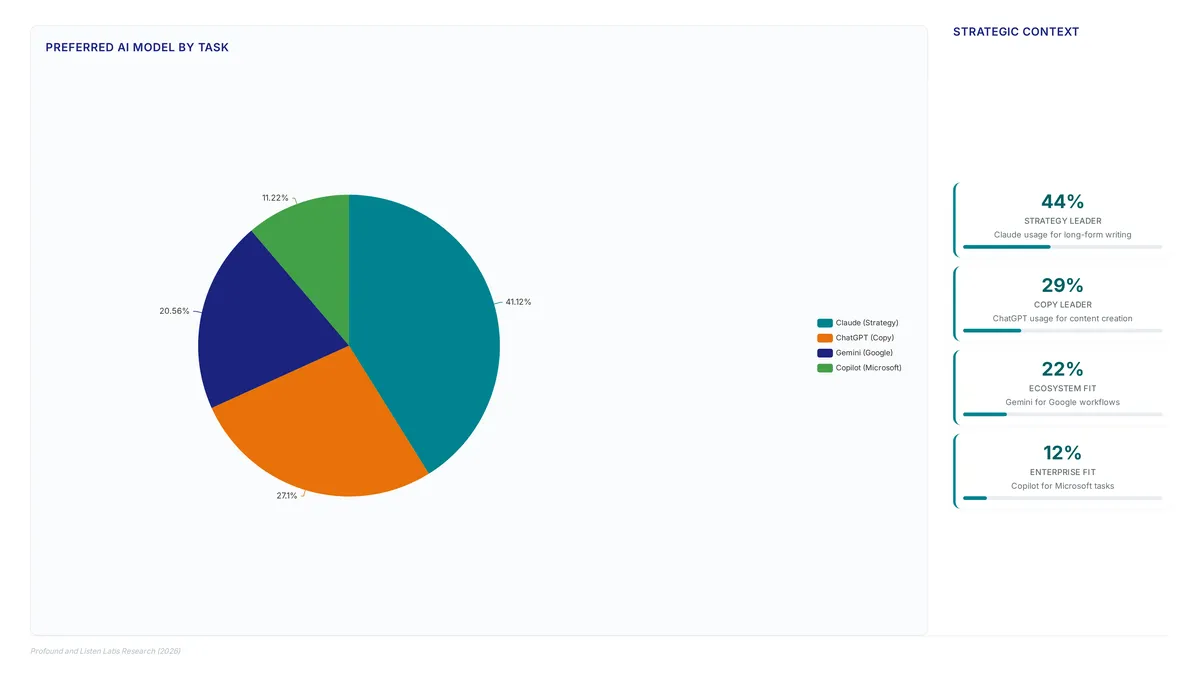
Strategic stacking assigns specific large language models to distinct workflow stages rather than standardizing on a single provider. This architecture optimizes output quality by matching model strengths to task constraints like context window size and reasoning depth. Operators segment deployment based on functional capability: 44% use Claude for strategy and longform writing, 29% rely on ChatGPT for general copywriting, 22% deploy Gemini for Google system workflows, and 12% use Copilot for Microsoftcentric enterprise tasks. This segmentation reflects a shift from experimental novelty to structured AI stacks designed for production reliability.
The cost benefit of specialized outputs must outweigh the engineering overhead of maintaining multiple integration points and authentication flows. Teams avoid vendor lock-in while ensuring consistent governance across all generated assets through centralized policy enforcement. Adopting a multi-model strategy requires strong monitoring to detect drift in output quality as providers update their underlying weights silently. LLM marketing success depends on this precise alignment of tool capability with strategic intent, not merely aggregating generative capacity. Deploying the right model for the right task reduces token waste and improves final content relevance. Start by auditing current content bottlenecks and mapping them to specific model strengths.
Cost Volatility: Managing 600x Price Swings in LLM Budgets
Cost variance for top-tier models swings by a factor of 600, turning model selection into a primary budget variable. This extreme volatility means artificial intelligence now commands a significant share of total marketing spend, making unmanaged usage a direct threat to quarterly financial stability. Unlike traditional marketing channels with predictable CPMs, LLM marketing operates on flexible token economics where provider price wars create unpredictable expenditure spikes. The financial risk escalates when teams deploy frontier models for simple tasks, burning capital on unnecessary reasoning depth.
Without such controls, the shift from commodity utility to critical budget line item forces operators to choose between capping volume or overspending. The consequence of ignoring these mechanics is a fragmented stack where performance gains are erased by unchecked operational expenses. Precise model routing remains the only viable defense against market-wide price instability. In this environment, doing more with less is now table stakes.
How Generative AI Processes Data to Automate Content and Personalization
How LLMs Change Raw Data into Strategic Content
LLMs convert raw tokens into coherent output by predicting sequences against training data to automate content generation. This mechanism relies on vast context windows where the model maps input prompts to statistical probabilities, effectively handling execution while humans retain strategic oversight. This shift forces a division of labor where AI accelerates throughput but human expertise drives quality. Buyer behavior in B2B sectors now favors AI-mediated discovery over traditional search patterns. Marketers must optimize for these new discovery processes to maintain visibility.
| Component | Function | Operator Role |
|---|---|---|
| Token Prediction | Generates text sequences | Define constraints |
| Context Window | Holds active memory | Curate input data |
| Strategy Layer | Directs output goals | Validate alignment |
Scaling volume via token sequences often conflicts with maintaining a distinct brand voice. Automated systems drift toward generic phrasing that fails to convert without rigorous human review. Organizations address this gap by adopting structured prompt templates that enforce specific strategic criteria before publication. Every output aligns with brand standards through these enforced constraints.
Executing Flexible Personalization via Strategic Model Stacking
Production personalization requires segmenting generative tasks across specialized models rather than relying on a single generalist engine. Organizations now deploy distinct models for specific capabilities to optimize cost and output quality. This strategic stacking approach replaces the inefficient standardization on one vendor. Failing to segment results in higher token costs and generic outputs that miss brand nuance. Managing this diversity requires building distinct "AI stacks" to optimize for cost and capability per task. Teams often face the operational challenge of maintaining multiple API integrations while attempting to capture the performance benefits of a best-of-breed stack. Marketers can personalize the customer process across channels by carefully selecting models based on specific content requirements. The result is a scalable system where flexible content adapts to user behavior instantly. Four key benefits emerge from this architecture: reduced latency, lower aggregate spend, improved relevance, and simplified compliance auditing.
Navigating Cost Volatility and Budget Fragmentation in AI Stacks
Unmanaged model selection exposes enterprises to price swings exceeding a factor of 600 across top-tier providers. This volatility transforms the LLM stack from a predictable utility into a substantial budget variable that directly impacts quarterly financial reports. The shift from commodity purchasing to strategic cost management requires rigorous tracking of input-output ratios per task type.
| Risk Factor | Operational Impact | Mitigation Strategy |
|---|---|---|
| Price Volatility | Quarterly budget overruns | Implement hard caps per project |
| Model Fragmentation | Inconsistent output quality | Centralize model governance |
| Token Leakage | Wasted spend on redundant calls | Deploy caching layers |
Fragmented workflows across multiple vendors complicate cost attribution and obscure waste. A common failure mode involves deploying high-cost reasoning models for simple retrieval tasks, inflating unit economics unnecessarily. The financial risk extends beyond simple overruns; it fundamentally alters the return on investment for automation initiatives. Organizations ignoring these variances face unpredictable operational expenditures that undermine long-term planning. Five specific actions mitigate this exposure: auditing current token usage, setting hard caps per project, rotating providers based on task complexity, automating fallback protocols, and reviewing vendor pricing tiers monthly.
Executing LLM Marketing Strategies for Search Optimization and Support
OmniSEO: Defining Search Everywhere Optimization
Goodbye search engine optimization, hello search everywhere optimization. This strategic pivot changes visibility from securing ranked links to ensuring brand citations within synthesized AI answers. Discovery now depends on whether a brand is cited within AI-generated responses rather than traditional page position. This shift requires enterprises to align LLM marketing not as a tactical extension, but as critical infrastructure. Marketers increasingly track performance metrics to gauge success, moving from intuition to rigorous measurement.
A key tension exists here: optimizing for extractability by AI models often conflicts with maintaining narrative depth for human readers. The cost is clear; content engineered solely for machine parsing risks losing the contextual nuance that drives conversion. The discovery process for B2B buyers is fundamentally transforming, moving away from traditional search behaviors toward AI-mediated discovery. Future-proofing demands a strategic stack approach where different models handle distinct tasks, avoiding reliance on a single provider. This architecture uses diverse AI stacks to optimize for specific tasks and costs, such as using Claude for strategy and ChatGPT for general copywriting. This strategy is positioned as a method to future-proof SEO strategies.
Implementing AI Chatbots for Customer Support Workflows
Deploying LLM-driven agents transforms static help desks into flexible resolution engines capable of handling complex intent. This velocity forces a re-evaluation of support architecture, moving beyond simple keyword matching to semantic understanding that resolves tickets without human escalation. Raw model access introduces latency and consistency risks that degrade user trust if left unmanaged. Organizations build diverse "AI stacks" to optimize for cost and capability per task rather than standardizing on a single model. API spend becomes standard enterprise infrastructure. The choice of model has become a critical budget variable capable of materially impacting quarterly financial reports. Optimizing for generative search requires structuring support content so AI systems can cite specific resolution steps accurately. WebFX helps businesses implement proven LLM marketing strategies designed to drive measurable revenue. With years of experience and a team of seasoned experts, the organization is built to help clients stay competitive as AI transforms marketing. This approach ensures that automation scales reliability rather than compounding errors.
Validating LLM Marketing ROI with Seasoned Experts
WebFX helps businesses implement proven strategies designed to drive measurable revenue. Without rigorous tracking, organizations risk treating experimental costs as permanent infrastructure. A critical tension exists between rapid model deployment and accurate financial reporting. Ignoring distinct data streams obscures the true cost per acquisition. As the global LLM market is projected to expand notably through 2033, aligning AI outputs with revenue goals is necessary. WebFX invites readers to contact the company online for a free consultation to see how LLM marketing can turn AI into measurable ROI. The limitation of pure automation is its inability to distinguish between high-volume noise and high-value signals. Pure speed cannot replace financial discipline. Companies must separate signal from noise to survive the coming expansion.
Integrating ChatGPT and LLM Tools into Marketing Workflows
Defining Strategic Stacking for Marketing Workflows
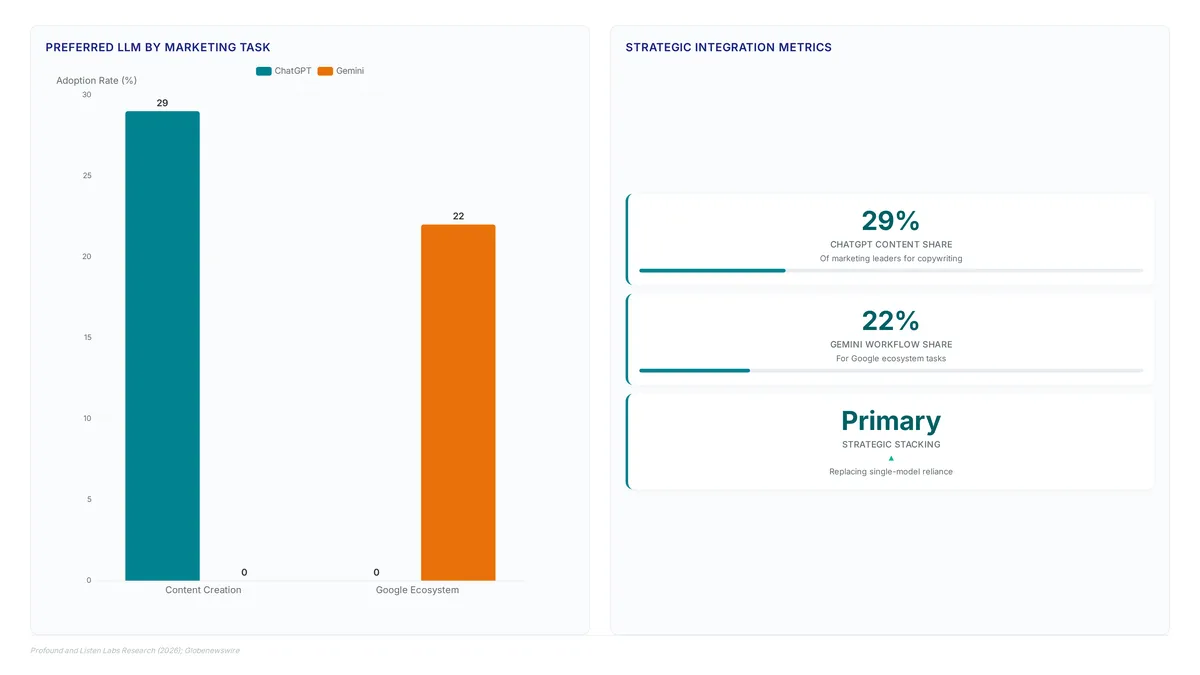
Organizations now replace single-model reliance with strategic stacking to optimize output quality and cost structures across diverse tasks. Such distribution prevents vendor lock-in and aligns model capabilities with specific functional requirements rather than brand loyalty.
- Audit existing content workflows to identify distinct task types requiring different reasoning depths.
- Assign model roles based on demonstrated strengths rather than assuming universal competence across all prompts.
- Implement routing logic to direct queries to the appropriate model endpoint automatically.
The limitation of this approach is increased orchestration complexity, as managing multiple API keys and context windows demands strong infrastructure. Teams must balance the performance gains of specialized models against the operational overhead of maintaining a fragmented stack. Enterium provides the necessary architecture to manage these LLM marketing pipelines without introducing latency or consistency errors. The next step is mapping your current content volume to specific model capabilities to establish a baseline for migration.
Executing Task-Specific Model Deployment in Campaigns
Assign model roles by matching specific campaign tasks to distinct architectural strengths rather than defaulting to a single provider. Marketing leaders now segment usage, reserving high-reasoning models for strategy while directing system-native tools to their each platforms. This approach prevents the latency and cost penalties associated with forcing one model to handle incompatible workloads like complex reasoning and simple formatting.
- Map content workflows to capability tiers, distinguishing between strategic planning and high-volume copy generation.
- Route Google-centric metadata tasks through specialized integrations to maximize schema accuracy.
- Direct internal Microsoft Office automation to enterprise-grade assistants to maintain data sovereignty.
Start production validation by mapping revenue attribution directly to LLM-driven workflows before scaling spend. Teams must verify that strategic stacking aligns model costs with output value, ensuring high-reasoning tasks do not consume budget meant for volume generation. The cost is measurable; without clear task segmentation, API expenses can erode marginal gains from automation.
| Workflow Type | Required Expertise | Validation Metric |
|---|---|---|
| Strategic Planning | Senior Analyst | Conversion Lift |
| High-Volume Copy | Junior Editor | Cost Per Asset |
| Data Synthesis | Data Engineer | Accuracy Rate |
- Audit current content pipelines to isolate tasks where human oversight remains non-negotiable.
- Deploy seasoned experts to define guardrails, as generic prompting fails to capture brand nuance or complex compliance needs.
- Measure revenue impact weekly, distinguishing between efficiency gains and actual top-line growth.
Blind adoption risks creating content debt that outweighs speed benefits. Enterium provides the seasoned experts necessary to audit these systems and ensure measurable revenue drives every deployment decision.
About
Arjun Patel is an Applied LLM Engineer who benchmarks LLM providers, models, and RAG architectures specifically for content workloads. His daily work involves rigorous, vendor-neutral evaluation of inference economics, measuring trade-offs between cost, latency, and output quality across substantial providers. This hands-on experience directly informs the article's thesis: moving from experimental prompts to executed content pipelines requires precise engineering, not just hype. At Enterium, a B2B publication dedicated to documenting how modern teams scale content with LLMs, Arjun applies these same metrics to build reproducible automation systems. While the broader market often chases new tools, his focus remains on the underlying pipeline architecture, research, generation, QA, and publication, where human expertise acts as the critical quality gate. By grounding strategy in hard data rather than speculation, Arjun helps technical marketers and content engineers transition from "doing more with less" to building sustainable, high-use content operations that drive measurable revenue.
Conclusion
Scaling LLM adoption beyond the current majority utilization rate exposes a critical fragility: the collision of creative variance with deterministic data needs. When organizations fail to segment workflows by model strength, they incur hidden operational costs where high-reasoning tokens waste budget on simple tasks. This inefficiency erodes the marginal gains of automation, turning a strategic asset into a financial leak. You must stop treating all text generation as identical and start enforcing strict capability boundaries immediately.
Implement a segmented deployment strategy this week by auditing your content pipelines to isolate high-value strategic planning from volume copywriting. Assign senior analysts to define guardrails for complex reasoning tasks while relegating generic drafting to lower-cost models. This separation ensures that your revenue impact measurements reflect actual growth rather than just speed. Do not wait for quarterly reviews to identify these leaks; the variance in output quality and cost demands weekly validation.
Start by mapping your current API spend against specific workflow types today to identify where high-cost models are performing low-value work. Enterium stands ready to architect these production-ready workflows, ensuring your marketing stack aligns model capabilities with campaign objectives for consistent, measurable revenue.
Frequently Asked Questions
Currently, a portion of organizations utilize LLMs specifically for customer service operations. This massive jump from less than a portion in 2023 means teams must immediately audit assets for structured data to secure visibility.
Operators segment deployment by capability, with 44% utilizing Claude for strategy and longform writing. This strategic stacking ensures output quality matches task constraints rather than relying on a single provider for everything.
Cost variance swings by a factor of 600, so precise model routing is the only defense against instability.
While 29% rely on ChatGPT for general copywriting, using one model for everything ignores specific strengths. Strategic stacking assigns distinct models to workflow stages to optimize reasoning depth and context window size.
Unchecked operational expenses can erase performance gains, requiring strict governance across generated assets.
References