Arena ratings: Why 7M votes matter now
Chatbot Arena calculates model rankings using over 7M user votes to generate Elo ratings that define the current AI hierarchy. This crowdsourced platform has become the definitive standard for evaluating large language models because it relies on human preference data rather than static test sets. The OpenLM.ai leaderboard demonstrates this by aggregating Arena battles alongside the AAII and ARC-AGI benchmarks to produce a thorough performance hierarchy.
Readers will learn how the underlying Bradley-Terry model converts pairwise comparisons into the multi-dimensional scoring architecture seen in the 2026 rankings. Ai data, edging out Claude Opus 4.8 Thinking at 1506. The analysis also covers how proprietary giants like Anthropic and OpenAI dominate the upper tiers while open-source challengers attempt to close the gap in specific domains like coding and vision.
The discussion extends to the specific evaluation suites within AAII v3, including MMLU-Pro and Humanity's Last Exam, which stress test fluid intelligence beyond simple memorization. By understanding these metrics, stakeholders can improved interpret the narrow margins separating industry leaders in an increasingly competitive environment.
The Role of Crowdsourced Benchmarks in Modern LLM Evaluation
Chatbot Arena Elo Ratings and the AAII v3 Framework
Blind taste tests replaced static datasets as the gold standard for LLM evaluation. Chatbot Arena operates as a crowdsourced, randomized battle platform using 7M+ user votes to compute Elo ratings for large language models. This methodology replaces static dataset scoring with direct human preference analysis derived from blind model comparisons. The system aggregates these pairwise wins into a single performance number, though the metric primarily reflects subjective quality rather than objective correctness. To address benchmark saturation, the platform now integrates the AAII v3 index, which aggregates ten challenging evaluations including MMLU-Pro and Humanity's Last Exam. This multi-dimensional approach counters the rapid obsolescence of single-task benchmarks by requiring models to demonstrate breadth across reasoning domains. A secondary layer, ARC-AGI, specifically measures fluid intelligence to isolate generalization capabilities from memorized training data.
Human voters often prefer helpful responses, yet enterprise deployments frequently prioritize token efficiency and deterministic output over conversational charm. Data indicates that top proprietary models cluster tightly, making the choice between them a matter of specific workload alignment rather than raw capability gaps. Anthropic is the top performer with a technical performance score of 1,503, followed closely by xAI at 1,495 and Google at 1,494. OpenAI holds a technical performance score of 1,481 according to the March 2026 data, placing it fourth among the tracked entities. Enterium recommends validating leaderboard claims against internal latency budgets before committing to a specific provider.
Interpreting AAII v3 Scores Across MMLU-Pro and GPQA Diamond
Aggregating ten specific evaluations exposes performance gaps that single benchmarks miss. The AAII v3 index exists because static datasets saturate quickly; evaluations intended to challenge AI for years are now being saturated in months. Consequently, a high MMLU-Pro score alone no longer guarantees utility in production environments where novelty is constant. The inclusion of GPQA Diamond as part of the ten aggregated evaluations adds a layer of difficulty focused on scientific reasoning. The AAII v3 framework combines these diverse challenges to provide a stronger assessment than single benchmarks. The cost of ignoring this granularity is deploying a model that excels in theory but fails under specific operational constraints. Select models based on the specific evaluation subsets the to your workload, not the aggregate score.
Benchmark Saturation Risks in Static Datasets Like MMLU-Pro
Obsolescence arrives faster than expected. Static datasets like MMLU-Pro now face obsolescence within months as models rapidly saturate evaluations designed to last years. This compression renders single-metric tracking ineffective for distinguishing frontier capabilities in production environments. Documentation highlights how evaluations intended to be difficult for years are solved in months, forcing a pivot toward flexible human preference data. Unlike static scores, Elo ratings calculate relative model strength through pairwise user votes, updating continuously to reflect current performance deltas. Meanwhile, ARC-AGI measures fluid intelligence by testing abstract reasoning on novel tasks rather than memorized knowledge patterns. The rapid saturation of benchmarks implies a recurring timeline where new evaluation suites must be developed every few months to maintain discriminative power between models. Operators depending on stale MMLU-Pro scores may deploy systems that fail on unseen logical structures despite high accuracy on training-distribution tasks.
Inside the Bradley-Terry Model and Multi-Dimensional Scoring Architecture
Bradley-Terry Model Probability Mechanics for LLM Ratings
The transition from online Elo to the Bradley-Terry (BT) model shifts evaluation from sequential updates to a centralized maximum likelihood estimate. Chatbot Arena adopted the Elo rating system since launch, converting pairwise human preferences into probability scores based on player ratings.
Meanwhile, the BT model treats the entire game history as a single batch, ignoring temporal order to calculate the underlying win-rate.
| Feature | Online Elo | Bradley-Terry Model |
|---|---|---|
| Update Mode | Sequential per game | Batch processing |
| Game Order | Matters (recency bias) | Irrelevant |
| Computation | Decentralized possible | Centralized only |
| Convergence | Asymptotic | Direct MLE solution |
Operators must recognize that real-world usage data often diverges from these controlled pairwise battles. The BT assumption of static performance creates a blind spot for models that receive silent backend updates. Consequently, a high Arena Elo score reflects historical consensus rather than current instantaneous capability. This lag necessitates frequent re-evaluation cycles to maintain accuracy in production selection.
Mapping Arena Elo to Coding and Vision Performance Scores
General preference metrics obscure sharp capability deltas in engineering tasks. Arena Elo aggregates general preference, yet distinct capability axes reveal sharper performance deltas for engineering tasks. Claude Fable 5 leads the rankings with an Arena Elo of 1510, a Coding score of 1566, a Vision score of 1311, an AAII of 81, an MMLU-Pro of 91.5, and an ARC-AGI of 86. GPT-5.5-high illustrates this tension, posting an Arena Elo of 1506 with a Coding score of 1561, a Vision score of 1312, an AAII of 76, an MMLU-Pro of 89.6, and an ARC-AGI of 85. The Bradley-Terry framework allows this decomposition by treating every pairwise vote as a data point for specific tags.
| Model | Arena Elo | Coding | Vision |
|---|---|---|---|
| Claude Fable 5 | 1510 | 1566 | 1311 |
| GPT-5.5-high | 1506 | 1561 | 1312 |
| Claude Opus 4.8 Thinking | 1506 | 1562 | 1311 |
Assessing coding performance in models demands looking past the aggregate to find the specific Coding delta. A limitation of relying solely on Arena Elo is the potential to select a generalist model that fails narrow, high-skill tasks like code generation. Infrastructure variance further complicates this, as the same model exhibits different latency characteristics across providers. Evaluating models against minimum Coding or Vision thresholds ensures candidates meet specific domain requirements before considering cost or latency.
Volatility Risks in Online Elo Algorithms with High K-Parameters
Recent games weigh heavier than history in online algorithms, a design choice that amplifies rating volatility. High K-parameters in online algorithms amplify rating volatility by weighing recent games more heavily than historical data. This mechanism assumes performance changes over time, requiring an online algorithm where the system updates ratings after each game based on the difference between predicted and actual outcomes. While large K values accelerate convergence for new players, they introduce instability for static models by causing excessive oscillation around true capability. The cost is measurable: a single anomalous vote can skew a model's rank more significantly than in batch-processed systems. Unlike approaches which adjust K based on tournament count, fixed high-K implementations risk misrepresenting long-term performance during transient noise. Real-world usage data from millions of users on platforms like OpenRouter influences the perceived value and effective cost efficiency of models, as higher usage often correlates with improved optimization and potentially lower effective costs per useful output. Operators must distinguish between genuine capability shifts and statistical noise before promoting a model to production. Relying on raw, unsmoothed Elo scores for critical path decisions invites unnecessary risk into the deployment pipeline.
Proprietary Giants Versus open-source Challengers in Performance Metrics
Defining the Proprietary vs open-source Performance Gap
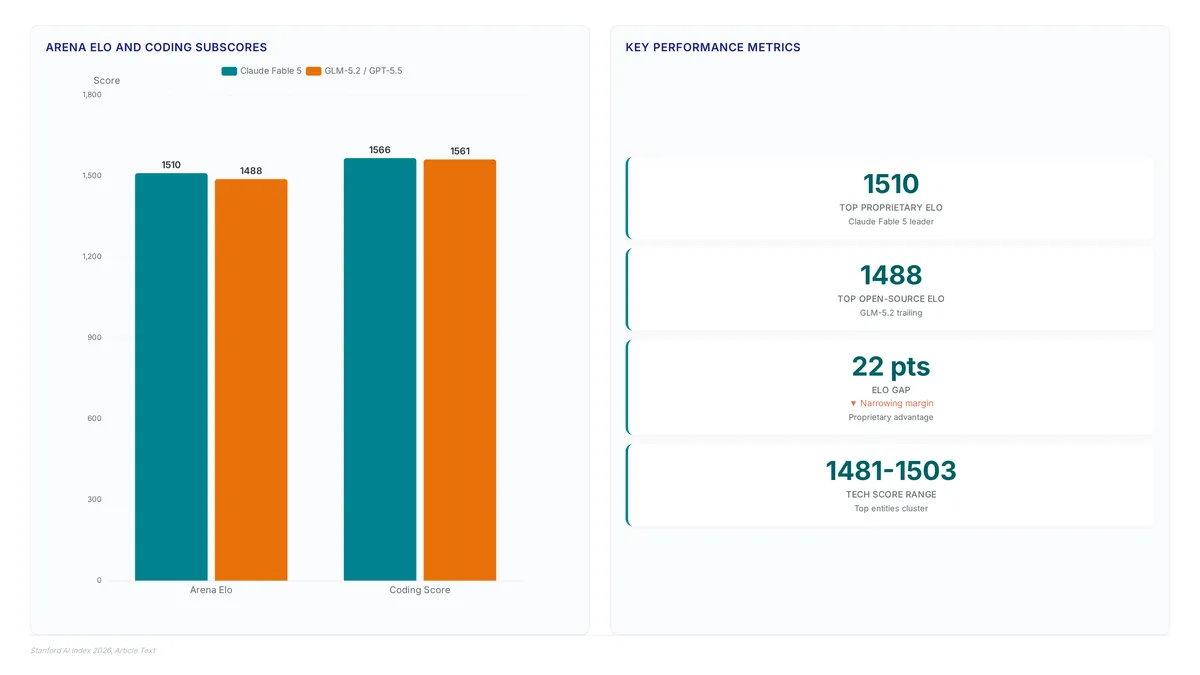
Narrow margins separate tier-one proprietary leaders from open-source alternatives. Arena Elo scores now separate tier-one proprietary leaders from open-source alternatives by narrow margins. Anthropic's Claude Fable 5 leads with an Elo of 1510, while top open-weight models like GLM-5.2 trail at 1488. This 22-point gap reflects consistent advantages in human preference voting where proprietary systems dominate real-world usage.
| Metric | Proprietary Leader (Claude Fable 5) | open-source Leader (GLM-5.2) | Gap |
|---|---|---|---|
| Arena Elo | 1510 | 1488 | 22 |
| Coding | 1566 | 1525 | 41 |
| License | Proprietary | MIT | N/A |
Technical performance scores for top entities cluster tightly between 1,481 and 1,503, suggesting a plateau in raw capability gains distinguishable by current metrics technical performance. The definition of "best" varies significantly: OpenRouter prioritizes developer adoption while Stanford focuses on benchmark saturation Artificial Analysis. Operators selecting between Claude Opus and Sonnet must note that Thinking variants often sacrifice latency for marginal accuracy gains in complex reasoning tasks. The primary distinction remains licensure rather than raw power; open models offer auditability but require significant engineering overhead to match the integrated safety and alignment of proprietary APIs.
Selecting Models for Coding Tasks Using Arena Elo Data
Software generation tasks demand subscore analysis over aggregate rankings. Developers should prioritize Coding subscores over aggregate Arena Elo when selecting models for software generation tasks. While GPT-5.5-high posts an Arena Elo of 1506, its Coding score of 1561 trails the leader Claude Fable 5, which achieves 1566. This four-point delta matters in latency-sensitive CI pipelines where token efficiency dictates cost. Visual analysis requirements introduce a different constraint; GPT-5.5-high leads this specific cohort with a Vision score of 1312, edging out Claude Fable 5 at 1311. Teams building multimodal debugging tools must weigh this marginal Vision advantage against the stronger code completion capabilities of the Anthropic entry.
The distinction between proprietary and open-weight options remains sharp in this tier. Qwen3.7-Max offers a competitive alternative with an Arena Elo of 1486, yet it lacks the specialized Coding depth required for complex refactorization without extensive prompting. Benchmark saturation accelerates this divergence, as new evaluations emerge rapidly to distinguish top performers who have plateaued on static tests technical performance. Relying solely on general leaderboards obscures these modality-specific gaps.
Operational selection requires mapping task modality to subscore maxima rather than raw rank. A model optimized for code may underperform on diagram interpretation despite a higher overall rating. Enterium recommends maintaining separate model routes for code-heavy versus vision-heavy microservices to optimize for both quality and latency.
Proprietary Leaders Versus open-source Challengers on Benchmarks
Reasoning tasks show where open weights close the gap. Proprietary models maintain a narrow lead in Arena Elo while open weights close gaps in reasoning tasks. Claude Fable 5 tops the chart at 1510, yet the MIT-licensed GLM-5.2 reaches 1488 with less training compute. This 22-point differential shrinks when examining ARC-AGI, where fluid intelligence metrics reveal sharper divergence than raw preference data.
| Model | License | Arena Elo | ARC-AGI |
|---|---|---|---|
| Claude Fable 5 | Proprietary | 1510 | 86 |
| GPT-5.5-high | Proprietary | 1506 | 85 |
| GLM-5.2 | MIT | 1488 | 22.8 |
The definition of best fragments across platforms, with some prioritizing technical scores while others track developer adoption. High Coding scores in proprietary entries often mask overfitting to specific evaluation datasets used during alignment. Open models like GLM-5.2 sacrifice some AAII aggregation performance but offer reproducible weights for fine-tuning. Operators choosing between them face a trade-off: pay for marginal gains in human preference or accept slightly lower baseline scores for full model access. The cost of proprietary reliance appears when custom domain adaptation requires data isolation that API-only providers cannot guarantee. Teams should benchmark ARC-AGI performance specifically if their workload involves novel problem solving rather than pattern matching.
Operationalizing Leaderboard Data for Enterprise Model Selection
Defining the Fragmented Best Metric in Model Selection

No single metric defines "best" anymore. The definition of best has fragmented, with some metrics prioritizing technical benchmark scores while others focus on developer adoption rates. Static evaluations like MMLU-Pro face rapid saturation, where models achieve near-perfect scores on difficult tasks within months, compressing the utility window for traditional datasets. This obsolescence forces engineers to rely on flexible signals, such as the crowdsourced Elo ratings derived from 7M+ user votes on the Arena platform. However, a high technical score does not guarantee production viability when latency and cost become primary constraints. External rankings demonstrate this divergence: some leaderboards prioritize API performance metrics like throughput, while others track saturation on challenging evaluations that separate frontier models from the rest. The inclusion of context window size as a standard comparison metric indicates that long-context capability has moved from a novelty to a core requirement for enterprise selection. Consequently, selecting a model requires balancing these orthogonal axes rather than chasing a single aggregate number. Operators must weigh the fluid intelligence measured by ARC-AGI against the specific latency SLAs required by their application layer. Relying solely on one dimension risks deploying a model that excels in benchmarks but fails under real-world load or specific domain constraints.
Application: Mapping Arena Elo Scores to Coding and Vision Workloads
Specialized syntax generation requires live, battle-tested data rather than broad intelligence metrics. Claude Fable 5 leads this specific workload with a score of 1566, outperforming its general ranking suggestion, while holding an overall Arena Elo of 1510 alongside an MMLU-Pro score of 91.5 and an ARC-AGI score of 86. Static benchmarks saturate rapidly, rendering broad intelligence metrics less predictive for specialized syntax generation than live, battle-tested data. The limitation is that high coding proficiency in the top tier currently correlates with proprietary licensing, as seen with Anthropic and OpenAI, restricting on-premise deployment options for regulated industries compared to MIT or Apache 2.0 licensed alternatives like GLM-5.2 or DeepSeek-V4-Pro.
| Model | Coding Score | Vision Score | Primary Strength |
|---|---|---|---|
| Claude Fable 5 | 1566 | 1311 | Code Generation |
| GPT-5.5-high | 1561 | 1312 | Balanced Hybrid |
| Gemini-3.1-Pro | 1531 | 1309 | Context Window |
While GPT-5.5-high edges ahead slightly at 1312, the margin against Claude Fable 5 is negligible for most document processing pipelines. Real-world usage data from millions of interactions on platforms like OpenRouter confirms that developer preference often diverges from raw leaderboard position due to latency constraints. A critical operational tension exists here: maximizing accuracy via top-tier vision models increases token consumption and cost per inference. Teams must validate that the marginal gain in ARC-AGI fluid intelligence justifies the infrastructure overhead before committing to an enterprise contract. Evaluating models against specific image corpora remains a standard validation step before finalizing API routing rules.
Application: Volatility Risks in Online Elo Algorithms with High K-Parameters
Recency bias drives algorithmic instability. Online rating systems assume performance changes over time, requiring an algorithm where recent games weigh more than older ones. This high K-parameter configuration accelerates convergence but introduces significant volatility, causing temporary fluctuations to skew model selection decisions. Enterprise operators relying on real-time data from platforms like OpenRouter must recognize that rank shifts can reflect sampling variance inherent in crowdsourced voting rather than fundamental capability changes. The mechanism prioritizes recency, meaning a single bad batch of user votes can disproportionately impact a model's standing compared to its long-term average. However, ignoring these flexible signals leaves organizations unaware of rapid regression or improvement cycles common in current deployment pipelines. Teams should implement hysteresis gates, requiring a sustained delta before switching production traffic, rather than reacting to single-day variance. This approach balances the need for current intelligence with the operational requirement for consistent API behavior across the 500+ endpoints tracked by Artificial Analysis.
About
Hannah Brooks, Marketing Operations Lead at Enterium, brings a practitioner's rigor to the analysis of Chatbot Arena and its evolving benchmarks. Her daily work involves auditing LLM providers and orchestrating complex content pipelines, requiring precise data on model performance beyond marketing hype. Brooks evaluates tools like the AAII v3 and ARC-AGI not as abstract metrics, but as critical inputs for governing enterprise content quality and cost. At Enterium, a brand dedicated to vendor-neutral AI content automation, she translates crowdsourced Elo ratings and technical evaluations into actionable intelligence for B2B teams. This specific expertise ensures the article moves past surface-level leaderboard chasing to address real-world trade-offs in latency, accuracy, and scalability. By grounding the discussion in reproducible benchmarks, Brooks connects the chaotic environment of model battles to the structured needs of marketing operations leaders building reliable, measurable systems.
Conclusion
Volatility in high K-parameter systems creates genuine operational friction. The cost of chasing every rank shift on Chatbot Arena manifests as unstable API latency and unpredictable token budgets. Teams cannot afford to treat transient score fluctuations as permanent capability upgrades without validating the impact on their specific image corpora. The marginal gain in fluid intelligence often fails to justify the infrastructure overhead required to support frequent model switching in production environments.
Organizations must implement hysteresis gates that demand a sustained performance delta before rerouting live traffic. Do not alter your primary routing rules based on single-day variance or isolated voting batches. This strategy preserves system stability while still capturing genuine regression or improvement cycles. Treat real-time ranking data as a signal for investigation rather than an immediate command to deploy. Your infrastructure requires consistency more than it needs the absolute theoretical maximum score from a volatile source.
Start by auditing your current routing logic this week to ensure it ignores rank changes smaller than five percent. Verify that your monitoring tools distinguish between sampling noise and actual capability shifts before committing to new enterprise contracts.
Frequently Asked Questions
Claude Fable 5 leads with an Arena Elo of 1510. This narrow four-point margin over Claude Opus 4.8 Thinking means enterprises must test both models on their specific workloads before selection.
The platform calculates ratings using over 7M user votes. This massive dataset ensures the resulting Elo scores reflect real human preference rather than static benchmark performance on outdated test sets.
ARC-AGI measures fluid intelligence by testing abstract reasoning on novel tasks. Unlike static datasets that saturate quickly, this benchmark isolates generalization capabilities from memorized training data patterns.
Static datasets now face obsolescence within months as models saturate them. Evaluations intended to challenge AI for years are solved quickly, forcing a pivot toward dynamic human preference data.
Anthropic achieved a technical performance score of 1,503. This top ranking indicates a highly competitive cluster where choosing a provider depends on specific workload alignment rather than raw capability gaps.
References