Content workflow mechanics for B2B tech teams
Building content workflows has become a primary operational focus for B2B tech marketing teams. This isn't a trend; it's a survival mechanism. Without structured handoffs, AI-driven production volumes will drown teams in inconsistent, non-compliant noise.
This guide dissects the mechanics of a functional content workflow. We move beyond abstract strategy to the specific sequences that prevent duplication, enforce legal guardrails, and scale output without burning out creators. You will see how an AI-enhanced content lifecycle relies on event-driven triggers rather than human nagging, and why a scalable content approval process is the only barrier between a repeatable revenue engine and chaotic guesswork.
Colleen Jones from Content Science defines these workflows as the convergence of people, process, and technology. Ignore this operational backbone, and your institutional knowledge walks out the door with every departing employee. For leaders aiming to convert content vision into business outcomes, mastering these mechanics is mandatory.
The Role of Content Workflow in Modern Content Operations
Content Workflow as the Connective Tissue of Strategy
Strategy sets the destination; content workflow dictates the velocity of arrival. High-level planning collapses without execution mechanics, leaving organizations reliant on chaotic guesswork. When pathways remain undefined, institutional knowledge evaporates the moment a key staff member leaves. Documented systems provide the repeatable framework solo creators and large enterprises alike need to ensure consistency across every asset. Content governance acts as the enforcement mechanism, guaranteeing each piece meets brand and legal standards before release.
Specialized AI agents now handle distinct content stages, freeing humans to focus on strategy while automation manages research tasks. The results are tangible: Indian Express Tamil tripled their page views within a 45-day period after implementing AI-assisted optimization and distribution within their publishing workflow.
However, tool capability often outpaces organizational readiness. Customization of these flows within platforms like Bynder depends heavily on the specific plan allowed. Advanced configuration often requires higher-level subscriptions, creating friction where operational maturity lags behind tool adoption due to licensing constraints. Organizations must map required handoffs before selecting tiers to avoid paying for unused complexity or lacking critical approval gates. Audit current friction points against available feature sets to align investment with actual workflow density.
Scaling Content Operations with Set Approval Checkpoints
Clear approval checkpoints prevent bottlenecks from stalling production before it begins. Roles and timelines at each stage clarify who decides what and when. B2B tech marketing teams increasingly report building content workflows as a primary operational focus to address this exact friction. Structured sequences prevent the risk of duplicating efforts or publishing outdated assets that fail brand standards. The mechanism relies on assigning specific decision rights at each stage rather than assuming consensus will occur naturally.
Tools like Bynder Content Workflow offer customizable paths with strong task approvals, though per-user pricing models can penalize rapid team expansion. Open-source alternatives provide visual builders with hundreds of integrations for those prioritizing flexibility over out-of-the-box polish. A documented system ensures every participant knows their decision rights, reducing the cognitive load on creators who otherwise manage chaotic email threads. Clear roles, timelines, and approval checkpoints allow content to move quicker with fewer roadblocks. Organizations produce more content without sacrificing quality or burning out teams by removing these frictions. Teams moving away from indiscriminate tool adoption are instead centralizing complexity into one clear system to manage these variables effectively. This shift allows teams to produce higher volumes while maintaining governance and audit trails that disconnected point tools lack.
| Factor | Centralized Workflow | Ad Hoc Process |
|---|---|---|
| Visibility | High | Low |
| Risk | Managed | Unchecked |
| Scalability | Linear | None |
Establishing these guardrails transforms content operations from a reactive cost center into a predictable engine. Auditing current handoff points helps identify where undefined roles cause the most rework.
The Cost of Informal Workflows: Duplication and Outdated Assets
Unmapped handoff points create blind spots where teams unknowingly duplicate existing assets. Organizations often spend thousands rewriting content that already exists simply because no one knows where to find or update the original version. Financial waste stems directly from leaving workflows informal, undocumented, or outdated, particularly as artificial intelligence reshapes content creation velocity. Operational risk extends beyond immediate labor costs to the total loss of institutional knowledge when employees depart. The specific logic behind past decisions vanishes without a documented system, forcing remaining staff to re-validate settled questions from scratch. New hires cannot distinguish between current strategy and legacy artifacts, creating compounding debt.
| Failure Mode | Consequence | Root Cause |
|---|---|---|
| Asset Duplication | Wasted budget on redundant drafts | No central registry of record |
| Version Drift | Conflicting messages in market | Missing update triggers |
| Knowledge Silos | Delays during staff turnover | Undocumented decision paths |
Implementing AI within a managed platform retains compliance controls and audit trails. This approach avoids potential costs associated with disconnected point tools that lack governance. Teams must shift from ad hoc coordination to set sequences to prevent these leaks. Standardizing these paths ensures every asset maps to a strategic goal rather than accumulating as orphaned data. A repeatable system works for both solo creators and groups, providing structure that scales with demand.
Inside the AI-Enhanced Content Lifecycle and Data Flow
Defining the Six-Phase AI-First Content Lifecycle
The six-phase lifecycle replaces linear checklists with event-driven triggers that activate specialized agents upon data arrival. A key technical advancement is the move toward event-driven automation, where triggers such as new document uploads or form submissions automatically prompt AI execution. Unlike legacy models where humans manually initiate every task, modern architectures rely on this automation to shift execution from reactive to autonomous. By 2027, content workflows have evolved into six tightly connected phases that blend AI efficiency with human oversight to triple output and cut production time. This technical shift eliminates idle time between stages, allowing distinct models to process research, drafting, and SEO optimization in parallel rather than sequence.
However, this distributed processing model introduces specific challenges. Scaling content by simply adding more tools, people, or AI solutions without a centralized system often creates confusion and lost comments, leading to increased operational costs and version control errors. These stops ensure human verification of facts and tone before an asset advances to the next stage, preventing errors from compounding downstream.
A documented workflow acts as the necessary constraint, detailing exact responsibilities so that AI agents operate within set boundaries rather than improvising logic. Without this rigidity, the speed gains from automation are negated by the cost of correcting hallucinated outputs. Implementing AI within a managed platform retains compliance controls and audit trails, avoiding the potential costs associated with disconnected point tools that lack governance.
Operationalizing AI Agents Across Ideation to Maintenance
Artificial intelligence, specifically generative AI, is transforming workflows by reshaping them rather than replacing them. The pipeline uses specialized AI agents to handle distinct phases like SEO optimization while humans focus on strategy. A standard workable per-post workflow timeline allocates Day 1 for brief writing, Days 2, 5 for drafting, and Days 6, 7 for structural editing and voice passes. Teams use these specialized agents to ensure research and drafting occur within set windows, shifting the model from manual initiation to autonomous execution.
| Stage | AI Function | Human Guardrail |
|---|---|---|
| Ideate | Trend scanning | Strategic alignment |
| Create | Drafting assets | Brand voice check |
| Maintain | Performance alerts | Retirement decision |
A critical tension exists between speed and accuracy; generative models reshape workflows by automating routine metadata tagging but risk amplifying errors without controls. Unlike broad Kanban boards, dedicated software enables customizable statuses that enforce governance checkpoints before publication. Disconnected point tools lack the compliance controls, audit trails, and editorial oversight provided by managed platforms, making the latter superior for organizations running AI at scale who need governance. Activepieces offers over 442 pre-built connections, known as pieces, to integrate various tools like Google Sheets, Slack, WordPress, and OpenAI into content workflows.
Organizations fix content workflow bottlenecks by inserting explicit bias and compliance auditors into the approval chain. This structural change prevents the system from publishing non-compliant material at scale. The cost of skipping these gates is measurable in reputational damage rather than just lost time.
This approach ensures that quicker production cycles do not compromise the integrity of the final asset.
Governance Gaps and the Need for Bias Auditors
Generative models amplify existing bias unless workflows embed explicit governance checkpoints before publication.
Disconnected point tools lack the audit trails required to trace how an AI generated a specific claim, creating compliance blind spots that managed platforms resolve through enforced editorial oversight. When organizations rely on informal processes, they risk publishing content that violates brand safety or regulatory standards because no single step verifies ethical alignment. This structural gap forces teams to choose between speed and safety, a tension that stalls scalability.
Mature operations now define new roles like bias auditor to validate outputs against fairness metrics before human review.
| Workflow Type | Governance Capability | Risk Profile |
|---|---|---|
| Disconnected Tools | None | High |
| Managed Platforms | Full Audit Trail | Low |
The cost is not merely reputational but legal, as unverified claims trigger liability. Teams must implement hard stops where compliance auditor agents flag anomalies for human intervention.
Without these controls, AI accelerates the distribution of errors rather than insights. Organizations should adopt platforms that technically enforce these reviews to maintain trust.
Designing and Documenting a Scalable Content Approval Process
Defining Repeatable Steps for Blog and Campaign Workflows
Content workflow represents the repeatable sequence of steps and handoffs moving assets from idea to publication. This definition distinguishes simple linear tasks from complex multi-asset operations demanding strict coordination. A standard blog post follows a direct path: ideating topics, assigning writers, drafting, editing, reviewing, publishing in a CMS, promoting, and measuring performance. Campaign workflows differ notably by defining goals, planning assets across channels, developing creative pieces, and localizing for specific segments. The architectural difference lies in the number of parallel threads; campaigns require coordinating email, social, and landing page assets within a unified plan.
Bottlenecks emerge when teams ignore the complexity of multi-asset launches, allowing delayed components to derail schedules. Mapping creation steps explicitly defines who does what and when.
- Map out all creation steps including last-minute requests.
- Define specific owners for every task to eliminate approval chasing.
- Establish clear handoffs between stages to maintain momentum.
Treating content as a structured system with set artifacts ensures governance checkpoints catch errors before they reach production systems. Undefined handoffs invite organizations to duplicate efforts and publish inconsistent messaging across channels.
Mitigating Silos and Undefined Roles in Content Operations
Silos fracture content operations when marketing, product, and customer teams execute parallel processes using disconnected toolsets.
Content Science identifies these structural gaps as primary drivers where distinct groups work in isolation, creating friction during handoffs. Undefined or overloaded roles occur when creators handle everything from strategy to analytics, leading to burnout and inconsistent output. This lack of clarity forces teams to operate in chaotic phases rather than achieving scalable consistency. Without explicit assignment, organizations risk duplicating effort or publishing outdated assets that erode trust.
Neglected maintenance protocols create a secondary failure mode where content creation exists without corresponding retirement workflows. This oversight fuels content sprawl, causing repositories to accumulate stale material that confuses users and dilutes brand authority. Organizations without clear processes often struggle to identify when assets require review or removal.
- Map every handoff between departments to a specific owner and tool.
- Define explicit exit criteria for each stage before work moves forward.
- Implement regular audits to identify assets exceeding their review cycle.
Bynder Content Workflow addresses some friction through customizable paths, though its per-user pricing model can strain budgets for large teams scaling rapidly. Alternatively, platforms like Activepieces provide visual builders with hundreds of integrations to bridge tool gaps without heavy customization. The operational cost of ignoring these definitions is measurable revenue loss from rewritten assets and missed market windows. Auditing current role descriptions against actual daily tasks can help identify immediate overload risks. Clear documentation transforms ambiguous expectations into enforceable service level agreements.
Integrating AI Agents via Activepieces for Automated Handoffs
Event-driven triggers replace manual handoffs when new documents upload to shared storage, instantly prompting AI agents to begin processing. This architectural shift moves operations from static checklists to flexible systems where Activepieces connects over 442 pre-built integrations to route tasks between Google Sheets, Slack, and WordPress without human intervention. Implementing this pipeline requires defining specific triggers that initiate the next logical step in the content lifecycle.
- Configure a trigger on the document repository to detect new file uploads.
- Map the file metadata to an LLM context window for initial drafting or tagging.
- Route the generated output to a assigned approval channel based on content type.
- Post a notification in Slack with an interactive button for final human sign-off.
Rejected content re-triggering the same process creates a potential failure mode, necessitating explicit state flags to track revision counts. Unlike monolithic platforms that lock teams into per-user pricing models, this modular approach allows scaling based on execution volume rather than seat count. Bynder Content Workflow emphasizes customizable interfaces, yet independent agents offer superior flexibility for heterogeneous toolchains.
A critical tension exists between speed and governance; fully automated publishing increases velocity but risks brand misalignment without intermediate checks. This balance ensures that efficiency gains do not compromise the strategic alignment established during the ideation phase. Real-world application demonstrates significant impact, such as when Indian Express Tamil tripled their page views within a 45-day period after implementing AI-assisted optimization and distribution within their publishing workflow.
Measuring ROI and Performance Metrics in Content Systems
Defining Efficiency and Scalability in Content Workflows
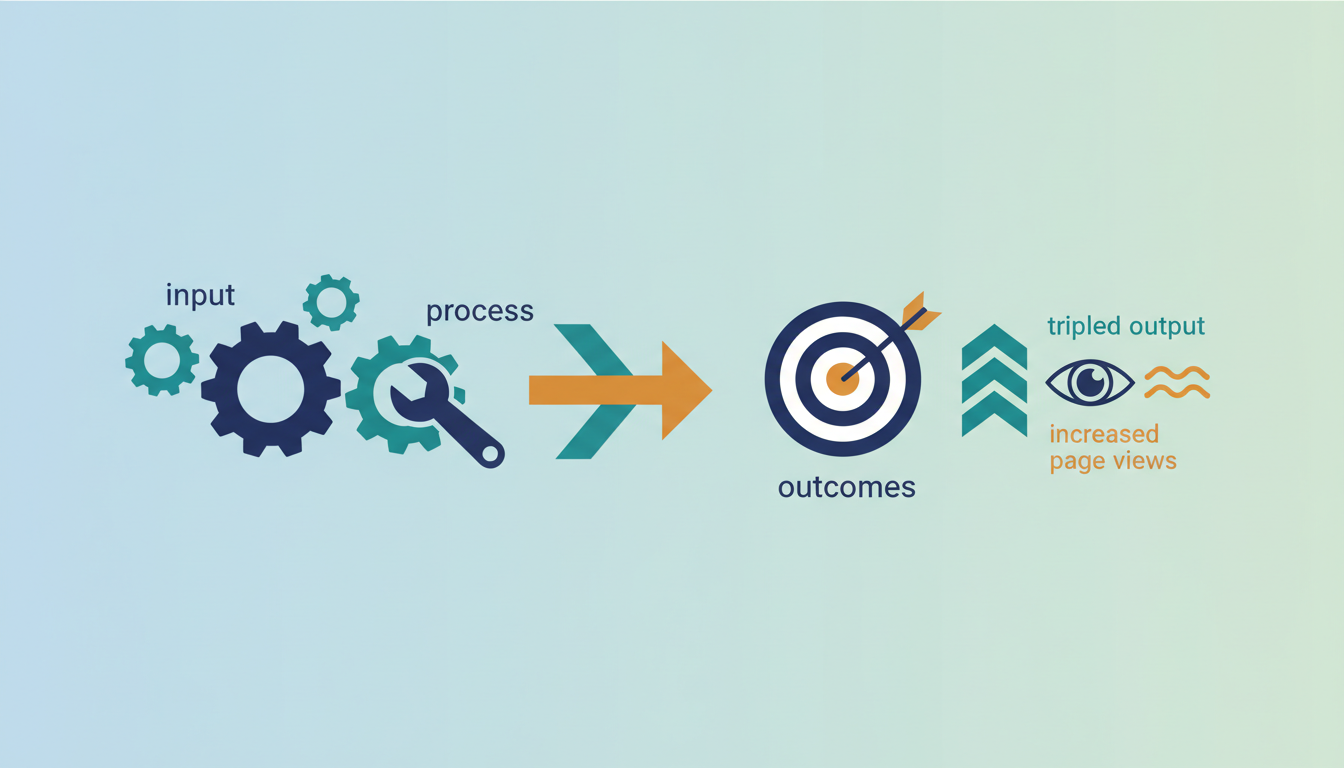
Clarity drives speed when every participant understands their specific role, timeline, and approval checkpoint. Teams increase output volume without degrading quality or triggering burnout once these elements become explicit. Removing the ambiguity that typically stalls production allows for a repeatable sequence scaling effectively across departments. This structural clarity guarantees that assets ranging from landing pages to video scripts consistently meet brand, legal, and UX standards before publication occurs.
Structured workflows establish predictable velocity by moving projects from brief writing through drafting and final edits within set cycles. Organizations frequently incur hidden costs by rewriting existing assets due to poor discoverability when these guardrails disappear. Speed conflicts with governance here; rushing publication often bypasses the validation steps required for long-term consistency.
Automation creates chaos rather than simplified operations when teams adopt tools without first documenting the underlying process. Mapping every handoff before introducing technology helps prevent compounding errors throughout the system. Undefined workflows erode trust in the content system itself rather than simply slowing down production speeds.
Case Study: Tripling Page Views with AI-Assisted Distribution
Indian Express Tamil tripled page views within a 45-day period by embedding AI-assisted optimization directly into their publishing workflow. Integrating AI into workflows transforms static editorial calendars into flexible feedback loops capable of rapid adjustment. The implementation utilized automated triggers that pushed new articles to high-traffic channels immediately upon CMS publication. Generative capabilities for social captions allowed the team to notably reduce the delay between writing and promotion activities.
Measuring content workflow performance in this context requires tracking velocity alongside engagement metrics rather than output volume alone. The substantial increase in traffic demonstrates that throughput combined with targeted distribution drives significant growth. A tension exists between speed and brand voice consistency when relying heavily on automated systems. Automated systems risk propagating tonal errors at scale if human review checkpoints get bypassed for the sake of velocity.
Operational success depends on automation handling frequency while human oversight preserves trust. Teams aiming to replicate this growth should audit their current handoff points between drafting and publishing tools. Mapping these latency gaps before introducing generative agents ensures the pipeline supports rather than bypasses editorial judgment.
Application: The Hidden Costs of Duplication and Outdated Assets
Substantial financial waste occurs when informal workflows prevent teams from locating existing assets, forcing unnecessary rewrites of available material. Distinct groups frequently duplicate efforts on identical topics without a centralized inventory, compounding production costs while diluting brand authority. This opacity creates a specific failure mode where legacy content remains active, contradicting current messaging and confusing customers. Financial impact extends beyond immediate labor costs; the loss of institutional knowledge when employees depart without documented processes increases operational drag notably. Lack of workflow clarity leads to duplication and outdated content; the author notes having seen organizations spend thousands rewriting assets that already exist. Scaling content by simply adding tools without a unified system creates version control errors that further inflate these hidden expenses.
Shifting from ad hoc creation to a governed content lifecycle where every asset has a verified owner and status addresses these issues directly. Organizations remain vulnerable to the high cost of lost comments and fragmented context during reviews without these guardrails in place.
About
Daniel Reyes, Head of Content Engineering at Enterium, defines the structural backbone required to scale modern content operations. With over a decade in data and ML platform engineering, Reyes specializes in building production-grade AI pipelines that move beyond theoretical strategy into executable systems. His daily work involves architecting the exact ingestion, retrieval, and QA gates that constitute a reliable content workflow. At Enterium, a brand dedicated to documenting how teams build and run content with LLMs, Reyes applies rigorous engineering standards to the often-chaotic process of content creation. He understands that without set handoffs and automated quality checks, AI adoption leads to inconsistency rather than scale. This article translates his hands-on experience with pipeline architecture and evaluation harnesses into a practical framework. By treating workflow as a repeatable engineering system rather than an administrative afterthought, Reyes provides the technical clarity B2B leaders need to turn vision into measurable outcomes.
Conclusion
Scaling content production reveals a critical breaking point where velocity without governance accelerates brand erosion rather than growth. While automation handles routine metadata and ideation, the operational cost of bypassing human review manifests as tonal drift and contradictory messaging that confuses customers. Teams often mistake tool adoption for workflow maturity, ignoring the latency gaps between drafting and publishing that allow errors to propagate. This fragmentation forces organizations to pay twice for the same work through duplicated efforts and the silent drain of rewriting existing assets.
Organizations must prioritize mapping their current handoff points before deploying additional generative agents. This specific action prevents the compounding error of creating new material that contradicts established facts or wastes resources on redundancy. True efficiency emerges only when automation supports a set content lifecycle rather than accelerating chaos. By securing these editorial checkpoints now, teams ensure that increased throughput strengthens rather than dilutes their market authority.
Frequently Asked Questions
Ignoring workflows causes expensive duplication and outdated assets. Organizations waste thousands rewriting existing content simply because no one knew where to find or update the original files effectively.
Clear roles and timelines help content move faster with fewer roadblocks. Teams produce more content without sacrificing quality or burning out members by removing these common operational frictions effectively.
B2B tech marketing teams focus on workflows to reduce friction. This priority addresses the chaos of informal processes that often stall production before it truly begins.
Defined workflows guarantee every asset meets brand, legal, and UX standards. This structure creates consistent and trustworthy experiences for customers while enforcing necessary governance before any public release occurs.
Formal workflows prevent spending thousands on rewriting assets that already exist. Clear systems stop duplication issues, ensuring teams do not waste money recreating content due to poor internal visibility.