Content operations: Scale 2k to 60k hotel descriptions
Scaling from 2,000 to 60,000 hotel descriptions without expanding staff proves that operational execution beats abstract planning.
Most organizations fail because they confuse high-level planning with the gritty reality of content operations. While a majority to 60% of marketers lack a practical plan for AI adoption according to Storychief data, successful entities like loveholidays bypass this paralysis by targeting specific workflow bottlenecks. The core argument posits that CMS architecture dictates AI comprehension more than the models themselves, rendering strategy workshops useless if the underlying system cannot support machine readability.
This article dissects the critical divide between deciding what to create and the mechanical execution of tagging, linking, and publishing. You will learn why transformation theater fails where targeted automation succeeds, using the loveholidays case study as a blueprint for efficiency. Finally, the guide outlines a concrete 30-day pilot designed to eliminate high-cost operational chores rather than generate vague promises. By auditing current processes and building minimum viable automations, teams can shift from resisting AI to using it for measurable business outcomes. This approach ensures that your content operations team stops wasting hours on repetitive metadata updates and starts delivering actual value.
The Distinction Between Content Strategy and Operational AI Readiness
Defining AI-Powered Content Operations vs Strategy
AI-powered content operations applies artificial intelligence to execute repetitive tasks like tagging, linking, validating, translating, and publishing rather than defining high-level brand direction. Content strategy determines what to create and why, requiring business judgment and market understanding that algorithms cannot replicate. Content operations handles the mechanical execution required to scale that vision across diverse channels and formats. Most AI initiatives fail at the boundary between content strategy and content operations because teams attempt to automate strategic decisions instead of eliminating expensive operational chores.
Scaling Hotel Descriptions with Operational Automation
Loveholidays scaled from 2,000 to 60,000 hotel descriptions by automating repetitive operational chores rather than refining high-level strategy. This tactical approach bypasses the paralysis facing a majority of marketers who lack a clear, practical plan for AI integration. The mechanism relies on identifying specific execution bottlenecks like tagging or validating, then deploying specialized AI agents to handle these stages independently. By focusing on eliminating manual friction, teams change content from one-off outputs into reusable assets that yield compounding improvements without expanding headcount.
Avoiding Transformation Theater and Strategic Gaps
Transformation theater occurs when organizations prioritize abstract strategy workshops over eliminating specific, high-cost operational chores. This approach creates a dangerous disconnect where leadership demands AI adoption while teams lack a unified plan for execution. Research indicates that a majority of marketers currently operate without a clear, practical plan for how their team uses AI to research, create, improve, distribute, and measure content clear, practical plan. Consequently, ad-hoc automation tools create fragmented workflows that increase technical debt rather than reducing it. The industry is now moving from experimental pilots to standard practice, making 2025 and 2026 critical years for maturing these systems 2025 and 2026.
CMS Architecture as the Primary Determinant of AI Comprehension
Why CMS Architecture Determines AI Comprehension Success
CMS architecture determines AI success more than the underlying model choice. When content lives in UI-based CMSes, artificial intelligence can only write instructions it cannot execute, creating a ceiling on automation potential. Conversely, systems where configuration exists as code allow engines to generate schemas and refactor requirements directly. This distinction dictates whether an organization achieves specialized AI agents that handle production stages independently or remains stuck with chat-based suggestions requiring manual implementation. The mechanism relies on structured access. AI understands content models through explicit schema definitions rather than visual field arrangements. Without API-first endpoints, external tools cannot validate data types or enforce consistency rules across large datasets. Teams attempting to automate workflows on legacy platforms often encounter timeout errors or incomplete updates because the system lacks native execution hooks.
| Architecture Type | AI Capability | Operational Outcome |
|---|---|---|
| UI-First | Read-only suggestions | Manual execution required |
| Code-First | Schema generation | Automated validation |
| API-Native | Full lifecycle control | Autonomous agents |
However, adopting code-centric platforms introduces a learning curve for teams accustomed to drag-and-drop interfaces. The trade-off is initial developer involvement versus long-term scalability. Organizations ignoring this architectural prerequisite risk joining the 42% of enterprises currently experimenting without deploying scalable solutions. The implication for operators is clear: before selecting a model, verify the CMS supports programmatic content manipulation. Enterium recommends auditing current content models for schema exposure prior to pilot initiation.
Auditing AI Readiness with the 15-Point Scoring System
Apply the 15-point assessment to quantify whether your infrastructure supports execution or merely simulation. This metric separates functional readiness from theoretical potential by evaluating schema accessibility and API control. Scores between 12 and 15 indicate AI-native architecture where complex implementations become achievable in weeks rather than months. Organizations in this range possess the API-first foundations required for specialized AI agents to handle different stages of content production independently specialized AI agents. Conversely, a score from 0 to 3 confirms AI theater, where the underlying system was never built for algorithmic interaction. Teams here expend more effort navigating interface limitations than extracting value from automation tools.
| Score Range | Classification | Operational Reality |
|---|---|---|
| 12, 15 | AI-Native | Implementations achievable in weeks |
| 8, 11 | AI-Capable | Significant limitations require workarounds |
| 4, 7 | Legacy-Base | Significant potential remains missing |
| 0, 3 | AI Theater | Architecture blocks automated execution |
The immediate risk for low-scoring teams is misallocated budget; without structural fixes, 95% of initiatives yield no measurable impact because the foundation cannot support the load. If your audit returns below 8, prioritize architectural remediation before purchasing additional model access. Enterium recommends fixing the foundation first to ensure subsequent pilots deliver compounding returns rather than isolated experiments. The mechanism of failure involves the AI attempting to parse unstructured text blobs rather than set fields, leading to hallucinated metadata and broken links. This operational friction occurs because UI-based systems often hide content logic behind layers that automation cannot penetrate without brittle workarounds. Teams attempting to force automation here face a binary outcome where brands that fail to crack the puzzle of true integration get left behind by competitors competitors. The cost is not merely wasted compute but the compounding debt of manual remediation required after every automated run.
| Architecture Type | AI Interaction Mode | Failure Consequence |
|---|---|---|
| UI-First Legacy | Screen scraping or brittle API hooks | High error rate requiring human review |
| Schema-Native | Direct model manipulation | Executable actions with audit trails |
An original analytical insight reveals that high failure rates often stem from conflating content storage with content understanding. A system can store data perfectly yet remain opaque to an agent if the relationships between entities are not explicitly modeled. If an assessment score falls below 8, the author advises fixing the foundation first rather than layering more models on top. The primary operational benefit cited is the elimination of repetitive tasks, which frees teams to focus on higher-level strategy rather than execution mechanics execution mechanics. Organizations must prioritize architectural readiness to avoid sinking resources into pilots destined for obsolescence.
Executing a 30-Day Pilot to Eliminate High-Cost Operational Chores
Defining the 30-Day Pilot Scope for Metadata Automation
Isolate one high-friction workflow like metadata tagging to establish a measurable baseline before introducing automation. Teams should track one week of manual effort to identify consistency rates and skipped tasks rather than guessing at inefficiencies. Consider a publisher releasing 1,000 articles monthly against a catalog of 15,000 items where each update consumes 5 minutes. This manual process creates a clear financial target for reduction. The primary operational benefit is the elimination of repetitive tasks, which frees teams to focus on higher-level approach rather than execution mechanics. Establish a go/no-go decision rule requiring measurable quality retention and significant time savings to proceed. Defining these scope boundaries explicitly helps prevent pilot drift into unmeasurable strategic planning.
Calculating ROI and FTE Capacity from a 90-Day Automation Path
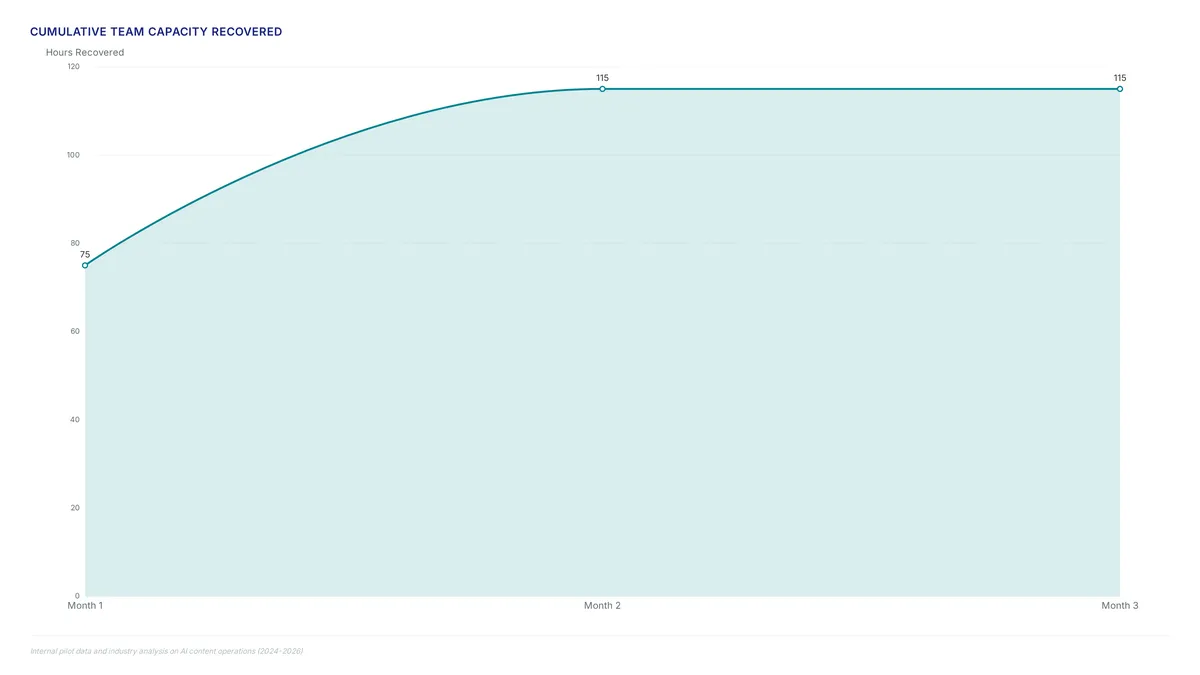
Converting manual minutes into dollar savings requires tracking cumulative hourly reductions across a 90-day progression. Start by documenting the baseline where a single chore consumes 5 minutes per asset, then layer additional automations monthly to compound capacity gains.
- Month 1: Eliminate the primary bottleneck to recover 75 hours of team capacity.
- Month 2: Target a secondary workflow like metadata tagging to save an additional 40 hours.
- Month 3: Connect isolated chores into a unified workflow, reaching 115 hours in total monthly savings.
By Month 3, the total savings reach 115 hours monthly, creating 0.66 FTE of capacity. Traditional methods demand hours of manual work per asset, whereas automation reduces this temporal cost to minutes.
| Phase | Hours Recovered | Cumulative FTE |
|---|---|---|
| Month 1 | 75 | 0.43 |
| Month 2 | 40 | 0.66 |
| Month 3 | 115 | 0.66 |
The limitation is that savings only materialize if teams connect disjointed tasks rather than automating single steps in isolation. Focusing on workflow cohesion ensures the 0.66 FTE figure translates to actual strategic output.
Act 1 vs Act 2: Distinguishing Cost Reduction from Operational Rewiring
Distinguish immediate efficiency gains from structural capability shifts by categorizing AI adoption into two distinct phases. Act 1 focuses on making old things cheaper, effectively reducing the temporal cost of existing workflows from hours to minutes. This approach delivers quick wins but often leaves the underlying operational chore intact, merely accelerating a flawed process. Teams risk stalling here if they measure success solely by speed rather than systemic change. Act 2 rewires how you operate by enabling previously impossible capabilities within your content stack. The goal is deploying dozens of agents working autonomously rather than simple accelerators. This shift moves beyond cost reduction to strategic advantage, where automation handles context-aware tasks that humans previously skipped due to volume constraints.
| Feature | Act 1: Cost Reduction | Act 2: Operational Rewiring |
|---|---|---|
| Primary Goal | Accelerate existing tasks | Enable new capabilities |
| Metric | Time saved per asset | New workflows enabled |
| Risk | Superficial optimization | Complex integration debt |
| Outcome | Quicker execution | Strategic capacity |
- Audit current workflows to identify repetitive metadata work consuming excessive hours.
- Pilot a single 30-day automation to validate time savings against quality thresholds.
- Scale successful pilots into permanent infrastructure rather than temporary fixes.
The critical failure mode for pilots occurs when teams optimize a process that should not exist in its current form. Fix a stalled AI pilot by abandoning broad strategy workshops in favor of eliminating one specific, expensive operational chore. Successful companies identify one repetitive problem and eliminate it, moving from "transformation theater" to actual improvement.
Scaling Operational Efficiency from Pilot to Permanent Practice
Defining the Pilot to Practice Transition in 2025
Connecting research, creation, distribution, and measurement into one unified plan defines the shift from experimental pilots to standard practice. Teams must rewire how they operate entirely instead of chasing simple cost reduction. This maturity curve demands content structures clear enough for generative engines to reuse assets without excessive crawling. AI-powered approaches have reduced content production time from hours of manual work per asset to mere minutes, representing a drastic efficiency shift in operations. Automation remains fragile and prone to failure during scale-up without this architectural clarity. Legacy workflows often lack the structured metadata required for these gains. Operators treating AI as a mere drafting tool will fall behind competitors who integrate it into their operational backbone. Ad-hoc AI use will be insufficient by 2027, making the transition a matter of survival rather than optimization. Auditing current content models for machine readability before expanding pilot programs is the concrete next step.
Application: Executing the 90-Day Path to Capacity
Month 1 delivers significant time savings by automating a single high-volume chore like metadata tagging. This initial win validates the technical approach without requiring broad organizational change. The second month targets a distinct operational bottleneck, recovering additional hours through similar workflow automation patterns. Teams achieving these speed metrics shift production from hours per asset to mere minutes. Connecting these isolated scripts into a unified content workflow by Month 3 yields substantial monthly capacity. This total allows teams to reallocate labor toward strategic oversight rather than manual execution.
| Phase | Target Action | Cumulative Savings |
|---|---|---|
| Month 1 | Automate one expensive chore | 75 hours saved |
| Month 2 | Eliminate second repetitive task | Additional 40 hours saved |
| Month 3 | Integrate into full workflow | Unified workflow capacity |
Operators must verify that their CMS architecture supports structured AI operations before compounding automations. Scaling scripts leads to unmanageable technical debt rather than efficiency without this architectural readiness. The compound effect of these savings creates tangible workforce capacity only when the foundation remains stable under increased load.
Application: Act 1 Cost Reduction vs Act 2 Operational Rewiring
Act 1 reduces the cost of existing tasks, whereas Act 2 rewires operations to enable previously impossible capabilities. Teams stuck in Act 1 simply execute current work quicker without changing the underlying workflow structure. This approach yields immediate efficiency but fails to enable new strategic value streams. Act 2 uses sophisticated algorithms to achieve flexible personalization at a volume that manual processes cannot support. The distinction defines whether an organization merely survives the transition from pilot to practice or truly matures its operational model.
Most teams begin by automating repetitive chores to free up capacity for higher-level strategy. Stopping at speed improvements leaves the fundamental content architecture unchanged and limited. The real advantage emerges when operators use reclaimed time to rewire how content functions across the enterprise. Moving from experimental pilots to established standard practice requires this deeper structural shift rather than superficial speed gains. Organizations must choose between making old things cheaper or building systems that do new things entirely.
About
Daniel Reyes serves as Head of Content Engineering, where he architects production-grade AI pipelines from ingestion to publication. His daily work building RAG systems and evaluation harnesses directly informs this guide's pragmatic stance on content operations. Unlike strategists who theorize about AI, Reyes engineers the actual workflows, tagging, validating, and orchestrating LLMs, that the article identifies as the critical failure point for most initiatives. At Enterium, a brand dedicated to documenting how modern teams scale content with vendor-neutral rigor, Reyes applies his decade of ML platform experience to separate "transformation theater" from functional automation. This piece reflects his hands-on approach to solving repetitive operational bottlenecks rather than debating high-level strategy. By grounding the discussion in real pipeline architecture and quality gates, Reyes connects the theoretical divide between content strategy and operations to the tangible engineering decisions required to ship reliable, automated content systems today.
Conclusion
Scaling content operations beyond the pilot phase exposes a critical fracture: speed without structural integrity creates unmanageable technical debt. While Act 1 automation lowers unit costs, it fails to solve the fragility of legacy workflows under increased load. The industry shift from experimental pilots to established practice in 2025 demands that teams prioritize architectural readiness over mere velocity. Without this fundamental rewrite, organizations risk joining the majority of initiatives that yield no measurable impact despite significant investment. True operational maturity requires moving beyond simple task acceleration to enable flexible personalization that manual processes cannot support.
Leaders must commit to a 30-day pilot focused strictly on validating CMS architecture for structured AI operations before deploying broader automations. This specific window allows teams to measure reductions in manual metadata tagging and confirm system stability. Do not expand your automation scope until your underlying platform proves it can handle structured data flows without collapsing into chaos. Start this week by auditing your current CMS configuration against the requirements for structured AI operations (content operations) to ensure your foundation supports Act 2 rewiring rather than just quicker Act 1 execution.
Frequently Asked Questions
Most initiatives fail because teams automate strategy instead of operations. Without structural fixes, 95% of these projects yield no measurable impact on efficiency or cost.
Between 53% and 60% of marketers lack a practical plan for AI adoption. This paralysis prevents teams from targeting specific workflow bottlenecks like metadata updates.
Only 40% to 47% of marketers possess a clear plan for integrating AI into workflows. This gap leaves most organizations unable to distinguish strategy from execution.
Legacy systems frequently reject structured data inputs from specialized AI agents. This incompatibility causes pilot programs to stall before they can eliminate expensive operational chores.
Automation shifts focus from manual updates to high-level strategy execution. This approach bypasses the confusion facing the 53% to 60% who lack clear direction.
References