Headless CMS: Why Manual Workflows Fail AI Scale
Manual workflows collapse under AI scale because they cannot deliver the machine-readable content structure required for modern indexing. The industry is rapidly shifting toward "AI Visibility," where the primary goal of publishing expands beyond human readership to ensure content is cited by generative models. This transition demands a move away from rigid monolithic systems toward flexible headless CMS architectures that treat content as raw data rather than formatted pages.
Traditional platforms tether content to specific presentation layers, creating silos that prevent efficient ai model retrieval optimization. By decoupling the backend from the frontend, teams can implement automated content publishing pipelines that feed structured data directly into large language models and search engines.
Readers will learn how headless architecture enables the three-layer stack necessary for high-volume ai content generation. Finally, the analysis compares these approaches to demonstrate why manual intervention fails to meet the speed and precision required for ai-powered content workflow success in 2026.
The Role of Headless Architecture in Modern AI Publishing
Headless CMS AI Publishing: Decoupling Creation from Delivery
Headless CMS AI publishing functions as an architectural pattern that strictly separates content creation from delivery to enable genuine automation. Monolithic systems fuse the database and presentation layer, whereas this model exposes content as raw data via APIs. Such decoupling allows AI agents to generate, optimize, publish, and index material programmatically without requiring human interaction with a visual editor. The definition of structured content in this context shifts from HTML blobs meant for browsers to machine-readable payloads designed for model retrieval. Traditional workflows fail at AI scale because they rely on manual entry points that cannot match the throughput of generative models.
From Manual Workflows to Workflow Orchestration for SEO Teams
Workflow orchestration replaces linear manual editing with parallelized API calls that trigger generation and indexing simultaneously. Traditional SEO teams often stall at the visual editor, creating a bottleneck where content velocity cannot match generative model throughput. Moving to an orchestrated pipeline allows operators to standardize keyword coverage and internal linking logic across thousands of pages without human intervention. Technical product teams build automation workflows that connect ideation, programmatic SEO, drafting, review, publishing, and distribution loops. These blueprints emphasize treating content as a build pipeline with versioned artifacts and acceptance tests. Automation handles structured data delivery that manual entry cannot sustain.
| Feature | Manual Workflow | Orchestrated Workflow |
|---|---|---|
| Throughput | Limited by human typing speed | Limited by API rate limits |
| Consistency | Variable, prone to drift | Enforced via code logic |
| Indexing Lag | Dependent on manual cycles | Near real-time via API |
Implementing validation gates at the API ingress point ensures only compliant payloads reach the publication layer.
AI Visibility vs Traditional SEO: Targeting Citations Over Rankings
AI visibility prioritizes machine-readable structures to ensure content is available for citation by generative engines. The industry focus is expanding beyond traditional human-centric SEO to ensure content is cited by generative AI search engines. This shift requires structured content delivery that favors semantic clarity rather than keyword density alone.
| Feature | Traditional SEO | AI Visibility |
|---|---|---|
| Primary Target | Human browsers | Generative models |
| Success Metric | Search rankings | Citation frequency |
| Content Format | HTML blobs | Machine-readable JSON |
| Optimization Goal | Keyword matching | Contextual relevance |
Content automation is transitioning from simple text generation to thorough workflow orchestration that handles strategic tasks previously served for human editors. Approximately 71% of organizations now regularly use gene Generative AI in at least one business function, with marketing and sales among the most commonly cited applications, signaling a departure from manual editing cycles. Legacy monolithic systems often lack the API-first flexibility required for this volume of structured output. Operators must rearchitect pipelines to serve machine-readable payloads instead of visual pages. A headless approach decouples creation from presentation, allowing agents to index material programmatically. Modern platforms demonstrate how native AI capabilities accelerate this pipeline from planning to organization, such as when Cometly used Sight AI to publish a live listicle. Ignoring this architectural split results in an inability to participate in the emerging citation economy. Validating all automated outputs against strict quality gates before publication remains a necessary step for maintaining trust and accuracy.
Inside the Three-Layer Stack Powering Automated Content
The Three-Layer Stack: Repository, AI Agents, and API Delivery
Separating content storage from generation logic removes the tight coupling found in monolithic systems. Layer 1 functions as the Content Repository, where a headless CMS stores entries as structured data with set taxonomies rather than HTML blobs. This separation removes the presentation layer entirely, allowing the system to function as a backend-only source of truth. Layer 2 introduces specialized AI Agents that consume this structured input to generate variations without altering the original record. These agents operate asynchronously, ensuring that generation latency never blocks the write path of the repository. Layer 3 handles API Delivery, exposing content via JSON endpoints optimized for machine retrieval instead of human browsing.
Executing the Six-Step Pipeline from Keyword Research to Sitemap Updates
Execution begins when distinct agents handle research, outlining, drafting, SEO optimization, internal linking, and schema markup in a strict sequence. This multi-agent model prevents context contamination between the research phase and the final draft. Each agent operates on structured JSON rather than raw text, enforcing schema compliance before the next stage accepts the payload. The system treats content as a build pipeline with versioned artifacts, requiring human sign-off only after automated lint rules verify density limits and heading validity.
- Ingestion: Raw keyword data enters the repository as structured entries.
- Generation: Specialized agents draft content segments asynchronously.
- Validation: Linters check brand voice against style embeddings.
- Assembly: The system compiles segments into a complete document.
- Publication: An API call pushes the final JSON to the edge.
- Indexing: An automated sitemap update triggers immediately upon publication.
The automated sitemap update ensures search crawlers discover new pages the moment the API confirms a successful write. This mechanism eliminates the latency gap where content exists but remains invisible to indexing bots. Structured content serves as the foundation for these workflows, enabling reliable operations where manual entry would fail under scale. Operators must note that asynchronous generation introduces eventual consistency; the repository may temporarily hold a draft state while the SEO agent completes its pass. This delay is a feature, not a bug, as it prevents premature indexing of unoptimized drafts. To maintain quality, teams should configure the pipeline to require citation tags and fact-check tasks, ensuring only accurate, machine-readable content reaches the public API.
SEO Versus GEO: Divergent Optimization Targets for Crawlers and Generative Models
Traditional SEO prioritizes crawlability through keyword density and page speed to satisfy indexer bots. In contrast, Generative Engine Optimization (GEO) focuses on making content citable by AI models through clear entity definition, authoritative sourcing, direct answers, and structured formats. The three-layer stack addresses both by separating raw data from presentation logic. Layer 1 stores content as structured entries, while Layer 2 agents apply specific optimizations for each target audience without duplicating effort.
| Feature | SEO Target | GEO Target |
|---|---|---|
| Primary Goal | Discoverability | Citability |
| Key Signal | Backlinks | Entity Definition |
| Format | HTML Tags | Structured JSON |
| Validation | Crawler Access | Source Attribution |
Optimizing for generative models often requires stricter schema adherence than traditional search engines demand. A common failure mode occurs when teams assume high SEO scores guarantee visibility in AI answers, yet the underlying data lacks the semantic relationships models need for retrieval. The cost of this gap is measurable in lost referral traffic as queries shift to direct answers. Teams should implement distinct validation gates for each optimization path within their pipeline. Effective workflows automate checks for keyword stuffing and broken headings while keeping a human in the loop for final sign-off. This dual-validation approach ensures content remains visible regardless of how users access information.
Comparing Monolithic and Headless Workflows for Scale
Throughput Caps and Indexing Lag in Traditional CMS
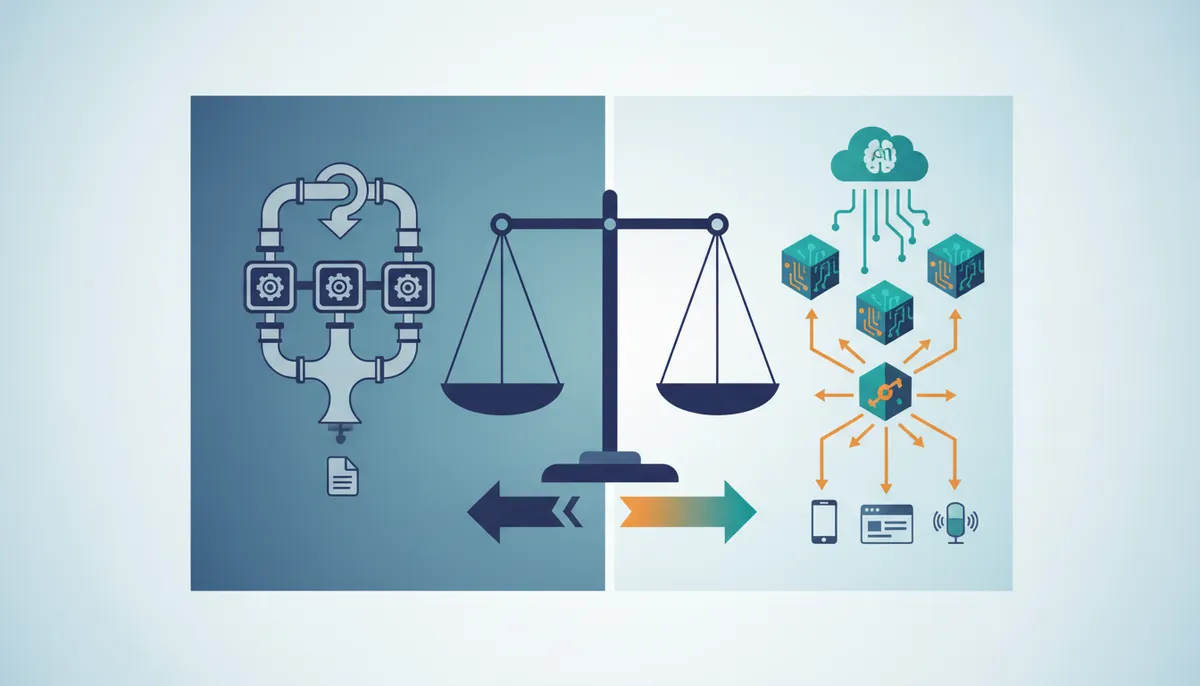
Traditional workflows often struggle when scaling from five articles a week to fifty due to reliance on manual processes. Teams cannot sustain high-velocity output when every asset demands direct operator action. Indexing delays compound this bottleneck because traditional workflows often depend on routine crawl cycles. Content sits dormant in the database while search engines wait for their next scheduled pass. The latency between publication and discovery renders real-time optimization difficult.
| Dimension | Traditional Workflow | Headless Workflow |
|---|---|---|
| Publishing Trigger | Manual Click | API Call |
| Indexing Speed | Dependent on Crawl Cycles | Optimized for Speed |
| Scalability | Linear (Labor Bound) | Exponential (Compute Bound) |
Data indicates that 94% of digital leaders plan to increase investment in AEO in 2026 as discovery shifts to AI-generated answers. Yet legacy systems physically cannot support the velocity required for this shift. The structural inability to push updates instantly means competitors using API-driven architectures may dominate visibility windows. Without this separation, organizations remain trapped in slow, labor-intensive cycles that fail modern scale requirements. The cost of maintaining manual publishing bottlenecks exceeds the engineering effort required to automate them.
Operationalizing Headless CMS for 2026 AI Visibility
Switching to a headless CMS for AI content removes the presentation layer bottleneck that stalls indexing in monolithic systems. This architecture decouples content storage from delivery, allowing APIs to push structured data directly to downstream consumers without waiting for page renders. Brands cited by AI models and ranked in search in 2026 and beyond are those building these pipelines today. The operational shift enables quicker synchronization where traditional platforms lag behind routine crawl cycles.
While traditional setups force teams to manually tag and submit every asset, headless systems automate structured delivery through machine-readable endpoints. Used strategically, AI becomes less about replacing SEO fundamentals and more about scaling them, helping teams focus on the work that drives performance: technical accuracy, content quality, and search experience optimization. The limitation is that migrating requires re-engineering the entire content schema rather than just swapping editors. Teams must define strict validation gates to prevent unverified data from polluting the knowledge graph. The immediate next step is mapping existing content fields to a neutral JSON schema compatible with multiple downstream consumers.
The AI Visibility Gap and Fragile Plugin Configurations
Structured data delivery determines whether generative models retrieve your content or ignore it entirely. Content not structured for machine retrieval is less likely to be visible to AI models, creating a hard ceiling on brand presence in automated answers.
The manual process caps operations even when AI can theoretically produce more pages in a day than a small team could publish in a month. This disconnect creates a scenario where generation speed outpaces publication capacity, leaving high-volume assets stuck in draft queues.
| Constraint | Monolithic Plugin Approach | Headless API Architecture |
|---|---|---|
| Integration Stability | Breaks on core updates | Stable via decoupled endpoints |
| Throughput Limit | Human-dependent | Infrastructure-bound |
| Data Format | Rendered HTML | Native JSON |
Meanwhile, the critical failure mode here is not generation quality but delivery latency. While AI agents scrape constantly, unstructured or delayed content misses the initial context window formation. Operators must choose between patching broken plugins or rebuilding the publishing pipeline for machine-first delivery.
Building a Scalable AI Publishing Pipeline in Five Steps
Defining the Five Core Capabilities of a Headless AI Stack
A functional AI publishing pipeline requires four distinct technical capabilities rather than a single monolithic tool. The foundation is a headless CMS with strong API access, enabling decoupled content delivery across multiple channels. This architecture supports the multi-agent AI workflows necessary for generating structured, machine-readable content at scale. Without this separation, content remains trapped in presentation layers that generative AI platforms cannot efficiently parse. Operators must integrate automated indexing mechanisms to push sitemap updates and IndexNow pings immediately upon publication. This step ensures new content enters search indexes without waiting for traditional crawl cycles.
Execute the pipeline by aligning keyword research with prompt engineering to capture both search volume and generative query patterns. This initial phase defines the structural constraints for downstream agents, ensuring generated text matches specific entity requirements rather than generic topic coverage. Multi-agent generation follows, where specialized models draft content segments that adhere to strict schema definitions before human review. Operators apply GEO optimization rules to embed local context signals directly into the machine-readable structure. API-based publishing moves the validated payload from staging to the production headless CMS without manual editor interaction.
Wisp CMS documentation confirms that integrating keyword research directly into AI drafting reduces manual revision time significantly. The final takeaway for operators is clear: manual intervention after the generation step reintroduces the very latency the pipeline aims to eliminate. Success depends on maintaining strict acceptance tests within the workflow to block non-compliant content before it reaches the API endpoint.
Validating AI Visibility Metrics Beyond Traditional Rankings
Traditional crawl coverage fails to capture whether generative models actually retrieve your content during inference. Teams must query AI platforms directly to measure mention frequency and sentiment analysis rather than inferring visibility from organic traffic logs. This validation layer tracks three distinct metric categories: standard SEO performance, indexing speed set as time from publish to index, and cross-platform AI visibility. Relying solely on server logs creates a blind spot where content appears indexed but remains invisible to large language model retrieval systems.
| Metric Category | Traditional Method | AI Visibility Requirement |
|---|---|---|
| Detection | Crawl bots | Direct platform querying |
| Latency | Days to index | Seconds via IndexNow |
| Context | Keyword density | Sentiment and entity linking |
Operators should implement a continuous validation loop using the following configuration logic:
The cost of this approach is increased API overhead, yet it prevents the scenario where optimized content sits idle in a vector database. Enterprises using native AI capabilities within their content pipelines can reduce the gap between publication and model availability. Without this specific validation step, teams cannot distinguish between a ranking algorithm update and a total retrieval failure.
About
Arjun Patel is an Applied LLM Engineer who specializes in benchmarking LLM providers and RAG architectures for high-volume content workloads. His daily work involves rigorously testing inference economics, latency, and output quality across substantial models, making him uniquely qualified to analyze why manual workflows fail when scaling AI publishing. In building and evaluating content pipelines, Arjun observes firsthand how traditional CMS architectures create bottlenecks that prevent machine-readable content structure necessary for AI search visibility. At Enterium, a B2B publication dedicated to documenting reproducible content automation methodologies, he applies this engineering rigor to dissect headless CMS integration. Unlike generic strategists, Arjun connects API-first content management directly to the technical requirements of AI model retrieval optimization. His analysis stems from practical experience configuring the very automated content publishing systems discussed, offering practitioners concrete data on transitioning from legacy tools to scalable, structured content delivery systems designed for the AI era.
Conclusion
Scaling AI visibility exposes a critical fracture: content that passes human editorial standards often fails machine retrieval due to latent semantic gaps. The operational burden shifts from simple publication to maintaining continuous retrievability, where the cost of ignorance is total invisibility to generative models. Organizations must stop treating indexing as a passive background task and instead enforce active validation loops that query AI platforms directly. Relying on traditional crawl logs creates a dangerous false positive, masking the reality that your assets may be technically indexed but logically inaccessible to large language models.
Teams should mandate a dual-layer verification protocol within the next thirty days, requiring that every high-value asset proves its presence in both standard search indexes and generative citation pools. This is not merely an SEO tweak but a fundamental restructuring of how value is measured in a headless architecture. You cannot optimize what you do not explicitly measure through direct platform interaction. Begin this week by selecting your top ten performing articles and running them through a direct citation check against substantial generative engines to establish a baseline for your current AI visibility gap. This immediate audit reveals whether your content pipeline actually delivers machine-readable value or simply stores data.
Frequently Asked Questions
Manual entry points cannot match generative model throughput speeds. Approximately 71% of organizations now regularly use gene tools that overwhelm rigid systems, causing bottlenecks where content velocity fails to meet indexing requirements for modern search visibility.
It exposes content as raw data via APIs for direct model access. This shift ensures machine-readable payloads replace HTML blobs, allowing 94% of digital leaders to plan increased investment in structures that optimize for ai model retrieval optimization effectively.
Visual editors create bottlenecks that stop parallelized API calls from functioning. Orchestrated pipelines allow teams to standardize keyword coverage across thousands of pages without intervention, ensuring structured data delivery matches the speed required for ai-powered content workflow success.
Strong schema validation at the API gateway stops malformed entries. Without strict content typing at ingestion, the orchestration layer propagates errors faster than humans can correct them, ruining the machine-readable content structure needed for reliable indexing results.
Decoupling removes the visual interface as a bottleneck for data flow. This allows AI agents to generate and publish material programmatically, enabling the three-layer stack necessary for high-volume ai content generation that traditional monolithic systems simply cannot support.
References