LLM content strategy: build scalable workflows
Seventy-nine percent of businesses report increased content quality using AI, proving LLM content strategy works when executed with discipline. You will learn how to construct scalable workflows that align publishing systems with semantic SEO signals while avoiding the content decay plaguing undisciplined adopters.
Adoption without architecture is just noise. Data indicates 68% of organizations achieve higher ROI through AI-enabled workflows, but only when they replace experimental prompting with systematic production. The gap between clutter and clarity comes down to prompt engineering and editorial oversight. Teams must integrate entity optimization and user-intent signals into every drafting stage. Without clear structured workflows, your CMS becomes a repository of misaligned drafts. Automation should serve credibility and efficiency, not dilute brand voice with generic output.
The Role of Large Language Models in Modern Content Ecosystems
Defining LLM Content Creation Strategy and Transformer Architecture
An LLM Content Creation Strategy is a structured methodology to plan, draft, optimize, and repurpose content at scale. Generative models are pattern-recognition engines predicting token sequences, not autonomous authors with linguistic comprehension. Their foundation is the 2017 advance known as Transformer architecture, detailed in Attention Is All You Need by Vaswani et al. This enables parallel processing of entire word sequences rather than linear token generation.
Statistical probability drives these systems, not meaning. Consequently, the definition of prompt engineering shifts from creative writing to precise constraint specification. Operators must define strict output schemas to mitigate the risk of fluent but factually ungrounded text. Raw generation speed conflicts with the necessity for human verification loops. Combining automation with human oversight ensures scalability, credibility, and efficiency.
According to Semrush, 79% of businesses report an increase in content quality thanks to AI, and 68% achieve higher ROI when they adopt AI-enabled content workflows. Teams increasingly apply multi-LLM aggregation platforms to switch between models like GPT-4 or Claude within a single interface, reducing subscription fatigue while maintaining access to specialized capabilities. Deploy human-AI hybrid workflows where algorithms handle drafting volume and humans enforce semantic precision.
Applying Semantic SEO and Entity Optimization in AI Workflows
Semantic SEO aligns publishing systems with entity graphs rather than isolated keywords to satisfy LLM retrieval patterns. Organizations evaluating AI integration should note that 85% of marketers now use AI in content creation as of 2025, indicating widespread adoption of LLM tools in professional workflows. Structured data markup explicitly defines content context for machine readers. Sites implementing this technical requirement see improved visibility in AI responses because structured data helps LLMs understand content context more effectively than unstructured text.
General-purpose writing assistants often lack the specific entity mapping required for high-fidelity output compared to niche solutions. There is a cost: increased initial setup time for schema definition versus generic draft speed. Teams adopting human-AI hybrid workflows where humans handle creative refinement while LLMs manage drafting mitigate this risk effectively. Brands risk missing opportunities to appear in AI-driven citations despite high output volume without this division of labor.
Raw generation volume matters less than machine readability. Brands ignoring entity optimization may struggle to maximize their visibility metrics regardless of content quantity. Experts recommend auditing current schemas before scaling production pipelines.
Validating Human Oversight and Co-Creator Methodologies
Validating LLM output requires human approval gates before any draft reaches publication systems. This checkpoint ensures generative tools function as co-creators rather than autonomous replacements, preserving brand voice while scaling volume. Risk of unchecked automation errors increases proportionally with such high adoption rates across the industry. Teams recognizing the nuances of LLM content creation understand that maintaining quality through verification is necessary for building trust. Final editorial authority within the publishing pipeline determines operational success.
Introducing manual review stages balances total output velocity with the need for accuracy. Augmentation yields higher quality than replacement strategies alone, making this friction necessary. Operators should configure their systems to include review stages for specific topic sensitivities. Experts recommend implementing a dual-signoff rule for all technical or financial claims generated by models. Structural friction prevents costly reputational damage from plausible but incorrect statements. Four distinct review layers often provide sufficient coverage for enterprise needs. Six specific trigger words can flag content for mandatory human intervention. Five key metrics track the efficacy of these oversight mechanisms over time.
Architectural Differences Between Human and AI-Generated Content Workflows
From Linear Drafting to Systemized Engines in Content Pipelines
Manual content creation struggles to keep pace with demand, forcing a shift toward systemized engines where writers guide strategy rather than execute line-by-line drafting. This architectural pivot transforms operations from a linear bottleneck into a scalable workflow where AI removes the blank page but never the writer. In this model, humans define constraints while models handle high-volume drafting and summarization tasks. The mechanism relies on prompt-based mapping to answer user queries at specific discovery stages instead of following rigid funnel steps.
Strategic syndication campaigns require a 60-90 day timeline to effectively increase brand mention frequency across substantial LLMs, setting a realistic expectation for results that linear planning often misses. Brands expecting immediate visibility gains frequently abandon valid strategies prematurely because they ignore this latency. Writers now guide strategy while LLMs produce high-quality output at scale, which explains why content operations evolved into this systemized engine.
Network operators and content architects must treat content as a build pipeline with versioned artifacts and acceptance tests. Teams implement guardrails for hallucinations and enforce density limits via lint rules before human review occurs. Such measures ensure that 2026 deployments shift from intuition-based approaches to rigorous measurement and tracking methodologies. Operational success depends on adopting a human-in-the-loop workflow where the system enforces consistency, not the editor.
Mitigating Hallucinations and Tone Fluctuations in Predictive Engines
Predictive engines generate confident but false information when pattern recognition fills data gaps with fabricated tokens. This Hallucinations failure mode stems from the model's inability to distinguish between high-probability syntax and factual accuracy. Operators mitigate this risk by implementing Retrieval-Augmented Generation (RAG), which forces the system to ground responses in verified external documents rather than internal weights. Fetching context before generation adds seconds to response time, creating a latency cost. Off-Brand Output proliferates as the model defaults to generic training distributions without this constraint.
Style volatility manifests when outputs fluctuate between academic and casual registers due to inconsistent training signals. Solving Inconsistent Tone or Style requires strict prompt engineering that defines persona constraints and provides few-shot examples of desired voice. Technical workflows can be configured to automatically generate platform-specific briefs, ensuring Instagram briefs maintain visual storytelling focus while LinkedIn posts adhere to professional.
| Failure Mode | Root Cause | Primary Mitigation |
|---|---|---|
| Hallucinations | Pattern completion without grounding | Retrieval-Augmented Generation |
| Tone Fluctuation | Mixed training data signals | Few-shot prompt examples |
| Repetition | Probability loop convergence | N-gram blocking |
LLMs handle drafting while humans focus on big-picture strategy, augmenting creators rather than replacing them. This division of labor addresses the black box problem by keeping final editorial authority with human operators. Brands ignoring these structural guards risk publishing Misinformation at Scale, where errors duplicate across hundreds of landing pages instantly. Effective strategies establish mandatory human-in-the-loop checkpoints where humans focus on creative refinement and emotional nuance before any automated draft reaches publication systems. Verification costs less than the reputational damage of unverified synthetic content.
Deploying RAG and Context-Rich Prompts to Enforce Brand Consistency
Retrieval-Augmented Generation enforces brand consistency by grounding model outputs in verified internal documents rather than relying solely on parametric memory. This architecture mitigates Inconsistent Tone or Style by forcing the system to reference approved style guides and previous high-performing assets during inference. Operators configure pipelines to ingest brand-specific corpora, ensuring the model mimics established voice patterns instead of defaulting to generic training distributions.
Solutions for Repetition & Redundancy include implementing N-gram blocking and crafting context-rich prompts that explicitly define structural constraints. Teams can automate platform-specific briefs, such as generating Instagram copy focused on visual storytelling or LinkedIn posts with professional tones, demonstrating the programmability of LLM outputs through workflow automation. Fetching external context before generation adds seconds to response time compared to standard completion, representing a clear latency constraint.
| Configuration | Mechanism | Outcome |
|---|---|---|
| RAG Pipeline | Queries vector store before generation | Reduces hallucinations, enforces facts |
| Context Prompts | Includes tone examples in system message | Stabilizes voice, prevents drift |
| N-gram Blocking | Penalizes repeated token sequences | Eliminates looped phrases |
Augmentation of creators defines the dominant trend, where LLMs handle drafting while humans focus on creative refinement and emotional nuance in human-AI hybrid workflows. Off-Brand Output proliferates as the model reverts to average internet syntax without these technical guardrails. Successful scaling requires deploying strict retrieval constraints and context-rich prompts to maintain editorial integrity as volume increases.
Constructing Scalable LLM Workflows with Governance and Quality Controls
Defining the Four-Stage AI-Enabled Content Workflow
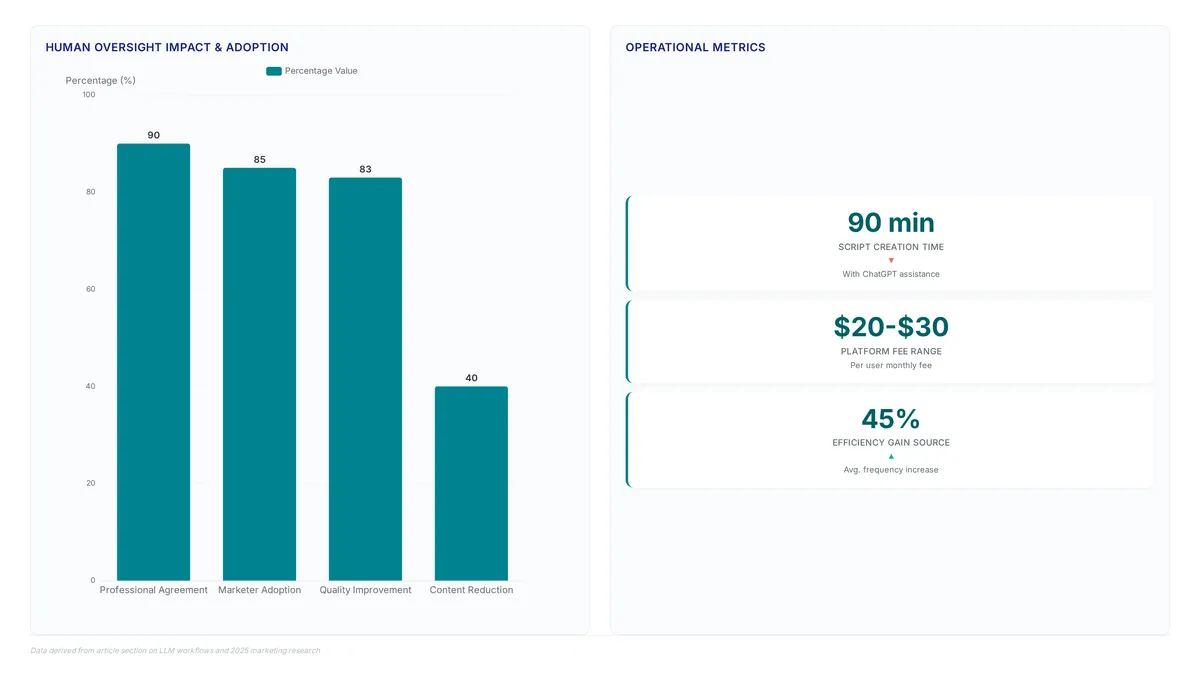
The production pipeline segments operations into Planning, Drafting, Editing, and Repurposing to maintain governance at scale. This structure isolates failure modes, ensuring that hallucination risks in the drafting phase do not pollute the final published asset without human verification. Studies show that 90% of professionals agree human editing significantly improves the quality of AI-generated content when routed through this specific governance funnel. The mechanism relies on distinct handoff points where context switches from strategic intent to syntactic generation.
- Planning & Outlining: Systems map prompt-based queries to user pain points rather than linear funnel stages.
- Drafting: Models generate initial token sequences using constrained temperature settings to reduce variance.
- Editing: Human operators apply brand voice filters and fact-check against source truth.
- Repurposing: Engines convert single long-form assets into multiple platform-specific derivatives.
| Stage | Primary Actor | Risk Vector |
|---|---|---|
| Planning | Human Strategist | Misaligned intent |
| Drafting | LLM | Hallucination |
| Editing | Human Editor | Tone drift |
| Repurposing | Automation | Context loss |
A critical limitation exists in the editing gate; if human review capacity lags behind generation speed, the backlog creates a bottleneck that negates throughput gains. The dominant trend is not the replacement of humans but the augmentation of creators; LLMs handle drafting and summarization while humans focus on big-picture strategy, creative refinement, and emotional nuance.
The structural cost of this approach is increased latency per asset, trading raw speed for verified accuracy. While video script creation tasks that previously took significantly longer can be completed in ninety minutes with ChatGPT assistance, representing a measurable efficiency gain, maintaining quality requires balancing this speed with human oversight.
Executing Prompt Engineering with Role Goal Tone Format
Structured prompting requires defining Role, Goal, Tone, and Format to convert generic LLM outputs into brand-consistent drafts. Direct instructions within this framework improve precision, scalability, and efficiency by constraining the model's probabilistic generation. Without these explicit boundaries, systems default to generic training distributions, creating the tone volatility that forces editors to rewrite rather than refine.
- Define Role: Assign a specific persona, such as "senior technical editor," to anchor the voice.
- Set Goal: State the exact objective, like "explain RAG architecture to network engineers."
- Specify Tone: Mandate "practitioner-to-practitioner" phrasing to avoid marketing fluff.
- Format: Define the output structure (e.g., Markdown table, bulleted list).
Editorial oversight remains the primary defense against search penalties following Google's March 2024 update, which aimed to fight AI-generated copycat content and resulted in a 40% reduction in mass-produced low-value material. This reduction in algorithmic noise confirms that automated systems without human verification struggle to meet high-quality standards required for visibility. The mechanism relies on editors acting as final arbiters of truth, catching hallucinations that probabilistic models miss.
However, relying solely on automation ignores the consensus that human intervention substantially lifts output quality. Teams must therefore implement a structured validation loop before publication.
- Fact-Check Claims: Verify all statistical assertions against primary source documents to prevent hallucination propagation.
- Align Brand Voice: Adjust tone from generic informational to specific practitioner expertise using established style guides.
- Confirm Expertise: Ensure the author's lived experience is explicitly stated to satisfy search quality raters.
| Validation Step | AI Capability | Human Requirement |
|---|---|---|
| Pattern Recognition | High | Low |
| Factual Accuracy | Variable | Mandatory |
| Emotional Nuance | Simulated | Native |
The operational cost of skipping this review is measurable degradation in trust signals. While workflow automation accelerates brief generation, it cannot replicate the strategic judgment required for high-stakes topics.
Treating AI as a drafting engine rather than a final publisher allows organizations to balance scaling volume with the content governance required for long-term visibility. Operators who bypass human editing risk reverting to the very low-quality patterns search engines now actively suppress, whereas the vast majority of marketers now use AI in content creation as part of a broader strategy that includes human oversight.
Maximizing ROI Through Strategic Content Repurposing and Decay Prevention
Application: Defining the AI Repurposing Workflow for Content Decay Prevention
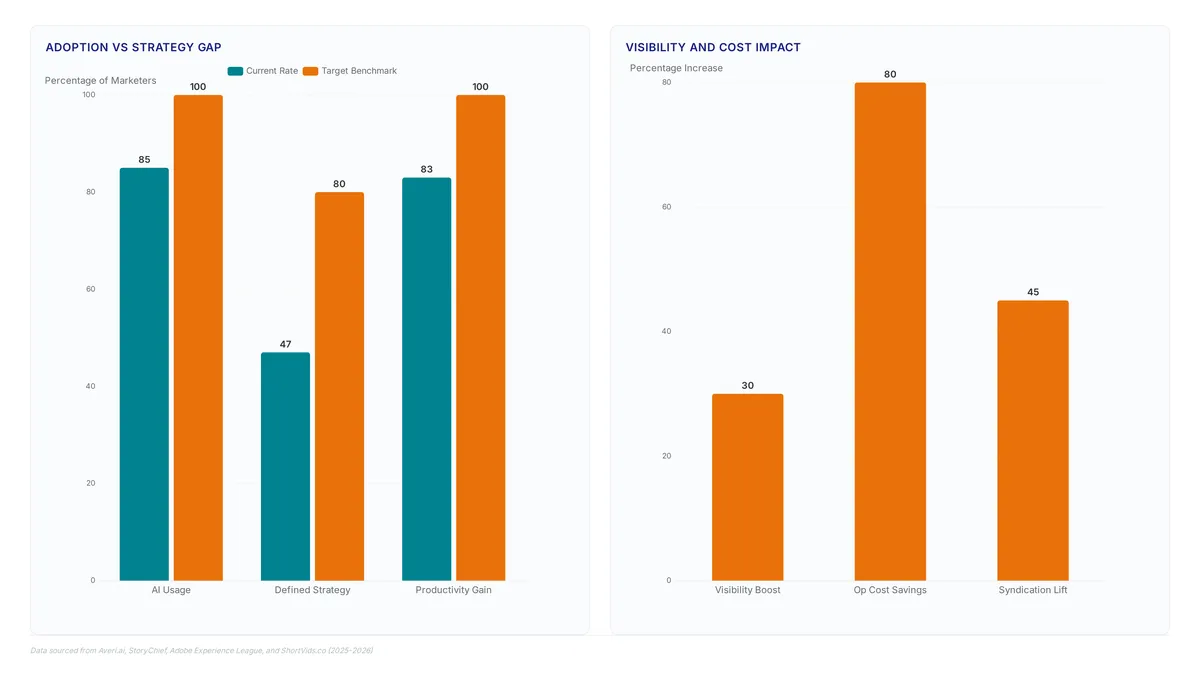
Saturation across distribution channels keeps legacy assets relevant by flooding feeds with updated signals. Static blog posts become flexible LinkedIn updates, video snippets, and newsletter briefs through a structured pipeline. Generative models prioritize fresh, multi-format data sources for retrieval, making this workflow necessary for visibility. Repurposing involves converting one asset into 5, 10 touchpoints, such as turning a blog into a LinkedIn post.
- Ingest: Parse the source document for core entities and claims.
- Fragment: Slice content into platform-specific lengths without losing context.
- Adapt: Rewrite tone for each channel while preserving the original thesis.
- Distribute: Push outputs to social, email, and knowledge base systems.
Volume often clashes with coherence during variant generation. Maintaining semantic anchors reinforces brand authority while expanding reach. Unlike simple copying, this process requires semantic restructuring to match the consumption habits of each target audience. Dependency on high-quality limits this approach. Flawed or outdated patterns can lead to misleading results. Successful execution demands human oversight to mitigate hallucinations and maintain accuracy. This ensures the expanded footprint enhances rather than erodes trust. Teams are advised to audit existing high-performing assets first to populate this repurposing engine effectively.
Executing Multi-Format Conversion with GrammarlyGO and Humanize AI
Applying tools like GrammarlyGO, Writer.com, or Humanize AI aligns tone and brand voice during repurposing. This step converts static blog posts into modular assets like short videos and social updates, a necessity for feeding diverse content types to modern retrieval systems. Outputs may sound generic or fail to match the specific voice required for professional audiences without this adaptation. The mechanism relies on passing draft text through these specialized layers to enforce style guides before distribution. Reformatting single assets into multiple touchpoints proves more efficient than generating new topics from scratch. Operators configure modular assets to prevent the decay of relevance that occurs when models prioritize fresh, multi-format signals. Manual reformatting remains expensive without automated assistance. Automated tools may require a final human review layer to ensure technical precision is maintained while smoothing syntax. Teams should treat these editors as constraint engines, not final authorship sources, to maintain factual integrity while shifting tone.
| Tool | Primary Function | Best Use Case |
|---|---|---|
| GrammarlyGO | Tone adjustment | Aligning casual drafts to the brand voice |
| Humanize AI | Syntax variation | Breaking repetitive AI sentence structures |
| Writer.com | Brand governance | Enforcing terminology across large teams |
Integrating these editors after the initial draft generation but before any factual validation step is a common workflow. This sequence ensures that style adjustments do not obscure the data points needing verification. The workflow prevents the propagation of polished but incorrect statements into published channels.
Preventing Repetition and Redundancy Loops in Repurposed Assets
Models sometimes loop phrases or echo structures, creating repetitive phrasing that affects readability. This repetition loop degrades quality by echoing structural patterns rather than advancing the narrative. Operators mitigate this by enforcing diverse prompts and context-rich input.
| Feature | Standard Generation | Constrained Output |
|---|---|---|
| Token Selection | Probabilistic Max | Penalized Recurrence |
| Structure | Echoes Input | Diverse Templates |
| Readability | Low Variation | High Entropy |
Strict blocking risks incoherence. Setting constraints too high forces the model into semantically weak alternatives. Teams must balance constraint strength with semantic fidelity to avoid nonsensical pivots. A more effective approach involves injecting diverse prompt contexts between generation steps to reset the model's attention mechanism. This prevents the system from fixating on a single syntactic track while maintaining thematic consistency. Without such context-rich input, the output risks repeating safe phrases instead of exploring valid variations.
- Enable N-gram suppression at the 3-gram or 4-gram level.
- Vary prompt instructions to force structural deviation.
- Insert human oversight checkpoints to flag looping artifacts.
Configuring these guardrails before scaling asset production helps prevent quality decay and ensures consistent output.
About
Sofia Marchetti is a B2B Content Strategist specializing in how automated content systems drive pipeline through topical authority and durable distribution. With over a decade of experience in B2B SaaS demand generation, she is uniquely qualified to dissect LLM content creation strategies that prioritize revenue outcomes over mere volume. Her daily work involves architecting content pipelines where human oversight gates AI-generated drafts, directly mirroring the article's focus on balancing scalability with credibility. At Enterium, a brand dedicated to documenting vendor-neutral AI content methodologies, Sofia translates complex automation workflows into reproducible steps for marketing operations teams. She connects the theoretical potential of Large Language Models to the practical realities of semantic SEO and entity optimization. By grounding her analysis in real-world trade-offs regarding cost and quality, she ensures that the strategies discussed are not just conceptual but immediately actionable for technical marketers aiming to scale operations without sacrificing content integrity or strategic alignment.
Conclusion
Scaling LLM output inevitably exposes the fragility of unguarded generation, where repetition loops and factual drift erode reader trust quicker than manual errors ever could. The operational burden shifts from drafting volume to the relentless verification of syntactic consistency and brand alignment. While many organizations rush to deploy agents across every channel, this approach accelerates tool sprawl and inflates per-user costs without guaranteeing coherence. A successful strategy requires treating AI not as an autonomous publisher but as a high-velocity draft engine that demands rigorous human calibration before release.
Organizations should mandate a 60 to 90 day pilot phase for any new syndication campaign to allow brand mention frequency to stabilize naturally. During this window, teams must prioritize consolidating disparate editing tools to eliminate redundant fees and enforce a single source of truth for terminology. Do not attempt to scale asset production until you have established clear checkpoints for human oversight that specifically target structural echoing.
Start this week by auditing your current prompt library to identify and remove instructions that encourage safe, repetitive phrasing. Replace generic directives with context-rich constraints that force structural deviation in every generated draft. This immediate adjustment prevents the accumulation of low-entropy content that dilutes your message.
Frequently Asked Questions
Sixty-eight percent of organizations achieve higher ROI using AI-enabled workflows. This financial gain results from aligning publishing systems with semantic signals rather than relying on raw generation speed alone.
Eighty-five percent of marketers now use AI in content creation as of 2025. This widespread adoption requires strict governance frameworks to prevent generic output from diluting brand voice.
Ninety percent of professionals agree human editing significantly improves final content quality. Teams must treat models as co-creators within strict governance frameworks instead of autonomous replacements for writers.
Tool sprawl forces teams to pay a $20-$30 monthly fee per user for each platform. Consolidating these workflows reduces subscription fatigue while maintaining access to specialized capabilities.
Structured workflows resulted in a 40% reduction in mass-produced low-value material. This decrease happens because human verification gates stop fluent but factually ungrounded text from reaching publication systems.
References