Content workflow automation: fixing approval delays by 2027
By 2027, a significant share of global enterprises will adopt an automation fabric strategy to link insights with execution, according to Gitnux. This isn't about swapping spreadsheets for slightly better lists. It is about embedding AI into real workflows to resolve approval delays and executing a five-step deployment plan that actually sticks.
The era of using simple tools for organizing digital content has ended. As noted in recent analysis from Sanity.io, the shift toward automated platforms now covers every stage from ideation to distribution. Thunderbit reports that adoption reached record highs in 2026 because organizations finally moved beyond isolating tasks. Instead, they are integrating advanced software solutions directly into their operational backbone to handle repetitive work like proofreading and social media scheduling.
Relying on manual processes fails when scaling operations. Artificial intelligence drives this evolution by managing complex functions such as personalized email campaigns and content monitoring. This approach ensures teams focus on strategic activities rather than getting stuck in endless review cycles.
The Role of Content Workflow Automation in Modern Digital Operations
Defining Content Workflow Automation Beyond Task Management
Content workflow automation manages the full lifecycle from ideation to distribution. This system extends past simple task lists by integrating AI to handle repetitive actions and simplify workflows. Emerging technologies such as artificial intelligence (AI) have played a critical role in shaping this evolution. Early tools organized digital assets, yet modern platforms use AI to create personalized email marketing campaigns, automate social media scheduling, and perform AI-based proofreading. Intelligent distribution adapts to audience needs without manual intervention.
Current adoption metrics reveal a fragmentation gap. Data indicates that a majority of marketers automated email sequences, nearly half automated social posts, and a third automated other content tasks. This disconnect leaves significant room for improvement in visibility, recovery, and governance across the pipeline. Treating automation as mere task management causes a loss of contextual continuity between stages. Teams sacrifice strategic alignment for speed when creation, editing, review, approval, and distribution operate in silos. True lifecycle management requires a centralized platform where AI-driven generation and human oversight coexist within a single audit trail. Scaling operations introduces quality variance that negates efficiency gains without this unity. Mapping out current workflows and identifying all tasks involved in the content lifecycle is necessary before automating. The chosen platform must support end-to-end traceability rather than isolated speed bumps.
Applying AI Assistants Across Ideation and Approval Stages
Just a minority of organizations have reached enterprise-scale deployment as teams navigate challenges around orchestration and consistency. This gap separates theoretical capability from operational reality in production environments. Systems use structured content foundations during ideation to generate variations that maintain semantic integrity. Effectiveness depends less on model sophistication than on the quality of fed content. Teams identified as "AI-mature" have compressed their cost-per-asset significantly, validating the financial benefit of advanced workflow integration. Generative output relies heavily on the quality of the underlying content foundation. Automated ideation produces noise rather than signal without rigorous content modeling.
Approval stages shift from line-editing to policy verification. Intelligent distribution systems actively optimize for each channel's algorithmic ranking factors in real-time. Human oversight remains critical for verifying strategic alignment during the approval process. Configuring workflows where AI handles initial drafting and compliance scanning ensures that speed does not compromise accuracy. Such a hybrid approach balances velocity with risk management.
Simple Software Tools Versus Advanced Automation Fabric Strategies
Content workflow automation evolved from basic digital asset organizers into interconnected automation fabrics linking insights directly to execution. Early software managed file storage, whereas modern strategies orchestrate complex task sequences across the entire lifecycle. This architectural shift addresses the latency between content creation and distribution. Basic tools suffice for individual creators, but enterprise operations require the scalability of a fabric approach. Upgrading introduces measurable friction. Adding predictive analytics increases development costs significantly and extends timelines notably.
Pricing structures reflect this computational intensity, with entry-level options like ContentBot starting at a modest monthly rate for basic needs. Advanced plans often gate capacity via token limits, such as substantial token allowances for standard tiers versus significantly higher limits for high-volume workflows. Evaluating platforms based on features and alignment with business needs is critical before selecting a tier. Paying for unused computational overhead becomes an unnecessary expense. Legacy standards show a significant adoption rate among global enterprises, yet the fragmentation gap persists. Organizations must bridge the divide between basic utility and thorough fabric strategies to realize full value.
How Intelligent Automation Resolves Content Bottlenecks and Approval Delays
Real-Time Tracking as the Mechanism for Early Bottleneck Detection
Visibility stops approval lag from ruining delivery dates. Automation acts as a centralized platform for planning and publishing, removing the mess of spreadsheets while showing exactly where projects stand. This shift helps teams spot stalled tasks hiding in email threads before they cause real damage. Operational data reveals significant overhead in maintaining these systems without proper integration. A typical agency running dozens of workflows incurs a real monthly cost between a few hundred and a thousand dollars when valuing operator time for maintenance. Governance features mitigate this by executing actions only where the and pausing for human approvals to ensure controlled automation. Visibility alone does not resolve the underlying friction; it merely exposes it.
Automating Proofreading and Social Sharing to Eliminate Repetitive Tasks
Removing subjective variance from early drafts lets teams address strategic gaps rather than typographical errors. Automated grammar checks lack brand context, requiring a final human pass to catch detailed tone deviations. Operators must configure these tools to flag issues for correction rather than auto-applying changes to preserve voice integrity. Workflow automation adoption reached record highs in 2026, with specific focus on embedding AI into real workflows rather than isolated tasks. A unified platform prevents the fragmentation typical of legacy spreadsheets while accelerating time-to-market. Relying solely on automation risks publishing errors if the initial content curation rules are too permissive.
Scalability Risks When Content Demand Increases Without Unified Workflows
Demand surges force teams into reactive cycles that compromise output quality when unified workflows are missing. Operators attempting to fix content workflow bottlenecks often encounter a coordination tax where adding staff yields diminishing returns due to synchronization overhead. Solving an inefficient content approval process becomes impossible as version conflicts multiply across disjointed tools without a centralized orchestration layer. Consolidating distribution through a unified automated platform can drive substantial traffic growth, contrasting sharply with the stagnation seen in manual environments. Introducing automation without first standardizing content models risks accelerating the production of unusable assets. The immediate risk is not slower delivery, but the compounding error rate that occurs when high-volume output bypasses semantic validation gates.
Executing a Five-Step Plan to Deploy Automated Content Workflows
Defining Goals and Mapping Current Workflow Bottlenecks
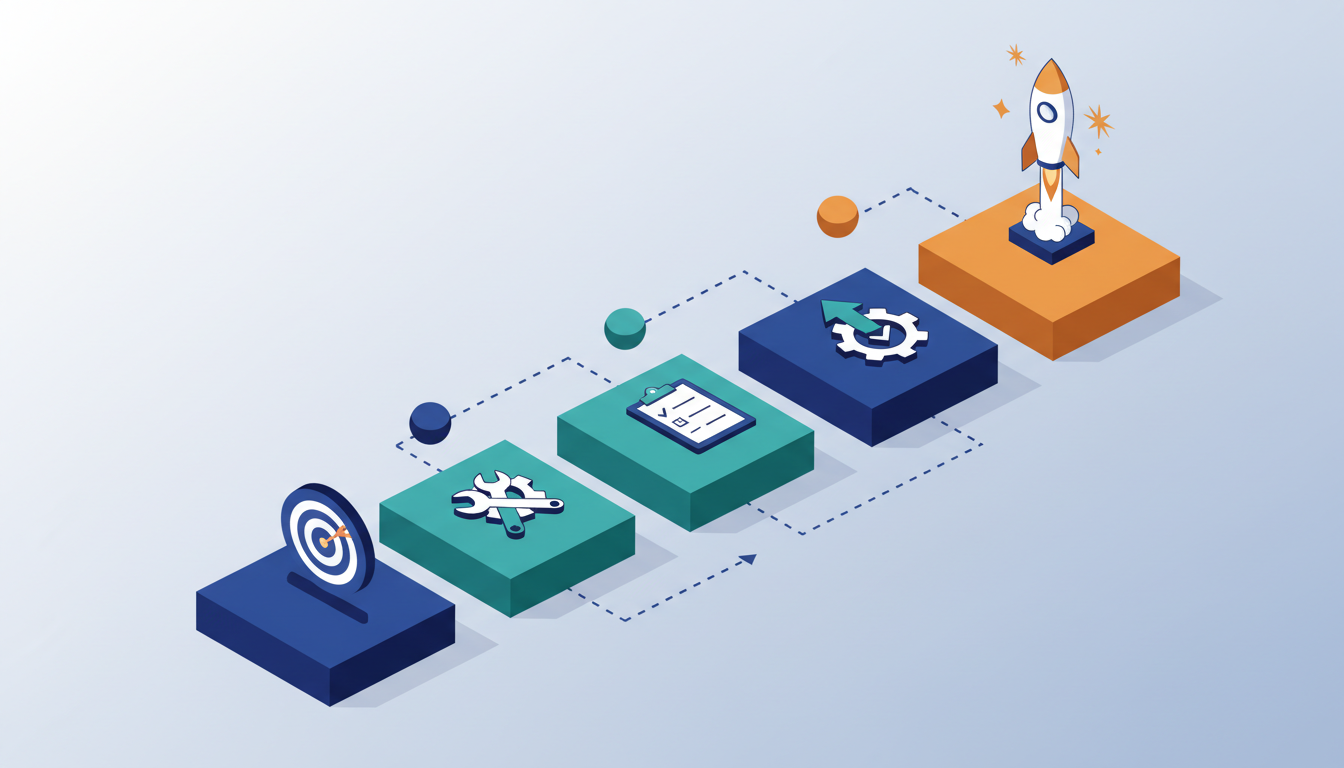
Define your goals by isolating specific friction points like review latency rather than targeting vague productivity gains. Without clear objectives, teams risk automating low-value tasks while leaving high-impact bottlenecks untouched, resulting in negligible ROI despite increased tool complexity. Identifying all tasks involved in the content lifecycle including ideation, creation, review, approval, and distribution is necessary before automating.
- Audit the Lifecycle: Document every handoff from ideation to distribution to visualize where work stalls.
- Quantify Delays: Measure time-in-state for approvals to establish a baseline for improvement.
- Prioritize Constraints: Select one bottleneck, such as legal review, as the primary target for initial orchestration.
Operators must map out their current workflow to distinguish between necessary governance gates and arbitrary administrative drag. Newer platforms turn content events into governed workflows, contrasting with manual chains that rely on human memory for state transitions.
| Phase | Manual Signal | Automated Trigger |
|---|---|---|
| Drafting | Email Request | Template Instantiation |
| Review | Shared Document | Status Change Event |
| Publish | FTP Upload | API Webhook |
Neglecting this mapping phase leaves organizations relying on spreadsheets or legacy software, making it difficult to identify bottlenecks early. Validating these maps against actual processes ensures that automation serves as a centralized platform for planning and publishing.
Configuring Custom Workflows in Sanity and HubSpot
Configuring Sanity or HubSpot requires mapping schema fields to specific business governance rules rather than accepting default states. Automation serves as a centralized platform for planning, creating, and publishing content, eliminating reliance on spreadsheets or legacy software. This approach embeds regulatory checks directly into the pipeline, ensuring governance rules are enforced before execution rather than relying on post-hoc audits. However, as businesses scale, manually managing all elements becomes increasingly challenging, making automated workflows necessary for maintaining quality and delivery timelines. Selecting appropriate software tools is critical for successful implementation.
- Define schema constraints in Sanity Studio to restrict input types at the source.
- Map HubSpot lifecycle stages to these technical constraints for synchronized tracking.
- Set triggers that ensure required metadata fields are populated before publication.
Teams selecting between platforms should evaluate based on whether the tool supports managed orchestration or requires manual chain maintenance. The cost of ignoring this integration is measurable in the latency between draft completion and live deployment. Starting with clear objectives such as increasing productivity or enhancing collaboration guides the implementation process effectively.
Validating Tool Selection Against Existing System Requirements
Match API connectivity and governance controls to your current infrastructure before deployment.
- Audit Integration Points: Verify that candidate platforms support bidirectional sync with existing CMS repositories to prevent data silos.
- Test Governance Gates: Confirm the system can pause for human approvals and execute actions only where the, ensuring controlled automation without manual oversight gaps.
- A platform might offer sophisticated generative capabilities but fail when token consumption spikes during peak campaign cycles. The cost is measurable; pricing generally scales by tasks, operations, or users, with most setups landing in the Professional tier within 60, 90 days.
Architectural fit matters more than marginal feature gains for pipeline stability. Teams must verify governance rules enforce compliance before content reaches distribution channels. This alignment stops workflow fragmentation caused by permission errors or schema mismatches. Skipping this step risks stalling automated tasks entirely.
Quantifiable ROI and Strategic Gains from Automated Content Ecosystems
Strategic Gains Beyond Basic Efficiency Metrics
Scale defines the enterprise advantage in 2026. Automated workflows allow operations to expand without sacrificing quality or missing delivery timelines, a capability distinct from simple speed increases. This structural shift supports AI-native generation where content creation becomes inherently automated rather than appended as an isolated feature. Centralized collaboration eliminates reliance on spreadsheets by serving as a unified platform for planning and publishing. Real-time tracking within these systems helps teams identify bottlenecks early, preventing the coordination tax that plagues manual processes. Increased efficiency remains the primary benefit. Teams must weigh the immediate utility of rule-based tools against the long-term strategic value of advanced platforms. Organizations risk automating inefficiencies rather than resolving them without this distinction. True strategic advantage lies not in doing more work quicker, but in fundamentally altering the content lifecycle to support complex, high-volume demands that manual processes cannot sustain.
Reallocating Team Focus from Repetitive Tasks to Strategy
Engineering hours shift from manual proofing to algorithmic strategy in 2026. Teams currently waste capacity on low-value distribution chores like social posting, which now consumes a measurable fraction of marketer bandwidth according to workflow automation statistics. Offloading these deterministic tasks to automated pipelines enables strategic capacity for high-use activities such as audience segmentation and message architecture. This reallocation directly addresses when to automate content distribution by establishing a clear threshold: automate repetitive tasks like proofreading, social media sharing, and content curation so teams can focus on more strategic activities. Velocity creates tension with oversight. Automation enhances collaboration by serving as a centralized platform, yet it requires strict schema enforcement to prevent data drift. Quicker execution merely increases noise rather than signal without these constraints. Organizations increasingly configure workflows to prioritize human review for edge cases requiring detailed judgment rather than routine validation. The result is a workforce focused on system design and exception handling rather than repetitive manual labor.
Visibility Gaps in Organizations Without Unified Workflows
Fragmented toolchains create blind spots where content versions diverge and approval status becomes ambiguous across teams. Latency between final edit and publication introduces consistency errors that compound at scale when distribution triggers rely on manual handoffs rather than automated pipelines. Operators cannot determine if an asset has passed legal review or if it awaits stakeholder sign-off without querying disparate systems due to this lack of centralized visibility. A governance gap emerges where unvetted material potentially reaches public channels because no single system enforces a hard stop. Moving to closed-loop analytics allows teams to track performance and automatically adjust workflows, creating a self-optimizing system that manual processes cannot match. Scaling content volume inevitably degrades quality assurance without this integration because human oversight cannot match machine-speed iteration. Teams should automate distribution to eliminate reliance on spreadsheets and offer real-time tracking of project progress to help identify bottlenecks early. Implementing strict state-machine logic ensures these gates are enforced before any external posting occurs.
About
Hannah Brooks serves as the Marketing Operations Lead at Enterium, where she architects the very content pipelines this article dissects. Her daily work involves rigorously evaluating AI tooling stacks and engineering the workflow automation necessary to scale B2B content without sacrificing governance. Unlike theorists, Brooks operates within the constraints of production environments, focusing on operational reliability and clean handoffs between human editors and LLMs. At Enterium, a brand dedicated to vendor-neutral methodologies for running content with AI, she ensures that every automated step, from ideation to distribution, is measurable and reproducible. This practical experience allows her to explain not just what content workflow automation is, but how to implement it with concrete guardrails and clear ROI. Her insights bridge the gap between abstract AI potential and the reproducible systems that marketing teams need to ship high-quality content consistently next week.
Conclusion
Scaling content operations reveals that fragmented toolchains create invisible latency where approval status diverges from publication reality. While basic automation handles email and social posts, the real operational cost emerges when legacy manual handoffs force teams to query disparate systems for simple governance checks. This friction prevents organizations from achieving the cost compression seen in mature enterprises. The shift toward AI-native generation in 2026 means creation will become inherently automated, making current patchwork solutions obsolete for high-volume needs. Teams relying on spreadsheets for tracking will find their oversight capabilities overwhelmed by machine-speed iteration.
Organizations must transition to unified workflow logic before adopting generative scale, specifically targeting a full migration of approval gates within the next two quarters. Do not layer new creation tools onto broken distribution pipelines. Start by mapping your current approval bottlenecks this week to identify where manual handoffs cause version drift. Replace these specific friction points with state-machine logic that enforces hard stops for legal review before any external posting occurs. This fundamental step ensures that increased velocity does not degrade quality assurance or expose the brand to unvetted material.
Frequently Asked Questions
Fragmented automation creates visibility gaps across your entire pipeline. Data shows 58% of marketers automate email, yet only 33% handle other tasks, causing strategic misalignment and lost context between creation stages.
Orchestration challenges prevent most teams from scaling AI effectively. Just a portion of organizations have reached enterprise-scale deployment, meaning the majority lack the consistency required for true operational reality in production.
AI-mature teams significantly compress their cost-per-asset through deep integration. These organizations have compressed costs by 41%, validating that advanced workflow integration delivers immediate financial benefits over isolated task management.
Basic tools fail to link insights directly to execution at scale. While 30% of global enterprises will adopt automation fabric strategies, relying on simple organizers causes latency between content creation and distribution.
Significant room remains for improving visibility, recovery, and governance. Only a portion of organizations have fully unified workflows, leaving half of all teams vulnerable to bottlenecks during approval and review cycles.