Content volume fails: Why 60% of sites crash
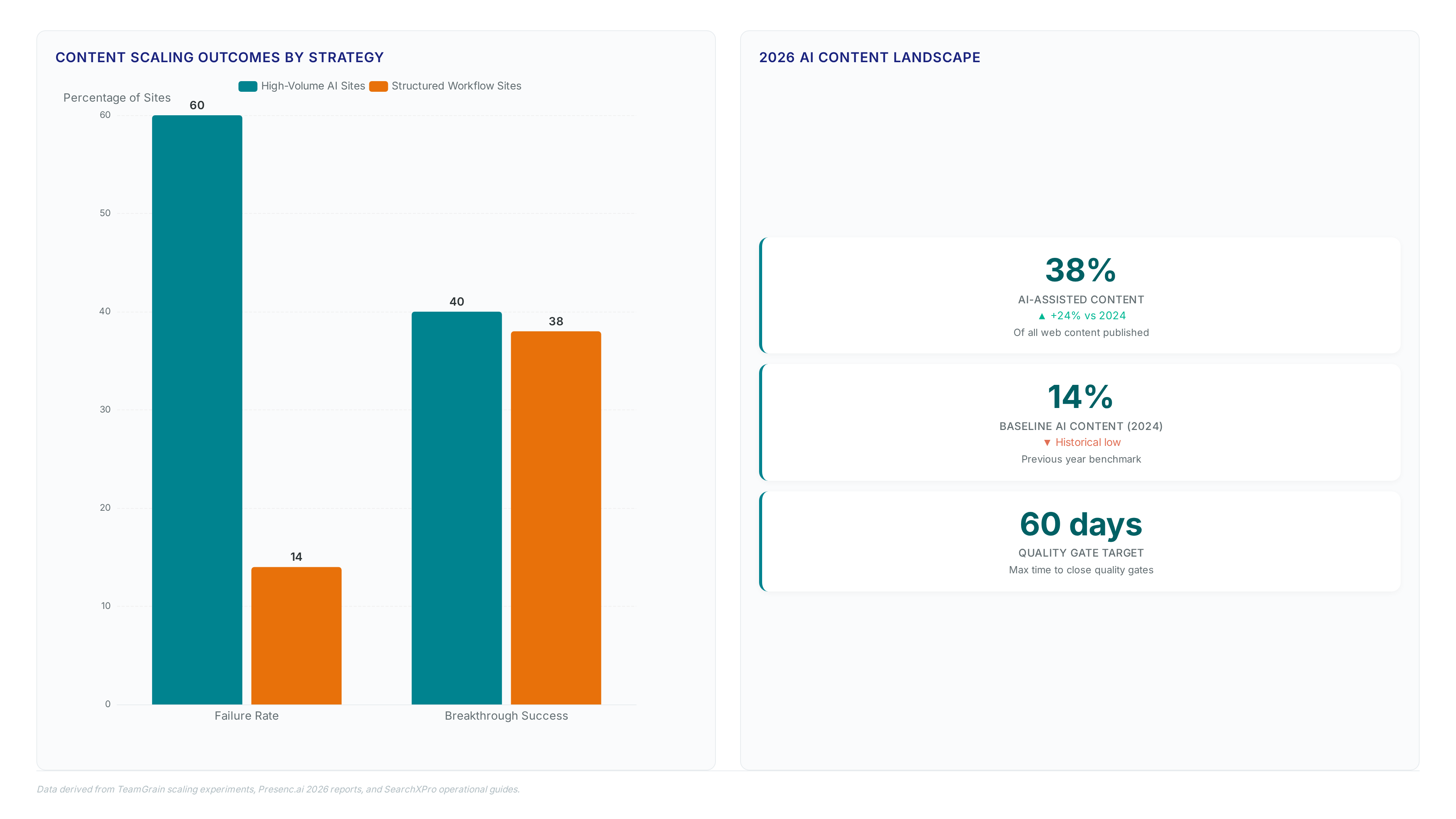
A systematic experiment across 73 personal blog sites revealed that 60% of high-volume AI-generated content sites failed completely. This data proves that the traditional content factory model, which assumes linear growth from mass production, is obsolete in 2026. Selim Yoruk argues that scaling velocity now burns cash because Google operates as an Answer Engine driven by AI Overviews rather than a simple link referrer. The algorithm no longer rewards the sheer mass of words but instead demands Information Gain and Machine-Readable Structure to survive.
Readers will learn how Google's RAG framework filters out redundant articles before they ever reach the AI overview window. The text explains that if your content merely summarizes concepts found in the top ten results, the system assigns it an Information Gain score of zero. This mechanism discards pages that lack proprietary data or unique methodologies, rendering high-volume strategies ineffective for organic distribution.
The article details how to build LLM-ready architecture through automated schema and precise chunking. It emphasizes shifting focus from keyword density to entity classification so crawlers can connect facts in meaningful ways. By adopting Semantic Blueprints and feeding crawlers named intellectual property via Quotation schema, brands can avoid scaling to zero. This approach ensures visibility when search engines prioritize classified data over synthesized text.
The Volume Illusion and the Collapse of Traditional Content Scaling
The Volume Illusion: Why Mass Content Fails SGE
Traffic numbers do not climb in a straight line alongside article counts, a mistaken belief known as the volume illusion. Answer engines now prioritize information gain over raw output size. When ten articles yield 10,000 visitors, publishing one hundred does not guarantee 100,000; that linear assumption is dead. Google functions as an answer engine where AI Overviews synthesize direct responses, making zero-click searches the default baseline for high-volume queries. Systems relying on mass-producing synthesized insights face immediate distribution collapse because retrieval-augmented generation filters discard content with flat information gain scores. A systematic experiment across 73 personal blog sites revealed that 60% of high-volume AI-generated content sites failed to sustain traffic. Algorithms ignore sheer word mass in favor of proprietary data and unique methodologies that cannot be simulated elsewhere.
| Traditional Metric | SGE Reality |
|---|---|
| Word Count | Information Gain |
| Keyword Density | Entity Relationships |
| Publication Velocity | Machine-Readable Structure |
High search volume keywords often result in zero real clicks when the content lacks distinct semantic value. Production speed conflicts with structural depth; rushing output sacrifices the machine-readable structure required for citation. Organic distribution scales to zero regardless of output volume without first-party surveys or named intellectual property explicitly mapped via schema. Enterium recommends shifting focus from keyword coverage to building interconnected entity nodes that answer specific user problems directly. Content factories must integrate proprietary frameworks rather than repackaging existing web insights to survive this architectural shift.
Applying Information Gain to Stop Cash Burn
High-velocity production burns cash because information gain scores remain flat when content merely repackages existing web insights. With 38% of business content now involving AI assistance, the market is flooded with synthesized articles that retrieval systems discard before human review. Answer engines prioritize proprietary data over keyword density, creating a fundamental problem for generic content. Kenny Lee's affiliate site lost visibility despite ranking for high-volume supplement keywords because an engineer recommending healthcare products lacks the necessary subject matter expertise for E-A-T validation. Generative engine optimization requires shifting focus from word count to machine-readable structures that explicitly map brand entities to customer pain points. Operators must stop asking should I stop high-volume content production and instead audit whether their pipeline generates unique methodological frameworks. Additional articles simply increase storage costs while failing to build the semantic authority required for citation without first-party surveys or internal metrics. The cost of ignoring this shift is measurable as organic distribution scales toward zero regardless of output volume. Enterium recommends halting generic article generation to re-engineer workflows around data extraction and entity mapping. Only content offering distinct analytical perspectives survives the RAG filter to appear in zero-click search results.
Risk: Zero-Click Defaults and Authority Erosion
Zero-click defaults strip traffic from sites publishing high-volume content without unique data. Google now operates as an answer engine where AI Overviews synthesize responses directly on the results page, leaving no reason for users to click through to source pages. High-ranking pages no longer guarantee high click-through rates because summarized answers satisfy user intent immediately. Strategies relying on mass production face severe penalties, including notifications for aggressive spam techniques and complete removal from search indices. This risk profile intensifies as algorithms prioritize Information Gain over the sheer mass of words published. If a growth playbook depends on repackaging existing insights, organic distribution scales to zero rather than compounding authority.
| Strategy Type | Algorithmic Outcome | Business Risk |
|---|---|---|
| High-Volume Synthetic | Discarded by RAG filters | Wasted compute budget |
| Structured Authority | Cited in AI Overviews | Sustainable traffic flow |
Bulk production workflows lacking proprietary data sources drain resources. The cost of maintaining low-quality pages exceeds their value when they fail to generate clicks. Operators must audit existing libraries to identify content lacking Machine-Readable Structure before filters de-index the entire domain. Shifting focus to unique methodologies prevents the erosion of brand trust in an automated search environment.
How RAG Filters and Semantic Blueprints Determine AI Visibility
RAG as a Database Architecture Problem for Entity Mapping
Poor entity recognition stops strong content from ranking because search engines check semantic identity with strict precision.
| Feature | Traditional SEO | AI-Driven Search |
|---|---|---|
| Primary Unit | Keyword Density | Entity Relationships |
| Structure | Linear Articles | Graph Nodes |
| Validation | Backlink Count | Semantic Consistency |
Adopting this architecture demands heavy modeling before publication, a hurdle many high-speed factories skip. Tools like Neo4j let teams simulate how an engine reads a brand system so the Company → Framework → Pain Point → Solution link stays intact. Content misses the information gain needed for citations in systems valuing depth over mass without this rigid structure. Crawlers drop unconnected text chunks during retrieval, making the page invisible. Skipping this step guarantees zero visibility. Enterium suggests checking semantic chains against graph databases before launch to secure machine readability. Limitations exist in the time required; the process slows initial output notably.
Structuring Articles for AI Chunking Using Graph Frameworks
Dumping unstructured text blocks stops AI from mapping authority since disconnected nodes fail semantic checks. Operators must map brand solutions as linked entities using graph database frameworks like Neo4j or ArcadeDB before writing starts. Retrieval systems cannot build the logical relationships needed for citation if a brand and its specific solutions are not modeled as connected nodes.
Successful deployment needs a pre-publication simulation of the Knowledge Graph to confirm entity connectivity. The workflow involves four distinct stages:
- Define a proprietary framework to establish a unique point of view distinct from generic summaries.
- Map the framework to a specific customer pain point where existing approaches fail.
- Connect the pain point naturally to a target solution as the logical resolution.
- Validate the semantic chain of Company, Framework, Pain Point, and Solution within the graph.
| Strategy Element | Content Factory Approach | Semantic Blueprint Approach |
|---|---|---|
| Primary Unit | Keyword Density | Entity Relationships |
| Structure | Linear Articles | Graph Nodes |
| Validation | Backlink Count | Semantic Consistency |
| Outcome | Undifferentiated Summaries | Original Insight |
Failed strategies often chase broad topics while ignoring structural needs for original insight that serve specific query intents. Articles stay isolated as text strings that AI filters toss out as low-value noise without this graph-based prep. Teams must spend time on architecture before writing, which slows early speed to lock in long-term visibility. Enterium recommends running these graph checks during the outline phase instead of after publishing. This discipline ensures every piece adds to a clear authority map rather than swelling the volume of undifferentiated content flooding the index.
Keyword Density vs Semantic Blueprints in Gemini-Powered SGE
Gemini-powered SGE skips keyword stuffing to focus on entity relationships inside the global Knowledge Graph. Old tactics based on repetition fail because search engines now crawl to sort connections between brands, events, and people instead of counting term frequency. Weak entity recognition acts as a technical wall stopping high-quality content from ranking when semantic identity stays undefined.
| Feature | Keyword Density | Semantic Blueprints |
|---|---|---|
| Target | Search Terms | Entity Nodes |
| Validation | Term Frequency | Relationship Maps |
| Outcome | Index Rejection | LLM Citation |
Enterium practitioners must model brand solutions as graph nodes using frameworks like Neo4j before drafting starts. Even factually correct text looks like disconnected noise to retrieval systems without this pre-simulation. Teams must validate semantic chains linking company frameworks to specific pain points before publication. Zero information gain scores result from failing to embed these relationships regardless of word count or topical relevance.
Building LLM-Ready Architecture Through Automated Schema and Chunking
LLM-Ready Architecture: JSON-LD and Entity Recognition Set

Raw text requires translation into JSON-LD because search engines prioritize structured data for immediate ingestion. Manual coding creates bottlenecks, so operators deploy Python scripts to trigger Extraction via API upon publication. The system executes Named Entity Recognition (NER) to isolate core concepts before mapping them to authoritative nodes like Wikipedia.
- Extraction: A script sends raw content to an LLM immediately after publishing.
- Entity Recognition: The model identifies internal experts and product relationships to resolve ambiguity.
- Semantic Ingestion: The system generates nested payloads linking entities to Wikidata using sameAs tags. 4.
Immediate Extraction triggers a Python script to send raw text to an LLM via API the moment publication occurs. This automation bypasses manual schema bottlenecks by executing Named Entity Recognition (NER) on the fly. The model isolates core concepts and internal experts, then maps them to authoritative nodes like Wikipedia using sameAs tags. Without this flexible injection, high-velocity pipelines fail to close feedback loops within the required 60-day window for automated quality gates. The implementation follows a strict four-stage sequence:
- Trigger: A post-publish webhook initiates the Semantic Ingestion workflow.
- Process: The LLM generates a nested JSON-LD payload, resolving entities against Wikidata.
- Inject: The backend inserts the structured data into the page header dynamically.
- Validate: Systems verify that internal nodes connect to external authority sources.
A critical tension exists between generation speed and graph accuracy. Rushing Entity Recognition often produces hallucinated links that break the Company → Framework → Pain Point → Solution chain, rendering the content invisible to RAG filters. Operators must balance throughput with semantic precision, as disconnected nodes cannot establish the logical relationships required for citation. Relying solely on velocity without pillar-and-cluster architecture ensures that even accurate data remains isolated rather than authoritative. Enterium practitioners should prioritize configuring strong failure modes where invalid sameAs mappings trigger a re-processing queue rather than publishing broken schemas. This guardrail prevents the accumulation of semantic debt that degrades overall site authority over time.
Validation Checklist for Flexible Schema Injection and Entity Mapping
Verify that the backend automatically injects the schema payload into the page header to prevent citation loss. Without this flexible step, AI systems must guess content meaning, leading to frequent rejection.
- Confirm Injection: Check that JSON-LD appears in the immediately after publication, ensuring Information Gain is detectable.
- Validate Entities: Ensure Named Entity Recognition correctly maps internal concepts to Wikipedia or Wikidata using sameAs tags.
- Test Relationships: Verify that brand solutions appear as interconnected nodes rather than isolated text blocks.
| Check Point | Failure Mode | Correction Action |
|---|---|---|
| Header Presence | Missing Payload | Trigger Python script on publish |
| Entity Linking | Ambiguous Identity | Map to authoritative nodes |
| Node Connectivity | Orphaned Concepts | Define relationship paths |
Weak entity recognition remains a primary technical barrier preventing high-quality content from ranking in modern search landscapes. Even well-researched articles fail if the system cannot parse semantic identity or connect facts to existing knowledge structures. Operators must treat this validation as a mandatory gate before any content goes live. Neglecting these structural checks means wasting resources on content that AI filters will discard before human review. Enterium practitioners should run this checklist against every new template to guarantee machine readability.
Strategic Realignment from Content Velocity to Model Mindshare
Defining Model Mindshare as the New Primary Metric
Search volume metrics fail because Google functions as an Answer Engine driven by AI Overviews rather than a link directory. The operational target shifts from raw traffic to model mindshare, set as the frequency an LLM cites a brand as an authoritative entity. Traditional strategies treating content as a volume game burn cash when algorithms prioritize Information Gain over repetitive synthesis. Operators must replace keyword density with semantic blueprints that map specific pain points to proprietary solutions as interconnected nodes.
Applying Hyper-Structured Data to Capture Entity Recognition
Brands must stop funding content factories that repeat known information and instead build a hyper-structured, data-forward architecture. If the model doesn't recognize your structure, the market won't recognize your business. This shift becomes urgent when scaling failure models treat high-volume content like a "magic button" rather than using repeatable workflows with automated quality gates. Operators should adopt LLM-ready architecture immediately if their current pipeline lacks proprietary data or unique methodologies. The implementation requires mapping content silos using graph database frameworks before publishing any text.
- Define proprietary frameworks that address specific customer pain points uniquely.
- Connect these frameworks to target solutions as logical resolutions within the semantic chain.
- Validate that entity relationships appear as interconnected nodes rather than isolated blocks.
| Strategy Type | Primary Risk | Structural Outcome |
|---|---|---|
| High Volume | Financial exposure during core updates | Weak trust signals |
| Hyper-Structured | Initial workflow complexity | Citable authority |
Content strategies relying on scale without structural integrity expose businesses to significant financial risk during core updates. A critical limitation of this approach is the operational overhead; teams cannot simply prompt-engineer their way into Information Gain without first establishing a clear knowledge structure. The consequence of ignoring this architectural requirement is invisible decay: traffic does not drop gradually but vanishes when the RAG filter discards pages with flat information gain scores. Enterium advises shifting the primary metric from search volume to model mindshare to ensure long-term viability. The next step is auditing existing content silos to verify if brand solutions are explicitly modeled as nodes in a global knowledge graph.
Risk: Why Scaling Content Velocity Burns Cash Without Authority
Scaling word count fails because algorithms now discard pages lacking Information Gain before human review. While AI generation capabilities have expanded, high-volume content scaling strategy data reveals that 40% of sites achieve breakthrough success, leaving the majority stranded with zero visibility despite massive output. This disparity exists because modern crawlers prioritize semantic structure over raw textual mass, effectively filtering out repetitive synthesis. Operators chasing volume often trigger scaled content abuse notifications, resulting in complete removal from search indices rather than temporary ranking dips. The financial risk compounds when brands invest heavily in producing content that search engines actively penalize for lacking unique data or proprietary methodologies. Instead of funding factories that repeat known information, teams must architect data-forward systems that map specific pain points to solutions.
| Strategy Focus | Outcome Probability |
|---|---|
| High Velocity | Low Authority |
| Structured Data | High Citation |
Enterium recommends halting unstructured production immediately to rebuild around entity relationships. If the underlying architecture does not support machine-readable connections between brand nodes, increasing publication frequency only accelerates cash burn without gaining market recognition. The operational imperative shifts from writing more words to engineering clearer semantic chains that AI models can reliably cite.
About
Daniel Reyes serves as Head of Content Engineering at Enterium, where he architects production-grade AI content pipelines from ingestion to publication. With over a decade in data platform engineering and four years specifically building content automation systems, Reyes possesses the technical depth to dissect why traditional "content factory" models fail in the era of Google's SGE. His daily work involves configuring rigorous QA gates, managing vector stores, and optimizing retrieval-augmented generation (RAG) workflows, directly informing his analysis that sheer volume no longer drives growth. At Enterium, a brand dedicated to vendor-neutral methodologies for scaling content with LLMs, Reyes focuses on reliability over raw throughput. He understands that without human-in-the-loop evaluation and precise orchestration, high-velocity pipelines simply amplify errors rather than authority. This article translates his engineering experience into actionable strategy, proving that modern content operations require reliable architecture, not just increased output, to survive the shift toward zero-click search environments.
Conclusion
Scaling content velocity fails because algorithms now discard pages lacking Information Gain before human review. The real breakage point occurs when organizations lose feedback loops within the required 60-day window for automated quality gates, cementing poor semantic patterns before correction is possible. While 40% of sites achieve breakthrough success, the majority burn cash on repetitive synthesis that search engines actively penalize. This operational cost grows as teams confuse output volume with market presence, ignoring that modern crawlers prioritize semantic structure over raw textual mass.
Teams must halt unstructured production immediately to rebuild around entity relationships. If your current architecture does not support machine-readable connections between brand nodes, increasing publication frequency only accelerates cash burn without gaining market recognition. The strategic pivot requires shifting focus from writing more words to engineering clearer semantic chains that AI models can reliably cite. You should start by auditing your top twenty performing pages this week to verify if brand solutions are explicitly modeled as nodes in a global knowledge graph. This specific check reveals whether your content functions as a citable authority or merely recycled noise. Only by ensuring your data-forward systems map specific pain points to unique solutions can you secure the model mindshare necessary for long-term viability.
Frequently Asked Questions
Sixty percent of high-volume sites fail because they lack unique data. This flat information gain score causes search engines to discard pages before they ever reach users.
Thirty-eight percent of business content now involves AI, creating massive redundancy. Systems filter out these synthesized articles, forcing brands to provide proprietary data to avoid invisibility.
The RAG filter assigns a zero score to content merely summarizing existing top results. This mechanism discards redundant pages, meaning mass production without unique methodology yields no traffic.
Brands must shift from keyword density to entity classification using semantic blueprints. This machine-readable structure allows crawlers to connect facts, whereas thirty-eight percent of current content remains unstructured.
Scaling velocity burns cash because sixty percent of high-volume sites fail to sustain traffic. Algorithms now reward information gain and structure rather than the sheer mass of published words.