AI content strategy: stop generic recombination now
Human-written content drives 5.44 times more traffic than AI-generated pieces according to Samwell.ai data.
Generative tools make terrible writers but exceptional researchers. When teams flip this script, they get derivative sludge that erodes brand distinctiveness. Heather Campbell notes that because AI functions by recombining existing information, relying on it for drafting produces work sounding identical to the ten other articles already ranking for your topic. The challenge in 2026 isn't publishing volume; it's ensuring your content offers something readers cannot find elsewhere.
This article defines the strategic boundary between human originality and machine efficiency while detailing the mechanics of effective human-AI collaboration. You will learn to identify specific workflow stages where AI adds value, such as SERP analysis and gap-finding, versus areas where it incurs costs, including point of view and expert angle. We will also examine methods to detect repetitive drafts before publication and analyze engagement metrics by reader segment to prevent brand voice erosion.
Winning teams treat AI limitations as a starting condition rather than a prompt engineering flaw. By restricting artificial intelligence to research and outlines, organizations avoid the trap of publishing finished-looking drafts that add no new information. The path forward requires a disciplined approach to content originality that prioritizes unique data over speed.
The Strategic Definition of AI Content Strategy and Originality
AI Recombination vs Original Content Strategy
AI recombination remixes existing data instead of originating fresh insights, forcing drafts to mirror current search results. Algorithms prioritize pattern matching over invention, so output converges on the median of available training data. This mechanical limitation explains why high-volume production often yields generic coverage that fails to differentiate a brand. Research indicates human-written content generates 5.44 times more traffic over a five-month period compared to AI-generated content, highlighting the tangible cost of delegated authorship. The core issue is not prompt engineering but the fundamental architecture of generative models which recombines what already exists. Efficiency clashes with distinctiveness when automation handles the actual writing, producing polished yet derivative assets. Data shows a significant share of marketers express concern about losing originality when AI tools fail to reflect their established brand voice. Content strategies risk saturating markets with redundant information that readers can find elsewhere without this intervention.
Applying SERP Analysis to Beat Ten Other Articles
SERP analysis identifies content gaps where current top results merely recombine existing data without adding new value. Reviewing search results reveals that AI drafting often replicates the median of available training data, leaving reader questions partially answered. Humanwritten content achieves 41% longer session durations than content generated by artificial intelligence, proving that distinct perspectives retain attention improved than generic summaries. The more significant challenge is determining if content offers something readers cannot find in ten other articles.
| Workflow Stage | AI Role | Human Role |
|---|---|---|
| Research | Aggregate signals | Validate source credibility |
| Outlining | Suggest structures | Define unique argument |
| Drafting | Expand bullet points | Inject original data |
| Review | Check grammar | Verify brand voice |
Relying solely on algorithmic generation risks producing drafts that appear complete but lack the specific expertise required to outperform incumbents. Models prioritize pattern matching over invention, inevitably converging on standard answers found in ten other articles. Brands struggle to offer insights unavailable elsewhere in the index without human-led differentiation. The cost of ignoring this split is a library of interchangeable pages that drive no incremental traffic.
Why High Volume AI Drafts Fail Brand Voice
High-volume AI drafting fails because models recombine existing patterns rather than originate unique brand perspectives. When production prioritizes quantity, output inevitably converges on the median of available training data, mirroring pages that already rank. This structural limitation explains why only a minority of marketers using AI report strong results, as tools frequently lose the specific context required for differentiation. Unlike human authors who introduce novel data points, generative systems optimize for probability, creating content that reads as finished yet adds no new information.
| Failure Mode | Technical Cause | Business Impact |
|---|---|---|
| Generic Tone | Probabilistic token selection | Low engagement rates |
| Context Loss | Limited window memory | Brand dilution |
| Repetition | Training data overlap | Reduced trust |
Teams treating this recombination as a starting condition must audit workflows before scaling. Ignoring this split accelerates the production of mediocrity rather than quality.
Mechanics of Human-AI Collaboration in Content Workflows
Defining AI's Role in Research Versus Point of View
Operational boundaries place SERP analysis and outline generation within the AI domain, reserving expert angle formation for human leadership. Generative models function by recombining existing patterns, making them ideal for aggregating signals but structurally incapable of originating unique data points or distinct brand voices. Output inevitably mirrors the median of available workshop data when teams delegate actual writing to algorithms. Readers find no new information in such text because ten other articles already cover the same ground. Only a minority of marketers report strong results when AI handles the full draft rather than just the scaffolding. Efficiency in research clashes with the necessity of human judgment for empathy and originality. Strategies focused on human-first principles require AI to accelerate drafting without replacing the core human qualities that build trust.
| Workflow Stage | Optimal Executor | Rationale |
|---|---|---|
| Gap Finding | AI | Rapidly processes vast datasets to locate missing topics |
| Original Data | Human | Requires proprietary access and experimental design |
| Outlining | AI | Structures logic based on common schema patterns |
| Point of View | Human | Injects unique experience and non-obvious conclusions |
Strategists position AI as a tool for research, SERP analysis, outlines, and gap-finding. Point of view, original data, and expert angles remain tasks for human operators. A draft merely restating pages that already rank indicates the process has over-automated the creative phase. Teams must catch these derivative drafts before they go on the calendar to avoid generic outputs. Success depends on identifying areas where AI is detrimental, specifically regarding point of view, original data, and expert angle.
Executing SERP Analysis and Gap-Finding Before Drafting
Run SERP analysis before drafting to detect when AI merely restates pages that already rank. Generative models function by recombining existing patterns, so delegating initial research often yields drafts indistinguishable from the top ten results. Teams must identify appropriate uses for AI, such as gap-finding, to ensure the final output addresses unique reader needs rather than echoing the median of training data. A forecasted shift toward human-first strategies now dictates that algorithms accelerate research while humans retain judgment on empathy and originality. The operational tension lies between speed and distinctiveness. Automating the outline preserves velocity, but handing the writing to AI sacrifices the expert angle required for differentiation. Practitioners should implement a workflow that reads engagement by reader segment to prioritize formats based on performance data instead of instinct.
Relying solely on algorithmic gap detection risks missing detailed reader questions that do not appear in keyword volumes. Tools map what exists, yet they cannot originate the novel data points that define authority. The most effective pipeline treats AI as a scavenger for existing information while reserving the actual synthesis for human experts. This division ensures content offers value beyond what a reader finds in competing articles. Marketing teams work to determine what to hand AI, what to keep human, and how personalization shows which content is landing.
The Recombination Risk: Why AI Drafts Resemble Existing Rankings
Failure stems from algorithmic recombination rather than prompt engineering if generated drafts mirror pages already ranking for a topic. Generative models function by remixing existing patterns, causing output to converge on the median of available coaching data when entrusted with full authorship. Increased reliance on automated writing produces coverage indistinguishable from competitors discussing the same ground due to this structural constraint. Human-written content generates notably more traffic over five months because it originates unique angles instead of restating established facts. The operational risk is not merely stylistic blandness but the inability to answer reader questions that ten other articles already address. Teams must implement detection methods to identify when a draft simply restates high-ranking pages before scheduling publication.
| Failure Mode | AI Capability | Human Requirement |
|---|---|---|
| Data Synthesis | Aggregates signals | Validates source context |
| Narrative Voice | Mimics median tone | Establishes expert angle |
| Originality | Recombines inputs | Introduces new data |
Production workflows should restrict generative tools to research, SERP analysis, and outline creation while reserving point-of-view development for human experts. Delegating the actual writing phase often yields finished-looking text that adds no new value to the discourse. Content teams should read engagement by reader segment so they invest in the formats and topics that are performing instead of publishing on instinct. The distinction between efficient scaffolding and derivative final copy determines whether automation scales quality or accelerates mediocrity.
Risks of Repetitive AI Content and Brand Voice Erosion
Defining Brand Voice Erosion in AI Workflows
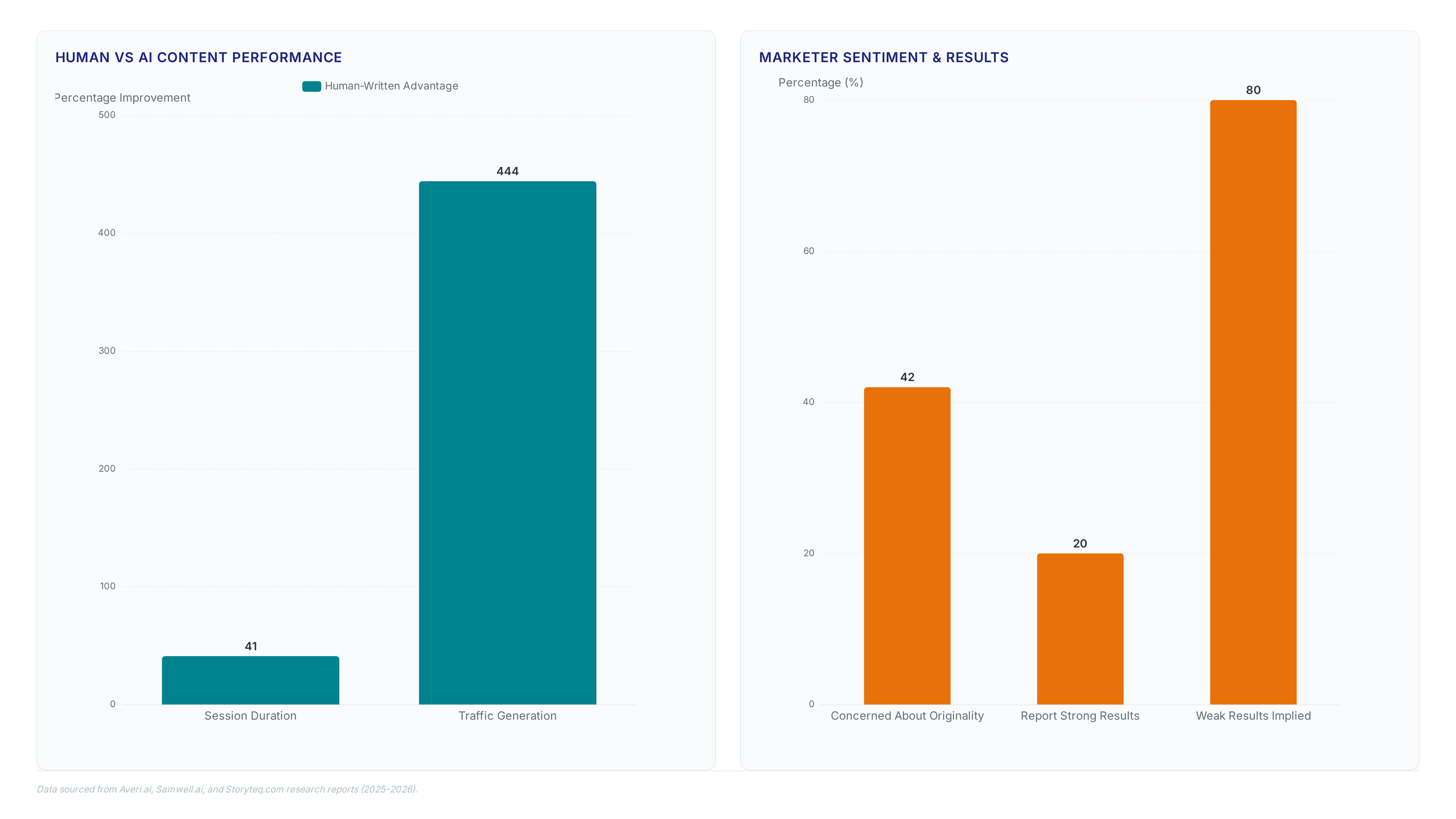
Generative models recombine existing patterns until the output mirrors the median of available education data. This mechanistic limitation explains why a significant portion of marketers using AI report weak results, as tools frequently fail to retain the specific context required for differentiation. The consequence is not merely stylistic blandness but a structural inability to offer readers information they cannot find in ten other articles. Hidden costs of this convergence include:
- Drafts that resemble pages already ranking for a topic despite varied prompting.
- Loss of unique point of view when algorithms handle the actual writing.
- Reduced session duration as content lacks original data or expert angles.
Professionals often worry about losing originality, yet the deeper risk involves the false economy of volume over value. Teams mistake finished-looking prose for completed thought while ignoring that AI remixes rather than originates. Tension lies between scaling production and maintaining the distinct expert angle that drives engagement. Operators must treat algorithmic output as a starting condition, reserving human leadership for the final synthesis. Successful teams build their processes around this limitation by ensuring AI is used for research and outlines while humans retain control over point of view and original data.
Diagnosing Low Engagement via Traffic Disparity
Diagnosing repetitive AI content starts by measuring traffic gaps against human-written benchmarks rather than total page views. When generative models recombine existing patterns, the resulting drafts often mirror pages already ranking for a topic, causing a measurable decline in user retention. Research indicates that purely algorithmic outputs fail to capture the nuance required for deep engagement, leading to session durations that lag notably behind human-authored equivalents. This disparity suggests that high-volume publishing schedules may be diluting overall site authority instead of compounding it.
| Metric | Human-Written Baseline | AI-Generated Average |
|---|---|---|
| Traffic Growth | 5.44x increase over five months | Baseline |
| Session Duration | Significantly longer | Baseline |
| Originality Risk | Low | High |
Diminished brand differentiation and reduced return on content investment follow the decision to ignore this traffic disparity. A draft merely restating information available in ten other articles adds no unique value proposition for the reader. Teams relying heavily on automation often miss this signal until revenue impacts become unavoidable. Operators must shift from volume-based metrics to engagement-quality gates to fix repetitive AI content. A practical approach involves auditing session duration trends by reader segment to isolate algorithmic drag. Workflows require adjustment if performance lags so humans retain control over point of view and expert angle. Effective strategies involve catching drafts that restate existing pages before they go on the calendar, ensuring the final output offers something readers cannot find elsewhere.
The Recombination Trap: Why Prompts Cannot Fix Generic Drafts
Implementing a Human-Led Workflow for Engagement and Gap Analysis
Defining the Human-Led Workflow for Originality
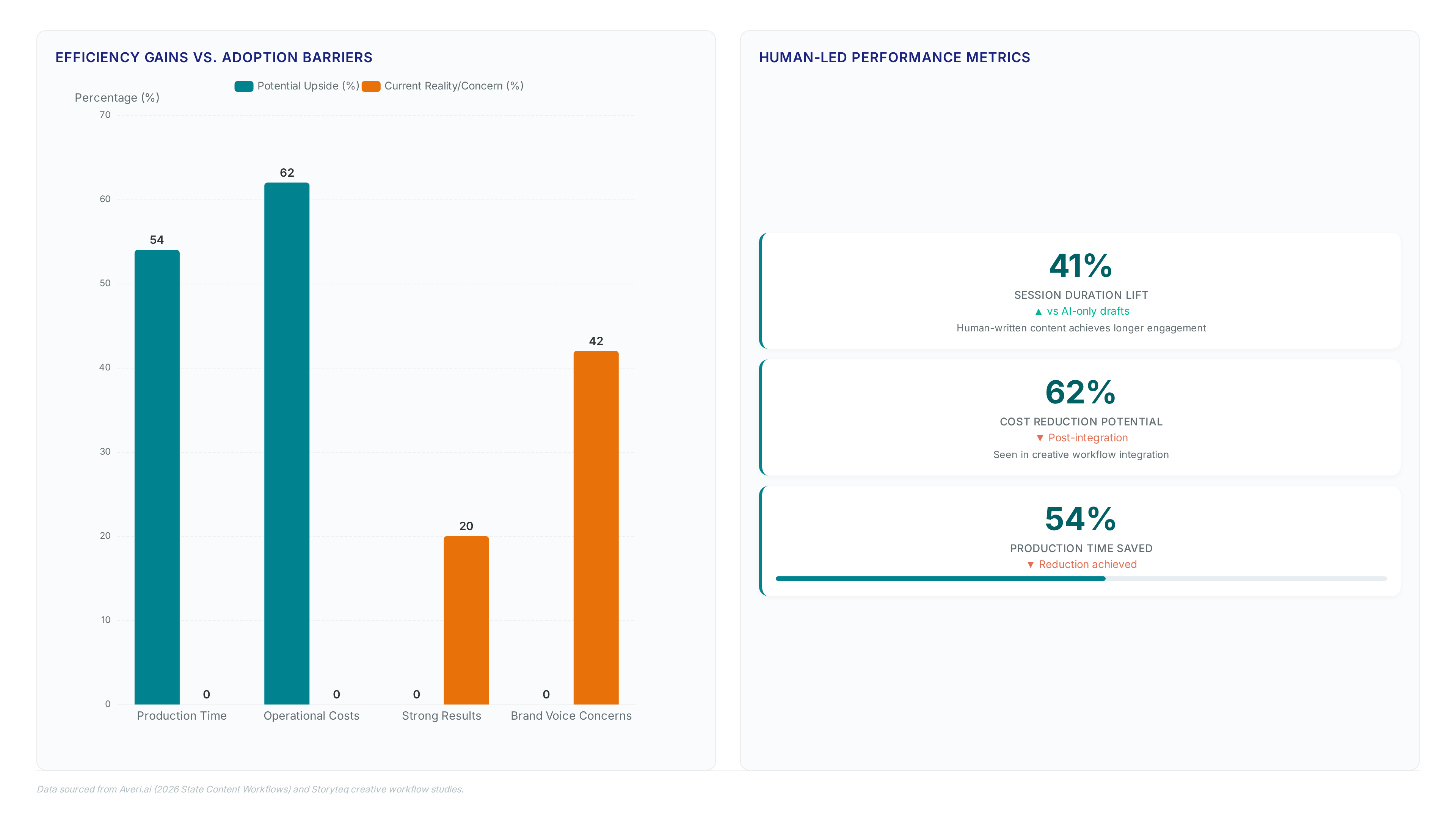
Algorithms excel at assembling research notes and sketching outlines, yet they stumble when asked to inject genuine point-of-view or original data. This specific division of labor stops the recombination trap where software merely shuffles existing patterns into generic drafts. Because artificial intelligence aggregates training data, handing it the actual writing task often yields text indistinguishable from competitors covering identical ground. Judgment and empathy must remain central to the final output if the goal is differentiation. Publishing high volumes of material offers little value when readers find the same information in ten other articles. Effective implementation requires distinct gates between automated drafting and human refinement:
- Restrict generative tools to SERP analysis and initial gap identification tasks.
- Ensure human experts inject proprietary data or unique angles before finalizing drafts. 3.
Marketers frequently worry that these tools cannot reflect an established brand voice. Treating automation as a research accelerator rather than an author prevents brand voice erosion. Structured frameworks allow organizations to scale quality production without sacrificing what makes them unique. Success depends on spotting exactly where AI becomes detrimental, particularly regarding point of view, original data, and expert angle.
Implementation: Executing Gap Analysis to Beat Ten Other Articles
- Extract the primary argument from your AI-assisted draft and verify it against current SERP leaders.
- Flag any section where the logic merely restates available information without adding unique data or expert perspective. 3.
Skipping this step invites mediocrity because algorithms naturally converge on median responses. A distinct human-led workflow solves this by reserving final authorship for subject matter experts capable of introducing novel angles. Industry discussions regarding AI content creation workflows highlight how often these tools fail to mirror a specific brand voice. Generic outputs serve only as a starting condition, not a finished product. Organizations that skip this gate simply increases noise, creating volume without value. Content sounding like everything else performs like everything else, delivering zero competitive advantage.
Tracking Reader Engagement by Segment to Prioritize Topics
Isolating performance metrics by audience cohort replaces gut instinct with data-driven prioritization. Successful teams audit production processes to locate bottlenecks before applying automation layers.
- Define reader segments to improved understand audience needs.
- Measure engagement across these groups to identify format preferences. 3.
| Analysis Target | Human Review Required | Automated Metric |
|---|---|---|
| Topic Resonance | Yes | Session Duration |
| Format Fit | Yes | Scroll Depth |
| Voice Alignment | Yes | Bounce Rate |
Scaling volume blindly dilutes brand authority. Distinguishing between generic traffic and meaningful interaction helps avoid the recombination trap. Operators who skip this validation publish material lacking specific brand context. Strong detection of copied or generic material requires review tools like Originality AI. Embedding these checks early guarantees original data drives the pipeline. Ignoring segment data results in a catalogue of content that sounds like everything else.
About
Sofia Marchetti is a B2B Content Strategist with over twelve years of experience driving demand generation in the SaaS sector. Her expertise lies in distinguishing between high-volume output and genuine topical authority, making her uniquely qualified to address the pitfalls of generic AI content. In her daily work, Sofia designs editorial systems where artificial intelligence serves as an accelerator for original insight rather than a replacement for human expertise. She understands that when AI merely "remixes" existing data, brands lose the competitive edge required to rank in modern search environments. At Enterium, a publication dedicated to scaling content operations through rigorous methodology, Sofia applies this philosophy by building pipelines that prioritize quality gates and strategic differentiation. Her approach directly counters the trend of "AI slop" by ensuring every piece of content offers unique value that readers cannot find elsewhere. This article reflects her commitment to building revenue-generating assets that survive the shift toward AI-driven search results.
Conclusion
Scaling AI content without rigorous human oversight breaks brand authority by flooding channels with derivative assets that fail to retain attention. The operational cost here wasted budget, but the erosion of trust as audiences disengage from generic messaging. To survive this saturation, organizations must mandate a human-led validation layer where subject matter experts refine algorithmic outputs before publication. This approach ensures every piece offers a unique perspective rather than restating common knowledge. Relying solely on volume creates a false sense of productivity while actual influence stagnates.
You should implement a strict policy requiring human review for all high-stakes topics immediately, rather than waiting for engagement metrics to collapse. This timeline allows teams to adjust workflows before quarterly goals are compromised by poor performance data. Start this week by auditing your current top-performing pages to identify which specific elements required human insight versus automated generation. Use these findings to establish a baseline for your AI content approach that prioritizes distinct voice over raw output speed. Integrating detection tools now helps maintain originality standards as the environment becomes more crowded. Success depends on treating AI as a drafting assistant, not a final author, ensuring your brand remains distinguishable in a sea of synthetic noise.
Frequently Asked Questions
Most initiatives fail because tools lose specific brand context during generation. Only a portion of marketers report strong results when relying on these systems for drafting. Teams must restrict AI to research tasks to avoid publishing generic, derivative assets that lack unique value.
Artificial intelligence content often fails to hold reader attention as effectively as human writing. Human-written content achieves 41% longer session durations than content generated by artificial intelligence. Brands should use AI for outlines but require humans to inject original data for better retention.
Marketers fear that automated tools cannot accurately reflect their established and unique brand voice. Data shows a portion of marketers express concern about losing originality when AI tools fail to reflect their voice. Human oversight is mandatory during the review stage to verify distinct brand tone.
High-volume drafting fails because models recombine existing patterns rather than creating new insights. This structural limitation explains why only a portion of marketers using AI report strong results with current workflows. Teams must prioritize unique data over speed to differentiate from ten other articles.
Teams must prevent AI from drafting final text to avoid mirroring existing search results. Human-written content achieves 41% longer session durations than content generated by artificial intelligence. Assign humans the role of injecting original data while limiting AI to aggregating signals and suggesting structures.