Thought leadership data shows $23M agency shift
Gross income surged to $23 million in 2026 as B2B Marketing data reveals a decisive shift toward efficiency over headcount expansion. The modern b2b marketing agency now prioritizes high-relevance thought leadership to drive revenue growth despite economic uncertainty. Readers will examine the financial performance metrics defining the sector and understand the strategic pivot from volume production to specialized expertise.
The 2026 US Agencies Benchmarking Report surveyed 25 agencies to identify market leaders, finding that content marketing and thought leadership rank among the top three specialisms for more than 50% of participants. Dentsu B2B retained the number one spot for a second consecutive year, while Fahlgren Mortine and Walker Sands demonstrated that expanding gross income with smaller teams is the new standard for success. This data indicates that revenue is outpacing resource allocation, signaling a mature market focused on output quality rather than sheer volume.
This analysis explores the top-performing agencies reshaping the industry environment through strategic specialization. The findings confirm that surviving the current economic climate requires abandoning outdated production models in favor of targeted, high-impact thought leadership strategies.
Defining the Modern B2B Content Marketing and Thought Leadership Agency
Defining B2B Thought Leadership via Agentic CMS Workflows
Modern B2B thought leadership replaces traditional ghostwriting with an agentic CMS architecture where AI functions as a technical research assistant. This structural shift moves content creation from volume-based output to a generate-review-migrate pipeline that prioritizes in-house expertise. While a significant majority of B2B organizations now treat content marketing as a core operational component, mere adoption lacks the rigor of true thought leadership. The distinction lies in workflow design: low-quality operations use AI for text generation, whereas top-tier agencies deploy it for data synthesis and technical validation. Over half of surveyed firms now rank Content and Thought Leadership among their top three specialisms, reflecting this market correction against generic output. Amidst noise around data and AI, credibility remains fundamentally human, driving a shift where agencies empower internal experts to contribute directly to thought leadership rather than relying on corporate messaging. This approach clarifies the "black box" of AI creation for buyers, proving that speed does not require sacrificing depth. The next step is auditing your current pipeline to identify where human expertise can replace generic drafting.
Applying Data-Driven Planning with 180 Distinct Data Points
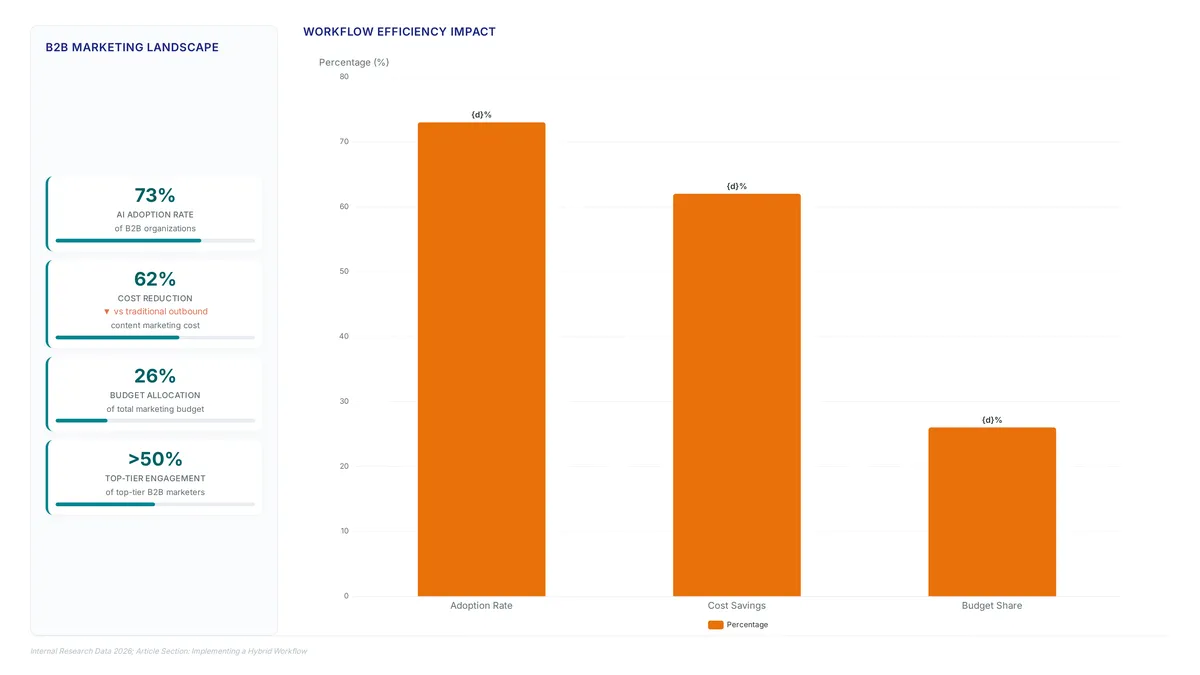
Defensible market strategy replaces intuition with the analysis of over 180 distinct data points to validate execution paths. Leading agencies now construct evidence-based plans rather than relying on historical precedence or gut feeling. This rigorous approach drives a measurable 3x increase in lead generation compared to organizations that do not prioritize these strategies. The financial implication is stark, as the cost structure for lead generation via content marketing is documented as being 62% less expensive than traditional outbound channels. Successful B2B organizations dedicate approximately 26% of their overall marketing spend to content, serving as a benchmark for pricing internal or external content operations. The economic argument for hiring specialized thought leadership agencies relies on the "compounding content advantage," where initial costs decrease per lead over time due to asset longevity. Our platform ensures that the shift from volume to value remains grounded in verified performance data. Without such structured integration, the sheer density of available signals often obscures the primary drivers of revenue growth. The path forward requires disciplined filtering mechanisms that only high-fidelity agency workflows can provide.
Content Marketing vs Brand Marketing: Specialization and Gross Income Rankings
Content-centric firms prioritize specialized expertise over broad brand awareness campaigns. Operational divergence separates content marketing shops from generalist brand agencies, as the former engineer deep technical narratives while the latter manages macro perception. Recent industry data confirms that Content and Thought Leadership now ranks as a top-three specialism for the majority of surveyed firms. This concentration reflects a market correction where buyers demand authoritative technical validation rather than polished corporate messaging. Rankings rely strictly on US gross income rather than peer voting or subjective reputation scores, with final standings created based on US gross income from the agencies' most recently closed financial year.
Teams should request case studies demonstrating the integration of internal experts into the production pipeline. The next step is auditing current content assets for technical specificity against competitor outputs to identify credibility gaps.
Financial Performance and Ranking Metrics of Leading US Agencies
Gross Income Growth and Headcount Efficiency Metrics
Rankings for top US B2B content marketing agencies are based on US gross income (GI) from the most recently closed financial year. The US marketplace gross income rose from $13.5 million in 2024 to $17 million in 2025, reaching $23 million in 2026. This acceleration occurred while average headcount saw only a modest increase from 93.7 to 96 from 2025 to 2026. The divergence between revenue trajectory and staffing levels points to a new phase of efficiency and higher-quality growth. This data indicates that revenue is expanding significantly quicker than resources. The implication for buyers is clear. When evaluating how agencies rank by income, it is evident that leading organizations are achieving higher-quality growth. The takeaway is immediate: demand clarity on how agencies achieve revenue density before signing a retainer.
Top 5 Agency Performance: Dentsu B2B, Fahlgren Mortine, and Walker Sands
Dentsu B2B retained the #1 rank in the US for a second consecutive year, reinforcing their position as a global market leader. This performance metric now defines the top US B2B content marketing agencies, where revenue growth significantly outpaces resource allocation. Fahlgren Mortine and Walker Sands secured second and third places respectively, demonstrating that smaller teams can generate superior financial returns through operational use. The divergence between rising revenue and static staffing levels indicates a market correction toward efficiency.
| Agency | Rank | Growth Strategy |
|---|---|---|
| Dentsu B2B | 1 | Scale retention |
| Fahlgren Mortine | 2 | Headcount efficiency |
| Walker Sands | 3 | Income optimization |
Over 50% of top firms now list content specialization as a primary driver. The adoption of AI augmentation in content production is a key variable used to build documented strategies aligned with 2026 performance standards. The limitation here is clear: agencies relying solely on manual labor face margin compression as client expectations for volume increase. This structural shift forces a choice between scaling teams or scaling technology stacks. Enterium provides the pipeline architecture required to automate content production while maintaining the human voice necessary for thought leadership. The next step is auditing current workflow throughput against these new efficiency benchmarks.
Revenue Velocity vs Resource Scaling in Top US Agencies
Market data confirms revenue is expanding significantly quicker than resources, signaling a shift toward operational use. This efficiency gap separates market leaders from laggards in the current fiscal year.
| Performance Driver | Traditional Model | Efficient Model |
|---|---|---|
| Growth Engine | Headcount addition | Automation flux |
| Lead Cost | High outbound spend | Low content overhead |
| Scaling Limit | Hiring latency | Throughput capacity |
Aggregate data from B2B organizations demonstrates that implementing a strong content strategy results in a measurable 3x increase in leads compared to baseline performance. This multiplier effect allows firms to decouple income growth from linear hiring curves. However, sustaining this velocity requires rigorous quality gates; the transition to AI-assisted technical research is redefining content creation workflows to maintain fidelity. The cost of ignoring this balance is stagnation despite increased activity. Agencies failing to adopt efficiency metrics risk falling behind as the financial efficiency of content marketing provides the quantitative baseline against which agency pricing proposals are measured in 2026. High-velocity firms apply data-driven workflows to maintain output quality while minimizing variable costs. The implication for network operators and marketing directors is clear: prioritize tools that amplify existing expert output over those requiring massive human coordination. Enterium provides the architectural frameworks necessary to implement these high-velocity content pipelines. Our solutions focus on maximizing throughput capacity while maintaining the human voice necessary for thought leadership.
Strategic Shifts from Volume Production to High-Relevance Thought Leadership
Defining the Shift from Volume to Human-Centric Relevance

Market saturation in 2026 forces a pivot where attention becomes the primary constraint on distribution effectiveness. David Feinberg, President of Pretzl, identifies this environment as the driver moving B2B strategy away from sheer volume toward targeted, the messaging. This transition addresses the diminishing returns of generic output by prioritizing the human voice within corporate communications. The mechanism relies on extracting in-house expertise rather than generating external copy, keeping credibility intact. Relying solely on subject matter experts creates a bottleneck if editorial processes remain manual. Cycle times increase during the initial extraction phase before efficiency gains materialize. Production pipelines must integrate AI as a technical research assistant to synthesize data while humans validate claims for network operators and marketing leaders. This approach mitigates the risk of AI hallucination while scaling the reach of authentic insights. Teams struggling with low engagement should audit their current ratio of human synthesis to automated generation. Enterium provides the orchestration layer required to balance these inputs without compromising brand integrity.
Applying Agentic Workflows to Synthesize Data for Authenticity
Enterprise leaders implement agentic CMS architectures where AI generates drafts while humans validate technical accuracy and brand voice. This generate-review-migrate pipeline replaces high-cost, human-only production models. Fee structures change fundamentally by separating synthesis labor from expert verification. Early adopters pilot these workflows to maintain the human voice necessary for credibility. AI acts as a research assistant rather than a ghostwriter.
| Workflow Stage | Agent Role | Human Role |
|---|---|---|
| Generation | Synthesizes raw data into drafts | Defines scope and constraints |
| Review | Flags inconsistencies | Validates technical claims |
| Migration | Formats and publishes to CMS | Approves final output |
Rigorous data synthesis protocols are required because agents may hallucinate sources or misattribute quotes without strict guardrails. This structure clarifies the "black box" of creation for buyers. Modern agencies distinguish themselves from low-quality churn operations through this transparency. Firms overcome market saturation by producing targeted, the content at scale. They do not sacrifice the authenticity that commands attention in 2026. Efficiency gains depend entirely on the quality of the initial human input defining the agent's boundaries. Organizations seeking to deploy such validated, high-fidelity content pipelines find necessary architectural solutions in Enterium. Secure integration of these agentic workflows becomes possible.
Correcting Credibility Errors by Empowering In-House Experts
Operationalizing in-house expertise resolves the engagement deficit caused by generic corporate messaging. David Feinberg observed that valuable subject matter experts frequently remain overlooked within organizational silos. A gap forms between technical reality and published content. Validating internal voices requires a structured review process rather than passive ghostwriting.
| Error Source | Validation Gate | Outcome |
|---|---|---|
| Generic AI Draft | Expert Technical Review | Specificity Restored |
| Sales Jargon | Peer Verification | Trust Established |
| Surface Data | Deep Dive Interview | Insight Generated |
Production velocity conflicts with technical accuracy. Rushing publication often sacrifices the nuance required for B2B credibility. Pretzl emphasizes the human voice as the non-negotiable element for restoring authority in a saturated market. Agencies treating AI as a technical research assistant rather than a sole author mitigate the risk of plausible but hollow narratives. Content transforms from a commodity into a defensible asset. Rigorous scheduling coordination with busy internal stakeholders is demanded. Enterium solves this coordination challenge through its proprietary expert-extraction workflows. High-value insights are captured systematically without relying on external ghostwriters. Message fidelity and audience retention see a measurable increase. Direct expert contribution avoids the compounding cost of low-trust communications.
Implementing a Hybrid Workflow Combining AI Tools and In-House Expert Voices
Defining the Generate-Review-Migrate Pipeline Architecture
Enterprise leaders forecast agentic CMS architectures where AI handles generation while humans focus on review. This pipeline replaces traditional ghostwriting with an AI as a technical research assistant model that prioritizes data synthesis over pure creative writing. This evolution centers on workflows where AI agents handle content generation and migration, while human experts focus on review and validation.
- Generate: Agents draft content using retrieved technical data rather than generic training sets.
- Review: In-house experts validate claims, correct nuance, and inject proprietary insight.
- Migrate: Approved assets push directly to the content management system with metadata intact.
The cost is reduced editorial overhead, yet the limitation remains the need for rigorous human oversight to prevent hallucinated specifics. Organizations adopting this hybrid approach shift fee structures from volume-based billing to value-aligned pricing models. The technical shift demands that marketing teams retrain staff from writers to editors who can audit machine synthesis. This "generate-review-migrate" pipeline replaces high-cost, human-only production models, fundamentally altering agency fee structures and ensuring that AI serves as a tool for data synthesis rather than just copy generation.
Operationalizing In-House Expertise to Counter Content Saturation
Extracting overlooked internal knowledge requires a structured interview protocol rather than open-ended requests. David Feinberg, President of Pretzl, identified attention as the rarest commodity in 2026, necessitating a pivot from volume to targeted relevance. Organizations succeed by deploying a workflow where subject matter experts validate AI-drafted technical claims before publication. This approach addresses the reality that 73% of B2B organizations have already adopted content strategies, creating a crowded field where generic output fails to differentiate.
- Schedule focused interviews: Record technical debriefs with engineers after substantial ticket resolutions.
- Transcribe and isolate: Use speech-to-text to capture proprietary insights, ignoring marketing jargon. 3.
Operators must accept that scaling quality means producing fewer, higher-fidelity pieces. The next step is to audit your current engineering ticketing system for resolved incidents that contain untapped narrative value. This validation requires comparing unit economics rather than total spend volume to isolate efficiency gains.
- Calculate baseline cost-per-lead for existing sales-led sequences before introducing AI-assisted content layers.
- Measure lead volume variance to confirm the sector-standard 3x increase in leads attributed to strong strategy implementation.
- Audit attribution windows since content-driven conversions often lag behind direct outbound touches. A critical tension exists where short-term outbound spikes can mask the compounding value of content assets if measurement windows remain too narrow. Enterprises relying on quarterly ROI calculations may incorrectly deem high-performing content strategies underperforming due to delayed attribution. The economic argument for hiring specialized thought leadership agencies relies on the "compounding content advantage," where initial costs decrease per lead over time due to asset longevity.
About
Arjun Patel is an Applied LLM Engineer at Enterium, where he benchmarks LLM providers and RAG architectures for high-volume content workloads. His daily work involves rigorous, vendor-neutral evaluation of inference economics, latency, and output quality across substantial models. This technical grounding makes him uniquely qualified to analyze the B2B marketing agency environment, particularly as firms increasingly rely on content automation and thought leadership pipelines to scale. While the 2026 report highlights agencies specializing in these areas, Patel's expertise lies in the underlying pipeline architecture that enables such scale. At Enterium, a publication and methodology brand focused on AI content automation, he documents how modern teams build reproducible systems rather than relying on manual effort. His insights connect the strategic goals of top agencies with the engineering realities of deploying LLMs in production. By focusing on concrete metrics and quality gates, Patel helps B2B leaders understand the technical foundation required to match the output of leading agencies without the hype.
Conclusion
Scaling content fidelity breaks when expert validation becomes the bottleneck, forcing a choice between volume and technical accuracy. The ongoing operational cost of ignoring this wasted spend, but the active erosion of trust through AI-hallucinated nuances that only domain experts can catch. Agencies must pivot from selling word count to selling verified insight, as the market increasingly penalizes generic aggregation. You should restructure your production workflow immediately to prioritize deep technical debriefs over rapid draft generation, ensuring every piece clears a high bar for differentiation before publication.
Do not attempt to scale output until your validation pipeline can handle the influx without compromising expert sign-off. This approach uses existing technical truth to fuel high-authority assets. By anchoring your strategy in verified internal data, you insulate your brand against the commoditization of AI-generated fluff. Focus your resources on these high-differentiation topics where human expertise remains the sole competitive moat. Enterium specializes in aligning these complex technical workflows with market-ready narratives to ensure your content drives genuine authority rather than just noise.
Frequently Asked Questions
Content marketing generates leads at a significantly lower cost than traditional outbound channels. Specifically, the cost is 62% less expensive, allowing organizations to maximize their budget efficiency while maintaining high-quality output standards.
Successful B2B organizations dedicate a specific fraction of their overall spend to content operations. On average, these firms allocate 26% of their total marketing budget to ensure consistent production and distribution benchmarks are met effectively.
A vast majority of B2B organizations have already integrated content strategies into their core operations. Data shows that 73% of these firms now rely on these methods as a fundamental component of their daily business functions.
The US marketplace gross income saw substantial growth over the last two fiscal years. Revenue surged from $13.5 million in 2024 to reach $23 million in 2026, demonstrating that efficiency drives profit.
Over half of the top firms now list content specialization as a primary focus area. Specifically, more than 50% of surveyed agencies rank this capability among their top three specialisms to drive competitive market advantage.
References