Unified content platforms cut ops debt by 42%
AI-mature teams report a significant compression in cost-per-asset, proving that fragmented workflows are financially unsustainable. Without consolidating research, creation, and distribution into a single architecture, organizations merely accelerate their accumulation of technical and operational liabilities.
This analysis cuts through the noise to show how content workflow automation directly addresses content ops debt reduction by removing manual handoffs between disparate tools. We dissect the specific mechanics of an AI-powered content workflow, showing how automated indexing triggers and keyword clustering replace guesswork with data-driven precision. Integrated systems enforce consistency where siloed applications fail.
The return on investment found in consolidated content operations is measurable, specifically in content performance tracking. By establishing a reliable content performance feedback loop, teams ensure every asset contributes to broader visibility goals rather than adding to the noise. The path forward requires abandoning patchwork solutions for an architecture designed for scale and intelligence.
The Role of Unified Platforms in Eliminating Content Ops Debt
Unified Content Operations Platform vs Fragmented Tool Stacks
A unified content workflows platform functions as a single system that connects research, creation, optimization, publishing, indexing, and performance measurement into one coordinated workflow. This architecture contrasts sharply with environments where disjointed tools operate on isolated data models, forcing teams to rely on manual handoffs that introduce latency and context loss. Moving assets from research to publication in a fragmented environment often requires exporting CSVs or re-entering metadata. Such a process breaks the feedback loop necessary for modern content workflow automation. Data continuity defines the distinction here because integration is not the same as interoperability. Point solutions may exchange data via APIs yet rarely share a common state model. The content performance tracking layer often lacks visibility into original research constraints or AI visibility tracking metrics generated during creation.
Current industry data indicates that 42% of enterprise-scale companies have actively deployed AI, with another 40% experimenting, signaling a move from pilot to practice. This volume can exacerbate operational friction without a unified backend. Teams face increased operational costs due to repetitive tasks and costly revisions or rework caused by errors, a condition known as content ops debt. Adopting a unified approach allows organizations to combine strategic inputs, production workflows, data feedback, and governance rules. The team can create, adapt, and improve content across channels with less manual friction. Teams adopting this consolidated approach avoid the latency penalties inherent in stitching together best-of-breed point solutions that were never designed to share state.
Eliminating Context Switches in Disconnected Content Workflows
Disconnected toolchains force manual data re-entry that breaks workflow continuity and inflates operational overhead. Each step requires a context switch, moving researchers away from analysis to manage file transfers between isolated systems. This fragmentation prevents the closed-loop feedback necessary for effective content workflow automation, as performance data rarely returns to the planning layer without human intervention. Teams relying on these disjointed stacks often duplicate research efforts because shared historical data remains siloed within specific applications.
Consolidating these functions into a single unified content tasks platform removes the friction of switching between interfaces. By pairing expert dictations with AI formatting and human editorial review, organizations can reduce content production timelines notably while delivering structured, authoritative answers. The reduction stems from eliminating the time spent exporting CSVs and re-uploading assets for indexing. Simply connecting APIs does not guarantee data fidelity. True unification requires a shared data model where metadata persists unchanged from ideation to publication. Organizations incur hidden costs through version drift and metadata loss without this architectural cohesion. Effective solutions engineer this persistence by design so that research signals directly inform creation parameters without manual translation. The result is a measurable decrease in time-to-publish while maintaining strict governance over brand voice and factual accuracy.
Operational Risks of Data Silos and Missed Analytics Feedback
Disconnected analytics dashboards prevent performance signals from reaching the research phase, creating content ops debt. This architectural gap causes missed opportunities because insights generated post-publication fail to inform new topic clustering or keyword strategy. Teams cannot validate hypotheses against actual user behavior when data remains siloed. Static assumptions replace flexible evidence in such scenarios.
The critical constraint is temporal. Effective content performance feedback loop mechanisms must close within 60 days of publication to maintain strategic relevance. Delayed analysis renders optimization actions obsolete as search algorithms and user intent shift. Organizations that pull structure and governed AI inputs into one connected system compound improvements over time. Every performance signal turns into a quicker feedback loop. The AI-human balance suffers without this continuity as creators lack the context needed to refine brand voice based on real-world results. Solutions that enforce a single source of truth ensure that indexing triggers and metric ingestion occur automatically. This approach eliminates the latency that degrades content value. Research teams operate with current data rather than historical artifacts. Content strategies drift from market reality without unified visibility.
Inside the Architecture of AI-Driven Content Workflows
Defining AI Visibility Tracking and Topic Clustering Mechanics
AI visibility tracking monitors how AI models reference a brand within generated responses. This mechanism captures citation frequency and context to determine if a brand appears as a primary source or is omitted entirely. Access to this data allows teams to optimize for generative engine outcomes. Raw monitoring creates noise without structural organization, making topic clustering necessary.
Topic clustering organizes keywords into thematic groups rather than treating them as isolated search terms. This approach groups semantically related concepts to signal authority to retrieval systems.
| Feature | Function | Operational Outcome |
|---|---|---|
| Visibility Tracking | Monitors model citations | Identifies missing brand references |
| Topic Clustering | Groups semantic keywords | Signals thematic authority |
Balancing breadth against depth creates tension; broad clusters capture more traffic but may dilute specific relevance signals. Integrating these mechanics directly into the workflow helps manage this balance. Centralizing intelligence reduces the time between detecting a visibility gap and deploying corrected content. This consolidation transforms raw data into actionable strategy so content production aligns with how modern algorithms retrieve and weight information. The result is a feedback loop where every published piece reinforces the thematic clusters identified as vital for brand visibility.
Applying Generative Engine Optimization to Brand Mention Gaps
When generative models omit a brand for central topics, the signal indicates a specific content gap in the training corpus or retrieval index. This absence requires Generative Engine Optimization (GEO) to shift focus from keyword density to claim clarity and authoritative structure. Traditional SEO differs because GEO optimizes how systems synthesize information, ensuring the brand appears as a primary source rather than an omitted entity.
Effective strategies address these gaps by correlating AI visibility tracking data with thematic topic clustering. The process identifies exactly where a brand fails to appear in model responses for high-value queries. Teams can then restructure content to emphasize expertise signals and factual density within those specific clusters.
| Optimization Target | Traditional SEO Focus | GEO Requirement |
|---|---|---|
| Structure | Header hierarchy | Claim-evidence pairs |
| Authority | Backlink count | Citation frequency |
| Coverage | Keyword match | Concept completeness |
Over-optimizing for frequency while neglecting context creates operational risk, which can trigger quality filters in synthetic data pipelines. A unified approach ensures that content updates align with re-indexing cycles. Teams using integrated systems report that a significant portion of their optimization efforts now target model synthesis logic rather than simple ranking factors. This shift reduces the latency between content publication and AI recognition.
Brands risk remaining invisible to AI-driven research workflows regardless of static search performance without this feedback loop. Closing this loop transforms raw visibility data into actionable content revisions. The result is a measurable reduction in brand mention gaps across substantial generative interfaces. Practitioners must prioritize structural clarity over volume to secure placement in synthesized answers.
Checklist for Validating Unified Platform Content Intelligence Layers
Validate that a platform unifies keyword research, competitive gap analysis, and AI writing into one environment. A genuine unified content functions platform must include capabilities across these three functional layers to prevent data silos. Operators should invest in AI content tools when manual handoffs between research and creation tools increase cycle time beyond acceptable limits.
- Verify the system ingests raw search data and immediately applies thematic grouping without external export.
- Confirm the writing environment surfaces competitive gaps directly within the editor interface during draft creation.
- Ensure the platform tracks how generative models reference brand claims after publication.
| Capability | Fragmented Stack | Unified Intelligence |
|---|---|---|
| Data Handoff | Manual CSV export | Real-time API sync |
| Gap Visibility | Post-publish audit | In-line editor alerts |
| Workflow State | Static documents | Flexible feedback loops |
Price points often dictate the threshold where teams transition from disjointed utilities to integrated systems. The entry-level Solo Plan for thorough AI content platforms, specifically Averi, is priced at a monthly fee. However, entry tiers frequently limit the volume of AI visibility tracking queries, forcing a choice between depth of analysis and breadth of coverage. Resolving this tension involves embedding continuous intelligence checks directly into the publishing pipeline rather than treating them as add-on modules. Teams using fragmented tools often miss the correlation between a missing topic cluster and a drop in generative citation rates. The operational consequence is a content backlog that looks complete but fails to trigger retrieval in target models. Deploying a unified system ensures that every drafted piece immediately validates against current competitive gaps. This architecture reduces the latency between identifying a market void and publishing a verified response.
Measurable ROI from Consolidated Content Operations
Defining Workflow Integration Depth and Automation Scale
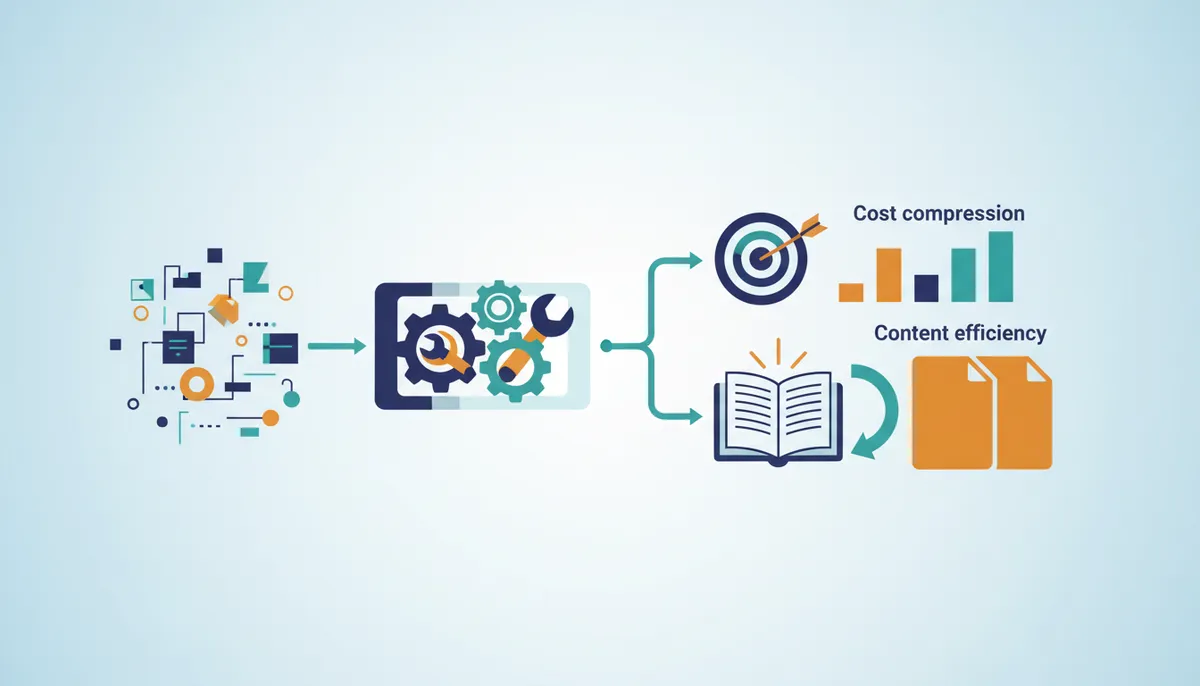
Manual data transfer between disjointed modules creates structural friction that bundled tools exacerbate by forcing constant asset exports and imports. This inefficiency generates content ops debt which accumulates as teams scale, slowing response times to market shifts without adding proportional value. Automation scale measures the multiplier effect a unified system exerts on human output. AI-driven content creation combines strategic inputs, production workflows, data feedback, and governance rules so teams create, adapt, and improve content across channels with less manual friction. The distinction lies in whether the system executes logic or merely stores files.
Operators often mistake feature density for integration depth, assuming that purchasing a suite of point solutions solves the fragmentation problem. If AI visibility tracking requires logging into a separate interface to verify indexing status, the workflow remains broken. The cost is not time; it is the inability to close the feedback loop quickly enough to influence the current news cycle. Embedding performance tracking directly into the creation pipeline ensures that insight drives iteration immediately. Organizations stagnate without this native connectivity, trapped by the very tools intended to accelerate them.
Achieving 60-Day Feedback Loops to Compress Marginal Production Costs
Closing the feedback window requires automated indexing triggers that connect publication directly to performance telemetry without manual export steps. A unified system eliminates this friction by routing performance signals back to the content intelligence layer immediately upon publication. This architecture allows operators to identify underperforming assets and deploy corrections rapidly rather than waiting for annual reviews.
The structural advantage lies in decoupling output volume from headcount expansion. Integrating research, creation, and visibility into a single pipeline enables content ops debt reduction through continuous feedback. Teams accumulate technical debt in the form of outdated topic clusters and broken internal links that degrade organic reach over time without this integration. Compressing the cycle demands rigorous governance because quicker loops increases errors if quality gates are weak. Rapid propagation of brand misalignment across channels follows ignored protocols. Consolidating these functions transforms content from a static asset into a flexible instrument responsive to market signals. Every publishing cycle reduces the cost of the next iteration while maintaining brand fidelity.
Validation Checklist for Automatic Indexing and Internal Link Automation
Adoption requires verifying that scheduled publishing executes without manual file exports between modules.
- Confirm automated routing rules function without human intervention.
- Validate that internal link updates occur instantly upon publication.
- Check that performance data flows back to the creation interface automatically.
- Ensure governance policies trigger alerts before errors propagate.
This disconnect inflates marginal production costs even when output volume appears high. Effective workflow governance validates these automation depths before migration. The platform enforces strict automated routing rules that eliminate the latency found in bundled solutions. Promised efficiency gains remain theoretical without this capability, leaving the organization with the inefficiencies of a disjointed toolchain.
Implementing a Unified Strategy to Automate Publishing Cycles
Defining Autopilot Mode and IndexNow Automation Mechanics
Manual handoffs between content creation and distribution layers vanish under this mechanism. Production time drops notably as workflow fragmentation ends because AI handles repetitive tasks while humans refine brand voice and strategy on unified platforms. Automated indexing triggers become necessary for lifecycle management at this stage. Implementations couple this capability with automated sitemap management to ensure immediate discovery by search crawlers.
| Feature | Standard Scheduling | Unified Autopilot |
|---|---|---|
| Trigger Source | Manual or Basic Cron | Automated Workflow Events |
| Indexing Signal | Passive Crawl | Active Push Signal |
| Feedback Loop | None | Integrated Performance Data |
The configuration below illustrates the binding of publishing events to indexing signals:
A system fails if the planning layer ignores performance data, resulting in automated noise rather than strategy. True lifecycle automation demands that performance metrics feed directly back into content strategy logic. This closure closes the loop between execution and research effectively.
Deploying Specialized AI Agents for GEO-Optimized Article Generation
Specialized AI agents generate articles optimized for search engines and generative answer engines. Each agent targets a specific workflow segment, ranging from keyword clustering to final syntax validation, ensuring brand alignment appears correctly in models.
- Configure the generation layer to assign distinct roles for research, drafting, and optimization.
- Integrate AI visibility tracking to monitor performance across platforms.
- Route outputs through a unified validation gate before triggering publication schedules.
Raw model output often lacks the nuance required for high-stakes brand communication. This division of labor remains necessary because teams using unified platforms observe that AI handles repetitive tasks while humans refine brand voice and strategy. Latency between agents can stall the entire pipeline without a central orchestration layer. Unified systems solve this by binding these agents within a single execution context, eliminating the need for external glue code. Speed gains from automation do not come at the expense of content coherence through this approach. Defining specific validation rules your brand requires before an article clears the generation layer is the next step.
Validation Steps for Single-System Architecture and Feedback Loop Integration
Performance data must flow automatically into content planning to close the feedback loop. A unified architecture requires this bidirectional sync to maintain strategic relevance. Assets stagnate rather than compound value without this constraint. Teams must ensure data reciprocity exists between creation layers and analytics dashboards.
- Audit the pipeline to confirm performance signals trigger planning updates without manual intervention.
- Validate that governed AI inputs apply structured workflows to turn every signal into a quicker loop.
- Measure latency from publication to planning adjustment to ensure timely iteration.
Organizations pulling shared workflows into one connected system report compounding improvements over time. Strict governance is the cost; loose integrations re-introduce the very ops debt the system aims to eliminate. Unified platforms enable this by combining planning and tracking, yet the operator must configure the feedback gates explicitly.
| Validation Target | Failure Mode | Required State |
|---|---|---|
| Data Flow | Manual export/import | Automatic sync |
| Loop Latency | Delayed reporting | Real-time integration |
| Workflow Scope | Isolated silos | Connected system |
Low-quality drafts cannot pollute the performance dataset used for future planning cycles. Skipping this step creates a corrupted feedback loop where bad data reinforces poor strategy. Operators must treat the feedback mechanism as a control plane, not a passive report.
About
Arjun Patel is an Applied LLM Engineer who benchmarks LLM providers, models, and RAG architectures specifically for content workloads. His daily work involves rigorous, vendor-neutral evaluation of inference economics, directly addressing the complexities of building a unified content activities platform. Unlike generic strategists, Patel engineers the actual pipelines that reduce content ops debt, focusing on the trade-offs between cost, latency, and output quality in production environments. At Enterium, a B2B publication dedicated to documenting how modern teams scale content with LLMs, Patel translates these technical realities into reproducible methodologies. His expertise bridges the gap between theoretical AI potential and the architectural rigor required for automated content publishing and performance tracking. By analyzing real-world data from substantial providers, he provides the factual grounding necessary for technical marketers to construct reliable, AI-powered content workflows without relying on hype. This article distills his hands-on experience into actionable insights for leaders aiming to unify research, creation, and distribution effectively.
Conclusion
Scaling AI workflows reveals a critical breaking point: disconnected agents generate volume but erode brand coherence without a central orchestration layer. The operational cost of maintaining loose integrations quickly exceeds the price of a governed system, as manual glue code fails to support the bidirectional sync required for strategic relevance. Organizations must recognize that content operations has structurally shifted from simple production to an AI-mature discipline where daily activities depend on automated validation. Waiting for perfect data before integrating planning and execution creates a latency gap that competitors exploiting real-time feedback will not tolerate.
Enterium recommends implementing a single-system architecture immediately if your current pipeline requires manual exports to correlate performance with planning. This transition must occur before your next substantial campaign cycle to ensure clean data reciprocity. Do not attempt to patch isolated silos with temporary scripts, as this reintroduces the very inefficiencies you aim to solve. Start this week by mapping every point where performance data currently requires human intervention to reach your planning team. Identify these manual handoffs as your primary target for automation to establish a true control plane. Only by enforcing strict governance at the generation layer can you prevent low-quality drafts from corrupting future strategy. Secure your workflow integrity now by demanding automatic sync capabilities across your entire operation.
Frequently Asked Questions
This reduction proves that fragmented workflows are financially unsustainable and drives significant operational expenditure savings per unit of content produced [content operations](https://koanthic.com/en/ai-content-quality-control-complete-guide-for-2026-2/).
Currently, 42% of enterprise-scale companies have actively deployed AI solutions. This widespread adoption signals a critical shift from pilot programs to standard practice, forcing organizations to address the operational friction caused by disjointed tool stacks [scalable content operations](https://pantheon.io/learning-center/content-operations/content-management-workflow).
Another 40% of firms are currently experimenting with AI technologies. While this indicates interest, relying on experimental setups without a unified backend often exacerbates operational friction and increases the accumulation of technical liabilities [ai content operations](https://www.isophist.com/p/what-is-ai-content-operations).
Fragmented stacks break the feedback loop required for strategic relevance. Without a shared data model, performance data rarely returns to the planning layer automatically, forcing teams to rely on manual handoffs that introduce latency and context loss [content operations framework](https://www.sanity.io/blog/the-pragmatists-guide-to-ai-powered-content-operations).
Consolidated systems eliminate manual handoffs between disparate tools to reduce debt. By removing the need to export CSVs or re-enter metadata, organizations prevent the version drift and metadata loss that typically inflate operational overhead in disconnected environments [content operations system](https://slatehq.com/blog/best-ai-tools-for-content-operations).
References