AI density data: Why top pages stay under 20%
Ahrefs data shows 54.7% of top-three Google results contain under 20% AI-generated content, proving low AI density correlates with superior visibility. While automation tools proliferate, the clear thesis remains that search algorithms still penalize heavy reliance on synthetic text despite official claims of neutrality. Readers will learn how ranking distribution shifts across specific AI score thresholds and why strategic human oversight remains the only viable path for sustainable SEO growth.
The research indicates that pages scoring under 50% AI text occupy 82.2% of the top three spots, whereas fully synthetic pages represent a mere 5.3% of those prime positions. This disparity suggests that while AI-heavy pages technically appear in indexes, their average score climbs from 27.1% at position one to 30.9% at position ten. Such metrics reveal that higher concentrations of machine-written material consistently push content deeper into the results or out of the index entirely.
Marketers relying on AI-powered tools to mass-produce content face diminishing returns as detection capabilities evolve. The data confirms that simply flooding the zone with automated output is a losing strategy compared to curated, human-led editorial processes. Understanding these mechanical limits is necessary for anyone attempting to maintain relevance in an increasingly synthetic search environment.
Defining AI Density and Its Role in Modern Search Visibility
Defining AI Density Scores and Crawl Budget Impact
AI density quantifies the estimated proportion of text a detector flags as machine-written rather than recording actual authorship. Every number provided is an estimate of how much of a page reads as AI-written, not a record of authorship. Scores from tools like the Ahrefs AI detector measure text occupancy, meaning a 100% score indicates the content reads entirely synthetic without confirming its origin. Data shows 54.7% of pages in the top three results contain less than 20% AI-generated text, suggesting a correlation where pages identified as mostly AI-written tend to rank lower than those with little AI text. This metric differs fundamentally from crawl budget, which represents the finite number of URLs a search engine will spider and index on a site within a given timeframe.
Meanwhile, AI text occupancy estimates the proportion of machine-written syntax detected within a page rather than confirming authorship. Data indicates that pages scoring under 50% AI text occupancy captured 82.2% of the top three spots in Google search results. This distribution suggests that while high-density content appears in rankings, lower occupancy correlates with premium visibility. Operators must distinguish between AI detectors explaining how algorithms flag patterns and what constitutes AI-generated content in a legal or ethical sense. The mechanism relies on statistical deviation from human writing norms, yet high scores alone do not trigger manual penalties.
| Metric | Top 3 Share | Index Presence |
|---|---|---|
| 80%+ AI Flagged | 8.4% (Position 1) | 40.35% |
The table illustrates that index presence drops as density rises, falling to 40.35% for pages exceeding 80% AI flags compared to 49.28% for pages with the least AI text. A critical limitation is that these samples did not evaluate content depth, internal linking, or factual accuracy. Consequently, a high score serves as a diagnostic signal to inspect quality rather than proof of algorithmic demotion. Enterprises relying on scaled production face a tangible tension between output volume and the crawl budget required to maintain index coverage. Implementing strict quality gates that mandate human editorial review for drafts exceeding set occupancy thresholds before publication can mitigate the risk of publishing thin content that consumes crawl budget without delivering commensurate value. The next step is to audit existing high-traffic pages using enterprise-grade detection tools to establish a baseline occupancy score.
Risk of Misinterpreting High AI Scores as Penalties
AI density scores estimate synthetic text patterns rather than confirming authorship or triggering manual actions. Detectors measure statistical deviation from human writing norms, not policy violations. Operators often conflate low ranking correlation with causation, assuming the score itself caused the drop. However, samples did not evaluate content depth, originality, or factual accuracy, which remain primary quality signals. The tool functions as a diagnostic flag for review, not a definitive verdict on weakness. Assuming a penalty exists based solely on detector output ignores the nuance of crawl budget allocation and content value. Treating high AI text occupancy as a prompt for human audit rather than an automatic disqualification signal prevents unnecessary deletion of valuable assets that simply require editing. Focus remains on whether the content satisfies user intent, regardless of the generation method.
Mechanics of Ranking Distribution Across AI Score Thresholds
Defining the Non-Linear AI Score Gradient in Top 10 Results
Position 1 averages a 27.1% AI score, rising gently to 30.9% at rank 10. The increase in average score was not linear, as position 9 scored higher than position 10. Such non-linearity indicates ranking distribution varies across positions rather than following a simple volume count. A more significant risk lies in the "high density" tier, where over one-third of new pages exceed 41% AI composition. High automation levels correlate with reduced visibility in these competitive slots.
Applying Indexing Rate Drop-Offs to High-Density AI Pages
Indexing probabilities shift as AI density increases, creating a visibility gap for automated drafts. Search engines do not purely ban machine-written text, yet the share of pages meeting index signals decreases as AI scores rise. Reduced index inclusion couples with lower average positions to create a compound effect. Publishers relying on unedited generation face scenarios where visibility metrics lag behind human-edited counterparts. Content management tools address this friction through modules that flag decay and enforce density thresholds before publication. The gap between groups represents the finding, not the absolute levels, meaning relative improvement drives recovery more than perfect scores. Operational focus should remain on lowering automation density to improve indexing chances.
Comparing 2026 Top 10 Data Against 2025 Top 20 Correlations
Shifting analysis from the top 20 to the top 10 results transforms an "effectively zero" correlation into a measurable, gentle downward trend. A 2025 version of this study examined 600,000 pages and reported a statistical correlation of 0.011 between AI score and rank, described as 'effectively zero.' That earlier dataset concluded there was no clear relationship, largely because the signal dilutes notably when including positions 11 through 20. The current dataset, restricted to the top 10, reveals that ranking distribution is not uniform but exhibits specific variations for high-density automation. Broad sampling masks the competitive intensity found strictly within the top decile. The 2025 data suggested parity, while the narrower 2026 view confirms that AI content vs human-written content dynamics favor lower automation scores in high-stakes slots. Entering production with unedited, high-volume outputs may suffice for long-tail visibility but faces stiffer competition in the first page results. Validating content pipelines against top-10 benchmarks rather than broad-index averages helps ensure competitive viability.
Strategic Application of AI Tools for Sustainable SEO Growth
Defining AI Density Thresholds for Sustainable Rankings
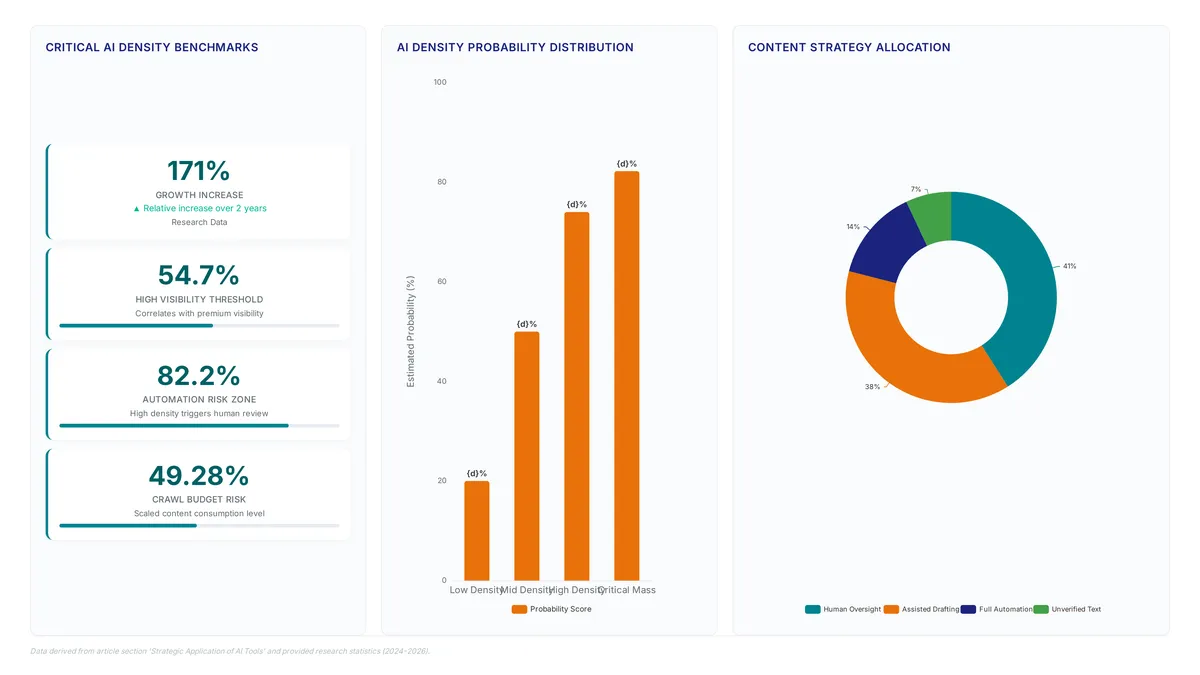
AI density calculates an estimated probability of machine generation rather than providing definitive proof of authorship or a direct signal for Google penalties. Maintaining low content density correlates strongly with premium visibility despite detectors serving as imperfect tools sold through third-party platforms. A high score functions primarily as a trigger for human review instead of an automatic disqualifier from the index. Detector outputs measure stylistic patterns while ignoring the presence of original insight or factual accuracy. Relying solely on these metrics overlooks the nuance that Enterium solutions address through multi-dimensional quality gates.
Application: Risk of Ignoring Indexing Drop-Offs in High-Density AI Pages
Publishers relying wholly on automation risk crawl budget exhaustion as detection density rises. Scaled content consumes resources without securing placement when originality checks are absent. Publishing unverified machine text at scale may waste the very crawl budget required for discovery. Teams should avoid AI writing tools for core landing pages where indexing stability dictates revenue. Deploying Enterium solutions to insert human oversight gates before publication offers a safer path. This approach mitigates the risk of mass de-indexing while preserving the efficiency of assisted drafting. Audit existing high-score pages immediately. Reduce automation reliance on critical paths to restore ranking potential.
Operational Workflows for Monitoring and Fixing AI Content Performance
Defining the AI Score Indexing Gap Floor
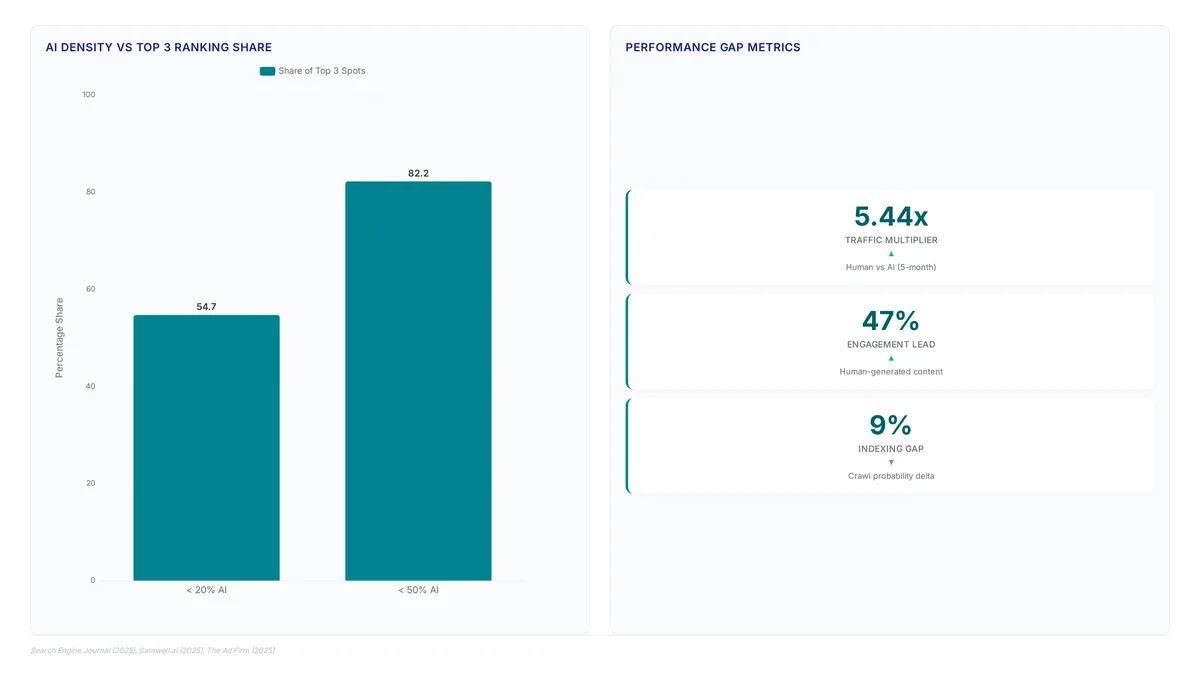
Measuring presence rates across specific AI density bands establishes an indexing gap floor improved than assuming binary exclusion. This roughly nine-point divergence acts as a statistical baseline for discovery rather than an algorithmic penalty applied to machine-generated syntax. High-density content remains eligible for ranking, yet the probability of initial crawl capture diminishes as synthetic markers increase. Operators must treat this delta as a signal to audit crawl budget allocation on outputs. To monitor these scores effectively, implement the following workflow:
- Export URL performance data filtered by Search Console impression status since January 2026.2. Run the dataset through an AI detection model to assign density percentages. 3.4. Flag domains where high-volume publishing correlates with presence in the lowest visibility tier.
Detector scores measure stylistic probability instead of factual accuracy or originality. Search algorithms prioritize utility over composition method, meaning the indexing gap reflects quality variance often correlated with heavy automation rather than a hard ban. Teams should focus on whether scaled content justifies its crawl cost instead of fearing detector flags alone. For structured remediation of these gaps, consult Enterium's content optimization services. Remediation begins by filtering Search Console exports for pages exceeding this density mark. Operators must cross-reference these URLs against internal AI detection logs to confirm synthetic text volume. High-density pages often suffer from reduced indexing probability compared to human-dominant counterparts. The following workflow isolates underperforming assets for manual revision or hybrid rewriting.
- Export performance data filtering for impressions below the median baseline.
- Flag any URL where AI text occupancy exceeds the set threshold.
- Rewrite introductions and conclusions to lower synthetic density scores.
- Request re-indexing only after human authorship signals are verifiably strengthened.
Maintaining high-volume output schedules while preserving indexing stability creates tension. Rapid publication of high-density content consumes crawl budget without guaranteeing visibility retention. This approach prevents synthetic bloat from degrading overall domain authority over time. Prioritizing human editorial oversight on flagged pages restores the balance required for sustained ranking performance.
Checklist for Validating Quality Decline Versus Detector False Positives
Initiate manual review when detectors flag high AI density, as scores alone do not prove quality failure. Operators must distinguish between algorithmic de-ranking and genuine content deficits before deleting assets. Enterium recommends validating four specific attributes that standard detectors ignore during automated scanning.
- Assess content depth against top-performing competitors to verify substantive value.
- Audit internal linking structures to ensure proper crawl path distribution.
- Verify factual accuracy through primary source cross-referencing.
- Evaluate originality of insight rather than just surface-level phrasing.
| Attribute | Detector Blind Spot | Operator Action |
|---|---|---|
| Content Depth | Ignores semantic completeness | Expand sections with unique data |
| Internal Linking | Misses structural isolation | Add contextual parent/child links |
| Factual Accuracy | Cannot verify real-world truth | Cite primary industry reports |
| Originality | Scores syntax, not insight | Inject proprietary case studies |
False positives frequently occur when technical writing styles mimic synthetic patterns without actual quality loss. Deleting these pages wastes existing crawl budget and removes potential ranking signals from the index. Instead of immediate removal, apply targeted edits to improve human oversight markers within the text. This workflow prevents the accidental deletion of valuable assets that merely trigger semantic alarms. Focus remediation efforts on pages lacking substance rather than those simply flagged by imperfect tools.
About
Hannah Brooks, Marketing Operations Lead at Enterium, analyzes the intersection of AI-generated content and search performance through a practitioner's lens. Her daily work involves architecting reliable content pipelines where governance and measurement dictate success, making her uniquely qualified to interpret data on AI-heavy pages. At Enterium, she designs the very workflows that balance LLM efficiency with human oversight, directly addressing the quality variances highlighted in recent findings. While tools like Ahrefs provide estimates on AI detection, Brooks focuses on the operational reality: building systems where humans remain on the gates to ensure value regardless of creation method. Her expertise connects the abstract concept of "AI flags" to tangible pipeline adjustments, helping B2B teams navigate the noise of detector scores. By focusing on reproducible architectures rather than speculation, she guides leaders toward reliable content operations that withstand algorithmic shifts, ensuring that automation serves strategy rather than compromising it.
Conclusion
Scaling AI-heavy content creates a hidden operational debt where crawl budget is consumed by low-value pages that fail to secure visibility. The real breaking point occurs when teams delete flagged assets without distinguishing between synthetic bloat and false positives caused by technical writing styles. This approach preserves existing ranking signals while filtering out genuine quality deficits. Do not treat detector output as a final verdict; instead, use it as a trigger for deeper human editorial oversight. Your immediate action this week is to select five high-flagged pages and audit them for original insight and internal linking structures before making any deletion decisions. By verifying substantive value against AI-heavy pages, you ensure that remediation efforts target actual content gaps rather than algorithmic quirks. This disciplined workflow protects domain authority and ensures that human expertise remains the primary driver of search performance.
Frequently Asked Questions
Pages should aim for under 50% AI text occupancy to maximize visibility potential. Data shows pages scoring under this threshold captured 82.2% of the top three spots, indicating lower density correlates with superior search performance.
High AI density reduces the likelihood of a page appearing in search indexes significantly. Index presence drops to 40.35% for pages exceeding 80% AI flags versus 49.28% for those with minimal synthetic text.
Fully synthetic pages can rank but represent a tiny fraction of top results.
More than half of the top results feature very low levels of machine-written text.
The average AI score increases slightly as ranking positions decrease down the list.
References