Model pricing breakdown: input vs output costs
Prompt caching can slash effective call costs by 90% when stacked with other optimization strategies, yet most teams still overpay for raw token usage. Understanding token-based pricing models is merely the entry fee; the real work lies in calculating the total cost of ownership for your specific deployment patterns. Enterprises frequently fixate on headline rates like the $30 input cost for legacy OpenAI models, blind to how context window efficiency and provider variance drastically alter actual spend.
This analysis dissects the core mechanics explaining why a model like gpt-4o-mini at $0.15 per million input tokens might outperform expensive alternatives for specific workloads. We conduct a comparative analysis of substantial providers, examining data points such as Anthropic's claude-3-haiku at $0.25 input versus Google's gemini-flash-1.5 at $0.075 to reveal hidden cost drivers. We move beyond simple rate cards to expose how quality scores and context limits interact with pricing tiers.
Finally, we detail how to calculate true deployment costs by factoring in retry rates and prompt engineering overhead rather than just API list prices. By applying rigorous cost optimization research, organizations can stop treating AI spend as a fixed utility bill. Enterium provides the strategic framework and proprietary tooling necessary to audit these complex variables, ensuring your infrastructure scales without bleeding margin on inefficient model selection.
The Core Mechanics of Token-Based Pricing Models
Input and Output Tokens as LLM Pricing Units
Input tokens represent the prompt data sent to the model, while output tokens constitute the generated response, forming the distinct billing units for API usage. Providers like OpenAI and Anthropic list rates per million tokens, yet the economic impact varies notably between reading and writing operations. Output generation often incurs higher costs than input processing. Specific model pricing exhibits extreme variance depending on the capability tier. This asymmetry means that optimizing for cheap input does not guarantee low total cost if the model requires extensive generation to complete a task. Operators must recognize that the cheapest model per token is not necessarily the cheapest model per task due to differences in reasoning efficiency and output quality. Effective budget management requires tracking these distinct flows rather than aggregating them into a single average cost metric. Implementation of specific cost optimization techniques can notably reduce total API spend, providing a critical lever for production AI economics. The fundamental unit of account remains the token, but the economic weight of that unit shifts based on directionality. Accurate forecasting demands a clear separation of read versus write operations in all financial models.
Context Length and Knowledge Cutoff Impact on Cost
Context length defines the maximum input and output tokens a model processes simultaneously, directly capping the data volume per API call. Models like Anthropic Claude support 200,000 tokens. Legacy variants often restrict context to 8,000 tokens. This limitation forces operators to chunk large documents and incur additional API overhead. Such an architectural limit dictates whether a single request suffices or if complex retrieval patterns are necessary. Knowledge cutoff marks the temporal boundary of a model's training data, determining its utility for time-sensitive queries without external augmentation. A 2023-10 cutoff renders a model blind to subsequent market shifts, necessitating expensive RAG pipelines to inject current facts. Specific providers mentioned include OpenAI GPT-4, Anthropic Claude, Google Gemini, and Mate Llama 3.
The cost implication extends beyond per-token rates. Limited context windows can increase total project spend by increasing call frequency due to the need for chunking. Prompt caching offered by substantial providers can reduce effective per-call costs. Maximizing these savings requires managing context continuity effectively. Selecting a model requires balancing context capacity against task complexity to avoid unnecessary token fragmentation. Architects should align context windows with document structures, minimizing API calls while ensuring knowledge freshness through targeted data injection.
Batch Processing Versus Standard API Rate Structures
Batch processing endpoints execute asynchronous jobs at approximately 50% off standard real-time API rates, fundamentally altering unit economics for non-urgent workloads. Substantial providers distinguish these synchronous and asynchronous paths technically. The former demands immediate compute allocation while the latter queues tasks for off-peak execution windows. This architectural separation allows operators to bypass latency constraints inherent in interactive chat interfaces. The cost differential is not marginal but structural, effectively halving the token price for offline data enrichment or large-scale fine-tuning preparation.
Combining these asynchronous capabilities with prompt caching strategies reduces the effective cost per call. This compounding saving reshapes budget projections for high-volume deployments. Operators ignoring this stackable discount architecture face unnecessarily inflated operational expenditures. The constraint remains strict: batch methods require accepting higher latency and job-level error handling rather than per-request streaming. Tracking these distinct transaction types is necessary, as infrastructure costs and variable API rates compound the total cost of ownership for AI agents.
Comparative Analysis of Substantial LLM Provider Cost Structures
Defining Quality Scores and Token Economics Across Substantial LLM Providers
Quality scores establish a normalized performance baseline where gpt-4o and claude-3-opus both achieve a perfect 100 yet diverge sharply in unit economics. The token economics favor OpenAI for high-fidelity tasks, charging $5 per million input tokens compared to $15 for Anthropic's equivalent tier. Lower-tier models like mistral-7b offer symmetric pricing at $0.25 for both input and output but operate at a Quality score of 40. This disparity forces operators to calculate value per task rather than per token, as the cheapest model per token is not necessarily the cheapest model per task. The limitation is that caching requires static prefixes, which may restrict utility for highly flexible conversational agents. Enterprises must therefore weigh the context window size against the likelihood of cache hits before selecting a provider.
Selecting Cost-Optimized Models for High-Context Workloads Using Gemini and Claude
High-context workloads demand precise model selection where input volume dictates total expenditure rather than output complexity. Google's gemini-1.5-pro supports a 1M token context window with Input pricing at $3.5/1M and Output at $10.5/1M, positioning it as a mid-tier option for massive document ingestion. In contrast, gemini-flash-1.5 offers a 2.8M context window at significantly lower rates of $0.075/1M input and $0.3/1M output, enabling real-world use cases for massive-scale applications where higher rates would be prohibitive.
The cost disparity forces a strategic calculation between context capacity and unit price. A failure to match context window size to the document length results in chunking overhead that erodes savings from lower token prices. Deploying flash-tier models for initial data sweeps while reserving pro-tier instances for final synthesis is a common strategy where nuance matters. The limitation lies in the 200K ceiling for Haiku, which necessitates agentic chunking strategies for larger corpora.
OpenAI vs Anthropic Cost Structures: gpt-4o Mini Versus claude-3-haiku for Scale
Gpt-4o-mini undercuts claude-3-haiku on unit pricing while delivering a higher Quality score of 85 against 78. Output generation widens this gap, with gpt-4o-mini priced at a lower rate per million compared to $1.25 for the Haiku variant. Operators prioritizing raw cost efficiency for high-volume chat completion tasks often find the OpenAI tier mathematically superior despite similar latency profiles. However, claude-3-haiku retains a larger 200K context window, making it the necessary choice for tasks requiring broader document ingestion without chunking. Stacking prompt caching mechanisms can reduce effective per-call costs by up to 90% on both platforms, drastically altering the baseline economics for repetitive workflows. The visibility gap remains the most expensive hidden cost, as infrastructure costs including hosting and monitoring are significant components that sit alongside LLM API costs. Teams deploying at scale must calculate total cost of ownership including retry rates rather than relying on listed token prices alone.
Calculating Total Cost of Ownership for AI Deployments
Deconstructing the Total Cost of Ownership Formula for LLM APIs
The mathematical framework for LLM Total Cost of Ownership extends beyond simple token multiplication to include infrastructure overhead and quality weighting. A precise calculation requires summing input and output volumes against variable API pricing tiers while factoring in the hidden costs of hosting and databases. Standard rates show extreme variance, with output tokens ranging from approximately $0.05 for specific Gemini API pricing modes to as high as a premium rate for Claude Opus output tokens.
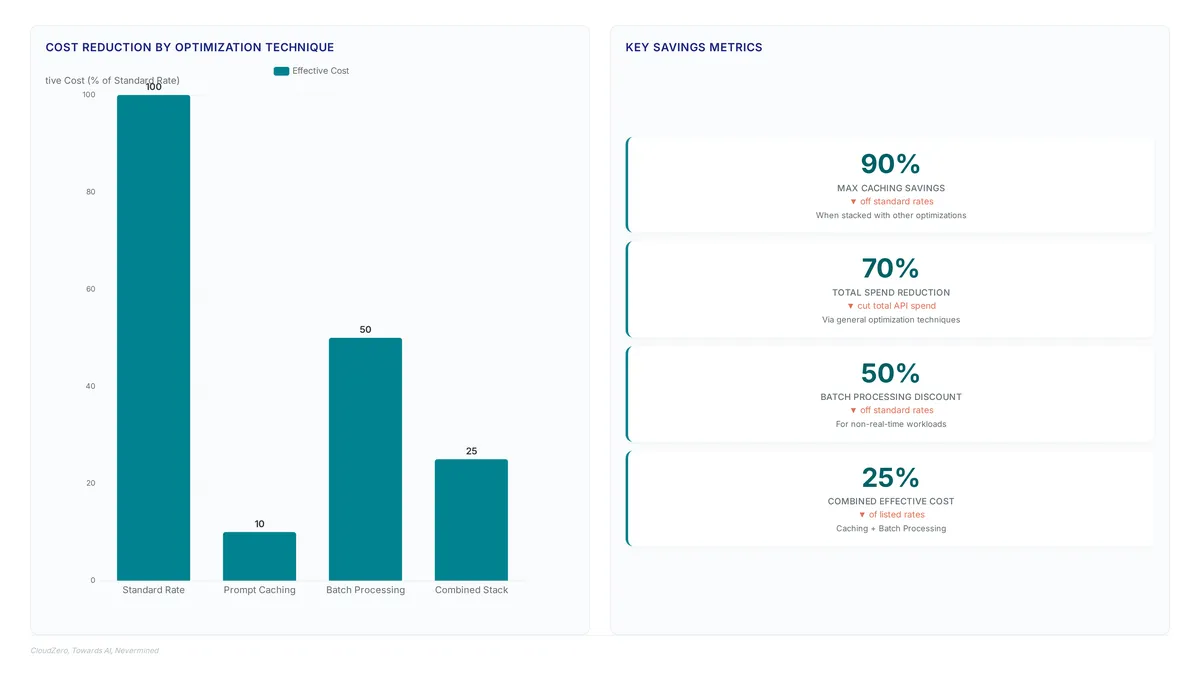
Operators must prioritize effective cost per task over raw token price, as the cheapest model per token is not necessarily the cheapest model per task.
Stacking prompt caching with batch processing transforms standard API rates into highly efficient cost structures by targeting redundant compute. This method preserves the context window state, allowing the system to skip re-processing static instructions or large document blocks on subsequent requests. The primary limitation is latency; cached responses are only valid when the input prefix remains unchanged, requiring careful architecture design. Operators should layer this with asynchronous workloads to maximize savings. When combining these approaches, the effective cost per call can be reduced to roughly 25% of standard listed rates, drastically altering the economic viability of high-volume deployments. Most price comparison guides focus on base token costs, yet ignoring these multipliers leads to inflated operational budgets. The visibility gap regarding which transactions qualify for caching remains the most expensive hidden cost in LLM API economics. Deploying these layers requires precise tagging of input streams to distinguish between real-time user queries and background processing tasks.
Validation Checklist for High-Volume Deployment Economic Viability
Verify projected unit economics against optimized baselines before scaling production traffic. Teams must calculate total spend across these layers rather than isolating LLM API fees alone. Audit current retry rates and output quality to establish a true cost per unit of work. Map infrastructure dependencies to ensure hosting costs do not negate token savings. Validation frameworks are necessary to stress-test these economic models before committing to long-term provider contracts. Operators who skip this verification risk locking into inefficient patterns that compound at scale.
Strategic Framework for Selecting and Optimizing LLM Providers
Defining the Cost-Quality-Context Decision Matrix
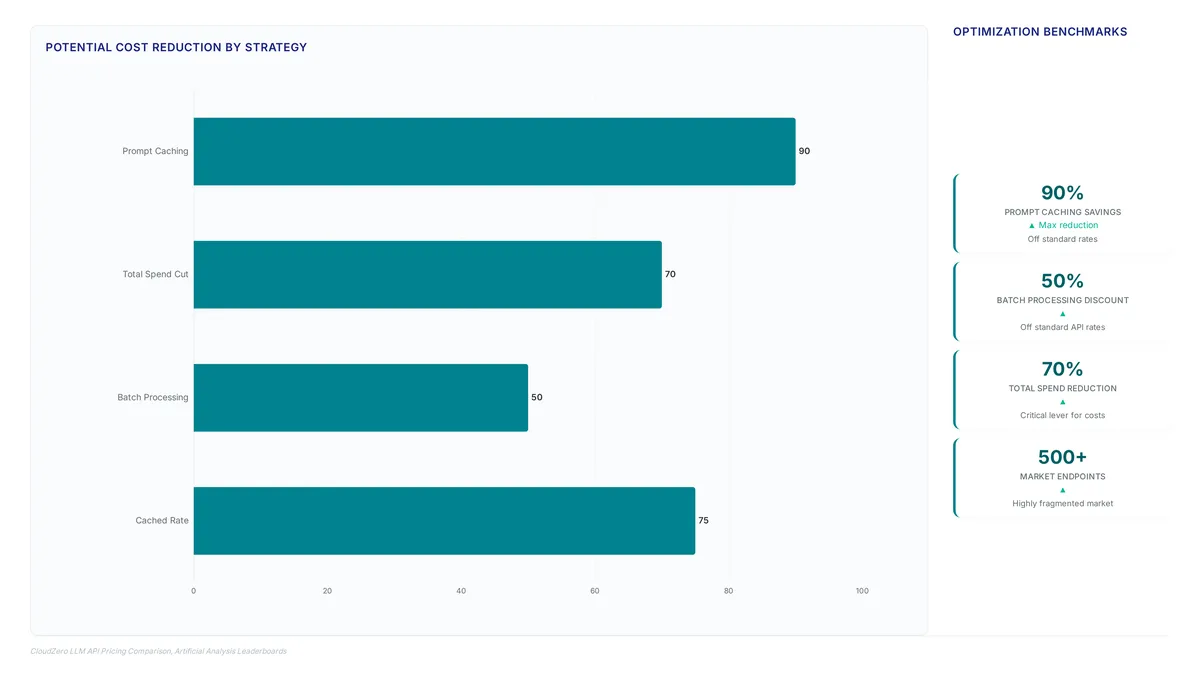
Map quality scores, context windows, and per-token pricing into a unified selection logic to avoid budget overruns. Operators must evaluate trade-offs between raw capability and operational efficiency rather than chasing peak performance metrics blindly. Conversely, claude-3-sonnet provides Quality 85 performance with a 200K context window, optimizing for volume processing where retaining long conversation history matters more than marginal quality gains. The limitation lies in visibility; many organizations struggle to track AI spend by transaction, creating a gap where cheap tokens become expensive outcomes due to retry loops and poor prompt engineering. Prioritizing models with batch processing capabilities for non-real-time workloads can secure significant discounts off standard API rates. The decision matrix must weight technical constraints against financial realities, ensuring the chosen model fits both the task complexity and the available optimization levers.
Applying Tiered Selection Logic for Budget-Constrained Deployments
Route high-fidelity reasoning tasks to premium tiers while diverting bulk summarization to economy models based on strict quality thresholds. Operators often overlook that the cheapest token rate does not equate to the lowest project cost when retry rates and output quality vary significantly across providers. This approach requires mapping specific workload requirements against model capabilities rather than defaulting to a single provider for all traffic types.
| Workload Type | Primary Constraint | Recommended Tier Strategy |
|---|---|---|
| Complex Reasoning | Accuracy | High-quality models only |
| Data Summarization | Volume | Economy models with large context |
| Real-time Chat | Latency | Balanced mid-tier options |
The hidden tension lies in context overhead; large windows on cheap models can still inflate costs if the application repeatedly re-sends history unnecessarily. Engineers using production AI optimization strategies confirm that isolating tasks by complexity prevents budget leakage from over-specifying model power. However, relying solely on per-token pricing ignores the infrastructure overhead required to manage multi-provider routing logic effectively. Enterprises must weigh the savings of cheap tokens against the engineering hours needed to maintain strong fallback mechanisms. An effective orchestration layer enforces these tiered selection policies dynamically, ensuring traffic flows to the most cost-efficient model that meets the set quality gate without manual intervention.
Hidden Cost Risks in Legacy Model Context Windows and Knowledge Cutoffs
Selecting models solely on base token rates ignores how limited context windows force excessive API calls. The legacy gpt-4 model restricts input to 8K tokens, whereas modern standards like gpt-4o support 128K, creating a severe fragmentation risk for document-heavy workflows. Operators relying on the older 8K limit must chunk data aggressively, inflating request counts and compounding latency. This architectural constraint often negates any per-token savings when total project volume is calculated. Knowledge obsolescence presents a parallel financial drain. The gpt-4 knowledge cutoff is 2021-09 while gpt-4-turbo extends to 2023-12, a critical distinction for domains requiring recent data.
About
Arjun Patel is an Applied LLM Engineer who specializes in benchmarking LLM providers and RAG architectures for enterprise content workloads. His daily work involves rigorously testing inference economics across substantial vendors to optimize cost, latency, and output quality for production pipelines. This hands-on experience directly informs the article's detailed breakdown of LLM API pricing structures from providers like OpenAI, Anthropic, and Google. At Enterium, a B2B publication dedicated to AI content automation, Arjun applies this practitioner-led methodology to help teams build scalable, vendor-neutral content systems. By analyzing real-world trade-offs rather than relying on marketing claims, he ensures that content leaders can make data-driven decisions when architecting their generative AI stacks. This analysis supports Enterium's mission to document how modern teams effectively run and scale content operations using precise, reproducible engineering.
Conclusion
Scaling LLM integration reveals that architectural fragmentation often consumes the savings gained from low token prices. When engineering teams build custom routing logic to chase marginal rate differences, the operational overhead of maintaining fallbacks and monitoring context limits creates a hidden tax on development velocity. The market has shifted toward task-based economics, where the true cost is set by completion quality rather than raw token volume. Relying on legacy models with small context windows forces excessive chunking and retry loops that inflate total spend regardless of the advertised rate.
Organizations must stop optimizing for unit price and start optimizing for workflow efficiency immediately. Adopt a policy where high-fidelity models with large context capacities handle complex, document-heavy tasks to minimize API call volume, while reserving budget-tier endpoints for simple, stateless queries. This strategic segregation prevents the compounding latency and error rates that plague monolithic architectures. Do not wait for a quarterly review to assess these inefficiencies.
Start this week by auditing your current error and retry logs to identify workflows where small context windows are driving unnecessary request duplication. Quantify the ratio of successful completions to total API calls for your most volume-heavy endpoints. This data provides the empirical basis needed to justify shifting specific workloads to models with larger context capacities, ensuring your infrastructure scales without collapsing under its own complexity.
Frequently Asked Questions
Batch processing cuts standard API rates by approximately 50%. This allows operators to significantly lower costs for non-urgent workloads by queuing tasks for off-peak execution instead of demanding immediate compute allocation.
GPT-4o input tokens cost $5 per million while Haiku costs $0.25. This massive variance means selecting the wrong model for simple tasks can drain budgets without adding necessary reasoning power to your application.
Output costs range from $0.05 for basic models to $75 for premium tiers. This extreme variance requires architects to strictly separate read and write operations in financial models to avoid unexpected billing shocks.
Combining these strategies can reduce effective call costs to roughly 25% of listed rates. Teams ignoring this stack often overpay for raw token usage despite having access to these powerful optimization levers.
Limited context windows force document chunking, which increases total call frequency and overall spend. Architects must align model context capacity with document structures to minimize API overhead and avoid unnecessary token fragmentation.
References