AI-powered social content: Cut manual work by 80%
Brands reduce manual work by 80% through AI generation and automated publishing across seven platforms. The thesis is clear: Large Language Models change social media from a manual bottleneck into a scalable strategic asset rather than simply replacing human creativity. Jasdeep Singh argues that while algorithms demand daily freshness and instant relevance, only AI-driven platforms can adapt tone and context at the required speed without exhausting marketing teams.
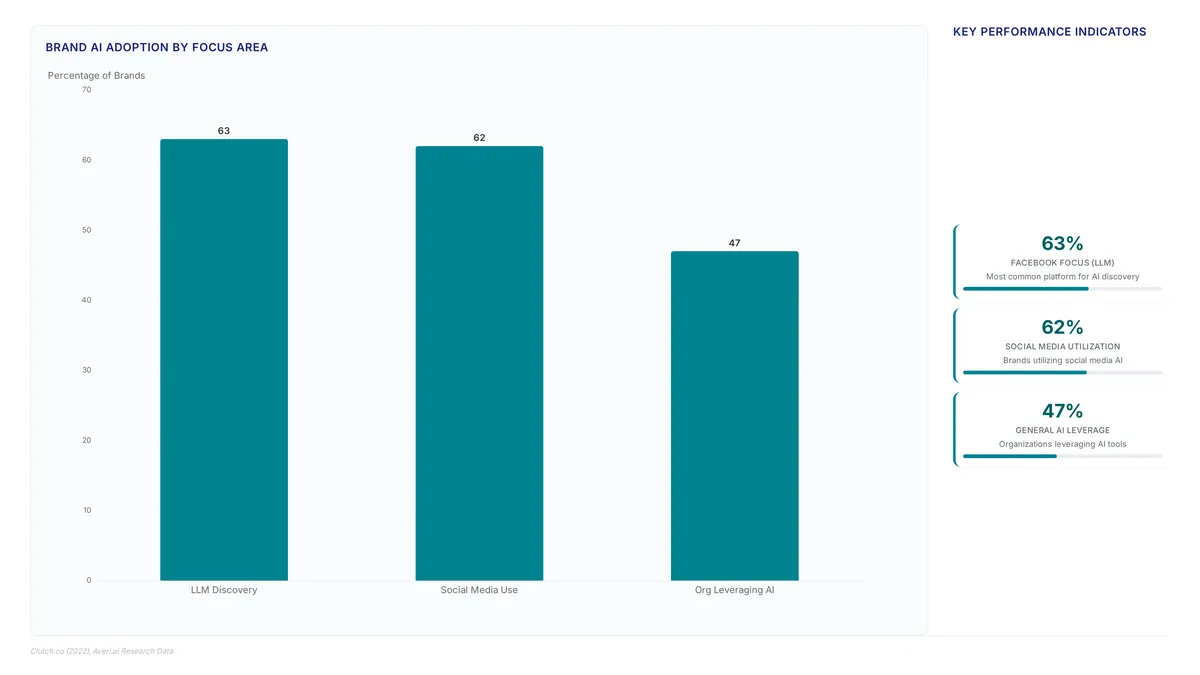
The Clutch report reveals that 63% of brands targeting LLM discovery focus their efforts on Facebook, making it the primary venue for AI-driven social targeting. This concentration highlights how organizations prioritize platforms where machine learning can best interpret audience behavior and platform trends. Meanwhile, n8n data shows teams simplify production across X, Instagram, LinkedIn, TikTok, Threads, and YouTube Shorts by using these tools to maintain brand consistency.
Readers will learn how GPT-based systems handle the full scope of content planning, creation, and optimization without succumbing to content fatigue. The discussion covers the specific mechanics of the content creation pipeline, detailing how machines repurpose long-form assets into short posts and generate platform-specific captions. Finally, the analysis examines measurable community management outcomes, proving that intelligent automation allows humans to focus on strategy while machines handle the repetitive execution required to stay the in 2026.
The Role of LLMs in Modern Social Media Strategy
Defining AI-powered Social Media and LLM Context Awareness
AI-powered Social Media defines the use of artificial intelligence tools to plan, create, publish, analyze, and optimize social media content. These systems rely on machine learning and natural language processing to understand context, tone, and user intent. Basic automation executes fixed schedules without deviation. LLM content creation adapts outputs based on performance data and platform trends instead. The distinction lies in the training data composition. Models ingest publicly available text from websites, articles, and forums to generate contextually the posts. This capability allows brands to move beyond template fatigue, though 63% of brands targeting Large Language Mode currently focus efforts primarily on Facebook. Scaling volume often creates tension with maintaining specific brand voice fidelity. LLMs can simulate entire social networks for strategy testing. Their linguistic properties often differ from organic human interaction patterns. Practitioners must treat generated content as a draft requiring human refinement rather than a final asset.
- Mechanism: Systems parse audience behavior to adjust tone dynamically.
- Limitation: Training data may not reflect real-time sentiment shifts.
- Implication: Teams gain throughput but lose some control over nuance.
- Requirement: Human review gates prevent authenticity loss before publication.
Implementing a human-in-the-loop review gate before any AI-drafted post reaches publication ensures that the efficiency gains from automation do not compromise the authenticity required for sustained engagement.
LLM Capabilities: Generating Platform-Specific Captions and Repurposing Content
LLM content creation functions by predicting token sequences to generate fluent, context-aware text rather than filling static templates. This mechanism allows systems to ingest a single long-form asset and output distinct variations tailored for specific platform constraints. A technical whitepaper converts into a LinkedIn thought leadership post. That same becomes a Twitter thread or an Instagram caption without manual rewriting. Content fatigue and inconsistent posting schedules plague manual workflows. The primary operational benefit addresses these specific failures directly. Brands targeting discovery channels must adapt quickly; notably, 62% of brands using social media for AI prioritize TikTok as a primary channel for LLM visibility. This shift requires tools that handle vertical video scripts and casual tones distinct from professional networks. Unlike basic automation, these models analyze language patterns and emotions to match a set brand voice. Relying solely on generation introduces risk regarding factual accuracy and brand safety. The cost is that while volume increases, human review remains necessary to ensure accuracy and compliance. Operators must implement a workflow where AI handles the heavy lifting of draft creation while humans manage compliance and final nuance.
| Capability | Function | Operational Impact |
|---|---|---|
| Tone Adaptation | Adjusts vocabulary for audience | Enables cross-platform scaling |
| Repurposing | Converts long-form to short | Maximizes asset utility |
| Pattern Recognition | Analyzes sentiment and context | Improves engagement relevance |
Integrating these tools within a human-in-the-loop framework helps maintain authenticity alongside scale.
AI-Driven Platforms vs Traditional Automation: Adapting to Audience Behavior
AI-driven platforms distinguish themselves by adapting content outputs based on real-time performance data and audience behavior signals. Traditional automation tools execute fixed schedules using static templates. They lack the mechanism to adjust tone or format after deployment. This rigidity often results in content fatigue, where engagement drops as algorithms penalize repetitive or irrelevant posts. Conversely, systems built with feedback loop architecture execute tasks, learn from metrics, and iteratively improve future generations rather than functioning as isolated features. Manual creation ensures high contextual accuracy. It cannot match the volume required to maintain algorithmic relevance across multiple channels. Organizations targeting specific discovery engines must align their strategy accordingly; for instance, 47% of organizations using social strategie specifically target Instagram to ensure their content is surfaced by generative models. Consolidated solutions like Averi AI offer end-to-end capabilities that reduce the operational overhead of managing disparate point tools. Relying solely on automated adaptation risks drifting from core brand voice if human review gates are not strictly enforced. The constraint is clear: teams gain scale and responsiveness but must invest heavily in prompt engineering and oversight to prevent quality degradation.
| Feature | Traditional Automation | AI-Driven Platforms |
|---|---|---|
| Adaptation | Static templates | Flexible based on data |
| Scope | Scheduling only | Full lifecycle management |
| Learning | None | Continuous optimization |
| Cost Model | Flat fee per seat | Usage or consolidated tier |
Implementing a hybrid workflow where AI handles initial variation generation while humans retain final approval on tone balances the efficiency of machine speed with the nuance of human judgment.
Inside the AI Content Creation and Scheduling Pipeline
Defining the Three-Step AI Content Workflow Structure
Scaling production demands a rigid three-step sequence: Strategy and Prompt Design, Content Generation, and Human Review. Machine outputs mirror their inputs, meaning clear prompts must dictate tone, audience, format, and objectives. Such specificity converts raw LLM potential into coherent content that exceeds human-only output limits.
The second phase uses these constrained inputs to build multiple post variations for A/B testing and creative experimentation. Generation-focused tools like the provider apply pricing models separate from end-to-end platforms, frequently isolating creation from full lifecycle management. This division creates friction between specialized quality and operational unity; teams must connect disparate systems to keep a single source of truth for brand assets.
| Workflow Stage | Primary Function | Critical Input |
|---|---|---|
| Strategy Design | Define constraints | Brand voice, audience data |
| Content Generation | Produce variations | Structured prompts |
| Human Review | Ensure compliance | Accuracy checks |
Human review serves as the final gate, validating accuracy, compliance, and emotional resonance before publication. Models replicate detailed humor and subtle snark effectively when prompted correctly, yet they cannot assume liability for factual errors. Sole reliance on algorithmic output endangers brand reputation; the hybrid approach preserves trust while keeping speed. Integrating a review step into the pipeline architecture stops unverified drafts from entering scheduling queues. Operators must treat the human reviewer as a mandatory quality gate rather than an optional add-on.
Implementing Cross-Platform Adaptation for Blog-to-Social Repurposing
Cross-platform adaptation turns one blog post into distinct LinkedIn carousels, Twitter threads, and Instagram captions without manual rewrites per channel. AI reshapes a single message into multiple formats automatically, such as converting a blog snippet into a LinkedIn carousel, Twitter thread, or Instagram post. This mechanism parses platform-specific constraints to reformat long-form text into visual slides or threaded responses, slashing manual workload through automated publishing.
| Feature | Manual Repurposing | AI Adaptation |
|---|---|---|
| Format Logic | Static templates | Flexible constraint matching |
| Scheduling | Fixed intervals | Audience activity analysis |
| Output Volume | Single format | Multi-platform variants |
Developers have shown this autonomy with tools that generate daily visual content and post directly to platforms like Twitter. These systems manage the full lifecycle from ideation to deployment, unlike generation-only tools. Some specialized platforms provide end-to-end LLM solutions representing a consolidated cost model, whereas content creation-focused tools often operate distinctly from full lifecycle management, forcing teams to assemble disparate tools for a thorough strategy.
High-volume output increases the risk of tonal drift if prompt boundaries remain undefined. Automation handles volume, yet the strategic tension lies between scaling reach and maintaining the detailed voice required for professional trust. Publishing without human review can result in contextually accurate but emotionally flat communications.
Embedding explicit brand voice guidelines into the initial prompt strategy helps prevent generic outputs. Teams should configure their workflow to generate multiple variations per asset for A/B testing rather than relying on a single generated draft.
Why Human Review Prevents Compliance Failures in AI Captions
LLM outputs need human verification to catch hallucinated claims before triggering regulatory penalties. Algorithms process vast token sequences to predict coherent text, but they lack the legal context to distinguish between a persuasive hook and a false advertising violation. This gap creates risk when brands scale production without oversight. LLMs generate post ideas aligned with brand goals by analyzing trending topics, audience interests, competitor content, and seasonal patterns.
Effective governance embeds reviewers into the workflow after generation but before publication. Operators must validate that brand voice replication does not accidentally mimic competitors or violate platform policies on impersonation.
A strong review protocol focuses on specific failure modes:
- Factual accuracy of product specifications and pricing.
- Adherence to industry-specific disclosure requirements.
- Emotional tone alignment with current brand sentiment.
- Consistency with historical campaign messaging.
- Verification of linked | Risk Factor | AI Behavior | Human Mitigation |
| Regulatory Claims | Generates plausible but unverified stats | Verifies against source of truth |
| Brand Safety | Misses subtle cultural insensitivity | Applies contextual ethical judgment |
| Context Awareness | Cannot detect real-time crises | Halts scheduled posts during incidents |
Operational tension exists between speed and safety; pushing for maximum velocity often bypasses the very guardrails that prevent reputational damage. Mandating human sign-off on all generated captions ensures that the hybrid approach maintains both trust and authenticity.
Measurable ROI from AI-Driven Community Management and Personalization
AI-Driven Audience Segmentation and Flexible Messaging Mechanics
Segmentation engines parse interaction history to cluster users by intent rather than simple demographics. Audience segmentation relies on machine learning models that analyze user behavior, interests, and interaction history, separating new followers from loyal customers without manual tagging. This granular grouping allows systems to tailor content specifically for industry professionals or local audiences based on verified engagement patterns.
Flexible messaging layers tone and call-to-action adjustments on top of these segments. Large Language Models shift vocabulary and sentence structure to match the inferred state of the user, ensuring relevance across diverse groups. Research indicates this automation of ideation and personalization enables flexible customization for specific audiences at scale.
The mechanism creates a tension between hyper-relevance and brand consistency. If the model drifts too far to match a niche segment, the core voice fractures. Clear prompts defining tone, audience, and format are necessary to maintain a consistent brand identity across different user clusters.
| Segment Type | Data Signal | Flexible Adjustment |
|---|---|---|
| New Followers | Follow date, initial click | Welcome tone, educational CTA |
| Loyal Customers | Purchase history, frequency | Exclusive offers, community focus |
| Professionals | Job title, industry tags | Technical depth, case study links |
Operational logic must include authenticity checks to ensure flexible messages remain human-readable. Regular audits of segment outputs help verify tone alignment and ensure content remains authentic.
Smart Inbox Management and AI-Assisted Comment Replies
Smart inbox systems route incoming messages into support, sales, feedback, and spam buckets to accelerate triage. This categorical sorting reduces the cognitive load on community managers who otherwise scan hundreds of unstructured notifications daily. The mechanism relies on intent classification models that parse semantic meaning rather than simple keyword matching. A limitation exists where niche slang or sarcasm may trigger false positives, requiring manual overrides to maintain user trust. Consequently, these categories function best when treated as initial sorting mechanisms that benefit from human oversight to ensure accuracy.
For responses, LLM-assisted replies generate drafts that align with brand tone while addressing specific user intent. These systems produce polite, clear text that matches the required style, effectively scaling creative and the copy production. AI tools enable the processing of vast token sequences to predict next words, ensuring coherent content generation that scales beyond human-only output limits. However, relying solely on automated drafting risks generic phrasing that fails to resolve complex technical grievances. Human review remains the mandatory quality gate to ensure emotional resonance and factual correctness before publication.
| Function | AI Capability | Human Requirement |
|---|---|---|
| Categorization | Intent classification | Edge case resolution |
| Drafting | Tone matching | Fact verification |
| Volume | High throughput | Strategic oversight |
The operational tension lies between response speed and conversational depth. Rapid-fire automated answers satisfy volume metrics but often degrade community sentiment if nuance is lost. Deploying AI for initial drafting and sorting allows teams to reserve human agents for high-value interactions. This hybrid workflow balances efficiency with the authenticity required to retain audience trust.
Validating ROI Through Content Performance Analysis and Continuous Improvement
Validating return on investment requires tracking engagement rates, click-through rates, follower growth, and conversion metrics to determine if automation delivers value. Operators must move beyond basic volume counts to assess whether AI suggestions for content length and posting frequency actually drive business outcomes. Predictive analytics helps allocate resources to high-performing content before publication. This quantitative edge allows teams to prioritize high-yield topics rather than guessing at audience preferences.
A continuous improvement loop processes performance data to recommend specific tone changes or topic shifts without manual auditing.
| Metric Category | Manual Analysis | AI-Driven Analysis |
|---|---|---|
| Data Scope | Last 30 days only | Real-time cross-platform aggregation |
| Pattern Recognition | High-level trends only | Micro-segment behavioral shifts |
| Actionability | Retrospective reporting | Predictive adjustment suggestions |
| Latency | Weekly or monthly | Immediate feedback cycles |
Content creation-focused tools operate on distinct pricing models compared to end-to-end platforms, affecting how smaller teams measure cost-per-post efficiency. The limitation of this approach is that over-optimization for engagement can dilute brand voice if human guardrails are removed entirely. Operators must balance algorithmic suggestions with strategic brand goals to prevent the system from optimizing for vanity metrics alone. The consequence of ignoring this balance is a feed that performs well statistically but fails to convert loyal followers into customers. Establishing a regular review cadence where human strategists validate AI-proposed topic shifts against long-term brand roadmaps ensures that the drive for efficiency does not compromise the authentic narrative required for sustained community trust.
Best Practices for Responsible AI Adoption and Authenticity
Defining Responsible AI Use Through Structured Prompt Design
Clear prompts define tone, audience, format, and objectives, ensuring outputs align with organizational identity. A documented capability confirms that LLMs can adapt tone for different audiences and generate platform-specific captions when provided with detailed context. The mechanism relies on the model parsing semantic constraints to understand language patterns and emotions effectively.
However, balancing strict adherence to style guides against the need for creative experimentation is necessary, as LLMs generate multiple variations of posts to allow for A/B testing.
- Define target audience details including specific demographics and interests.
- Specify desired length, formatting rules, and mandatory call-to-action requirements.
- Input brand voice guidelines to ensure consistency across generated content.
Teams implementing this workflow observe that AI tools enable the production of more content without compromising quality. This efficiency gain allows marketing groups to scale output while freeing teams to focus on strategy instead of execution.
Fixing Over-Automation by Adapting Messages Across Platforms
Manual rewriting is significantly reduced when the system adapts a single message into multiple formats, such as LinkedIn carousels or Twitter threads, automatically. This approach reduces manual production time from hours of work per asset to mere minutes for social assets.
The implementation follows a structured sequence to maintain brand integrity while scaling output:
- Define tone vectors that differentiate professional LinkedIn syntax from casual Twitter phrasing within the prompt context.
- Set max token limits to prevent run-on captions that violate character counts on specific channels.
A tangible trade-off exists where aggressive formatting for one channel can dilute the core message if the source context is too thin. Teams risking low-quality volume must recognize that failing to adopt these adaptation protocols creates a significant opportunity cost against competitors solving the production puzzle. It is recommended to map every output format to a specific engagement goal rather than generating generic variations. The operational consequence is clear: AI-driven platforms can adapt content based on performance data and platform trends, whereas generic inputs may fail to capture necessary nuance.
Checklist for Addressing AI Inaccuracies via Human Review
Human reviewers must validate factual assertions against primary sources before any automated post reaches publication. This step prevents the propagation of errors that LLMs occasionally introduce when simulating niche domain knowledge.
- Verify that tone vectors match the specific emotional resonance required for the target demographic.
A critical tension exists between scaling output volume and maintaining the nuance required for authentic brand connection. Research using synthetic bot personas indicates that AI-generated network properties often diverge linguistically from organic human behavior, creating detectable patterns.
| Check Point | Verification Method | Failure Mode |
|---|---|---|
| Data Accuracy | Source URL validation | Hallucinated statistics |
| Brand Voice | Blind taste test | Generic, robotic tone |
| Context Fit | Thread continuity review | Non-sequitur responses |
To institutionalize this quality gate, implement a mandatory approval gate in your workflow configuration.
Organizations can configure these validation rules to enforce strict compliance before scheduling. The immediate next step is to audit your last ten automated posts for factual precision using this framework.
About
Sofia Marchetti is a B2B content and demand-generation strategist with over a decade of experience scaling SaaS content operations. Her expertise lies in connecting automated content systems directly to revenue outcomes, making her uniquely qualified to dissect the practical application of LLMs in social media strategy. Unlike theoretical overviews, Sofia's daily work involves architecting content pipelines where speed must coexist with topical authority and consistent brand voice. At Enterium, a publication dedicated to vendor-neutral content automation, she documents how modern teams replace manual grunt work with reproducible AI workflows. This article reflects her hands-on approach to solving the exact bottleneck B2B marketers face: maintaining daily relevance without sacrificing quality. By using her background in GEO/SEO and durable distribution, Sofia provides a factual blueprint for using LLMs not just to generate text, but to build a scalable social media engine that drives measurable pipeline growth.
Conclusion
Scaling AI content creation breaks when volume overrides verification, turning your brand into a source of hallucinated statistics and robotic tone. While many firms chase the efficiency of automated publishing, the hidden operational cost is the erosion of trust caused by unverified claims and contextually flat messaging. You cannot afford to let speed compromise the authentic connection that drives actual engagement. Organizations must immediately shift from generating generic variations to enforcing strict, platform-specific validation gates before any content goes live.
Implement a mandatory human-in-the-loop review for all AI outputs starting this week, specifically targeting factual assertions and emotional resonance. Do not publish a single post without verifying that the tone vectors match your audience's expectations and that every data point links to a primary source. This discipline separates market leaders from the noise of low-quality automation. Begin by auditing your last ten automated posts against the Data Accuracy and Brand Voice criteria outlined in the verification table, correcting any deviations before your next scheduling cycle. This immediate action secures your reputation while you scale.
Frequently Asked Questions
Facebook is the primary venue, with 63% of brands focusing efforts there for LLM discovery. This concentration means marketers must optimize specifically for Facebook algorithms to effectively interpret audience behavior and platform trends.
TikTok is the priority channel, as 62% of brands utilizing social media for AI discovery target it first. This shift requires teams to adopt tools that handle vertical video scripts and casual tones distinct from professional networks.
Teams reduce manual work by 80% through AI generation and automated publishing across seven platforms. This efficiency allows social media managers to streamline content production while maintaining strict brand consistency across multiple channels simultaneously.
Scaling volume often creates tension with maintaining specific brand voice fidelity across different posts. Practitioners must treat generated content as a draft requiring human refinement rather than a final asset to ensure authenticity.
Human review gates prevent authenticity loss before publication and ensure factual accuracy and brand safety. Operators must manage compliance and final nuance while AI handles the heavy lifting of draft creation for them.
References