Social signals: Drive external search traffic
Social media SEO targets three distinct discovery surfaces: external search engines, in-platform search bars, and algorithmic feeds. This reality demands a shift from vanity metrics to a rigorous multi-surface visibility strategy. Marketers often ignore that optimizing a social profile is now a primary driver for appearing in AI overview content and traditional search engine visibility. Without deliberate keyword research, your content remains invisible to both bots and buyers.
You need to understand how engagement signals and context signals ranking dictate where your content appears within social platform algorithms. The analysis covers how LLM content sourcing pulls directly from optimized profiles to answer user queries automatically. Ignoring these vectors cedes ground to competitors who understand that E-E-A-T social media principles apply everywhere.
Success requires treating every bio, video, and post as a data point for AI visibility. You must align your optimize social profiles workflow with the specific demands of how to appear in google search from social media. Whether addressing what keywords to use for tiktok seo or determining how to optimize instagram bio for search, the goal is consistent discovery. We will also examine best practices for facebook local rankings and methods to ensure your youtube video surfaces in ai overviews.
Social Media SEO Set as a Multi-Surface Visibility Strategy
Defining Social Media SEO's Three Visibility Surfaces
Social media SEO targets three distinct discovery surfaces rather than a single search bar. This definition shifts optimization from generic engagement toward specific visibility mechanics across external and internal systems.
External search results form the first surface, placing social profiles alongside traditional web pages. Optimizing here requires treating bios and headers as metadata that search crawlers parse for relevance.
In-platform search constitutes the second surface, where users query directly within the application interface. Keywords in handles and captions determine ranking here, independent of external domain authority signals.
Algorithmic feeds inside platforms create the third surface, surfacing content based on predicted interest. Unlike search, this mechanism relies on engagement velocity and watch time to distribute content to non-followers.
| Surface | Primary Trigger | Optimization Target |
|---|---|---|
| External Search | Query Engine Crawl | Profile Metadata |
| In-Platform Search | User Keyword Entry | Caption Keywords |
| Algorithmic Feeds | Engagement Signals | Retention Metrics |
Keyword density for search conflicts with natural language needs for feed retention. Operators must balance these conflicting signals rather than maximizing one metric.
Gen Z and Millennials are the primary demographics conducting searches directly within social platforms rather than traditional search engines. This behavior forces a divergence from standard web SEO tactics.
Ignoring this tripartite structure risks invisible content.
Real-World Examples of In-Platform and External Search Ranking
This shift forces brands to treat video captions as critical metadata for external search visibility. When users ask ChatGPT questions like 'which managed WordPress host should I pick,' answers are often sourced from Reddit threads, YouTube tutorials, and LinkedIn.
The distinction between in-platform search and external indexing creates a complex optimization matrix. Platforms including Instagram, TikTok, X, and Threads function as primary search engines where keyword-rich handles drive discovery independent of web crawlers. Optimizing for broad external relevance can dilute the specific context signals required for internal feed ranking.
Content appearing in AI Overviews relies heavily on perceived authority within niche communities. If a brand's social content lacks clear topical focus, LLMs may ignore it entirely in favor of established community discussions. AI systems prioritize structure, semantic clarity, and contextual completeness over simple engagement metrics.
Operators must verify that profile bios explicitly state service categories to satisfy crawler parsing logic. Ignoring context signals in favor of viral trends risks invisibility in high-intent search layers. Success requires distinct strategies for each surface rather than a single cross-posted asset.
Gen Z Search Behavior: Social Platforms vs Traditional Search Engineers
Gen Z operators treat in-platform search bars as primary discovery interfaces rather than deferring to external gateways. This behavioral shift forces content architects to optimize for native tokenizers instead of traditional crawler logic. In 2026, social media is a big part of social SEO with people searching brands, services, and solutions directly inside the platform instead of depending on Google.
| Feature | External Search | In-Platform Search |
|---|---|---|
| Query Intent | Navigational or factual lookup | Discovery and entertainment |
| Ranking Signal | Domain authority and backlinks | Engagement velocity and retention |
| Result Format | Blue links and snippets | Native video and carousels |
External engines prioritize historical relevance. Social algorithms weight immediate engagement signals heavily. A significant portion of this demographic now bypasses traditional browsers entirely for product research. Social media SEO focuses on optimizing for search intent, matching what users type into search bars rather than chasing trends. This divergence means a single asset rarely performs optimally across both surfaces without distinct metadata strategies. Brands targeting social media SEO must recognize that query syntax differs fundamentally between a Google text box and an app search bar.
The Mechanics of Algorithmic Ranking and Engagement Signals
The Four Signal Types Driving Algorithmic Feeds and Search
Ranking logic divides into query-based discovery and passive feed recommendations, relying on four distinct signal categories. Content signals cover on-screen text, captions, and audio transcripts that align with user search intent. Context signals incorporate device type, location data, and language settings to filter relevance before any content evaluation occurs. User signals depend on prior interaction history to forecast interest in specific topics or creators. Engagement signals control feed surfaces, where watch time, completion rate, likes, shares, comments, saves, and follows dictate distribution velocity.
| Signal Type | Primary Weight: Search | Primary Weight: Feed |
|---|---|---|
| Content | High | Medium |
| Context | High | Low |
| User | Medium | High |
| Engagement | Low | Critical |
Static keyword optimization often conflicts with the flexible interaction rates feed visibility demands. A profile tuned exclusively for search terms might miss the engagement signals needed for broad algorithmic distribution. Content built purely for virality frequently lacks the semantic density required for long-term discoverability via search bars. Social activity is not a direct ranking factor for external engines, yet a strong reputation boosts trust and visibility indirectly SEO ranking factors. Practitioners balance these inputs because feed algorithms prioritize immediate retention metrics over static keyword matches. This dual requirement means a single asset rarely satisfies both discovery modes without deliberate structural adjustments to captioning and hook placement.
How Social Activity Indirectly Boosts Google Rankings and E-E-A-T
Discovery on social platforms increases the likelihood users search for a brand on Google, signaling authority to crawlers. Active profiles support Experience, Expertise, Authoritativeness, and Trustworthiness (E-E-A-T), criteria Google prioritizes and AI platforms reward. Social activity is not a direct ranking factor, but a strong reputation boosts trust and engagement that support SEO visibility SEO ranking factors. This indirect mechanism functions through volume; increased exposure drives query frequency, which search engines interpret as a relevance signal for the entity.
To fix low engagement on social posts, operators must align content with the specific weighting of feed versus search signals. Engagement metrics like shares and comments dominate algorithmic distribution, whereas content signals drive query results.
| Signal Focus | Primary Goal | Optimization Target |
|---|---|---|
| Feed Distribution | Velocity | Shares, saves, completion rate |
| Search Visibility | Relevance | Keywords, captions, bio text |
Resource allocation creates friction; chasing viral velocity often sacrifices the keyword density required for long-term search retrieval. A profile optimized purely for broad appeal may fail to capture the specific terminology required for in-platform search indexing. Consequently, brands risk high visibility but low discoverability when users attempt to find them via specific queries later.
One stream targets immediate engagement velocity, while a second targets persistent keyword relevance for retrieval. This dual approach ensures social activity translates into measurable branded search volume rather than ephemeral attention. The constraint is clear: without explicit keyword targeting in captions and bios, high engagement does not guarantee search indexation.
Optimizing Content Signals for Search Bars Versus Engagement Signals for Feeds
Search bar ranking prioritizes content signals like body copy and alt text over raw interaction volume. When a user types a query, the algorithm matches specific keywords found in captions, on-screen text, and voiceovers against the input string. This mechanism demands precise keyword placement rather than broad appeal. Operators targeting discovery via search must treat captions as metadata, ensuring every term aligns with known user queries. High keyword density does not guarantee distribution if the content fails to retain viewers once surfaced.
Feed distribution operates differently by weighing engagement signals such as shares and comments as primary drivers. These metrics indicate content quality and relevance to the platform's curation logic. A post with moderate keyword relevance but high completion rates will often outperform a perfectly tagged video with low retention. Optimizing for search can sometimes reduce the broad emotional hook required for viral feed performance.
| Optimization Target | Primary Signal Type | Key Elements |
|---|---|---|
| Search Bar | Content | Captions, Hashtags, On-screen Text |
| Algorithmic Feed | Engagement | Watch Time, Shares, Comments |
Creators must distinguish between intent-based discovery and passive consumption to fix low engagement on social posts. Content designed for search should answer specific questions directly within the first few seconds. Conversely, feed-native content must prioritize immediate visual hooks to maximize watch time. Social signals act as necessary components for SEO strategies by validating content utility through user action. Enterium recommends auditing top-performing assets to determine whether they succeeded via keyword match or engagement velocity before replicating the format.
Executing Keyword Research and Profile Optimization Workflows
Autocomplete and Platform Tools for Keyword Discovery
Typing seed keywords into platform search bars and adding letters reveals real-time autocomplete variations.
- Enter a broad industry term into the native search field.
- Cross-reference findings against dedicated planning tools.
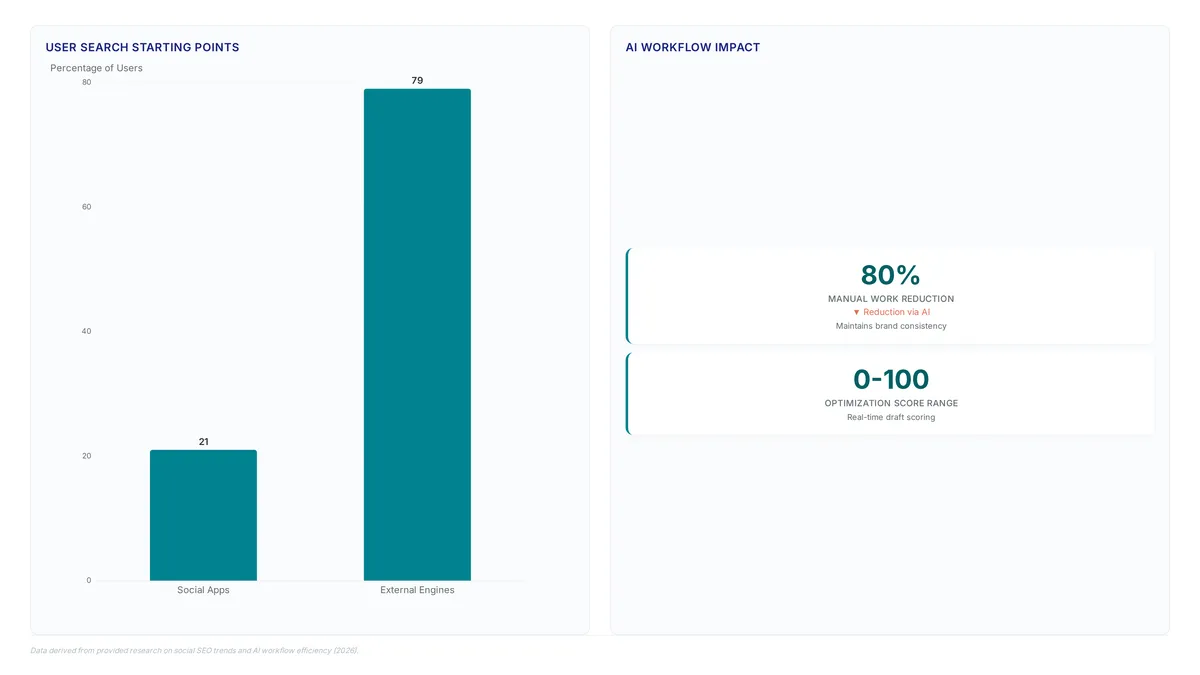
Validating these terms requires moving beyond manual observation. Specialized utilities provide search volume data that confirms whether a suggestion represents a fleeting trend or sustained interest. External tools offer broad visibility, yet relying solely on them ignores the nuance of in-platform query syntax. General data often clashes with specific internal ranking logic; a term might trend generally but fail to trigger distribution within a specific app's system. Operators must prioritize native search signals over generalized metrics so content appears in the feeds. Artificial intelligence tools now assist in scaling this research phase, though manual verification remains necessary for accuracy. Teams sometimes optimize for external search engines while neglecting that 21% of users now start product searches directly inside social apps. Ignoring this shift leaves significant discoverability gaps unaddressed. Treating profile fields as flexible on-page SEO elements that align with these discovered keywords maximizes visibility across surfaces.
Optimizing Profile Fields as On-Page SEO Elements
Social profile fields function as indexed on-page elements where the display name pairs a brand identifier with a descriptive category. This configuration directly influences how external crawlers and internal search surfaces parse entity relevance. Handles require character consistency across all presence layers, reducing friction for users attempting to locate specific accounts.
- Align the handle string across platforms to create a predictable address pattern for direct navigation.
- Populate the bio section with the phrases that reflect search queries rather than abstract slogans.
Matching search intent requires optimizing for what users type into search bars rather than chasing transient trends. Branding teams sometimes prioritize aesthetic minimalism over semantic clarity, leaving the bio field devoid of indexable terms. Algorithms struggle to associate the profile with the topic clusters without explicit category descriptors.
Platforms weigh profile completeness heavily when surfacing business pages in local and vertical search results. Teams must balance keyword density with human legibility to maintain trust signals. Neglecting these structured fields cedes visibility to competitors who treat their profiles as searchable databases rather than static brochures.
Validation Checklist for Bio Keywords and Link Consistency
- Draft a one to two sentence statement defining the brand, audience, and location, leading with seed keywords.
- Place high-intensity seed keywords at the start of the first sentence to maximize crawler weight.
- Set the destination URL to a single canonical domain, reinforcing brand clarity for AI systems processing entity graphs.
| Element | Configuration Goal | AI Impact |
|---|---|---|
| Bio Text | Leading keywords | Improves semantic matching |
| Link Target | Consistent URL | Reduces entity fragmentation |
| Status Badge | Verified state | Boosts source credibility |
Creative copy often takes precedence over structural clarity, yet AI models fragment entities when profile signals conflict. A consistent URL structure prevents the system from treating the same brand as multiple distinct sources during answer assembly. This approach shifts focus from click-through rates to citation frequency, as AI search optimisation prioritizes credible fragments over isolated page ranks. Verification badges do not guarantee inclusion, though they signal authority to parsing algorithms.
Maximizing Brand Visibility Across AI Overviews and Recommendation Feeds
Application: Defining AI Visibility Signals for Social Content
Operators must treat alt text not as an accessibility afterthought but as a mandatory context field for non-textual elements.
| Signal Type | Primary Function | Optimization Constraint |
|---|---|---|
| Caption Text | Semantic indexing | Must balance keyword placement with natural flow |
Social metrics reinforce the authority required for sustained discoverability even though they function indirectly within search algorithms.

Platform-Specific Tactics for YouTube and TikTok Ranking
Optimizing for in-platform search requires distinct configuration of text fields to match user query intent on each surface. This approach captures explicit search queries while providing the transcript data necessary for context signals. Effective execution involves combining broad tags with niche identifiers alongside explicit on-screen captions, a method seen when Notion's TikTok account pairs explicit captions with broad hashtags like and niche hashtags like. This dual-layer approach helps content surface for both wide-audience exploration and specific problem-solving searches.
| Feature | YouTube Tactic | TikTok Tactic |
|---|---|---|
| Primary Signal | Title & Transcript | Hashtags & On-screen Text |
| Query Match | Explicit "How-to" phrases | Broad + Niche tag combinations |
| Risk Factor | Reduced CTR from keyword stuffing | Diluted relevance from broad tags |
Precision matters more than raw volume when targeting specific audience segments.
Validation Checklist for High-Value Platform Selection
Operators should validate platform choice by checking if the target audience uses the channel for problem-solving rather than passive entertainment.
| Platform | Primary Search Value | LLM Citation Frequency |
|---|---|---|
| YouTube | Long-form instructional queries | Moderate |
| Community problem resolution | High | |
| Professional best practices | High |
In-platform search optimization on these networks yields compounding visibility benefits across external engines. Resource intensity presents a real constraint; producing deep, citation-worthy content for Reddit threads or long-form video requires notably more effort than short-form clips. Focusing initial workflows on these high-value environments maximizes return on investment.
About
Hannah Brooks, Marketing Operations Lead at Enterium, approaches social media SEO through the lens of pipeline architecture and governance. Her daily work involves auditing AI content tooling stacks and orchestrating workflows where context signals and engagement metrics must be measurable from day one. This article translates her operational experience into a framework for optimizing social profiles, treating in-platform search and LLM content sourcing as engineering challenges rather than creative guesses. At Enterium, a B2B publication dedicated to AI content automation, Brooks documents how technical marketers can build reliable systems that ensure search engine visibility without sacrificing quality gates. By applying rigorous tool evaluation methods to social platform algorithms, she demonstrates how to align on-screen text optimization with broader content ranking strategies. This analysis provides the concrete, reproducible steps necessary for teams to secure AI overview content placement and improve E-E-A-T signals across channels.
Conclusion
Scaling social discoverability breaks when operators treat every channel as a generic broadcast feed rather than a distinct search engine. The hidden operational cost is the wasted effort of producing high-volume content that fails to match the specific query syntax of platforms like Reddit or YouTube. You must shift strategy immediately by prioritizing platforms where your audience actively seeks solutions over those designed for passive scrolling. This transition requires validating that your target demographic uses the channel for problem resolution before investing in deep, citation-worthy content creation.
Start by auditing your current content calendar against the specific query intent of each platform this week. If a video or post does not explicitly answer a "how-to" question or resolve a set community problem, rework the metadata and on-screen text to align with those search signals. Focus your limited resources on high-value environments where in-platform optimization yields compounding visibility benefits across external engines. Neglecting the dual-layer approach of broad and niche identifiers dilutes relevance and reduces the likelihood of LLM citation. Commit to producing fewer, higher-precision assets that serve explicit user needs rather than chasing raw view counts. This targeted method ensures your social profile functions as a sustainable discovery engine rather than a fleeting content stream.
Frequently Asked Questions
About 21% of users start product searches directly on social media. This shift means brands must optimize bios as metadata to capture this significant audience segment effectively.
Gen Z and Millennials are the main groups searching within social apps. Marketers must target these users with keyword-rich handles to ensure content appears in their specific discovery feeds.
Shares and likes act as pivotal data points for content quality. These signals help algorithms determine relevance, directly influencing whether non-followers see your posts in their feeds.
On-screen text serves as crucial metadata for AI systems sourcing answers. Without clear textual context, LLMs may ignore your content in favor of more semantically complete community discussions.
Strategies must cover external search, in-platform bars, and algorithmic feeds. Ignoring any single surface limits visibility, as each requires unique optimization tactics like metadata or retention metrics.
References