Unified content data stops fragmentation errors
Teams using mature AI workflows cut cost-per-asset significantly compared to traditional methods. The math is simple: unified content operations eliminate the expensive fragmentation that bleeds margin in disjointed stacks.
Disjointed toolchains create content ops debt. Only a unified content platform resolves this through architectural integration, not superficial connectors. We need to stop treating SEO and content creation as separate silos and start viewing them as a single, continuous loop. When AI content workflow automation reduces context switching, scalable content operations become possible. This requires deep content operations integration where topic clustering AI mechanics live alongside production environments.
Current content operations framework designs often fail because they address content performance measurement after the fact, inviting manual data transfer errors. An AI-powered content platform must automate indexing after content publishing to ensure AI visibility tracking remains accurate without human intervention. The path forward demands a content operations foundation that treats data as a shared asset, not a handoff.
The Role of Unified Platforms in Eliminating Content Fragmentation
Unified Content Operations Platform vs Isolated Tool Stacks
A unified content workflows platform merges research, creation, optimization, publishing, and performance measurement into one coordinated workflow. In isolated tool stacks, keyword tools, CMS instances, and analytics dashboards function separately, creating data silos. Fragmentation forces manual data transfer, spawning version control errors and slowing publication cycles. A unified system maintains a shared data layer that aligns topic clustering with real-time performance metrics.
Efficiency losses from context switching between applications measure the operational cost of fragmentation. Removing these handoffs lets AI manage repetitive formatting tasks while humans polish brand voice and strategy. Production shifts from a linear assembly line to a continuous feedback loop where automation clears the path from creation to visibility.
Aligning content ideation with keyword research and search engine optimization (SEO) goals drives discoverability during migration to a unified workflow. The constraint is the upfront work needed to normalize legacy data formats across the new shared layer. Accelerating inconsistent metadata propagation occurs if this normalization fails to happen.
| Feature | Isolated Stack | Unified Platform |
|---|---|---|
| Data Layer | Siloed per tool | Shared global state |
| Indexing | Manual trigger | Automated post-publish |
| Workflow | Linear handoffs | Continuous feedback |
Eliminating operations debt and speeding time-to-value results from deploying a unified architecture. Auditing current tool integrations identifies data transfer bottlenecks that a shared layer would fix.
How AI and Shared Data Layers Eliminate Content Ops Debt
Content ops debt accumulates when disconnected tools force manual transfer of keyword targets and research artifacts between systems. This fragmentation creates version control errors and delays publication cycles by requiring operators to re-enter data across isolated interfaces. Deploying AI to handle discrete tasks like topic clustering and drafting directly within a shared data layer resolves this issue.
Preventing the duplication of effort that typically inflates production costs occurs when AI handles keyword grouping and initial drafting. Performance metrics synchronize automatically with topic structures through the shared data layer, removing the need for human intervention in data transport.
| Fragmented Stack Behavior | Unified System Behavior |
|---|---|
| Manual export/import of keyword lists | Automated keyword research integration |
| Disconnected analytics dashboards | Synchronized performance measurement |
| Duplicate research efforts | Single source of truth |
Automation without integration merely accelerates chaos for networked content teams. Deploying AI tools on top of fragmented stacks often increases ops debt by generating unmanaged assets quicker than humans can reconcile them. True efficiency requires the AI to operate within a single coordinated workflow where research, creation, and publishing share the same database context. Implementing a unified content tasks platform centralizes these functions and eliminates the latency of manual data transfer. Compounding technical liabilities while chasing output volume is the risk organizations face without this architectural consolidation.
Operational Risks of Context-Switching and Manual Handoffs
Context-switching interrupts cognitive flow and increases error likelihood when operators manage disconnected systems.
Time consumed by manual transfer of keyword targets gets reclaimed for strategic refinement by automated pipelines. Version control errors emerge when research artifacts move between isolated interfaces, creating a specific form of content ops debt that compounds with scale. Teams must re-verify data integrity at every handoff due to this fragmentation, delaying publication cycles regardless of individual writer speed.
Systemic fragility extends beyond simple delay; a single manual entry error propagates through the entire asset lifecycle. Human verification during high-volume transfers lacks consistency compared to automated validation gates, leading to missed indexing opportunities and broken metadata chains.
Embedding research, creation, and publishing into a single coordinated workflow addresses these structural failures. This architecture eliminates the need for manual handoffs, ensuring that keyword targets and performance metrics remain synchronized without human intervention. Operators gain a reproducible system where publication delays caused by tool friction are replaced by deterministic pipeline execution. Teams facing these bottlenecks should audit their current handoff points and identify where manual data transfer creates the highest error probability.
Inside the Architecture of AI-Driven Content Workflows
Defining Topic Clustering and AI Visibility Tracking Mechanics
Topic clustering organizes keywords into thematic groups so content systems map semantic relationships between queries. A unified workflow creates a shared data layer where research and creation operate from one intent map. Aligning content ideation with keyword research and search engine optimization (SEO) goals ensures discoverability within these thematic structures.
AI visibility tracking functions as a component of modern content operations by monitoring performance signals to create quicker feedback loops. Traditional metrics focus on static indicators while emerging approaches evaluate presence and descriptive accuracy inside flexible responses. This shift supports the move toward AI-first content workflows that combine unified platforms and automation to maintain brand alignment.
| Feature | Traditional Rank Tracking | AI Visibility Tracking |
|---|---|---|
| Target | Search Engine Results Pages | Generative Model Outputs |
| Metric | Position (1-100) | Mention Frequency & Sentiment |
| Data Source | Crawler Index | Model Inference Sampling |
Output format defines the distinction. AI systems synthesize information so a brand might be described accurately without holding a top rank in any traditional index. These systems generate inaccurate attributes at times which requires operators to verify not if the brand appears but how it is characterized. Unified platforms integrate these mechanics to provide a single source of truth for content strategy. Teams reduce context switching by viewing clustering data and model mentions in one dashboard. Content creation aligns with how AI systems actually retrieve and present information to users through this unified.
Applying Generative Engine Optimization to Fix Content Gaps
Generative Engine Optimization (GEO) addresses content gaps by aligning content ideation with SEO and GEO goals to ensure discoverability. Teams integrate analytics with content research to map these omissions against user intent. Topic clustering based on semantic relationships outperforms rigid keyword lists by grouping related queries during this process.
| Traditional SEO Approach | GEO-Aligned Workflow |
|---|---|
| Targets exact string matches | Optimizes for semantic relationships |
| Measures position in link lists | Measures citation frequency in answers |
| Relies on manual gap analysis | Detects missing entity references |
Optimizing for machine extraction risks reducing human readability if claims become overly declarative or stripped of nuance. A balanced approach maintains narrative flow while embedding clear factual statements that satisfy retrieval algorithms. Unified architecture aligns these research signals with creation workflows so every published piece reinforces brand authority. Content may remain less visible to generative systems without structural alignment.
SEO Backlinks vs GEO Claim Clarity and Coverage Breadth
Traditional SEO targets backlink authority and exact-match keywords whereas Generative Engine Optimization (GEO) prioritizes claim clarity so language models synthesize brand mentions accurately. GEO focuses on claim clarity expertise signals and coverage breadth to ensure thorough representation in generated answers. This mechanical divergence requires distinct architectural approaches to content creation and measurement.
| Metric Dimension | Traditional SEO Focus | GEO Requirement |
|---|---|---|
| Primary Signal | Backlink count and domain age | Claim clarity and entity definition |
| Data Structure | Rigid taxonomy and exact strings | Semantic vectors and topic clustering |
| Success Indicator | Page one ranking position | Brand citation in AI responses |
| Gap Detection | Missing keywords in rank trackers | Absence in model synthesis |
Operators integrate analytics with content research to detect when AI models omit a brand for central topics which indicates a potential lack of authoritative structure. A unified platform reduces duplicated content research by maintaining a single source of truth for both keyword gaps and synthesis failures. This architecture unifies these signals so teams do not maintain separate silos for SEO and AI visibility. Automating research and on-page SEO allows teams to focus on strategy and storytelling. Friction decreases when moving between disparate systems for keyword analysis and performance tracking becomes unnecessary.
Measurable ROI from Automating Content Indexing and Publishing
Defining ROI Through Workflow Integration Depth and Automation Scale
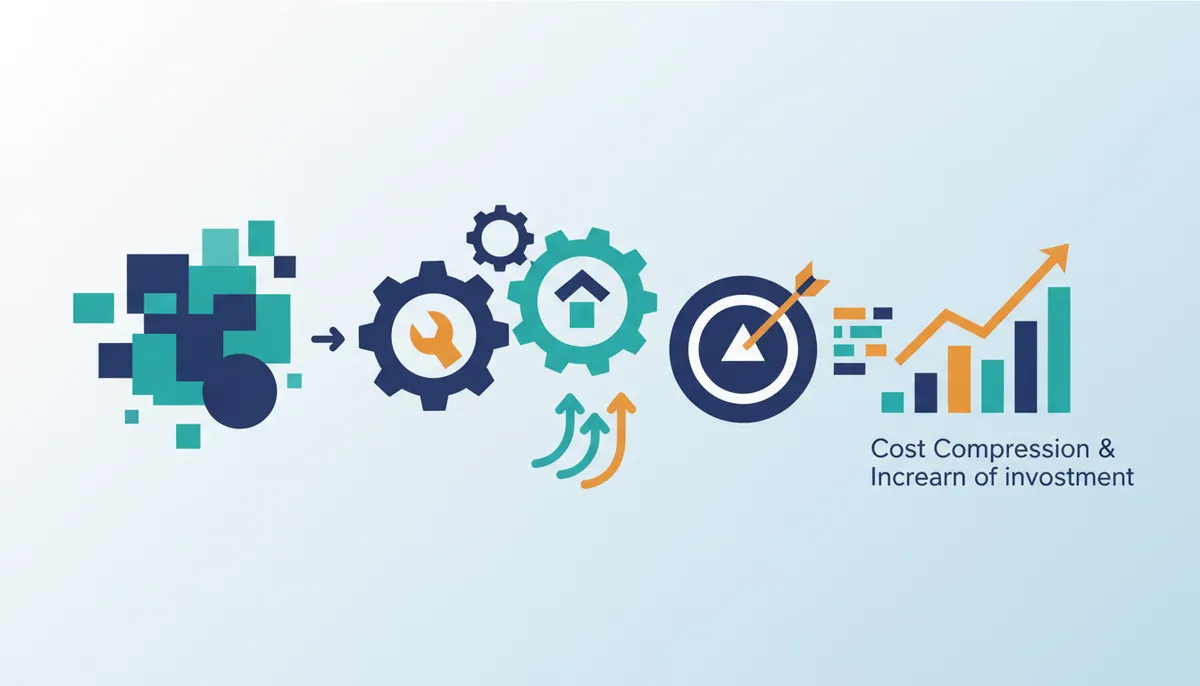
Deep workflow integration connects research, creation, and publishing without requiring manual handoffs. Systems lacking native connectivity create coordination overhead that eats the time generative tools save. Unified stacks prevent the fragmentation that dilutes output as headcount increases. AI-first content workflows combine unified platforms with automation to triple output and cut production time while maintaining brand control. The mechanism relies on AI handling repetitive tasks while humans refine brand voice and strategy, so scale does not degrade quality.
Efficiency gains depend entirely on the depth of the initial system design. A scalable SEO content strategy functions as an operating system for content, not a publishing calendar. Partial adoption costs manifest in continued context switching and delayed visibility.
| Integration Level | Handoff Type | Operator Burden |
|---|---|---|
| Shallow | Manual Transfer | High |
| Deep | Automated Pipeline | Low |
Operators evaluating a unified content platform must scrutinize the transition between content creation and distribution. Workflows stopping at the draft stage yield theoretical ROI only. Effective solutions deliver complete orchestration by embedding indexing and performance tracking directly into the generation loop to guarantee measurable returns.
Applying IndexNow and Autopilot Mode to Fix Publishing Delays
New articles face discovery delays without automated triggers, deferring traffic generation and obscuring performance data needed for iterative optimization. Modern platforms implement Autopilot Mode concepts to execute scheduled publishing and automatic indexing triggers without human intervention. Maximum efficiency requires the platform to run significant operations portions on autopilot, including scheduled publishing, automatic indexing triggers, internal link automation, real-time error correction, and automated sitemap updates.
The platform automates the entire sequence from draft completion to search engine notification. This removal of manual handoffs stops coordination overhead from accumulating between writing, editing, and deployment stages. Operators configure these workflows once, allowing the system to handle repetitive execution while the team focuses on strategic refinement.
| Failure Mode | Manual Workflow Latency | Automated Resolution |
|---|---|---|
| Crawl Discovery | High latency | Reduced via API |
| Internal Linking | Missed opportunities | Real-time insertion |
| Schedule Adherence | Human-dependent | Strict cron execution |
Solutions embed these checks directly into the workflow so speed does not compromise accuracy. Integrating research, creation, and publishing into a single AI-driven platform eliminates the fragmentation causing delays. The result is a cohesive system where a small team achieves the output volume of a much larger unit.
Content teams using unified systems report tripling output while cutting production time notably.
Checklist for Validating Genuine Integration Versus Bundled Tool Stacks
Distinguish genuine integration from bundled stacks by verifying that keyword targets appear in the writing environment without copy-pasting. Platforms requiring export/import between modules function as disconnected tools rather than a unified system. This architectural distinction determines whether a team eliminates context switching or merely accelerates manual handoffs.
| Feature | Genuine Integration | Bundled Stack |
|---|---|---|
| Data Flow | Automatic synchronization | Manual export/import |
| Workflow | Single interface | Multiple logins |
| Latency | Real-time updates | Delayed sync |
Teams adopting fragmented workflows often misinterpret high output volume as efficiency, overlooking the coordination overhead that erodes margin on every handoff. A unified approach allows operators to simplify strategy within a single data layer, ensuring research directly informs creation. Solutions enforce this continuity by design, preventing the data silos plaguing multi-vendor setups. Native connectivity prevents content operations debt from accumulating quicker than generative tools produce drafts.
Practitioners must audit the pipeline for manual friction points before scaling production. Workflows requiring users to leave the editor to check analytics or retrieve briefs remain bundled. True unification means the platform handles the invisible work of data alignment. Structural integrity allows smaller teams to sustain higher throughput without proportional increases in headcount. Ignoring this validation creates a permanent ceiling on operational velocity. Validate the architecture before committing to a vendor.
Implementing a Unified Strategy to Reduce Operations Debt
Implementation: Defining Workflow Integration Depth and Automation Scale
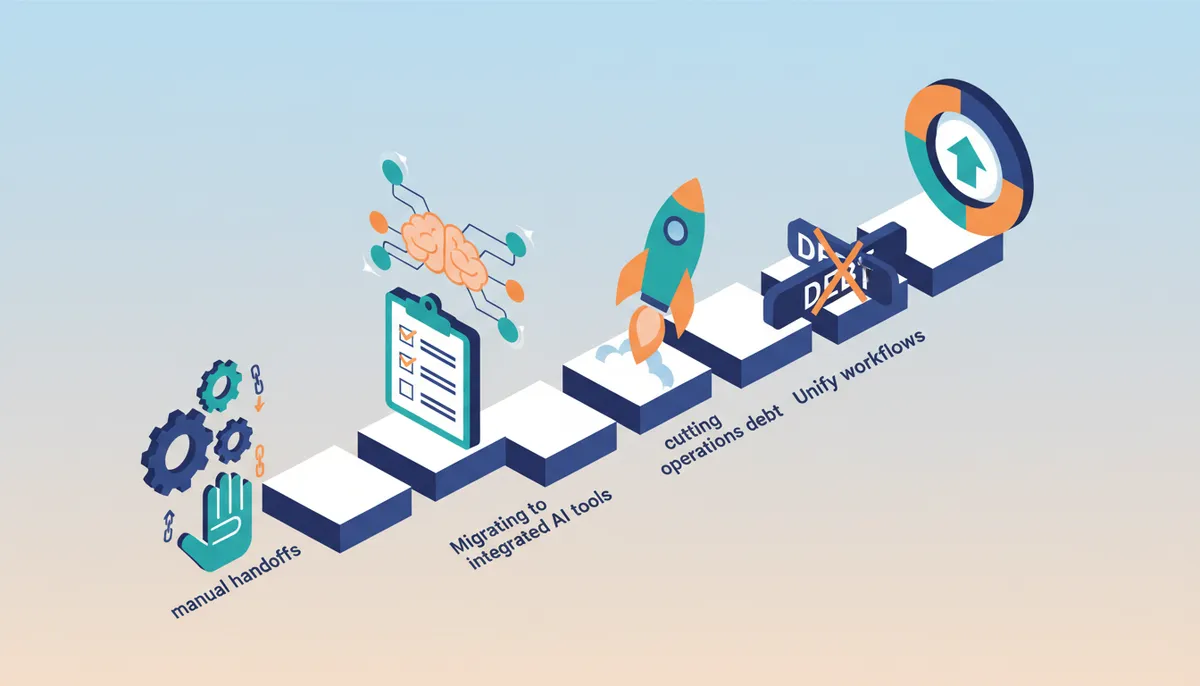
Keyword targets appearing directly inside writing environments eliminate manual copy-pasting tasks. This specific capability defines the reduction of content ops debt.
- Map every handoff where writers switch contexts to retrieve research data.
- Replace manual transfers with automation that pushes briefs directly into editors.
- Verify that performance metrics flow back to the planning stage without intervention.
Unified platforms combine planning, creation, and performance tracking into a single system to accelerate time-to-value. Specialized best-of-breed tools offer granular control yet demand significant overhead to maintain connectivity between disparate systems. Fragmented stacks frequently struggle to support the AI-first content workflows necessary for modern velocity because they cannot automate research, outlines, and on-page SEO while maintaining governance. Partial integration preserves the illusion of unity while retaining the high cost of context switching. Architectural choices determine whether a team can compound improvements over time or remains constrained by administrative overhead. Auditing current brief-to-draft transitions reveals any lingering manual data entry requirements.
Applying AI Visibility Tracking and GEO Optimization
Traditional search console data alone no longer suffices for modern content strategy. Teams must align content ideation with search engine optimization (SEO) and generative engine optimization (GEO) goals to ensure discoverability. This mechanism shifts optimization focus toward strengthening E-E-A-T signals that build trust and visibility. Optimizing for volume while ignoring that Generative Engine Optimization (GEO) prioritizes authoritative citations and entity salience over repetitive phrasing represents a common failure mode. Ignoring this shift reduces visibility in AI-driven answer layers regardless of legacy SEO rankings.
To operationalize this within a unified workflow, teams should execute the following integration steps:
- Map entity relationships before drafting begins
- Configure automated citation tracking for source verification
- Establish real-time E-E-A-T scoring metrics
- Sync generative engine response data with editorial calendars
- Deploy automated alerts for entity salience drops
Genuine integration ensures data flows automatically, such as keyword targets appearing in the editor without manual transfer.
Implementation: Checklist for Validating Genuine Integration Versus Bundled Tool Stacks
Organizations should verify that keyword targets flow directly into the writing environment without copy-pasting to reduce content ops debt.
| Capability | Bundled Stack | Unified System |
|---|---|---|
| Data Flow | Manual Export/Import | Automatic Shared Layer |
| Trigger Mechanism | Human Scheduled | Event-Driven Autopilot |
| Indexing Latency | High (Delayed) | near-zero |
Testing write-access permissions during validation confirms the system truly eliminates fragmentation rather than masking it with single-sign-on wrappers. Skipping this check creates a fragile pipeline that breaks whenever external schema definitions change.
About
Sofia Marchetti is a B2B content and demand-generation strategist who specializes in aligning automated content systems with revenue outcomes. Her decade of experience in B2B SaaS makes her uniquely qualified to dissect the complexities of a unified content functions platform, specifically regarding the reduction of content ops debt. In her daily work, Sofia architects pipelines that integrate SEO analytics directly into content briefs, eliminating the context switching that plagues disjointed teams. This article draws from her practical methodology at Enterium, a brand dedicated to documenting how modern teams build scalable AI content workflows without vendor lock-in. Unlike generic generators, Enterium's approach focuses on the full lifecycle, from topic clustering to performance measurement, ensuring humans remain on quality gates. By connecting content creation to AI visibility tracking, Sofia demonstrates how a unified workflow transforms raw output into durable topical authority. Her analysis provides the technical grounding necessary for leaders aiming to operationalize LLM-driven pipelines effectively.
Conclusion
Scaling content production breaks when teams rely on bundled stacks that introduce indexing latency and require human intervention for every data handoff. The ongoing operational cost is lost time, but the real damage is the erosion of entity salience as manual transfers create version drift between research and final drafts. Organizations must shift from assembling disjointed tools to enforcing an event-driven architecture where citation tracking and E-E-A-T scoring happen autonomously. Migrate to a unified system within the next quarter if your current workflow involves any copy-pasting of keyword targets or delayed performance feedback loops. True integration demands that write-access permissions and automated alerts function without external schema dependencies. Start this week by mapping every instance where a writer switches context to retrieve research data, then prioritize automating that specific handoff. Only by ensuring keyword targets flow directly into the editing environment can teams validate they are building a resilient foundation rather than masking fragmentation with single-sign-on wrappers. For teams ready to eliminate these inefficiencies, Enterium offers the architectural clarity needed to change chaotic workflows into simplified, entity-focused operations.
This reduction proves that unified content activities eliminate expensive fragmentation and resolve operational debt effectively.
Q: How does context switching between disjointed tools affect content team efficiency?
A: Context switching interrupts cognitive flow and significantly increases the likelihood of human error during production. Removing these manual handoffs allows teams to achieve the significant cost compression seen in mature AI workflows.
Q: What happens when organizations deploy AI tools on top of fragmented data stacks?
A: Automation without integration merely accelerates chaos for networked content teams by generating unmanaged assets rapidly. True efficiency requires a shared data layer to avoid compounding technical liabilities while chasing output volume.
Q: Why is a shared data layer critical for accurate SEO and content creation?
A: A shared data layer synchronizes performance metrics with topic structures automatically without human intervention. This architectural consolidation prevents the duplication of effort that typically inflates production costs across disconnected systems.
Q: What operational risk arises from manually transferring data between isolated analytics dashboards?
A: Manual data transfer spawns version control errors and slows publication cycles by requiring operators to re-enter data. Eliminating these handoffs is necessary to stop compounding technical liabilities within the content supply chain.
Frequently Asked Questions
This reduction proves that unified content operations eliminate expensive fragmentation and resolve operational debt effectively.
Context switching interrupts cognitive flow and significantly increases the likelihood of human error during production.
Automation without integration merely accelerates chaos for networked content teams by generating unmanaged assets rapidly. True efficiency requires a shared data layer to avoid compounding technical liabilities while chasing output volume.
A shared data layer synchronizes performance metrics with topic structures automatically without human intervention. This architectural consolidation prevents the duplication of effort that typically inflates production costs across disconnected systems.
Manual data transfer spawns version control errors and slows publication cycles by requiring operators to re-enter data. Eliminating these handoffs is essential to stop compounding technical liabilities within the content supply chain.
References