Topical authority beats keyword pages for AI search
AI Overviews now appear in 15 to 40 percent of searches. That stat kills single-page keyword targeting. The era of ranking individual documents for specific phrases has ended. We now face a structural mandate for topical authority. Businesses must own entire subject categories to maintain visibility.
As answer engines apply query fan-out to synthesize responses from multiple sources, sites with deep semantic understanding outperform those relying on keyword density. Topical clustering enables passage retrieval by signaling entity-level relevance rather than page-level matches. We are dissecting the execution of a modern pillar page strategy designed to maximize entity coverage in an environment where search results are assembled before a user ever scrolls.
This shift demands moving from competing for one ranking per page to dominating whole topic ecosystems. The following analysis details why content cluster strategy is the only viable path for organic survival in 2026. Without this architectural approach, your content remains invisible to systems that prioritize thorough topic ownership over isolated keyword matches.
Defining Topical Authority as the New Standard for AI Search Success
Defining Topical Authority as Domain-Level Entity Recognition
Topical authority measures how effectively a domain operates as a recognized, reliable entity across an entire subject instead of relying on a single page. This difference signals a fundamental architectural shift. Legacy models rewarded isolated keyword matches, yet modern retrieval systems evaluate the domain-level entity status of a source. A site holding this authority gains visibility across a full category of queries, including those never explicitly targeted within its text. Such a structural advantage matters because AI Overviews now appear in an estimated 15 to 40 percent of searches depending on the niche. Answer engines synthesize information from multiple sources before a user reaches a result, favoring ecosystems over individual documents.
Ranking for a Keyword vs Owning a Topic Category in AI Search
Stop chasing isolated pages. Topical authority requires interconnected clusters that answer engines cite as definitive sources. A keyword-centric approach yields fragile wins where a single document competes for visibility, creating vulnerability when answer engines synthesize responses from multiple inputs. Owning a category distributes domain-level advantage across a system of content, making displacement difficult without matching the entire structural depth. Fragmented content lacks the contextual map required for reliable passage retrieval. Systems demonstrate a clear preference for interconnected content clusters that resolve related questions thoroughly, outperforming strategies reliant on standalone assets.
| Feature | Keyword Strategy | Topic Category Ownership |
|---|---|---|
| Unit of Authority | Single Page | Domain Cluster |
| AI Retrieval Signal | Low (Isolated) | High (Contextual) |
| Displacement Risk | High | Low |
| Growth Pattern | Linear | Compounding |
Consider the operational cost. Developing roughly ten thoroughly developed pages covering distinct subtopics establishes stronger entity associations than fifty thin posts circling the same idea. Most operators overlook that answer engines extract passages based on bidirectional linking structures, meaning isolated high-quality pages often fail to trigger citation despite accurate information. Resource intensity presents a constraint; building a content cluster strategy demands coordinated planning across subtopics rather than independent article production. Enterprises attempting this scale frequently encounter bottlenecks in grouping terms and writing detailed briefs without automated strategic tools. Enterium solves this execution gap by generating ready-to-execute pillar-cluster plans that align with entity network requirements. Upfront architectural effort is the cost, yet the result is a resilient visibility model where authority compounds with each added cluster node.
Why Fragmented Content Fails to Trigger AI Overview Citations
Answer engines synthesize data from distributed sources, causing isolated pages to lose visibility against domains with established authority. When retrieval systems construct responses, they prioritize interconnected content clusters that demonstrate complete expertise rather than single documents. Brands using detailed how-to guides organized into these clusters perform best, satisfying the algorithmic preference for thorough sources over commodity content. Relying on standalone pages creates a structural deficit where ranking a single keyword no longer guarantees inclusion in synthesized results. Organic clicks are being cut by the presence of AI Overviews, creating a divergence between traditional traffic metrics and actual brand visibility. This instability forces operators to abandon page-level optimization in favor of entity-level recognition within knowledge graphs. Enterium architects these dense semantic networks to ensure your domain functions as the definitive source during synthesis. High-quality individual pages risk remaining invisible to the very systems generating user answers without this architectural shift. Building thorough clusters is now necessary for securing consistent citation in AI-generated responses.
How Semantic Architecture Enables Passage Retrieval in Answer Engines
Passage-Level Indexing and Bidirectional Linking Mechanics
Artificial intelligence systems extract specific content sections rather than evaluating entire pages as single units. This passage-level indexing functions best when a Pillar Page defines the core topic while Cluster Pages resolve specific subtopics. Together, they function as a single authoritative unit for retrieval algorithms. Content built with bidirectional linking, where the pillar links to cluster pages and each cluster page links back with specific anchor text, earns AI recognition. Interconnected content clusters outperform isolated pages by demonstrating complete topical expertise. The link structure serves as a signal to retrieval systems about relationships between content units.
| Architecture Type | Retrieval Signal | AI Citation Potential |
|---|---|---|
| Isolated Pages | Fragmented | Low |
| Topic Clusters | Contextual Map | High |
Strict adherence to semantic hierarchy matters because ambiguous linking dilutes the authority signal. Organizations must shift from keyword matching to owning entire topic categories. Businesses that own entire topic categories are surfacing in AI-generated answers more consistently than those chasing individual rankings. Fragmented strategies risk losing visibility as answer engines prioritize sources with verified depth. Implementing this structure removes ambiguity for the retrieval layer.
Structuring Pillar and Cluster Pages for Entity Density
Anchor the Pillar Page with broad definitional scope to bound the semantic field for retrieval systems. LLMs and generative search resolve over 60% of informational queries directly on the SERP, demanding precise architectural signals. The mechanism relies on entity density, where specific named concepts connect site content to external knowledge graphs. Operators must structure Cluster Pages to resolve discrete subtopics. Each node addresses a unique user intent without semantic overlap. Bidirectional linking reinforces this hierarchy; the pillar links outward to clusters, while clusters link back using specific anchor text. This creates a closed loop that validates behavioural depth through navigation patterns rather than static keyword repetition.
| Architecture Element | Function | Retrieval Signal |
|---|---|---|
| Pillar Page | Defines core topic boundaries | Topical breadth |
| Cluster Pages | Resolve specific sub-intents | Contextual depth |
| Bidirectional Links | Connects nodes with specific anchors | Relationship validity |
Brands using interconnected content clusters outperform those relying on isolated high-performing pages. Visibility in 2026 depends on owning the entire topic category rather than individual query variations. Passage-level indexing may extract competitors' content over yours without this structural rigor.
The Risk of Legacy Keyword Matching in Generative Search
AI Overviews now trigger on nearly half of all queries. Traditional ranking positions no longer correlate with actual brand presence inside generated answers. This divergence creates a blind spot where traffic metrics remain stable while brand visibility inside AI answers vanishes. Legacy strategies fail because they optimize for document retrieval. Modern systems prioritize passage-level extraction from authoritative topic ecosystems. Fragmented content lacks the entity density required to trigger citations in synthetic responses. Organizations chasing individual keyword rankings miss the single most necessary metric in modern marketing. Content remains invisible to retrieval algorithms that favor interconnected clusters over standalone pages without a unified topic strategy. This structural deficit prevents the behavioural depth signals necessary for AI trust. Enterprises must shift focus from ranking individual URLs to owning entire subject categories through architectural coherence. Failure to adapt results in a silent loss of market share as competitors secure citation dominance. Customers now make decisions in interfaces where irrelevance costs market share.
Executing a Modern Pillar Page Strategy for Maximum Entity Coverage
The Five-Step Cluster Planning Framework for Pillar Architecture
Selecting a broad, high-intent subject where the business holds genuine expertise starts the Cluster Planning Framework. This initial scope defines the topical boundary for the entire architecture. Specific cluster pages map to distinct user intents in step 2, ensuring coverage of informational and commercial queries alike. Step 3 enforces bidirectional internal links, requiring every cluster page to link back to the pillar with descriptive anchor text while the pillar links outward to avoid orphaned content.
| Step | Action | Technical Requirement |
|---|---|---|
| Step 1 | Select Pillar Topic | High-intent subject area |
| Step 2 | Map User Intent | Resolve specific decision points |
| Step 3 | Build Links | Bidirectional anchor text |
| Step 4 | Align Process | Guide from awareness to conversion |
| Step 5 | Governance | Audit and refresh cycle |
Aligning the cluster to the user process happens in step 4, integrating case studies to provide behavioral validation signals. Regular audits prevent cluster decay as search semantics evolve, a mandate established by step 5 which sets content governance. Teams often fail by skipping step 3, leaving isolated pages unable to transmit the entity-level authority required for AI citation. This framework constructs a semantic map that answer engines traverse to verify complete topical expertise instead of relying on simple keyword lists. Maintaining 5 steps across dozens of topics demands strict editorial calendars. Implementing step 5 ensures the architecture adapts as search semantics evolve.
Mapping Cluster Pages to Informational and Commercial User Intent
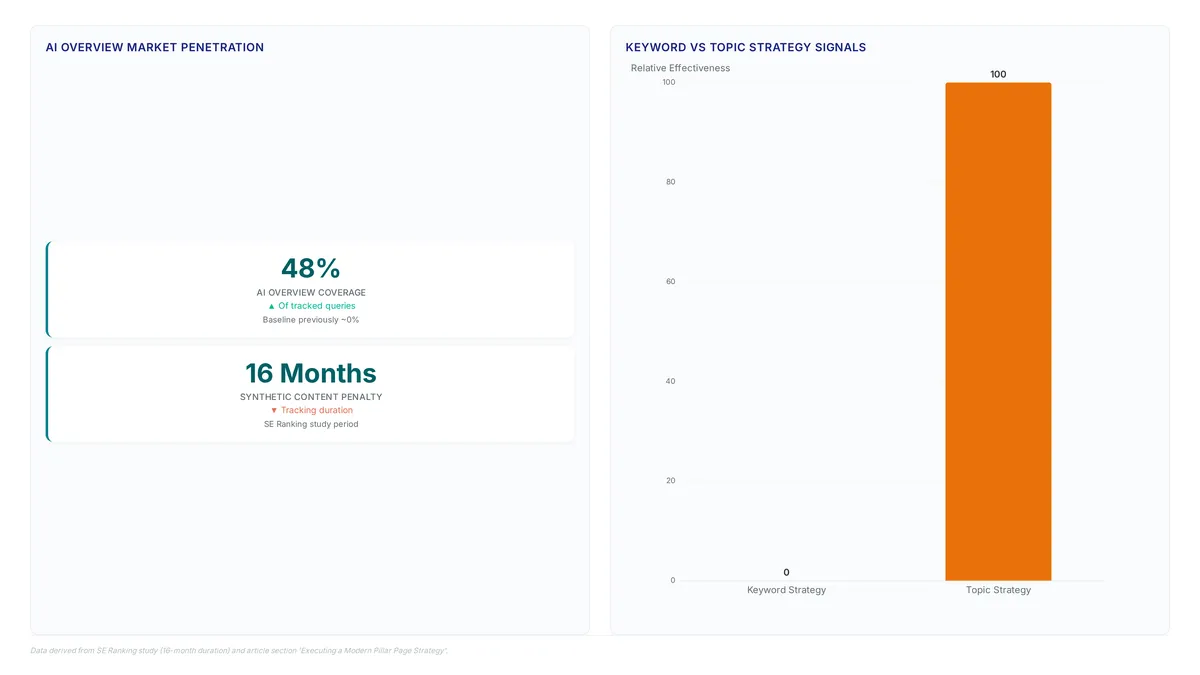
Semantic understanding allows modern search engines to assess what a user tries to accomplish rather than just matching words. Operators must assign specific informational, navigational, and commercial intents to individual cluster nodes to implement topic strategy effectively. A page targeting "air conditioning repair" resolves immediate breakdown scenarios, while adjacent content addresses installation costs or maintenance schedules. This granularity satisfies the algorithmic preference for sources demonstrating complete topical expertise over fragmented signals. AI Overviews now appear on an estimated 48% of tracked queries, making structural depth critical for consistent visibility across AI answer variations.
| Intent Type | Content Function | Cluster Role |
|---|---|---|
| Informational | Resolves specific questions | Expands topical surface area |
| Commercial | Guides decision points | Validates entity authority |
| Navigational | Directs to specific assets | Reinforces internal hierarchy |
Resource intensity limits this approach because covering every sub-topic requires significant editorial capacity compared to single-page targeting. Investment in content clusters becomes necessary when organic traffic plateaus despite high-quality individual articles. Interconnected clusters rather than isolated pages achieve optimal retrieval rates.
Keyword Strategy vs Topic Strategy for AI Retrieval Signals
Legacy keyword matching targets isolated queries, while topic strategies provide the structural depth answer engines require for retrieval. Concentrating authority on single pages leaves a site vulnerable when algorithms shift, a flaw inherent in the keyword approach. A topic strategy distributes entity-level authority across a cluster, creating structural durability that isolated assets lack. AI systems expand prompts across related subtopics, retrieving passages from sources with thorough coverage rather than single documents. Pages generated without these E-E-A-T signals often fail to sustain performance over extended tracking periods compared to supervised content ecosystems.
Low-effort generation incurs a measurable operational cost; content lacking original insights suffers a performance penalty that wastes the initial investment. Shifting focus from ranking for a keyword to owning a category changes the retrieval surface area. Operators must decide between chasing volatile single-term rankings or building a content system that answer engines can traverse. Auditing existing content gaps against a set pillar identifies missing subtopics before generating new assets.
Measuring Cluster ROI Through Citation Rates and Visibility Metrics
Defining the Three-Tier Cluster ROI Framework Components

The Three-Tier Cluster ROI Framework replaces isolated page KPIs with interconnected metrics that reflect how answer engines evaluate domain expertise. Tier 1: Visibility tracks the collective query footprint a cluster commands and its frequency of inclusion in AI Overviews, moving beyond single-keyword rank tracking. This tier captures the raw exposure necessary for retrieval, as fragmented content strategies often fail to trigger the thorough signals AI systems require. Tier 2: Authority measures qualitative strength through domain-level topical relevance scores, alongside entity recognition density.
Revenue data distorts when attribution logic ignores the non-linear paths users take through interconnected content clusters. Standard last-click models fail to credit the core research pages that initiate buyer journeys, reserving value only for the final conversion point. This approach systematically undervalues the specific architectural work required to satisfy AI retrieval systems seeking complete topical expertise. Operators must reconfigure analytics pipelines to capture assisted conversions across the full customer lifecycle. The following validation steps verify that cluster contributions are recorded accurately:
- Configure data layers to pass cluster identifiers on every interaction, not exit pages.
- Extend lookback windows to capture the full duration of complex buyer journeys.
- Assign fractional credit to early-stage cluster nodes that introduce the brand entity.
4.
| Model Type | Credit Assignment | Cluster Visibility |
|---|---|---|
| Last-Click | All to final touch | Zero |
| Linear | Equal split across path | Partial |
| Time-Decay | Higher weight to recent | Moderate |
| Position-Based | 40% start, 40% end | High |
The cost of skipping this validation is measurable revenue leakage. Longitudinal analysis over a 16-month duration reveals that low-effort synthetic content incurs performance penalties, while high-quality clusters compound value over time. Without multi-touch validation, organizations cannot distinguish between commodity traffic and genuine authority building. Implementing these attribution guards before scaling cluster production is necessary to guarantee ROI visibility.
About
Daniel Reyes serves as Head of Content Engineering at Enterium, where he architects production-grade AI content pipelines from ingestion to publication. His decade of experience building RAG systems and evaluation harnesses directly informs this analysis of topic clusters as the structural foundation for AI visibility. Unlike traditional keyword chasing, modern answer engines synthesize data across entire domains, a reality Reyes addresses daily while designing orchestration logic for B2B teams. At Enterium, the editorial front for enterium.ai, he documents how vendor-neutral automation methodologies must evolve to maintain organic reach when AI Overviews dominate search results. This article translates his engineering work on vector stores and quality gates into a strategic imperative: businesses must own topic categories to surface in synthesized answers. By focusing on pipeline architecture rather than isolated pages, content leaders can align their operations with the structural requirements of 2026's search environment.
Conclusion
Scaling topic clusters without corrected attribution logic creates a blind spot where early-stage authority building disappears from revenue reports. When AI models resolve queries directly, the traditional linear path to purchase dissolves, rendering last-click data obsolete for strategic planning. Organizations relying on outdated models will continue to undervalue fundamental content that triggers algorithmic recognition, leading to misguided budget cuts in high-performing architectural areas. You must transition to position-based attribution immediately to capture the full lifecycle value of your entities. This shift is not optional for teams aiming to prove the ROI of topic clustering in an era where generative answers dominate.
Start by reconfiguring your analytics data layer this week to pass unique cluster identifiers on every interaction, not just final conversion pages. This single technical adjustment enables the fractional credit assignment necessary to distinguish between commodity traffic and genuine brand authority. Without this visibility, you cannot validate whether your content strategy drives compound growth or merely generates ephemeral clicks. Enterium specializes in aligning these complex attribution pipelines with modern search realities, ensuring your reporting stack reflects the true impact of your topical expertise. Do not let flawed metrics dictate the fate of your long-term visibility strategy.
Frequently Asked Questions
Isolated pages lack the context needed for passage retrieval. Single documents miss the 60% of queries resolved directly by generative search systems today.
Interconnected clusters signal entity relevance better than density. This architecture supports the 60% of informational queries that answer engines now resolve without user clicks.
Fifty thin posts yield less authority than ten deep pages.
Brand visibility inside AI answers is now the priority.
Longitudinal analysis reveals performance trends over extended durations.
References