Citation rate wins: Structure your content for AI
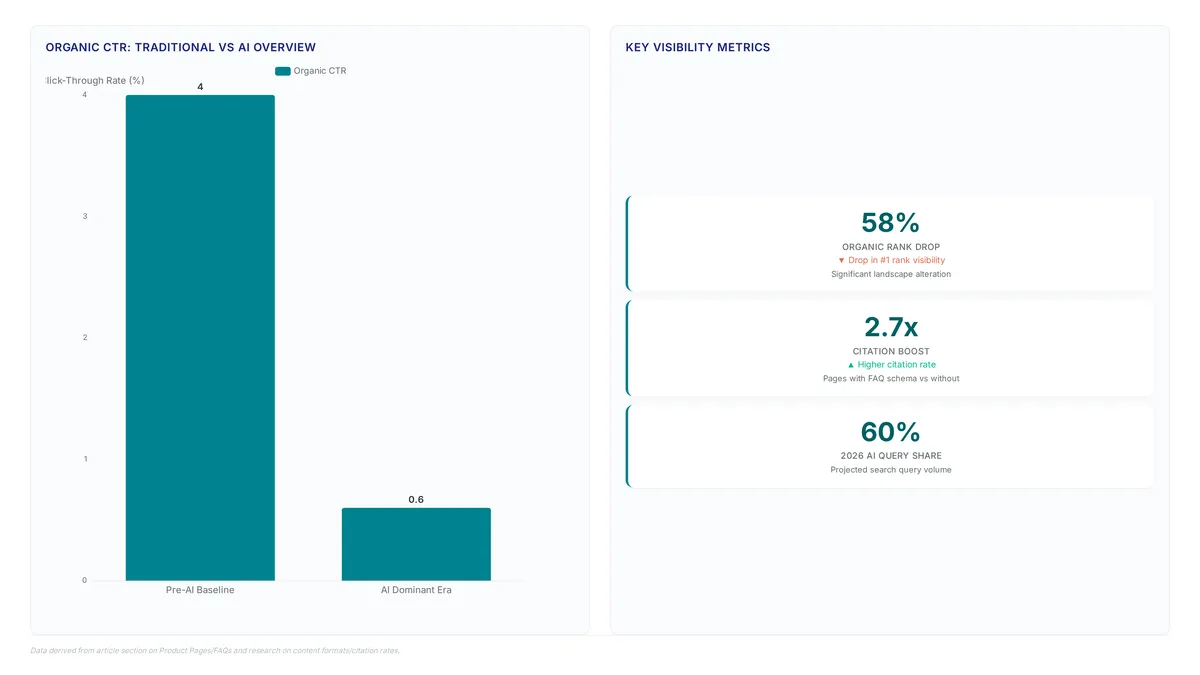
Pages using FAQ schema see a 2.7x higher citation rate than those without it, according to Animalz. This isn't a suggestion to tweak meta descriptions; it is proof that on-page content formats now dictate visibility more than keyword density ever did. Writing for human skimmers is a legacy habit. The new imperative is AI answer engine optimization, where structure functions as the primary ranking signal.
You need to understand why comparison content requires rigid structural definitions to survive AI search engine citations. We will look at specific methods for structuring product pages and FAQ sections to maximize answer engine visibility. The data shows how content types for ChatGPT and similar models favor distinct title patterns AEO over traditional narrative flows. Optimizing content for AI is a mechanical requirement for survival in 2026. Ignoring AEO content structure guarantees your data remains invisible to the algorithms that now control traffic.
Defining Answer Engine Optimization and the Role of Content Formats
Defining AEO and the Citation Rate Metric
Answer Engine Optimization structures text so artificial intelligence systems extract specific answers instead of merely ranking hyperlinks. This discipline shifts the primary success metric from organic traffic volume to citation rate, which tracks how often a brand appears as the direct source in synthesized responses. Visibility now moves toward these zero-click outcomes, demanding content formatted for immediate machine readability to capture attention.
Research indicates that answer engines prioritize information presented early in the text and clearly structured for access. Pages using FAQ schema markup achieve a higher citation rate in answer engines compared to pages without this structured data format. However, high citation volume does not guarantee click-through revenue if the extracted snippet fully resolves user intent. Operators must balance answer completeness with curiosity gaps to drive traffic. Legacy articles require audits to place critical definitions above the fold and carry explicit schema tags.
Why Listicles and Articles Dominate AI Citations
Listicles and articles function as primary citation sources because their explicit structural markers align with LLM token extraction patterns. Data identifies product pages, blogs, and listicles as the most cited formats across answer engines. Numbered lists and clear headings reduce parsing ambiguity, allowing models to map content directly to user queries without inferring context from dense prose.
Platform architecture dictates specific format performance, creating distinct optimization requirements for different engines. Structured, extractable answers such as direct answer paragraphs, clean lists, or comparison tables earn citations because they mirror the format answer engines need to generate a response. Pages formatted with explicit Q&A pairs align with how answer engines parse and cite content. Generic formatting strategies fail to maximize reach; operators must tailor content structures to the specific extraction biases of each target engine.
| Content Format | Primary Strength | Best Performer |
|---|---|---|
| Listicles | Explicit itemization | Answer Engines |
| Discussions | Community validation | Answer Engines |
| Product Pages | Attribute mapping | Answer Engines |
A limitation arises when legacy content formats remain static while model training data refreshes. Citations emerge from patterns of agreement across the web, requiring content recognition as a reliable source.
Teams must prioritize format audits alongside freshness checks to sustain visibility. Restructuring high-value legacy articles into scannable list formats while verifying timestamp accuracy addresses both the structural preference for listicles and the systemic requirement for current data.
The Risk of Ignoring Schema and Content Freshness
Outdated content and missing schema markup directly suppress visibility within AI-generated answers. The synthesized block becomes the primary traffic driver when an AI Overview appears, making presence within it necessary. Operators relying on legacy rankings without structural updates face immediate obsolescence as answer engines prioritize fresh, machine-readable data.
Implementing structured data requires alignment with actual page content to enhance visibility effectively. Applying schema to elements that don't exist violates Google's structured data guidelines. Content freshness acts as a gating mechanism; systems select the most the results and extract specific passages, facts, and data points, favoring accurate and current information. Maintaining high citation density requires continuous content auditing alongside technical schema validation.
Treating content freshness as a binary quality gate in the deployment pipeline is necessary. Teams must verify that FAQ sections and list items reflect current market realities before publishing schema. Failure to align technical markup with actual page content prevents proper understanding, effectively removing the asset from the answer engine conversation entirely.
How LLMs Process Listicles and Comparison Content for Citations
LLM Pattern Matching for Listicles and Comparison Tables
Tokenizers within large language models parse structured lists and tables with notably higher fidelity than dense prose blocks. Structured, extractable answers earn citations because AI answer engines pull from content that mirrors the format they need to generate a response: a direct answer paragraph, a clean list, or a comparison table. This mechanical preference exists because structured formats reduce the ambiguity inherent in natural language syntax, allowing the model to map entities directly to output slots without inferring relationships from context clues.
Nal, low noise Extraction Rate Baseline significantly higher accuracy with structure Context.
Relying solely on structure introduces a specific vulnerability regarding context window positioning. Content optimized for answer engines must lead with clear definitions and keep structure tight to ensure every section is easy for machines to reuse without misreading. This creates a tension between providing thorough background data and maintaining high retrieval reliability for specific facts buried deep within a document. Research from Stanford documents a U-shaped accuracy curve in which LLM performance drops when the information sits in the middle of long input contexts. Operators must therefore distribute high-value claims across the beginning and end of inputs or break large datasets into smaller, linked chunks to avoid potential performance dips. The implication for content architecture is clear: writers cannot simply convert articles to lists; they must also engineer the sequence of information to align with token-level attention mechanisms. Failure to account for this positional bias renders even perfectly formatted tables invisible if they fall into the model's attentional blind spot. Auditing existing comparison pages to ensure key differentiators appear early in the content is a recommended practice.
Applying Title Patterns Like 'X vs Y' to Boost Citations
Product pages, blogs, and listicles are the most cited formats across answer engines, making them critical for visibility. This statistical dominance exists because intent-matched title patterns like 'X vs Y' or 'Best X' align directly with the synthetic query structures LLMs generate when resolving user uncertainty. The mechanism relies on explicit semantic markers that allow the model to map competing entities into a structured output slot without inferring relationships from dense narrative text. Cited pages pair the format with an intent-matched title pattern to signal clear decision logic.
Prioritizing comparison content for high-value commercial queries where users weigh alternatives is a core strategy. Operators must verify that underlying data supports the binary distinctions implied by the title pattern. Success requires matching the pattern to genuine user decision points rather than applying it as a universal template.
Checklist for Schema Markup and Structural Citation Signals
Implement ItemList and FAQPage schema to enhance how crawlers interpret content boundaries. Pages with FAQ schema earn 2.7x higher citation rates than pages without it, according to recent analysis. This markup explicitly defines content boundaries for crawlers, distinguishing discrete items from narrative prose. Without these signals, models must infer structure from text patterns, increasing extraction error rates. The cost is implementation time; the benefit is deterministic parsing.
Operators must verify that structural citation signals match the visible DOM hierarchy. This constraint means templates cannot dynamically reorder content without updating JSON-LD blocks. Prioritize comparison content when targeting decision-phase queries, as listicles outperform articles for AI extraction. However, legacy pages often lack the semantic headers required for effective ItemList deployment. Refactoring these assets requires separating data layers from presentation logic. Neglecting this validation step risks publishing invalid markup that crawlers ignore entirely. Treating schema as a strict contract rather than a suggestion is necessary. The next step is running a diff against current production templates to identify gaps.
Structuring Product Pages and FAQs to Maximize AI Visibility
Mapping Schema Types to Product and FAQ Page Structures
Assigning specific schema types to page intent guides how answer engines parse and cite content structures. Product pages apply Product types to define explicit attribute relationships, while FAQ sections employ FAQPage markup to separate questions from answers cleanly. Crawlers may treat text as unstructured prose without these semantic signals, reducing the probability of direct extraction.
| Page Intent | Primary Schema | Extraction Target |
|---|---|---|
| Product Detail | Product |
Price, Availability |
| Category Listing | ItemList |
Rank, Grouping |
| Support/Help | FAQPage |
Question-Answer Pairs |
| Guide/Process | HowTo |
Step Sequences |
Implementing FAQPage schema allows engines to lift direct answers, particularly because pages with FAQ schema earn notably higher citation rates than those without it. Google restricted FAQ rich results in traditional search previously, yet the schema remains effective for AI citations. Maximizing surface area for citations requires strict adherence to factual Q&A formats where FAQPage is appropriate.
| Feature | Structured Data | Unstructured Text |
|---|---|---|
| Entity Recognition | High Confidence | Low Confidence |
| Citation Rate | Elevated | Minimal |
| Parse Speed | Fast | Variable |
Operators must audit legacy content so schema alignment matches the actual content layout rather than forcing a template. A product page lacking specific variant data fails to provide the grouped data models prefer for comparison queries. Schema alone cannot fix thin content; the underlying text must still satisfy the query intent set by the H2 hierarchy. Future updates should prioritize adding HowTo steps to procedural guides where step-by-step logic exists.
Implementing Set Entities Blocks and Definition Leads on Product Pages
Place a direct answer definition lead in the opening paragraph to satisfy LLM extraction patterns for product queries. Use titles such as "What is [X]?" or "What is [X], and why does it matter?" followed by a 1-2 sentence direct answer in the opening paragraph. This structural element provides the specific entity relationship data that answer engines prioritize over unstructured prose. These formats succeed because they front-load the set entities block near the top of the document. Crawlers often miss the core product attributes during the initial parsing window without this explicit positioning.
Leading with clear definitions benefits implementation, using question-style headings, and keeping structure tight so every section is easy for machines to reuse without misinterpretation. Operators must balance this brevity with sufficient context to avoid ambiguous entity resolution. A product page lacking this clear definition often fails to trigger the extraction target mechanisms in large language models.
| Element | Placement | Function |
|---|---|---|
| Definition Lead | Paragraph 1, Sentence 1 | Direct answer for snippet generation |
| Set Entities Block | Top of document | Attribute mapping for RAG systems |
| Schema Markup | HTML Head | Machine-readable context signals |
Practitioners recommend auditing legacy product pages to ensure the primary entity definition appears early in the content. Omitting this structure results in measurable lost visibility in generative search interfaces. Pages without clear definition leads force the model to infer relationships, increasing the risk of hallucinated attributes. Structural clarity directly dictates citation probability across all substantial answer engines. Update your template today to include these set blocks before the next indexing cycle.
The Zero-Click Threat of AI Overviews on Organic CTR
The rise of AI Overviews fundamentally alters the value of traditional ranking by synthesizing responses directly on the results page. The presence of an AI Overview in search results causes the click-through rate (CTR) for the number one organic ranking to drop significantly, notably altering the environment for organic traffic. This shift forces practitioners to prioritize direct citation necessity over positional authority when they optimize product pages for AI. Standard SEO tactics that target the top blue link now face a scenario where the answer engine extracts information to generate a thorough response, often referencing credible sources without requiring a click.
| Metric | Impact on Organic Traffic |
|---|---|
| AI Overview Present | Shift from clicks to zero-click visibility |
| Primary Goal | Direct brand citation |
| Required Format | Structured data blocks |
High visibility no longer guarantees site entry in this model, creating a tension between brand awareness and conversion volume. Operators must embed set entities and explicit attribute relationships within the source code so the engine extracts the brand name rather than a generic summary. Relying on unstructured prose yields extraction failures, leaving the traffic opportunity to competitors with cleaner semantic signals. Ignoring schema markup costs measurable session potential despite high query relevance. Teams should audit high-volume queries immediately to identify which product pages trigger these zero-click summaries. Adjusting content architecture to favor extractable citation signals becomes the primary defense against traffic erosion.
Executing a Five-Step Audit to Fix Low Citation Rates
Defining the 5-Step Quick Audit for Legacy Content
Start the audit by pulling the top 25-50 organic pages ranked by impressions to establish a high-signal candidate set. This narrow scope prevents analysis paralysis while targeting assets with existing traffic velocity. Standardize the heading hierarchy by inserting an H2 roughly every 150-200 words to create clear semantic boundaries for parser extraction. LLMs rely on these structural breaks to segment context windows effectively.
- Export impression data to identify the top 50 URLs.
- Scan each page for missing or nested H2 headers.
- Insert a TL;DR answer block immediately following the H1 tag.
- Convert dense paragraphs into bulleted lists where logical.
- Validate that listicles and comparison tables use explicit row headers.
The constraint here involves balancing readability with machine parseability. Adding explicit headers aids AI extraction but can alter narrative flow if over-segmented. Operators must prioritize structural clarity over literary flourish in these high-value entry points. The citation rate improves when the model encounters predictable patterns rather than inferring structure from prose.
Start bulk operations by targeting listicles and articles where statistics exceed a two-year age threshold. This specific temporal boundary matters because answer engines deprioritize stale data during synthesis windows. Teams using Marketing Hub Pro or Enterprise tiers can automate prompt generation through Smart CRM integrations to accelerate this rewrite phase. The operational constraint is that bulk republishing triggers full re-crawling cycles, which may temporarily dilute existing citation velocity if not staggered.
- Filter the content inventory for dates older than 24 months.
- Run Smart CRM prompts to draft updated statistical claims.
- Execute bulk updates via the Content Hub publishing queue.
A critical tension exists between update frequency and crawler trust; refreshing too many high-traffic pages simultaneously can reset citation signals across the entire domain rather than boosting individual URLs. Operators should stagger releases by content cluster to maintain steady answer engine visibility. This approach ensures that legacy assets regain relevance without overwhelming the indexing pipeline. The cost of this cadence is a temporary loss in ranking stability for previously cited pages. Enterium recommends a weekly batch size of five to ten pages for domains under 500 total URLs. Larger estates require proportional throttling based on crawl budget capacity. This measured refresh strategy preserves historical authority while injecting current data.
Internal QA Checklist for Schema Validation and Freshness
Validate FAQ schema against the Schema.org Validator before any production push to guarantee parseability. This step confirms that the structured data matches expected types without syntax errors. Run the same URLs through Google's Rich Results Test to verify eligibility for enhanced display features. Teams observing a drop in citation share should trigger an immediate re-validation cycle. Substantial model releases from OpenAI or Google often shift parsing heuristics silently.
- Verify schema markup renders correctly in validation tools.
- Confirm last-updated dates reflect the current publishing window.
- Check that author bios contain verifiable credentials and links.
| Check Point | Tool Target | Failure Signal |
|---|---|---|
| Syntax Validity | Schema.org Validator | Red error flags on properties |
| Rich Result Status | Google Rich Results | "Valid with warnings" status |
| Temporal Freshness | CMS Metadata | Date exceeds 24-month threshold |
The operational risk lies in assuming static validity; a page passing today may fail after a core update alters interpretation rules. While Google restricted FAQ rich results for traditional search in August 2023, many teams incorrectly removed the markup entirely. For AI citations, the schema still works and remains a primary signal for extraction. Enterium recommends treating schema not as a one-time fix but as a living configuration requiring quarterly audits. Neglecting this maintenance allows competitors with fresher, validated structures to capture citation volume.
About
Hannah Brooks, Marketing Operations Lead at Enterium, analyzes on-page content formats through the lens of pipeline architecture and governance. Her daily work involves evaluating LLM providers and orchestrating workflows where specific structures, like listicles or comparison tables, directly impact AI citation rates. At Enterium, a brand dedicated to documenting how teams scale content with vendor-neutral methodologies, Hannah tests how schema markup and title patterns influence visibility in answer engines like Perplexity and ChatGPT. Unlike generic SEO advice, her approach grounds AEO strategies in reproducible data, measuring how format choices affect downstream automation and quality gates. By connecting content engineering principles to real-world citation mechanics, she provides actionable frameworks for B2B leaders needing to optimize legacy assets for AI search. This analysis reflects Enterium's core mission: building reliable, measurable content operations where humans remain on the critical decision gates.
Conclusion
Scaling content updates without a structured approach causes crawl budget waste and dilutes the impact of your highest-value pages. The operational cost of ignoring temporal freshness is not merely a ranking fluctuation; it is a systematic exclusion from AI extraction pools where accuracy depends on recent, validated signals. When metadata dates exceed the 24-month threshold, the likelihood of accurate data extraction drops precipitously, rendering high-quality information invisible to modern retrieval systems.
Organizations must transition from ad-hoc updates to a proportional throttling strategy immediately. Do not attempt to refresh entire archives simultaneously, as this triggers volatility. Instead, mandate a workflow where teams update five to ten critical pages weekly, prioritizing those with the highest historical traffic but oldest metadata. This measured cadence preserves domain authority while signaling consistent relevance to parsing algorithms. Treat schema markup as a living configuration requiring quarterly re-validation rather than a one-time implementation, especially as underlying heuristics shift silently between substantial model releases.
Start this week by running a CMS metadata audit to isolate all pages where the last-updated date exceeds two years. Export this list and cross-reference it with your top organic entry points to identify the highest-risk assets for immediate revision. By targeting these specific gaps first, you secure the structural integrity required for sustained visibility in an evolving environment.
Frequently Asked Questions
FAQ schema increases citation rates by 2.7 times compared to pages lacking this structure. Implementing FAQ schema markup directly improves machine readability, making your content significantly more likely to be selected as a primary source for synthesized answers.
The top organic ranking loses a portion of its click-through rate when an AI Overview displays. This dramatic drop forces operators to prioritize citation rate over traditional position one rankings to maintain traffic value.
Listicles dominate citations because their explicit markers align perfectly with LLM token extraction patterns. Structuring data into numbered lists reduces parsing ambiguity, allowing models to map your content formats directly to user queries without inferring context.
Product pages must use rigid structural definitions to survive AI search engine citations effectively. Mapping attributes clearly helps retrieval systems parse data, ensuring your product pages serve as reliable sources for direct answer extraction.
Content exceeding a 24-month freshness threshold faces high operational risk of being ignored by answer engines. Systems prioritize fresh, machine-readable data, so legacy articles require audits to verify timestamp accuracy and update CMS Metadata Date fields.
References