Token consumption spikes: Why agents burn 50x
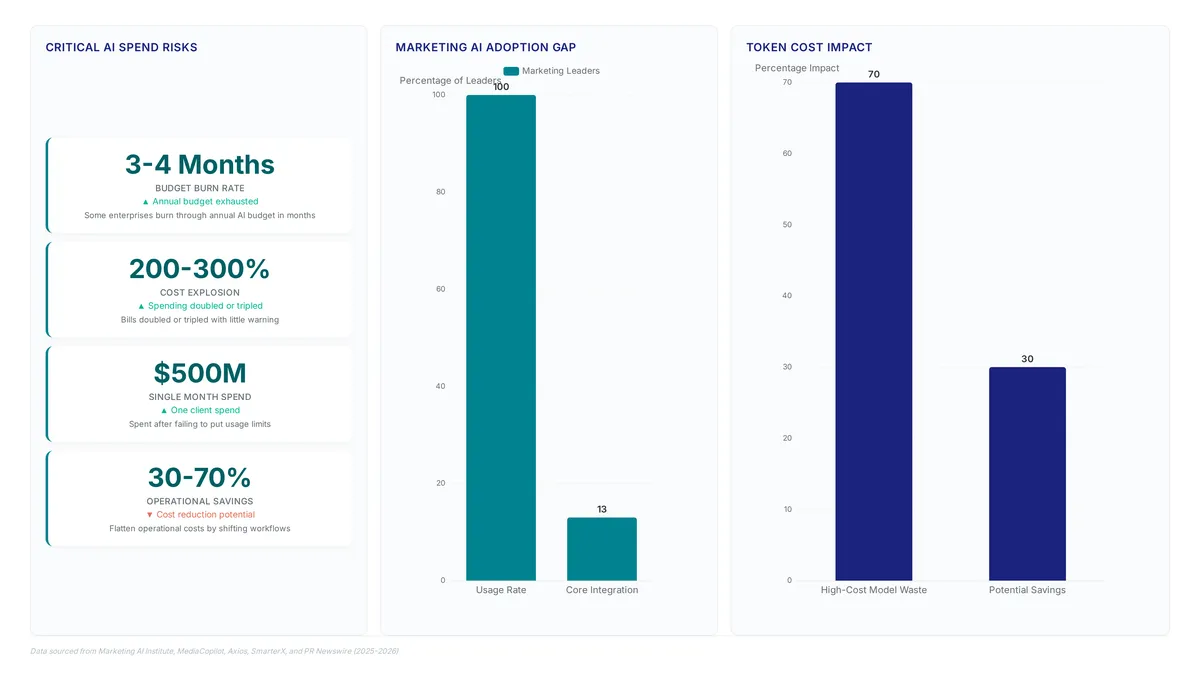
Enterprises are burning through annual AI budgets in months, not years. Reports from Axios and The Wall Street Journal confirm the pattern: legacy marketing ledgers cannot sustain the token velocity of modern AI agents. Unlike simple chatbots, these autonomous systems execute multi-step workflows that multiply compute usage by 50-fold per task, a dynamic highlighted in a May Goldman Sachs report.
Token consumption is projected to multiply 24 times between 2026 and 2030. This trajectory devastates unguarded marketing ledgers. The solution requires a framework for strategic AI budgeting that replaces blind restriction with granular governance.
Most organizations set financial guards in late 2025, assuming static usage patterns. Those budgets were never designed for agentic AI behaviors. Without immediate intervention to align model selection with specific task requirements, marketing teams will face bills that double or triple without warning. Enterium provides the governance layer needed to visualize spend and enforce controls before quarterly allocations vanish.
The Role of Agentic AI in Escalating Token Consumption
Agentic AI vs Chatbots: The Multi-Step Token Mechanism
Agentic AI drives complex tasks through autonomous loops that spike compute demand far beyond passive chatbots. A standard bot answers a single query and stops. An agent automating a workflow iterates through drafting, researching, and validating data without human intervention. This architectural shift turns one logical request into dozens of API calls.
Goldman Sachs observed in a May report that this sequential querying pattern blows up simple requests by 10-fold, 20-fold, or even 50-fold compared to static interactions. Token consumption is projected to multiply 24 times between 2026 and 2030 as these autonomous workflows scale. The distinction lies in the token mechanism: chatbots operate on a one-to-one request ratio, whereas agents generate a chain of dependent prompts where each step incurs a new charge.
| Feature | Standard Chatbot | Agentic Workflow |
|---|---|---|
| Interaction Model | Single-turn query | Multi-step execution |
| Token Pattern | Linear consumption | Exponential expansion |
| Governance Need | Low | Critical |
Enterium platforms address this by implementing outcome-based model selection rather than unrestricted access. The hidden cost is not volume but the lack of visibility into which specific agent loops drive value. Organizations face budget exhaustion within months rather than years without strict governance. Deploying strategic gates at the workflow level prevents runaway token generation before it impacts financial planning.
Audit current workflows to distinguish between single-turn queries and multi-step agent loops.
Real-World Agent Workflows: Drafting Briefs and Researching Prospects
An agentic AI workflow executing a content brief generates dozens of sequential requests rather than a single query. Unlike static chatbots, these autonomous systems iterate through drafting, validating, and refining steps, consuming compute at every iteration. This architectural behavior transforms one logical task into a high-volume token event. Goldman Sachs noted that such sequential querying expands simple requests by factors ranging from 10-fold to 50-fold compared to single-turn interactions.
Financial impacts of unrestricted agent deployment are measurable and severe. T reported that a client recently spent a substantial amount in a single month after failing to put usage limits on Claude licenses for employees. Ous reports indicate companies facing a significant increase in monthly cloud costs solely due to running autonomous agents without guardrails. These figures illustrate the risk of deploying multi-step workflows without pre-set budget caps or outcome metrics.
| Workflow Type | Request Pattern | Cost Implication |
|---|---|---|
| Chatbot | Single turn | Predictable, low volume |
| Agentic Agent | Dozens to hundreds | Exponential, variable spike |
Organizations must audit token consumption per workflow to distinguish between high-value automation and redundant looping. Shift from unrestricted access to strategic governance to prevent budget exhaustion.
Budget Exhaustion: When Annual AI Spend Vanishes in Months
Budget exhaustion occurs when enterprises deplete annual AI allocations within just a few months. Executives at substantial corporations including Uber, Meta, Microsoft, Salesforce, and DoorDash have launched cost-cutting campaigns after bills doubled or tripled unexpectedly. This volatility stems from agentic workflows that execute multi-step tasks rather than single queries. Budgets set in late 2025 assumed static chatbot usage, yet modern agents iterate through drafting and validation loops autonomously. Each iteration consumes additional compute units, compounding costs quicker than linear projections anticipated.
The primary driver is the structural difference between request types. A human asking one question triggers a single billable event. An agent researching prospects or pulling campaign data may generate hundreds of sequential API calls to complete one logical objective. Most organizations lack the governance frameworks to cap these recursive loops before they spike. Spending often outpaces approval cycles, leaving finance teams reacting to invoices rather than managing flow.
Token consumption will continue to outstrip marketing allocations designed for simpler eras without deliberate throttling mechanisms. Shift from unrestricted access to monitored utility. Teams must audit token drains weekly to prevent fiscal breaches.
Frontier Models Versus Standard Models for Marketing Workflows
Frontier Model Token Economics Versus Standard Model Pricing
Output tokens cost four times more than input tokens, creating severe budget variance for agentic workflows. This pricing structure penalizes frontier models when deployed for high-volume marketing tasks like SEO research or email sequencing. Unlike standard models optimized for speed and throughput, frontier reasoning engines repeat queries in sequence, inflating the token burn rate by factors of 10 to 50 per task.
Teams relying on consumption-based pricing for agents face bills that climb past modeled expectations, driving a strategic shift toward capping usage or returning to fixed-cost arrangements consumption. The cost is clear: applying frontier capabilities to simple content creation destroys marketing ROI before value realization. Most marketers lack visibility into which workflows consume these expensive cycles, leading to unchecked spend. Enterprises must audit token flows before restricting access, matching model capability strictly to task complexity. Enterium provides the governance frameworks necessary to enforce this outcome-based selection, ensuring teams apply standard models for draft work while reserving frontier reasoning for high-stakes analysis. Without this structural separation, token consumption will continue to outpace revenue growth.
Matching AI Models to SEO Research and Email Sequence Workflows
SEO research demands frontier reasoning for complex data synthesis, whereas email sequences require standard models for high-volume generation. Assigning a high-cost reasoning engine to draft routine social copy inflates the token burn rate without adding proportional value. Conversely, using a basic model for deep campaign analysis often yields superficial insights that fail to influence strategy.
Marketing departments apply AI power for several distinct workflows including content creation, personalization at scale, and campaign analysis. Tools often fail to connect spend to outcomes, making it difficult to determine which work produced the most value per token. This opacity forces teams to adopt a tiered selection strategy based on task complexity rather than defaulting to the most capable system.
- Deploy frontier models exclusively for SEO research requiring multi-step logical deduction.
- Route email sequences and social copy to standard models optimized for throughput.
- Cap internal tool budgets to prevent agents from repeating queries in sequence.
Companies are actively steering workers toward cheaper alternatives as bills climb past modeled expectations. Consumption models drive this strategic shift toward capping usage or returning to fixed-cost arrangements. The constraint is clear: unrestricted access to premium engines for trivial tasks accelerates budget depletion before the month ends.
Enterium solves this visibility gap by enforcing policy-based routing that matches model capability to task requirements automatically. The platform intercepts requests and directs them to the appropriate tier, ensuring output tokens are never wasted on simple generation jobs. This architectural control prevents the 10-fold query explosion common in agentic workflows. Marketers must audit current usage patterns immediately to identify where high-cost inference is draining resources unnecessarily.
Agentic AI Token Multiplication Risks in Marketing Campaigns
Agentic workflows multiply token consumption by repeating queries in sequence, inflating costs up to 50-fold per task compared to single-turn chatbots. This architecture drives exponential token burn because every reasoning step, from drafting briefs to analyzing prospect data, generates new input and output charges. Simple interactions remain budget-friendly. Autonomous agents executing multi-step marketing campaigns deplete allocated funds rapidly without producing proportional value.
The financial risk intensifies as output tokens cost roughly four times more than input tokens across substantial providers. A documentation generator or agent producing long-form content accelerates this drain, particularly when frontier models handle high-volume tasks improved suited for standard inference engines. Enterprise buyers are already shifting toward Chinese models to mitigate these expenses as the gap in weekly token usage widens.
| Risk Factor | Impact on Budget |
|---|---|
| Sequential Queries | Multiplies base cost by 10x to 50x |
| Output Pricing | Charges 4x rate for generated text |
| Human Oversight | Adds labor cost to the vast majority of outputs |
Human Oversight Adds labor cost to the vast majority of outputs Only a small fraction of marketers publish AI content with minimal editing, indicating that human review remains a dominant cost layer alongside compute. Teams failing to distinguish between agentic AI and simple chatbots face sudden budget breaches as usage scales. The inability to connect specific token spend to campaign outcomes prevents accurate ROI calculation.
Enterium provides the governance frameworks necessary to audit these workflows before they outpace marketing budgets. Strategic model selection and strict spend controls allow teams to maintain output quality while arresting unsustainable consumption growth.
Strategic AI Budgeting Through Governance and Spend Controls
Defining Strategic AI Spend Controls Beyond Raw Token Usage
Counting tokens misses the point of value creation in modern marketing stacks. Agentic systems execute tasks through repeated query sequences that explode simple requests into dozens of discrete compute events. Enterprises have burned through entire annual AI budgets in just a few months because nobody tracked the mechanical reality of these multi-step workflows. Raw volume numbers fail to distinguish between revenue-generating analysis and wasteful looping. Finance teams face sticker shock when consumption-based billing climbs past modeled expectations without warning. High-cost inference engines should handle complex reasoning while simpler generation tasks route to cheaper alternatives. Governance frameworks must align model selection with specific business outcomes rather than capping usage arbitrarily. Marketing teams need visibility into which workflows drive pipeline influence versus which operations simply burn cash.
Matching Frontier Models to Complex Tasks Versus Simple Content Generation
Expensive reasoning models drain budgets rapidly when applied to trivial content generation tasks. Agentic workflows multiply token consumption far beyond single-prompt interactions by repeating queries in sequence. Companies observing bills climb past modeled expectations are shifting toward capping usage or returning to fixed-cost arrangements to maintain financial stability. Social media copy and basic blog drafts do not require frontier-level intelligence to produce acceptable results. Leaders should direct low-complexity requests to standard models while reserving advanced engines for strategic analysis. This approach prevents rapid depletion of budgets set for simpler use cases.
| Task Complexity | Recommended Model Tier | Primary Cost Driver |
|---|---|---|
| Social Posts | Standard / Chat | Input tokens |
| Campaign Strategy | Frontier Reasoning | Output tokens |
| Data Synthesis | Frontier Reasoning | Multi-step loops |
Focusing on time saved and pipeline influenced justifies spend more effectively than tracking raw usage numbers. The cost is measurable: using the most capable and expensive models for trivial tasks like generating social media posts erodes ROI before marketing outcomes materialize. Teams must audit workflows to identify where agents consume excessive tokens for repetitive steps. Shifting these specific operations to cheaper alternatives allows teams to sustain high-value agentic applications without exceeding fiscal limits. Strategic governance requires matching model capability strictly to task difficulty.
Audit Workflows Before Restricting AI Access to Preserve Innovation
Understanding actual token flow prevents leaders from setting limits that stifle productivity unnecessarily. Cutting AI access trades one problem for a bigger one, so leaders should apply strategic thinking to AI spend similar to other tech investments. Teams should identify which workflows consume the most resources and determine if those activities drive measurable outcomes. Only a tiny fraction of respondents publish AI content with minimal editing, confirming that human oversight remains a persistent cost factor in production environments. Without understanding usage patterns, organizations risk repeating the conditions that caused massive single-month spending incidents.
Restricting access without data obscures the difference between high-value research and low-yield experimentation. A improved approach involves auditing specific use cases to see where token consumption aligns with business goals. Companies shifting from maximum usage to strict rationing often find that steering agents toward cheaper alternatives preserves budget without halting work. Establishing a baseline of current usage patterns informs governance frameworks rather than imposing arbitrary caps. This targeted analysis ensures restrictions protect necessary operations while eliminating waste. The immediate next step is deploying a usage audit to categorize agent tasks by complexity and output value.
Auditing Token Usage to Prevent Budget Overruns
Implementation: Defining Strategic AI Spend Controls Beyond Raw Token Usage
Counting tokens fails as a primary metric for marketing value because agentic workflows inherently inflate request volume. Simple inquiries expand 10-fold, 20-fold, or 50-fold when agents execute multi-step sequences. Leadership must pivot auditing efforts toward outcome-based metrics such as time saved or pipeline influenced. Ignoring this distinction invites operational failures stemming from absent technical guardrails.
Effective control requires a specific workflow adoption:
- Map current workflows to identify high-volume token consumption patterns across content creation and SEO research.
- Replace raw usage alerts with thresholds tied to specific business outputs rather than API call counts.
- Deploy usage guardrails such as rate limiting to prevent unbounded agent loops before they impact finance.
Single models running without oversight cause monthly expenses to spike dramatically. This method stops budget breaches while keeping workflow velocity intact. Configuration complexity increases as a result, yet the alternative remains unchecked financial exposure.
Implementation: Audit Workflows Before Restricting AI Access to Preserve Innovation
Mapping current agentic workflows exposes specific token drains before access limits stifle productivity. Marketing departments must catalog usage across content creation, personalization, and SEO research to spot waste patterns. Teams lack the ability to separate high-value automation from redundant agent loops without this visibility.
- Inventory all active AI agents operating within content and campaign analysis pipelines.
- Tag each workflow by business outcome rather than raw request volume.
- Flag multi-step sequences where repeated queries inflate costs without adding value.
Some enterprises have burned through their entire annual AI budget in just a few months. Usage varies wildly across team members, creating data gaps that hide which work produced the most value per token. Unrestricted access fails without governance structures in place.
Strict rationing spreads across the industry, yet cutting access entirely swaps cost control for lost innovation. Buyers seek cheaper alternatives among various global models, but swapping providers without auditing tasks merely moves the waste. Marketing leaders should apply strategic thinking to AI spend similar to other tech investments rather than removing access.
Enterium recommends matching the model to the task instead of applying blanket bans. A frontier reasoning model is overkill for generating social copy, making deliberate selection vital for cost reduction. Teams focusing on necessary outcomes like time saved and pipeline influenced justify spend improved than those tracking raw counts. Marketing leaders applying strategic thinking to AI spend preserve innovation while curbing excess.
Preserving experimental freedom conflicts with enforcing fiscal discipline; neither goal is achievable without workflow mapping. Operators must define outcome-based metrics immediately to prevent budget breaches while maintaining agent autonomy.
Implementation: Budget Exhaustion: When Annual AI Spend Vanishes in Months
Executives at substantial corporations report AI bills doubling or tripling before annual limits expire. These workflows have expanded rapidly, often without corresponding updates to budget or governance. Token consumption expands quicker than budget adjustments can accommodate when governance is absent.
Marketing teams must audit usage patterns before applying blunt restrictions that stifle innovation. The following steps establish a governance framework to prevent budget breaches while maintaining productivity:
- Map active agentic workflows to identify sequences where repeated queries inflate costs without adding measurable value.
- Tag each automation pipeline by business outcome rather than raw request volume to isolate high-yield agents.
- Deploy spend controls that trigger alerts based on workflow value rather than fixed percentage caps.
| Control Mechanism | Risk Profile | Operational Impact |
|---|---|---|
| Hard Caps | Low Financial Risk | High Innovation Friction |
| Soft Alerts | Moderate Financial Risk | Balanced Governance |
| Model Routing | Variable Financial Risk | Optimized Efficiency |
Unrestricted access creates a hidden cost by blurring the line between productive automation and redundant agent loops. Organizations that fail to implement outcome-based metrics often ration access prematurely, sacrificing long-term efficiency gains for short-term savings. Enterium recommends shifting focus from volume auditing to strategic model selection, ensuring expensive frontier models are reserved for complex reasoning tasks while simpler jobs apply cost-efficient alternatives. This approach prevents the scenario where entire annual budgets vanish in just a few months due to unmonitored expansion.
About
Arjun Patel is an Applied LLM Engineer who benchmarks LLM providers, models, and RAG architectures specifically for content workloads. His daily work involves rigorous, vendor-neutral evaluation of inference economics, directly addressing the article's focus on runaway AI agent costs. While chatbots answer questions, agents execute tasks, a shift that drastically alters token consumption and budget forecasting. Patel's expertise lies in quantifying these trade-offs between cost, latency, and quality, providing the data-driven clarity teams need when 2025 budgets fail to accommodate 2026 realities. At Enterium, a B2B publication dedicated to documenting how modern teams build and scale content pipelines, Patel translates complex infrastructure challenges into actionable strategy. His analysis moves beyond hype to expose the financial mechanics of autonomous agents. By grounding recommendations in reproducible benchmarks rather than marketing claims, he helps content leaders architect sustainable systems. This approach ensures organizations can deploy AI agents without exhausting resources, aligning technical execution with fiscal responsibility.
Conclusion
The current trajectory of AI adoption breaks when token consumption outpaces the financial governance structures designed to support it. While early adoption encouraged maximum usage, the operational reality now demands a strict shift toward rationing based on business value rather than raw volume. Without this pivot, organizations face a cycle where rising cloud costs force premature restrictions that stifle innovation before agents deliver meaningful ROI. The hidden cost is not just the spend itself, but the labor required to manually oversee the vast majority of outputs that lack automated quality gates.
Enterium advises enterprises to immediately cease treating all agent interactions as equal value transactions. Instead of applying blunt hard caps that create friction, teams must implement flexible spend controls tied directly to specific workflow outcomes. This strategy ensures that high-cost reasoning models are reserved for complex tasks while simpler operations route to efficient alternatives. The goal is to sustain agent autonomy within a framework that prevents budget exhaustion without sacrificing productivity.
Start this week by mapping your top three active agentic workflows to their specific business outcomes, discarding any automation pipeline that cannot justify its token cost with measurable value. Only by anchoring usage to outcome-based metrics can organizations scale AI agents without triggering a financial crisis.
Frequently Asked Questions
Skipping limits can cause massive overspending in a single month.
This spike occurs because multi-step workflows consume far more compute than standard single-turn queries.
Frontier models are often overkill for simple tasks like social posts. Using them unnecessarily inflates bills, whereas matching standard models to basic tasks prevents wasting budget on excessive reasoning power.
Annual budgets vanish quickly because agentic workflows multiply token use by up to 50-fold per task. This exponential consumption depletes funds fast unless teams audit loops and enforce strategic gates immediately.
You must audit current workflows to see where tokens go before restricting access.
References