Markdown extraction stops RAG pipeline waste
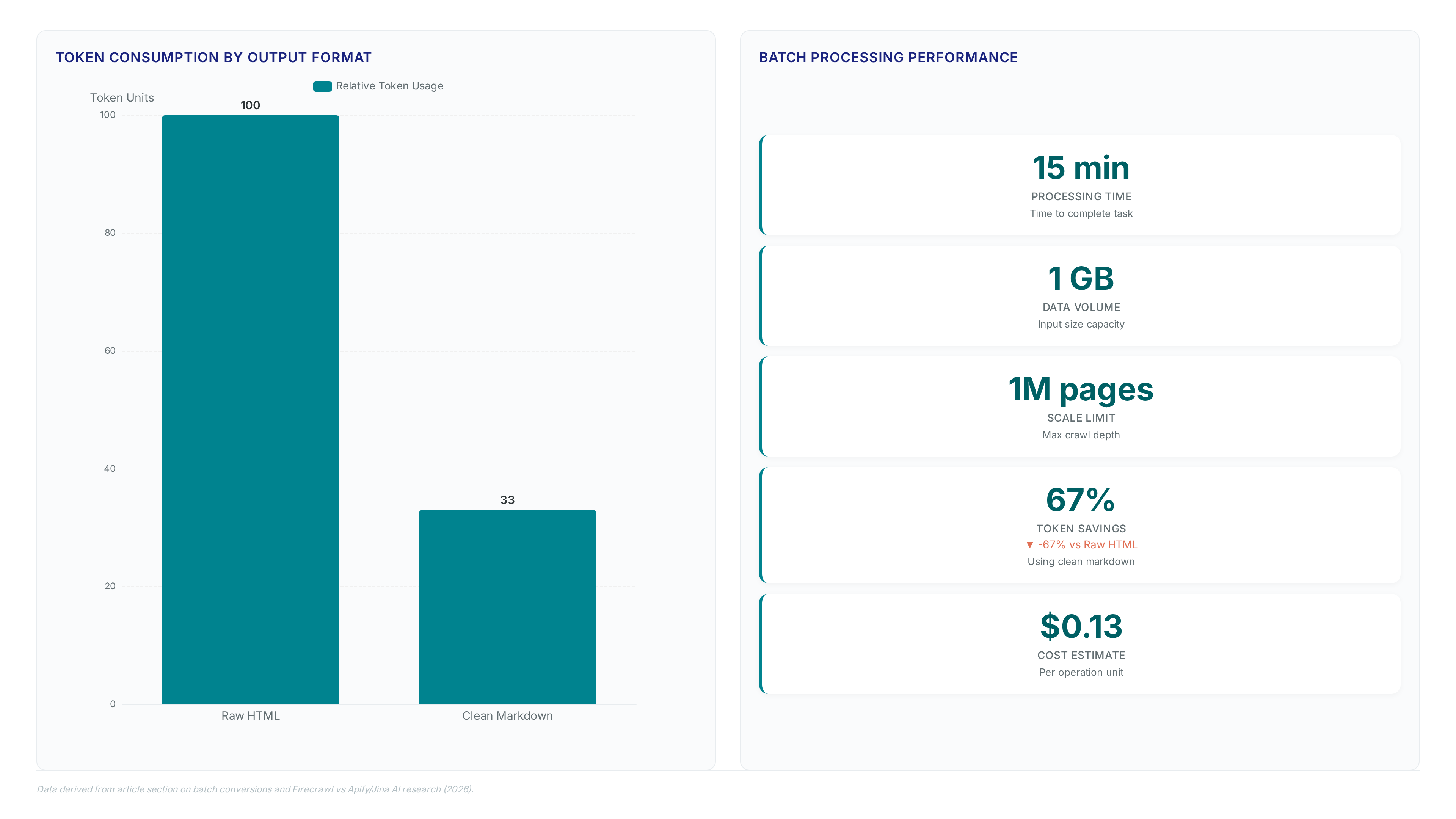
Converting raw HTML to clean markdown cuts token consumption by 67%, a necessity now that agentic traffic dominates the 2026 web environment. Architects must abandon human-centric HTML scraping. Machine-optimized markdown is the only viable path for efficient RAG pipelines and manageable LLM context windows. CSS and JavaScript are noise for the algorithms reading the web. Content purification is a fundamental requirement, not an optimization.
This article dissects the operational shift to serve agentic traffic. We move beyond simple scraping to intelligent extraction. First, we examine the critical role of LLM-ready markdown in reducing embedding costs and improving retrieval accuracy within vector stores. Traditional scrapers return bloated code. Modern tools must strip navigation, ads, and cookie banners to isolate core semantic value.
You will learn to implement domain-restricted crawls that respect robots. Txt while delivering precise token counts via cl100k_base encoding. Developers can build systems that feed models exactly what they need. This avoids the waste of processing irrelevant boilerplate.
The Role of LLM-Ready Markdown in Modern RAG Pipelines
A heading consumes just 3 tokens in clean markdown yet demands 12 to 15 tokens when buried in raw HTML tags. Stripping navigation menus and advertisements optimizes token efficiency for RAG pipelines by removing digital clutter. Converting noisy HTML into clean text reduces consumption by 67% on average compared to raw HTML. The cl100k_base encoding standard provides accurate budgeting metrics for embedding models. Tools like the ambitious_door/web-to-markdown Actor automate this workflow by preserving document structure while discarding boilerplate code.
Aggressive stripping sometimes removes contextual metadata needed for complex reasoning tasks. Operators must balance minimalism with the semantic richness required for high-fidelity retrieval. Raw HTML preserves every DOM node but inflates costs notably. Markdown sacrifices some fidelity to gain speed.
Enterium recommends validating output against specific model context windows before full deployment. The token count difference directly impacts operational budgets at scale. Ignoring this variance leads to unnecessary expenditure on irrelevant markup.
Deploying Markdown Extraction in RAG Pipelines
RAG pipelines ingest raw HTML into vector stores, yet agentic traffic now demands machine-optimized formats over noisy markup. By 2027, 75% of organizations will use LLMs for customer service, forcing architects to strip CSS and JavaScript that confuse embedding models. The ambitious_door/web-to-markdown Actor transforms clean HTML into structured markdown while preserving headings and code blocks. This process respects robots. Txt via Crawlee autoscaling to maintain reasonable request rates during extraction.
Selection between markdown and plain text depends on structural requirements. Markdown retains the semantic hierarchy necessary for chunking data. Plain text loses document outline context entirely. With a significant share of users using LLMs daily, the volume of machine-read content requires strict token discipline. Plain text output sacrifices navigational cues that aid retrieval accuracy in complex queries.
Metadata retention presents a constraint; aggressive stripping can remove attribution required for citation. Enterium recommends configuring includeMetadata flags to balance brevity with provenance tracking. Failure to preserve these links degrades the trustworthiness of generated answers in production systems.
Markdown Versus Raw HTML for AI Context Windows
Semantic structure survives in markdown while raw HTML injects noisy tags that inflate context window costs. Format selection determines retrieval accuracy and inference latency. Raw HTML forces models to parse tag soup, whereas structured markdown delivers clean headings and lists directly to the vector store. Operators using tools like Firecrawl eliminate parsing overhead, allowing the model to focus on reasoning rather than tag stripping. Plain text output remains viable for simple keyword matching where hierarchy is irrelevant.
Gartner predicted traditional search engine volume would drop by 25% by 2027 due to AI chatbots, making token efficiency a primary economic constraint. Some architects argue for plain text to maximize density, yet this approach sacrifices the semantic hierarchy required for complex chunking strategies. The cl100k_base encoding standard highlights how much wasted capacity exists in unoptimized HTML streams. Markdown offers the necessary balance of compression and structure for modern RAG systems. Enterium recommends sticking to markdown unless the downstream application strictly requires unstructured strings.
Inside the Architecture of Web-to-Markdown Conversion
How Crawlee and BeautifulSoup Strip HTML Chrome
Crawlee manages the URL queue and deduplication while BeautifulSoup parses the DOM to remove navigation chrome. The workflow executes four distinct phases. First, the system handles rate limiting and robots. Txt compliance automatically. Second, curated selectors strip sidebars and cookie banners before parsing begins. Third, the engine transforms clean HTML into structured text, preserving only headings and code blocks. Finally, the pipeline calculates token usage using cl100k_base encoding to precision-budget LLM context windows.
| Phase | Component | Function |
|---|---|---|
| Crawl | Crawlee | Queue management and autoscaling |
| Clean | BeautifulSoup | Boilerplate and ad removal |
| Convert | Internal Logic | HTML to markdown transformation |
| Count | tiktoken | Token estimation for budgeting |
Conversion relies on specific encoding standards to predict costs accurately. A single heading might consume 12-15 tokens in raw markup but only 3 tokens in the final output. This efficiency drives adoption as organizations scale their retrieval pipelines. Users can configure urlPattern filters to exclude binary files during the scrape. The process respects target server load through built-in autoscaling features.
However, aggressive cleaning risks removing semantic context required for complex reasoning tasks. Operators must verify that curated selectors do not discard nested data tables necessary for analysis. The trade-off is between maximum token savings and preserving deep structural relationships within the content. Precise configuration of the excludePattern parameter prevents accidental data loss. Enterium recommends testing selector coverage against diverse page layouts before full deployment.
Generating Token Counts with cl100k_base Encoding
Every page output includes a token_count integer calculated via tiktoken using cl100k_base encoding. This specific metric prevents context window overruns that occur when raw HTML inflates token usage beyond model limits. The generated dataset consistently provides six fields: url, title, content, token_count, content_length, and meta_description. Operators relying on token-based billing models find this precision necessary for forecasting expenses, as costs vary directly with content length.
Empty content outputs frequently stem from aggressive cleaning selectors that strip the main tag along with navigation chrome. Adjusting fallback logic to prioritize or tags resolves these voids without reintroducing boilerplate noise. Unlike fixed credit systems, variable pricing models make accurate token prediction a financial necessity rather than just a technical constraint. The ambitious_door/web-to-markdown Actor implements this counting step after converting clean HTML to structured markdown. This sequence ensures the token_count reflects the final payload rather than the source markup. Ignoring this verification step risks silent failures where vector stores ingest empty strings, wasting compute cycles on null embeddings. Precise budgeting requires knowing exactly how many tokens each page consumes before ingestion into the retrieval pipeline.
Validating OpenAPI Specifications and Robots Compliance
The OpenAPI Specification defines machine-readable API specs so GPTs consume data sources directly. Crawlers must respect robots. Txt rules or risk IP bans during high-volume extraction phases. Operators validate conversion integrity through a strict four-step checklist ensuring compliance and structural fidelity.
- Verify OpenAPI definitions expose correct schema types for downstream AI agents.
- Confirm Crawlee autoscaling adheres to target site rate limits automatically.
- Inspect logs for skipped pages triggering on empty content or policy blocks.
- Audit output token_count fields against expected cl100k_base baselines.
| Validation Target | Failure Mode | Operational Consequence |
|---|---|---|
| API Schema | Missing types | Agent hallucination on field usage |
| Crawl Policy | Ignored rules | Permanent IP blacklisting by edge |
| Content Filter | Over-aggressive clean | Loss of critical data context |
| Token Meter | Encoding mismatch | Context window overflow errors |
Skipped pages frequently indicate overly aggressive cleaning selectors stripping main content tags alongside navigation chrome. The cost of ignoring robots. Txt compliance is measurable immediate blocking rather than gradual throttling by defensive infrastructure. Enterium recommends pinning crawler versions to prevent silent behavior drifts that break RAG pipeline consistency over time.
Executing Batch Conversions and Path-Based Crawling Strategies
Configuring Path Prefixes and Domain Constraints for Crawling
Leaving the pathPrefix string parameter empty captures everything, while defining a value like /tutorial/ restricts extraction to specific directory trees. Teams building documentation datasets frequently combine this setting with crawlSameDomain set to true, a pairing that stops the crawler from wandering into external vendor links or ad networks. This setup keeps the queue focused on the technical content instead of diluting the dataset with unrelated third-party pages. Unlike single-page extractors such as Jina AI Reader, which lack native multi-page logic, this method handles deep site structures systematically. A drawback is that overly broad prefixes can still capture unnecessary navigation layers if the target site lacks clean URL hierarchies.
| Parameter | Default | Scope Effect |
|---|---|---|
| pathPrefix | "" |
Filters by URL path string |
| crawlSameDomain | true |
Blocks cross-domain redirects |
Badly configured prefixes waste tokens by feeding low-value index pages into the RAG pipeline. Competitors like Firecrawl specialize in LLM-ready output, yet manual prefix tuning remains necessary for legacy sites with flat architectures. Failure to constrain the domain boundary risks polluting the vector store with competitor data or login portals found in footer links. Retrieval accuracy in downstream queries depends directly on precise scope definition.
Implementing Batch URL Lists Versus Single Page startUrl Conversion
Assigning startUrl with maxPages limited to 1 forces single-page extraction, whereas populating the urls array enables targeted batch processing of specific addresses. This configuration choice dictates whether the crawler respects domain boundaries or executes a precise list fetch. Intercom utilized similar scraping logic to convert knowledge bases into clean Markdown for AI training, completing the task in under 15 minutes. Operators seeking immediate token efficiency without additional parsing overhead should prefer native Markdown outputs over raw HTML alternatives. The urls parameter accepts explicit addresses like [example.com](https://example.com/page-1,) ensuring the engine skips queue management for unrelated paths.
| Parameter | Use Case | Constraint |
|---|---|---|
| startUrl | Single page or full site crawl | Requires maxPages limit |
| urls | Batch conversion of specific assets | Ignores pathPrefix rules |
| maxPages | Controls total output volume | Defaults to 50 if unset |
Setup speed often conflicts with crawl logic requirements. Tools like Jina AI offer zero-setup single URL conversion but lack native multi-page crawling capabilities without custom code. Users attempting broad documentation coverage with single-page tools face significant development overhead when stitching results together manually. Batch lists eliminate this friction by defining the exact scope upfront, though they require manual URL enumeration. The limitation of the urls approach is its inability to dynamically discover new content, unlike a startUrl configuration that can traverse linked pages within a pathPrefix. Enterium recommends the batch method for static FAQ archives where content velocity is low and page addresses are known. Operators must toggle includeMetadata to true to capture token_count and meta_description, fields necessary for budgeting context windows before LLM ingestion. The choice between startUrl for deep crawls and urls arrays for batch jobs dictates whether domain constraints apply.
Single-page extraction suits immediate queries, whereas full site crawls require pathPrefix filters to avoid irrelevant boilerplate. Firecrawl delivers native markdown, unlike tools requiring post-process parsing that inflates compute costs. Strict domain locking prevents data leakage but may omit cited sources necessary for complete RAG context. Enterium recommends validating the meta_description field early, as missing values often indicate aggressive cleaning selectors stripping vital semantic signals.
Evaluating Web-to-Markdown Tools Against Specialized Scrapers
Defining the Pay-Per-Event Pricing Model for Markdown Conversion
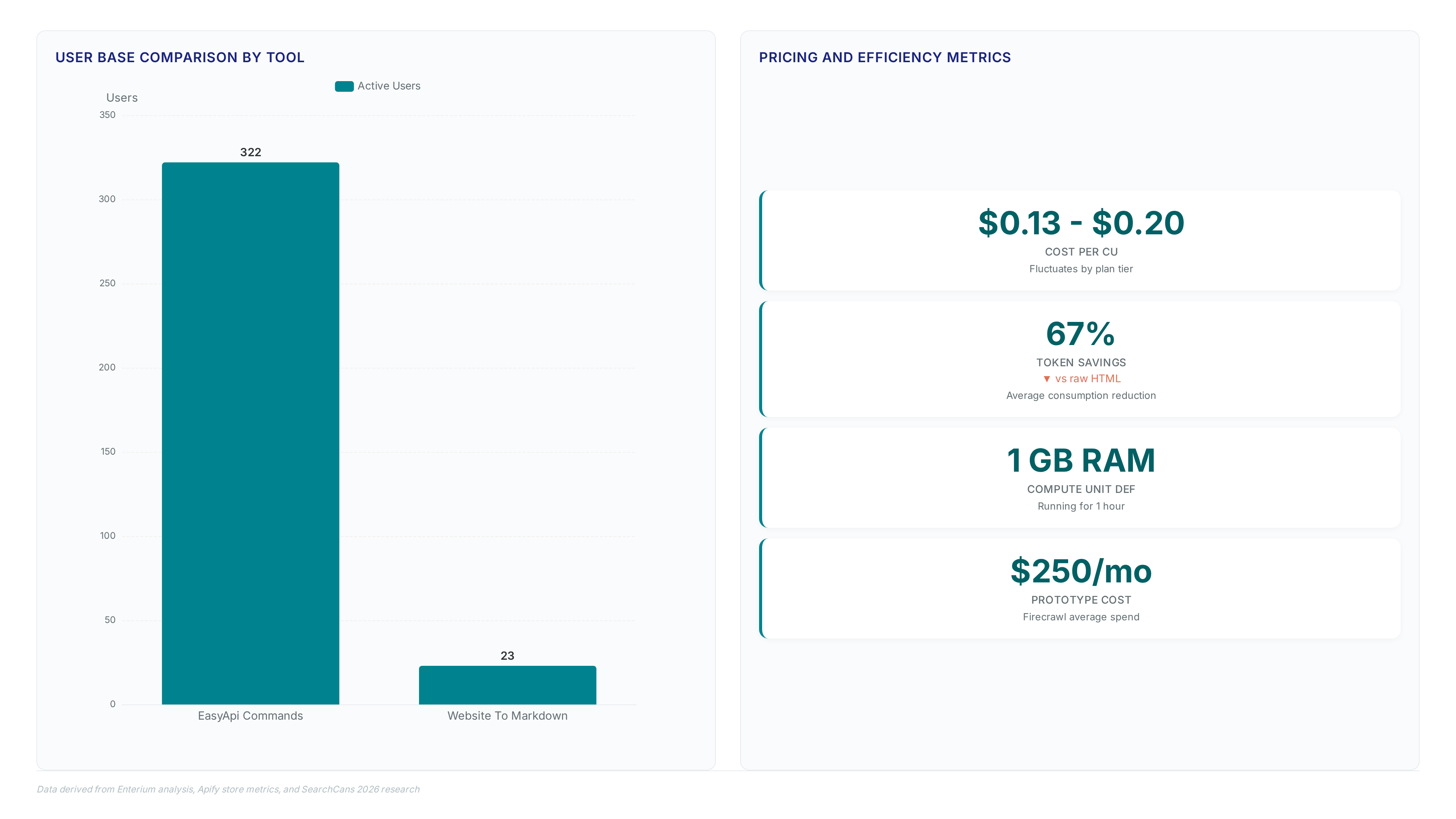
Billing occurs only when a page successfully converts to markdown, skipping charges for empty results or failed fetches. This event-driven structure differs sharply from compute-hour models where runtime inefficiencies inflate costs regardless of output quality. Operators pay strictly for valid markdown, eliminating waste on skipped URLs. Apify's broader framework relies on Compute Units, where 1 CU equals 1 GB of RAM running for 1 hour. Rates fluctuate between $0.13/CU and $0.20/CU depending on the selected plan tier.
Enterium analysis suggests that high user counts correlate with quicker resolution of edge-case parsing errors in complex DOM structures. Relying solely on popularity ignores the specific needs of competitor analysis where specialized, lower-volume tools might offer tailored selectors. The broader market includes over ten alternative Actors, yet fragmentation remains high as developers seek site-wide operations without custom coding. A distinct constraint exists between the stability of a widely used Actor and the potential for rapid, personalized support in smaller projects. Operators must weigh the risk of unmaintained code against the benefit of community-sourced bug fixes found in larger installations.
Compliance Risks: Robots.
Meanwhile, enterium advises that network architects treat default compliance settings as a baseline rather than a legal shield. Ignoring specific domain restrictions can lead to cease-and-desist orders regardless of the tool's configuration. Operators must manually verify permissions before deploying crawlers at scale.
About
Hannah Brooks, Marketing Operations Lead at Enterium, specializes in auditing AI content tooling and engineering scalable workflows. Her daily work involves connecting disparate automation tools to ensure clean data flows into LLM pipelines, making her uniquely qualified to evaluate web-to-markdown converters. In this article, she examines how stripping navigation and boilerplate from webpages directly impacts RAG efficiency and embedding budgets. At Enterium, a brand dedicated to documenting vendor-neutral content methodologies for B2B teams, Hannah focuses on the practical integration of tools rather than hype. She tests these systems against real-world governance and ROI metrics, ensuring that the content feeding enterprise AI models is precise and actionable. This piece reflects her pragmatic approach to solving the specific "job-to-be-done": transforming noisy web traffic into structured, token-optimized context that technical marketers can trust for production-grade AI applications.
Conclusion
Scaling web extraction for RAG pipelines breaks not on technical throughput, but on the compounding legal liability of automated access. As organizations shift from pilot projects to enterprise-wide deployment, the cost of ignoring specific domain restrictions escalates from minor IP bans to cease-and-desist litigation that technical defaults cannot prevent. While tools like Crawlee offer autoscaling, they provide no legal shield against Terms of Service violations, creating a dangerous gap between what code can execute and what contracts permit. The operational burden now shifts toward continuous governance rather than mere data volume.
Architects must mandate a legal verification layer before any crawler deployment by Q2 2026, treating manual permission audits as a non-negotiable gatekeeper for production workloads. Relying on community-maintained actors without validating their compliance logic against your specific target domains invites unacceptable risk. Do not assume that respecting robots. Txt satisfies corporate legal standards, as contractual obligations often exceed these technical baselines.
Start by auditing your top ten target domains this week to cross-reference their current Terms of Service against your existing scraping configurations. Identify any discrepancies where your technical allowance exceeds your legal permission, and immediately disable actors targeting those specific endpoints until counsel approves the strategy.
Frequently Asked Questions
Converting noisy HTML into clean markdown reduces token consumption by 67 percent on average. This significant reduction removes digital clutter like navigation menus and advertisements, optimizing token efficiency specifically for modern RAG pipelines.
By 2026, 75 percent of organizations will use LLMs for customer service, requiring clean data formats. Architects must strip CSS and JavaScript noise to ensure embedding models receive machine-optimized content rather than confusing raw markup.
Plain text output loses document outline context entirely, sacrificing the semantic hierarchy needed for accurate data chunking. With 34 percent of users utilizing LLMs daily, retaining structural cues in markdown is vital for retrieval accuracy.
Traditional search engine volume would drop by 25 percent by 2026 due to the rise of AI chatbots. This shift makes token efficiency a primary economic constraint, forcing developers to prioritize clean content extraction methods.
The cl100k_base encoding standard provides accurate budgeting metrics for embedding models by calculating precise token counts. This allows operators to plan embedding budgets effectively while converting raw HTML into clean, structured markdown content.