Content automation cuts drafting from hours to minutes
AI cuts content production from hours of manual work to mere minutes by automating repetitive ideation and drafting tasks. You will learn how modern AI writing assistants eliminate the blank page problem, how raw data transforms into personalized assets, and why automated workflows outperform manual creation methods.
Marketing teams face relentless pressure to fill every channel with fresh content. Artificial intelligence provides the only viable path to manage this demand without burning out staff. These tools analyze industry data to spot trending topics and content gaps that competitors miss. Advanced systems like the Progress Sitefinity CMS integrate directly into editors, removing the need for external prompt engineering or clumsy copy-paste workflows.
Readers will discover specific strategies for using content ideation engines to find frequently asked questions and gaps in existing coverage. We contrast these automated approaches with traditional manual workflows, highlighting how AI-driven automation allows teams to focus on strategic and creative output. By understanding these mechanisms, organizations can deploy technology that handles the heavy lifting of draft generation and tone consistency while humans retain control over the final narrative.
The Role of AI Writing Assistants in Modern Content Operations
Defining AI Content Creation and the Modern Writing Assistant
AI content creation applies algorithmic generation to scale output volume while maintaining editorial standards. An AI writing assistant goes beyond simple text completion; it automates repetitive drafting and editing tasks. These tools do not replace human creators. They handle the time-consuming production work so marketing teams can prioritize strategic oversight and authentic voice. Operational models now clearly separate machine-driven production from human judgment.
| Feature | Manual Workflow | Automated Assistant |
|---|---|---|
| Drafting Speed | Low | High |
| Editing Consistency | Variable | Standardized |
| Strategic Focus | Diluted | Preserved |
Adopting a unified platform ensures that automation serves strategy rather than dictating it. Enterium enables this balance by consolidating generation and governance into a single operational layer.
Applying AI for Idea Generation and Simplified Editing Workflows
AI content personalization ingests raw user data to output draft-ready copy and visuals within minutes, a pace impossible for manual teams. The mechanism relies on multi-modal pipelines that change unstructured inputs into structured assets without intermediate formatting steps. Acceleration enables rapid iteration. However, poor input signals generate irrelevant personalization layers. Operators must implement strict input validation before the generation phase to prevent brand misalignment.
Flexible content personalization differs by reorganizing page widgets in real-time based on live reader behavior rather than static segments. Enterprise teams apply performance marketing suites to receive recommendations on messaging clarity during the drafting phase, preventing extensive post-creation revisions messaging clarity. Deploying such flexible systems introduces latency risks if the underlying decision engine lacks optimized caching strategies. Network architects must balance personalization depth against page load thresholds to maintain user experience. This approach removes the copy-paste friction found in disjointed toolchains.
| Feature | Static Personalization | Flexible Personalization |
|---|---|---|
| Trigger | Pre-set Segment | Real-time Behavior |
| Update Frequency | Campaign Duration | Per Session |
| Complexity | Low | High |
Embedding intelligence within the editor reduces context switching errors. Teams adopting a lean workflow with a single brand pack before scaling see higher consistency scores. Enterium solutions enable this by unifying ideation and editing into a single governed environment.
Static vs Flexible Personalization: Automating Reader Experiences
Static content delivers identical assets to all users, whereas flexible personalization restructures page elements in real-time based on reader behavior. This shift moves operations from manual scheduling to automated systems that adjust posting times and formats instantly. Data-driven marketers now apply AI to analyze performance in real-time and enable this adaptive delivery model. Behavioral signals trigger specific content variations rather than pre-set segments.
Full automation carries a potential loss of narrative cohesion if human oversight remains absent from the loop. Teams must balance algorithmic efficiency with strategic direction to maintain brand voice consistency. This approach captures efficiency gains without sacrificing editorial control. Teams transition from creating every asset to governing the rules that generate them. AI-driven tools can automate suggestions for posting times, formats, and topics, removing multiple manual planning steps. Organizations adopting this hybrid model report significant reductions in production timelines. The next step is auditing current workflows to identify which static elements can accept flexible replacement rules.
How Neural Network Models Change Raw Data into Personalized Assets
The Two-Step Generation Flow for Raw Data Conversion
Raw inputs become draft-ready assets through a constrained initial pass followed by refinement. Teams adopting a lean approach begin with one template brief and a single brand pack to standardize output before scaling volume. This methodology prevents early over-engineering while establishing the structural integrity required for automation.
- Foundation: Ingest raw data into a fixed template to generate initial copy and visuals.
- Refinement: Apply a simple checklist to validate tone and factual accuracy before publication.
| Phase | Input Constraint | Output State |
|---|---|---|
| Step 1 | One template brief | Draft-ready copy |
| Step 2 | Simple checklist | Validated asset |
Artificial intelligence turns raw data into draft-ready copy within minutes, freeing marketers to concentrate on strategy rather than formatting. The limitation of this flow is its reliance on rigid initial constraints. Without a set brand pack, the generation variance increases notably, requiring more manual edits later. Most operators skip complex dashboards initially because the overhead outweighs the benefit when volume is low. Scaling strategies recommend expanding to advanced analytics only after the base workflow stabilizes.
Eliminating Prompt Engineering with Integrated CMS Editors
Embedded generation logic within the rich text interface removes the need for prompt engineering. This architecture eliminates the copy-paste friction inherent in using external LLM wrappers for routine drafting tasks. Operators gain capabilities that surface optimization guidance for structure and clarity during the editing phase rather than after publication. The Progress Sitefinity CMS rich text editor exemplifies this by integrating these features natively, removing the need to switch contexts between a chat interface and the content repository.
Teams adopting this approach avoid the latency of external toolchains while maintaining strict brand governance. Small budget teams use such embedded tools to turn raw data into draft-ready copy within minutes, competing effectively with larger entities. The shift moves optimization upstream, reducing the downstream costs associated with fixing misaligned content post-publication.
| Workflow Stage | External Toolchain | Integrated CMS Editor |
|---|---|---|
| Ideation | Manual prompt entry | Context-aware suggestions |
| Drafting | Copy-paste required | Native generation |
| Optimization | Post-hoc review | Real-time guidance |
External workflows often lose repository context during the generation window. External models cannot see unpublished drafts or specific persona rules set in the CMS without complex API bridging. Integrated systems access this metadata instantly, ensuring audience alignment remains consistent with set parameters. Deploying content platforms that embed intelligence directly into the creation workflow maintains operational velocity and ensures messaging clarity checks occur before an asset reaches the review queue. The result is a reduction in editorial cycles and a measurable increase in output consistency.
Weekly Review Cycles to Fix Low Content Engagement
Systematic identification and resolution of low content engagement requires performance data rather than intuition. This mechanism forces a binary decision on every asset: keep, fix, or cut. High-volume publishers implement this cadence to prevent library stagnation and maintain aggressive repurposing.
- Audit: Scan analytics for assets with declining traffic velocity.
- Diagnose: Determine if the core premise is outdated or the execution is weak.
- Execute: Apply optimization workflows to refresh high-potential drafts or archive low-value noise.
| Action | Trigger Condition | Operational Outcome |
|---|---|---|
| Keep | Metrics exceed baseline | Maintain current distribution |
| Fix | Strong topic, weak format | Apply refresh logic |
| Cut | Irrelevant or duplicate | Remove from index |
Skipping this loop creates accumulated technical debt in the form of irrelevant pages that dilute domain authority. Unlike manual audits, this automated filter ensures resources target only viable content vectors. Solutions can embed these decision gates directly into the publishing pipeline to enforce discipline. Without this constraint, teams risk scaling noise alongside signal. Successful strategies incorporate aggressive repurposing and batch processing, using a weekly review cycle to decide what content to keep, fix, or cut based on performance data.
Comparing AI-Driven Automation Against Manual Content Creation Workflows
Defining the Hybrid Workflow: AI Assistance vs Manual Creation
A hybrid workflow assigns repetitive generation to machines while reserving strategic direction for humans. ChatGPT reached 100 million users quicker than any prior application, signaling rapid adoption of these assistance models. Teams use this scale to focus on creativity and emotional connection rather than draft production. The distinction lies in execution: manual methods involve significant time investment per asset, whereas automation platforms enable batch processing and two-step generation flows for lean operations.
| Dimension | Manual Creation | AI-Assisted Workflow |
|---|---|---|
| Ideation Source | Human brainstorming only | Data-driven gap analysis |
| Editing Latency | Post-draft review | Real-time inline suggestions |
| Personalization | Static segments | Flexible page reorganization |
| Refresh Cycle | Quarterly audits | Continuous algorithmic scanning |
Relying solely on automation risks generic output, yet ignoring it forfeits efficiency. The operational cost of manual creation can be prohibitive compared to simplified approaches that mitigate the financial burden of scaling volume. This approach ensures that content structure and messaging clarity remain anchored in human strategy while machines handle volume. The result is a system where technology acts as a force multiplier rather than a replacement for editorial judgment.
Executing Routine Automation: Formatting and Style Consistency
Automating style guide enforcement eliminates manual proofreading bottlenecks that slow down content teams. Routine tasks like formatting content or checking style guide consistency are identified as prime candidates for automation to free up mental space for strategic work. Vendors like Progress have integrated platforms with large language models like Azure OpenAI to embed these checks directly within the editing environment. This integration removes the need for external copy-pasting, reducing error rates during the drafting phase.
Technical workflows include a weekly review cycle to keep, fix, or cut content, creating a data-driven feedback loop that refines future AI generation parameters. This approach ensures that style consistency is maintained across thousands of assets without proportional labor increases. Scaling content creation with AI tools allows teams to turn raw data into draft-ready copy, visuals, and insights within minutes, a pace impossible for small budgets to achieve manually. Rigid automation may miss detailed brand voice shifts if not periodically audited by human editors. Organizations must balance speed with editorial oversight to prevent generic output.
Enterium recommends configuring real-time validation rules within your CMS to enforce brand guidelines before publication. This shifts the operator role from formatting mechanics to quality assurance.
Speed and Scale: Manual Hours Versus AI Minutes in Production
Manual workflows consume hours per asset, whereas AI-driven approaches compress production to minutes for draft-ready copy. This velocity shift allows teams to turn raw data into draft-ready copy, visuals, and insights within minutes, a pace impossible for small budgets to achieve manually. Where traditional methods require hours of manual work per asset, AI reduces production time to minutes by automating ideation and enabling flexible personalization. This compression of timelines directly reduces the labor cost per asset, fundamentally altering the economics of content operations.
Seventy-one percent of organizations now regularly use generative AI in at least one business function, with marketing cited as a primary application. The limitation lies in output variance; effective scaling strategies recommend starting with a "two-step generation flow" before expanding to complex dashboards as volume grows. Operators must balance this speed against the need for human strategic oversight to maintain narrative coherence. The next step is implementing a hybrid workflow that reserves human effort for high-value creative direction rather than initial drafting.
Executing a Scalable AI Content Repurposing and Refresh Strategy
Defining Aggressive Repurposing and Batch Processing Workflows
Aggressive repurposing transforms high-performing assets into multiple formats through systematic batch processing rather than isolated editing passes. This approach treats content as modular data, where performance data dictates whether an asset gets kept, fixed, or cut during a weekly review cycle. Operators group similar tasks to minimize context switching, a method distinct from simple revision because it prioritizes volume scaling alongside quality control. Teams first generate raw variations in batches, then apply human oversight to select viable candidates for distribution. This workflow reduces the cognitive load associated with constant format switching.
The constraint of this strategy is the risk of homogenized output if batch processing lacks strict stylistic guardrails. Without set parameters, bulk operations can dilute brand voice across channels. Embedding governance rules directly into the repurposing pipeline ensures automated transformations adhere to established brand guidelines before publication. Successful implementation relies on balancing automation with human oversight to maintain creativity and strategic thinking.
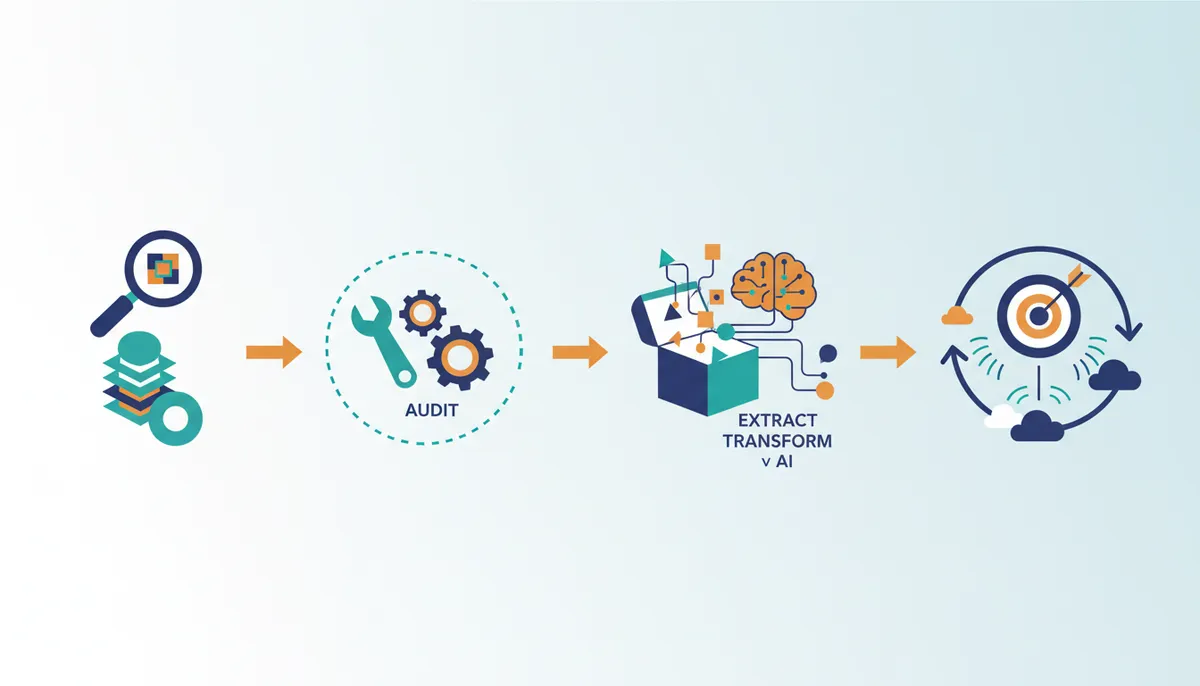
| Phase | Action | Objective |
|---|---|---|
| 1 | Batch Generation | Create multiple format variants simultaneously |
| 2 | Data Review | Decide to keep, fix, or cut based on metrics |
| 3 | Human Refinement | Apply creative oversight to selected assets |
Operators must define clear success metrics before initiating batch cycles to avoid generating irrelevant volume.
Application: Executing the Two-Step Generation Flow for Raw Data Conversion
Converting raw data into draft-ready copy requires a disciplined two-step generation flow rather than immediate complex dashboarding. Teams first batch process unstructured inputs to produce initial variations, then apply human oversight to refine outputs before publication. This architecture allows operators to turn raw data into draft-ready copy, visuals, and insights efficiently. The operational mechanism separates volume from quality control. Step one generates multiple format variations from a single source asset using batch processing logic. Step two involves a weekly assessment cycle where editors decide what content to keep, fix, or cut based on performance metrics rather than intuition.
| Workflow Stage | Action | Operator Goal |
|---|---|---|
| Generation | Batch create draft variations | Maximize output volume |
| Evaluation | Weekly data review | Identify high-performers |
| Refinement | Human edit and polish | Ensure brand alignment |
A substantial limitation exists in assuming automation replaces editorial judgment; the balance between automation and human oversight allows teams to focus on creativity and strategic thinking while machines handle repetitive generation. Without strict quality gates, volume increases noise rather than value. Implementing this two-step flow helps scale production while maintaining strict editorial standards. The immediate next step is configuring a single template brief to test batch generation before expanding to full dashboard complexity.
Checklist for Validating Start Lean Methodology Before Dashboard Expansion
Teams must validate a single template brief and brand pack before attempting complex dashboard integrations. This methodology helps avoid the high costs of over-engineered custom solutions. The standard best practice involves a two-step generation flow where operators generate initial drafts then refine them. This approach ensures teams master basic automation before scaling volume.
| Phase | Validation Requirement | Risk of Skipping |
|---|---|---|
| Template | Single brief set | Inconsistent tone across assets |
| Brand Pack | One voice profile active | Hallucinated style guidelines |
| Flow | Two-step generation | Unmanageable revision loops |
Skipping this validation often results in dashboard complexity that obscures rather than clarifies content performance. Operators frequently build elaborate monitoring tools before establishing a reliable weekly consultation cycle to decide what to keep, fix, or cut. Without a stable foundation, scaling efforts fail because the underlying data quality remains unverified. Completing this checklist before integrating advanced analytics suites is necessary. The limitation here is strict: do not add new variables until the base workflow produces consistent output. Mastery of the simple checklist prevents the need for costly remediation later in the deployment lifecycle.
About
Arjun Patel is an Applied LLM Engineer who specializes in benchmarking LLM providers and RAG architectures for high-volume content workloads. His daily work involves rigorous, vendor-neutral evaluation of inference economics, latency, and output quality across substantial models. This technical background makes him uniquely qualified to dissect how teams can scale content creation without compromising strategic depth. At Enterium, a B2B publication dedicated to AI content automation methodologies, Arjun applies these engineering principles to build reproducible content pipelines. While the broader market offers various point solutions for generation, Enterium focuses on the underlying architecture required to operationalize AI at scale. Arjun's insights bridge the gap between theoretical model capabilities and the practical realities of production environments. By grounding content strategy in hard data and system design, he helps marketing operations teams move beyond simple prompting to reliable, automated workflows that maintain human oversight where it matters most.
Conclusion
Scaling content operations breaks when teams prioritize dashboard complexity over fundamental consistency. The operational cost of skipping validation is wasted time, but the accumulation of unusable assets that require total re-generation is worse. As the industry shifts toward content repurposing to maximize asset lifecycles in 2026, your ability to remix existing work depends entirely on the initial structural integrity of your templates. If your base templates produce inconsistent tones, any attempt at scale will simply amplify noise rather than value.
You must enforce a strict moratorium on advanced analytics integration until your single-brief workflow yields predictable results. Do not expand your technical stack while your core output remains unstable. This approach ensures that human oversight focuses on strategic refinement rather than fixing basic hallucinations. The window to establish this discipline is before your next production cycle begins, not after you have generated thousands of flawed drafts.
Start this week by auditing your current template brief against your active brand voice profile to identify specific divergence points. Configure a single test batch using only this refined brief and mandate a two-step generation flow for all operators. This concrete action isolates variables and proves your workflow can sustain quality before you introduce the complexity of multi-channel distribution or advanced monitoring suites.
Frequently Asked Questions
AI reduces production time from hours of manual work to mere minutes per asset. This speed allows teams to transform raw data into draft-ready copy and visuals within minutes, a pace impossible for small budgets to achieve manually minutes.
Effective strategies recommend starting with a two-step generation flow before expanding to complex dashboards. This approach allows teams to turn raw data into draft-ready copy, visuals, and insights within minutes, ensuring volume grows without sacrificing initial quality control minutes.
AI-driven content calendars can automate suggestions for posting times, formats, and even topics. By removing multiple manual planning steps, these tools help teams turn raw data into draft-ready copy, visuals, and insights within minutes rather than hours minutes.
AI analyzes industry data to spot trending topics and content gaps that competitors miss. This capability enables organizations to turn raw data into draft-ready copy, visuals, and insights within minutes, effectively eliminating the blank page problem for creators minutes.
Teams shift from hours of manual work per asset to generating drafts in mere minutes. This change allows organizations to turn raw data into draft-ready copy, visuals, and insights within minutes, freeing humans for strategic oversight minutes.
References