Enterprise AI content strategy: fix siloed data now
Adopting an Enterprise AI Content Marketing Strategy is no longer optional; it is a survival requirement. We define the strategic role of AI in dismantling organizational silos, dissect the mechanics of agentic workflows for deep personalization, and outline a phased implementation plan.
The mandate to produce high-quality content across diverse channels demands more than basic automation. Clutch's 2026 State of Content Report indicates that three-quarters of marketers have already integrated AI-powered tools into their standard processes to handle this scale. By ingesting disparate customer data, these systems provide the complete view necessary to eliminate wasted effort and ensure brand voice consistency.
Enterium solutions enable this transition by transforming fragmented operations into a unified content model. Successful enterprises reject the notion of technology as a mere cost-cutting lever. Instead, they align content initiatives with overarching business goals. This approach allows marketing teams to shift focus from tactical execution to strategic growth while maintaining full control over their data assets.
Defining the Strategic Role of Enterprise AI in Modern Content Operations
Enterprise AI Content Marketing as a Growth Catalyst Beyond Cost Reduction
Enterprise AI content marketing functions as a strategic growth framework unifying siloed data to drive revenue rather than merely cutting labor costs. This approach shifts organizational focus from simple efficiency gains to distinct effectiveness in audience engagement. Separating these metrics reveals that agentic solutions do more than speed up drafting; they orchestrate complex workflows where autonomous agents ingest disparate customer signals to prescribe optimal messaging strategies.
Unlike static automation tools, these systems reconcile fragmented data sources to deliver personalized experiences at scale. AI platforms function by ingesting marketing metrics to provide prescriptive insights, suggesting the best performing audience and content combinations to execute.
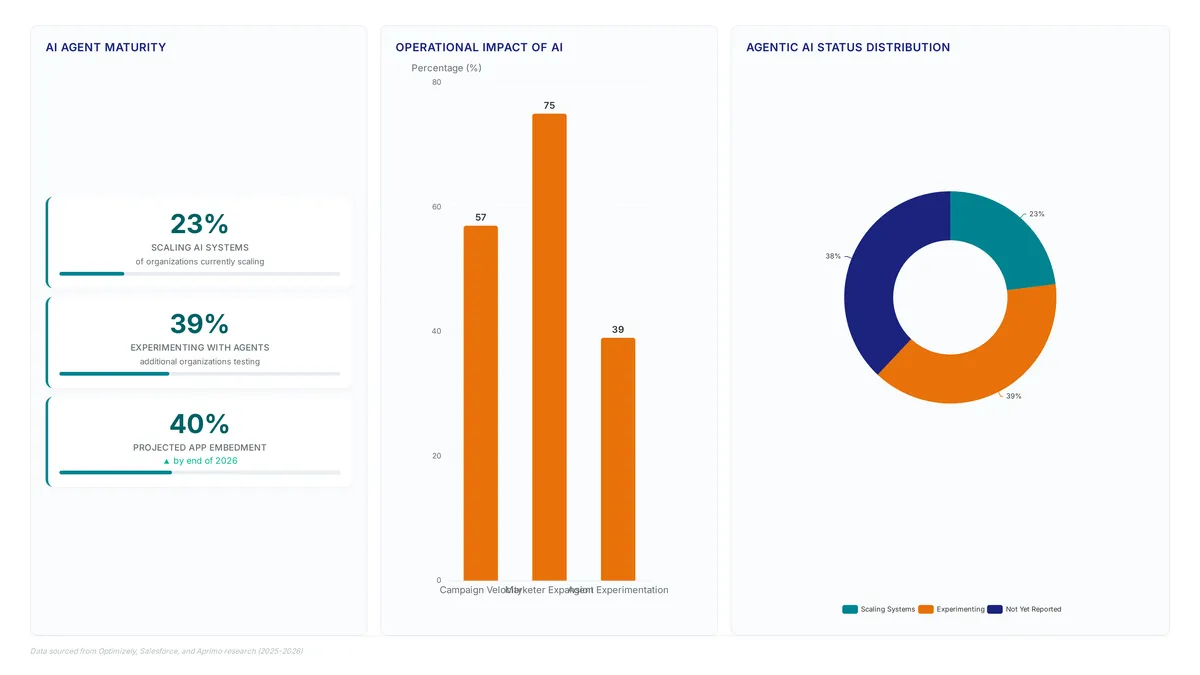
Unified workflows change fragmented output into a strategic growth engine by reconciling siloed data sources. This architecture enables teams to use AI-powered content creation as a mechanism for orchestrating autonomous agents rather than merely drafting text. Seventy-five percent of marketers have expanded the use of AI-powered tools across their standard content process, yet volume alone fails to distinguish market leaders. The critical differentiator lies in generating non-commodity content that demonstrates unique expertise instead of generic summaries.
Organizations using unified workflows via the Optimizely Content Marketing Platform (CMP) increased campaign velocity by a significant margin. This metric confirms that structural integration outperforms isolated tool usage.
True AI-enhanced strategy reconciles siloed data to drive effectiveness while basic automation merely accelerates volume without insight. The distinction centers on handling complexity; static scripts execute linear tasks, whereas agentic systems ingest disparate signals to prescribe optimal messaging paths. This architectural difference determines whether an organization produces generic summaries or non-commodity content that demonstrates unique expertise.
| Feature | Basic Automation | AI-Enhanced Strategy |
|---|---|---|
| Primary Goal | Efficiency and speed | Strategic orchestration |
| Data Handling | Linear input/output | Complete signal reconciliation |
| Output Quality | Commodity summaries | Differentiated insights |
| Governance | Post-hoc review | Embedded real-time guardrails |
Thirty-nine percent of organizations are currently experimenting with AI agents to manage these complex workflows. Traditional strategies focus on content volume, while advanced 2026 strategies focus on "content orchestration" to improve consistency and relevance across complex organizations. Without a unified approach, teams risk generating high-velocity noise that fails to convert. The shift toward "content orchestration" systems implies a reallocation of budget from pure creation to management and governance tools. The cost of ignoring this shift is a widening gap in output quality between competitors treating AI as a strategic system versus a simple productivity tool. Operators must choose between fragmenting their workflow with point solutions or adopting a unified framework that prioritizes relevance over raw count.
Mechanics of Agentic Workflows and Deep Audience Personalization
How AI Synthesizes CRM and Social Data for Persona Creation
Software aggregates CRM records, website behavior, and social interactions to identify behavioral patterns rather than assumptions. This synthesis moves persona creation from static demographics to flexible, predictive capabilities that analyze sentiment across buying stages. Manual research and basic segmentation set traditional methods, yet automated systems process these disparate signals to construct audience insights at scale impossible with human-only workflows.
| Feature | Manual Segmentation | AI-Driven Synthesis |
|---|---|---|
| Data Sources | Siloed CRM exports | Unified CRM, social, web |
| Update Frequency | Periodic reviews | Real-time feedback loops |
| Basis | Assumed demographics | Actual engagement signals |
| Scalability | Low (static groups) | High (flexible clusters) |
The technical mechanism involves ingesting unstructured social text and structured transaction logs to map emotional responses against purchase history. Flexible personalization algorithms then customize messaging for specific segments by detecting these complex pattern shifts. Data silos prevent the AI from accessing full customer contexts, a constraint that leads to fragmented persona models. Enterprises shifting investment toward content orchestration systems address this by prioritizing management governance over pure volume generation to 2026. This approach grounds personalization in verified engagement data so automated workflows drive measurable ROI.
Automating Metadata Enrichment and Variant Generation in DAM Systems
Agents within Digital Asset Management (DAM) systems execute intelligent task routing to enrich metadata and normalize taxonomy automatically. This process converts raw uploads into governed assets by adding semantic context and flagging risks before human review begins. The mechanism relies on agentic solutions that parse visual content against brand guidelines to generate channel-ready variants without manual resizing. Legacy architectures often stall this flow due to fragmented data silos that prevent unified workflow execution. Operators must prioritize content orchestration frameworks that turn every workflow into a repeatable engine rather than isolated creation events.
| Capability | Manual Workflow | Agentic DAM Workflow |
|---|---|---|
| Taxonomy | Static, human-applied tags | Flexible, context-normalized |
| Variants | Sequential resizing | Parallel generation |
| Routing | Email-based approval | Intelligent task routing |
| Risk | Post-publish audit | Pre-publish flagging |
Speed and control create tension when deploying these systems at scale.
Traditional Workflow Silos Versus AI-Driven Real-Time Feedback Loops
Manual research and basic segmentation stall campaign velocity in traditional workflows compared to automated systems. Static processes require hours of effort per asset, creating bottlenecks that prevent rapid iteration. AI-driven approaches analyze performance in real-time to identify shortcomings instantly. This capability enables immediate content adjustments, such as optimizing blog titles or adapting social media messaging based on live data. Flexible feedback loops replace linear execution to continuously refine audience targeting.
| Feature | Traditional Silos | AI-Driven Loops |
|---|---|---|
| Data Synthesis | Manual CRM exports | Unified behavioral signals |
| Adjustment Speed | Post-campaign analysis | Real-time optimization |
| Task Focus | Repetitive execution | Strategic initiatives |
Automation reduces repetitive tasks so human teams focus on strategic initiatives. The underlying mechanism ingests signals from CRM systems and social platforms to detect sentiment shifts before they impact conversion rates.
Executing a Phased Implementation Plan for Enterprise AI Adoption
Strategic Intent and Human-AI Collaboration Frameworks
Strategic intent defines AI as a growth multiplier rather than a replacement for human creativity. Success requires distinguishing efficiency from effectiveness to ensure automation serves high-impact goals. Teams must view these systems as co-creators that augment subject-matter experts. The prevailing industry insight suggests your job will not be taken by AI, but by a person who knows how to use it. This flexible demands immediate investment in Team Upskilling focused on prompt engineering and strategic oversight.
Establish clear governance policies for brand voice consistency.
- Deploy Digital Asset Management integrations for metadata enrichment.
- Train staff on interpreting AI analytics for continuous improvement.
- Audit outputs weekly to prevent generic content drift.
Inconsistent brand voice stems from unstructured metadata and lack of governance gates in generation pipelines.
- Structure Data Rigorously: Ensure data is clean, accurate, and structured with consistent metadata before agent ingestion.
- Define Disclosure Policies: Establish policies for responsible AI use and disclose AI involvement in content creation to maintain trust.
- Audit for Bias: Implement automated checks to detect algorithmic bias before publication.
The shift toward content orchestration systems indicates that success now depends on how tightly marketing holds the center rather than production volume. Without strict data governance, automated systems amplify noise, resulting in low-quality outputs that dilute brand equity.
A specific limitation exists: rigid guardrails can stifle creative variation if thresholds are set too narrowly. Operators must balance safety with flexibility to avoid sterile outputs. The cost of ignoring these protocols is measurable in lost stakeholder confidence and increased manual remediation time. Strategic oversight ensures that efficiency gains do not come at the expense of brand integrity.
Quantifying Business Value Through Rigorous AI Content ROI Measurement
Defining AI-Driven Incremental Value Attribution Models
AI-powered analytics calculate the incremental value of every marketing touchpoint and channel, discarding last-click attribution models. This shift allows enterprises to isolate the specific contribution of content assets instead of crediting only the final interaction. Predictive platforms ingest marketing metrics to offer prescriptive insights, suggesting the best performing audience and message configuration for deployment. Research indicates that companies using AI for strategic depth rather than simple cost reduction enable more than two times higher marketing-driven profitability. Implementing these models demands a structured approach to data reconciliation:
- Map business objectives to specific content KPIs before model training.
- Ingest disparate customer data to break down traditional marketing silos.
- Apply predictive analytics to forecast campaign outcomes and recommend optimal next actions.
- Audit current data pipelines for the connectivity required to support multi-touch attribution logic.
Data fidelity poses a hard constraint; without unified customer views, attribution models may misallocate credit across channels. Enterprises must address this by ensuring their underlying data architecture supports granular tracking before scaling agentic workflows. The immediate next step is auditing current data pipelines for the connectivity required to support multi-touch attribution logic.
Applying Predictive Analytics to Forecast Campaign Outcomes
Predictive analytics and prescriptive insights forecast campaign outcomes and recommend optimal next best actions. Technical implementation requires ingesting disparate marketing metrics to unify fragmented data sources. Platforms function by analyzing these inputs to suggest the best performing audience and message configurations for immediate deployment. This approach replaces reactive adjustments with proactive strategy aligned to real-time signals. This metric demonstrates how agentic systems accelerate execution beyond human-only pacing. Relying solely on speed without strategic governance risks amplifying low-quality outputs at scale. Poor input quality degrades predictive accuracy regardless of model sophistication.
| Capability | Traditional Approach | AI-Native Approach |
|---|---|---|
| Data Scope | Siloed channel reports | Unified cross-channel ingestion |
| Insight Type | Historical descriptive | Prescriptive next-action |
| Adjustment Speed | Weekly or monthly cycles | Real-time optimization |
High-velocity campaigns may drift from core messaging objectives without these controls. Teams must balance automation speed with rigorous human oversight protocols. This tension defines the maturity curve for enterprise deployments seeking sustainable growth by 2026.
Checklist for Validating AI Content Strategy Profitability
Validate profitability by confirming flexible delivery tailored in real-time based on user-specific data before scaling operations. This capability is expected to become the industry norm for high-performing enterprises. Teams must also address algorithmic bias and data privacy concerns as part of their core governance framework. Ignoring these responsibilities creates significant legal exposure and brand risk that outweighs efficiency gains. Stakeholders should verify their systems against these operational criteria:
| Validation Area | Required Capability | Risk Gap |
|---|---|---|
| Personalization | Real-time user data ingestion | Static segmentation |
| Ethics | Algorithmic bias auditing | Compliance failure |
| Governance | Data privacy enforcement | Regulatory penalty |
| Scale | Agentic workflow automation | Manual bottlenecks |
Production environments often fail when governance lags behind creation speed. The cost of retrofitting privacy controls after deployment exceeds initial setup investment. Enterium recommends integrating these checks into the content orchestration phase rather than treating them as post-launch fixes. This approach ensures sustainable growth without compromising ethical standards or data security protocols.
About
Arjun Patel is an Applied LLM Engineer who specializes in benchmarking large language models and RAG architectures for enterprise content workloads. His daily work involves rigorous, vendor-neutral evaluation of inference economics, latency, and output quality across substantial providers. This technical expertise directly informs the article's thesis on mastering Enterprise AI Content Marketing Strategy, moving beyond theoretical hype to reproducible pipeline architecture. At Enterium, a B2B publication and methodology brand, Arjun documents how modern teams build scalable content operations using LLMs. Unlike generic AI tools that promise magic, Enterium focuses on the practical mechanics of the research → generate → QA → publish lifecycle with humans on the gates. Arjun's analysis helps marketing-ops leaders and content engineers understand the specific trade-offs required to drive measurable ROI and simplify workflows. By grounding strategy in hard data rather than marketing fluff, he connects the abstract potential of AI to the concrete reality of shipping high-quality content at scale.
Conclusion
Scaling AI agents beyond pilot programs reveals a critical fracture point: governance structures rarely keep pace with automated velocity. When content model standards lag behind generation speed, organizations face compounding operational debt rather than linear efficiency gains. The industry shift toward treating AI as core infrastructure demands that teams stop viewing ethics and privacy as compliance checkboxes and start treating them as primary architectural constraints. Without this fundamental reorientation, the cost of retrofitting controls into live agentic workflows will erode any initial productivity benefits.
Enterium advises enterprises to halt broad agent deployment until real-time bias auditing and data ingestion protocols are hardcoded into the orchestration layer. This integration must occur before any scaling attempt in the coming fiscal year to prevent systemic drift from brand objectives. The window for reactive fixes is closing as regulatory scrutiny intensifies around algorithmic decision-making. Teams should prioritize building these guardrails now rather than risking costly post-deployment remediation.
Start this week by mapping your current approval workflows against the required capability matrix for real-time user data ingestion. Identify exactly where manual bottlenecks exist in your personalization logic and replace them with automated governance checks. This specific audit creates the foundation for sustainable scale without compromising security or ethical.
Frequently Asked Questions
Focusing solely on cost reduction creates a dangerous capability gap against strategic competitors.
A maturity gap exists between tool access and operational scaling across many large enterprises.
Most marketing teams have already integrated AI tools into their daily workflows to manage scale.
Remaining in experimentation prevents organizations from realizing full strategic value and market differentiation.
Unifying disparate data sources transforms fragmented operations into a cohesive engine for revenue growth.
References