Specialized agents beat generic prompts for 45 articles
Producing 45 articles monthly demands more than swapping a keyboard for a chatbot. You need specialized agent architectures. This multi-agent structure prevents the shallow, "corporate beige" output typical of platforms like the provider and Copy.ai while maintaining the editorial authenticity required to convert readers.
Traditional automation fails because rigid templates create identical reviews, and generic prompts lack the context to distinguish intent. The solution assigns specific responsibilities to individual agents, functioning like a dedicated marketing team rather than a simple text generator. This approach solves the critical balance between publishing volume and the unique voice required in competitive niches.
Here is the mechanics behind an eight-agent workflow that handles everything from strategic planning to automated Git commits. We will examine how a Routing Agent selects high-converting URL structures based on niche benchmarks and detail executing automated publishing workflows using Claude Code CLI to manage deployment without human intervention.
The Role of Specialized Agent Architectures in Modern Content Operations
Eight Specialized Agents Replacing Generic AI Prompts
Stop feeding single prompts to a model and expecting a marketing strategy. Specialized agent architecture swaps this guesswork for a coordinated workflow of distinct roles. Off-the-shelf tools like the provider or Copy.ai rely on general-purpose models that average out quality. This system deploys eight discrete agents to function as a cohesive unit. The Orchestrator Agent manages strategic prioritization so the Planning Agent generates a precise creative brief defining concept, angle, and structure before any text is produced. This sequential dependency kills the shallow output common in generic prompts. Data indicates 58% of content marketers currently use AI specifically for research and topic ideation, yet few enforce the strict handoffs required for quality control. Without those handoffs, you are just generating noise faster.
From Planning to Publishing in 35 Minutes with Agent Orchestration
Velocity comes from structure, not speed alone. The full workflow from concept to automatic deployment completes in 20, 35 minutes using specialized agent orchestration. We replace linear prompting with a sequential pipeline where the Planning Agent generates a creative brief before the Routing Agent selects URLs based on niche benchmarks. Static tools require manual intervention for every task; this architecture relies on specialized prompts to maintain editorial standards. A PropellerAds study indicates that a significant majority of affiliate marketers already apply AI tools, yet most lack the structural rigor to convert speed into conversion. The system mitigates the risk of generic output by ensuring the Content Agent receives specific structural constraints rather than vague directives.
Routing Agent URL Selection: Why /coupons/ Outperforms /reviews/
Generic prompts treat all URL paths as equal. The Routing Agent does not. It selects high-converting URL structures by analyzing niche performance metrics rather than relying on generic content heuristics. This specialized component directs traffic to /coupons/ endpoints where data indicates conversion rates are 4× better than /reviews/. Generic prompts often fail to distinguish between informational intent and transactional readiness, resulting in misplaced calls to action. Campaigns using AI-powered optimization see click-through rates increase by up to 40%, a gain driven by matching content format to user intent. The specialized prompts governing the Routing Agent enforce this logic automatically, whereas generic prompts require manual configuration to achieve similar precision. The system relies on analyzing niche benchmarks, such as VPNMentor data, to make these determinations effectively.
Inside the Eight-Agent Workflow for Data-Driven Content Creation
Planning Agent JSON Briefs Eliminating Pasteurized Content
Generic prompts yield shallow results because they guess at intent. The Planning Agent avoids this trap by executing a collaborative dialogue that generates unique creative briefs instead of relying on rigid templates like review.md. Flexible JSON structures replace static forms, forcing the system to resolve audience and tone variables through iterative questioning rather than guessing. Effective automation demands detailed input specifications including product descriptions and user profiles to guarantee distinct output. This process consumes time upfront yet prevents the "bland corporate tone" endemic to single-prompt workflows by ensuring every article begins with a validated data contract rather than a vague instruction.
| Feature | Rigid Template Workflow | Collaborative Planning Agent |
|---|---|---|
| Structure Source | Static file (e.g. review.md) | Generated JSON brief |
| Context Handling | Fixed variables | Flexible parameter resolution |
| Output Uniqueness | Low (template-bound) | High (brief-dependent) |
| Failure Mode | Repetitive phrasing | Clarification required |
Once the orchestrator-agent validates the JSON schema, the brief routes to downstream agents, ensuring the Content Agent never faces a blank slate. Specialized prompts drive variation within this architectural constraint. The Planning Agent collaborates with the user to define goals, avoiding vague descriptors by eliciting specific requirements for concept, angle, and tone.
Implementing Data-Driven URL Routing with routing-config.json
Data dictates structure. The Routing Agent executes data-driven URL decisions by analyzing niche benchmarks to choose the best URL structure. This agent uses specific performance data, such as the observation that /coupons/ converts 4× better than /reviews/, while /tools/ achieves double the click-through rate of /resources/ for utility content. By parsing these benchmarks, the system selects optimal routes before any draft generation occurs, preventing the use of generic directory structures that may dilute conversion.
| Metric Source | Path Comparison | Performance Delta |
|---|---|---|
| Benchmark Data | /coupons/ vs /reviews/ |
4× conversion lift |
| Utility Analysis | /tools/ vs /resources/ |
2× CTR increase |
| General Observation | Contextual routing | Optimized for intent |
Historical patterns guide these strategic choices to maximize conversion potential. Balancing established metrics with the need to test new content verticals where benchmarks may not yet exist remains necessary. The architecture allows for strategic choices that prioritize clear content separation and performance optimization without discarding experimental avenues.
Validating Agent Architecture: From 3,170 Lines of Prompts to Guardrails
Eight distinct agents form the backbone of this system. Validating this architecture requires verifying that each of the eight agents exists as a distinct .md file within the .claude/agents/ directory, collectively comprising 3,170 lines of specialized prompts. Reliance on generic templates often yields content lacking personality, necessitating a shift toward custom structures where agents engage in collaborative dialogue to define unique creative briefs. This approach counters the "pasteurized" output common in standard workflows by enforcing specific tonal and structural constraints before generation begins.
| Component | Generic Template | Specialized Agent |
|---|---|---|
| Definition | Static text file | Flexible .md prompt |
| Flexibility | Rigid structure | Adaptive dialogue |
| Guardrails | Manual review | Automated checks |
Strict guardrails maintain operational safety. The Publisher-agent follows one hard rule: "NEVER commit without explicit approval." Technical implementations include mandatory checkpoints to prevent content farm traps and ensure quality control before publication. Defining these guardrails early helps maintain editorial integrity while scaling output. Prompt versions evolve through real-world use to improve performance over time.
Executing Automated Publishing Workflows with Claude Code CLI
Claude Code CLI Six-Phase Workflow Architecture
The Claude Code CLI runs a deterministic six-phase pipeline covering Planning, Routing, Research, Content Generation, SEO Optimization, and Publishing. This design swaps linear generation for collaborative planning, forcing every output to follow specific creative briefs instead of generic templates. Distinct JSON artifacts like creative-brief.json and routing-decision.json emerge at each stage to keep state intact across agents.
- Planning: Dialogue establishes scope before any drafting occurs.
- Routing: Path selection relies on conversion heuristics.
- Research: Agents fetch current data to validate claims.
- Content Generation: Specialized prompts produce the final MDX.
- SEO Optimization: Meta tags align with schema requirements.
- Publishing: Git commits await explicit human approval.
An article moves through Planning, Routing, Research, Content Generation, SEO Optimization, and Publishing. Operators reach a high automation ratio, with the process being 90% automated and 10% human review, reducing total execution time to between 20 and 35 minutes per article. The remaining portion involves human review, specifically mandated at the publishing gate to prevent unverified commits. Generic tools often fail at workflow continuity, yet this CLI approach enforces strict handoffs between specialized agents. Enterprises copying this automated workflow must weigh the overhead of managing multiple agent definitions against consistency gains. The result is a reproducible system where content quality scales without falling into the bland corporate tone typical of single-prompt models. Takeaway: Implement the publisher-agent rule requiring explicit approval before any Git commit to maintain editorial control.
Implementing Astro and TypeScript Stack
Configuring Astro for static site generation delivers whole-site builds with zero JavaScript shipped by default. Astro 5.14.1 is used for static site generation (SSG), zero JS by default, and whole-site builds in 30, 60 seconds. This architecture isolates React strictly for interactive islands like theme toggles, ensuring the final JavaScript bundles remain lightweight. The resulting sites achieve Lighthouse scores of 95+ in Performance, load under 1 second, and have JS bundles of only 50, 80 KB (gzipped). The build process uses TypeScript to validate content collections against Zod schemas, preventing invalid frontmatter from ever reaching production.
- Initialize the project with strict SSG output to disable client-side hydration globally.
- Define content schemas that restrict description lengths and enforce valid URL structures for affiliate links.
- Configure the Cloudflare Pages adapter to handle automatic deployments upon git pushes.
This rigid typing system eliminates runtime errors caused by malformed metadata, a frequent failure mode in looser CMS configurations. The limitation is increased build-time latency if schema complexity grows unchecked. Teams must manage validation depth to maintain rapid iteration cycles. Operators managing high-volume publishing rely on this stack to ensure only structurally sound content enters the deployment pipeline. Adopting this strict typing early helps avoid refactoring debt as content scales.
Validation Checklist for JSON Artifacts and Git Commits
Operators must verify schema integrity for creative-brief.json, routing-decision.json, and research-report.json before any Git commit occurs. This step prevents cascading failures where malformed inputs corrupt downstream agents. The Publishing phase requires these three artifacts to pass strict validation before human approval and deployment proceed.
- Confirm creative-brief.json contains unique structural definitions rather than generic templates.
- Validate routing-decision.json to ensure data-driven URL selection based on niche benchmarks.
- Check research-report.json for current product data extracted via web fetch tools.
- Execute the Publisher-agent rule: NEVER commit without explicit approval.
| Artifact | Validation Target | Failure Consequence |
|---|---|---|
| creative-brief.json | Unique angle definition | Generic, bland output |
| routing-decision.json | Path conversion heuristic | Suboptimal directory structure |
| research-report.json | Factual accuracy | Hallucinated technical claims |
A pre-commit hook halts the pipeline if Zod schemas detect missing fields, acting as a necessary guardrail. This check allows the system to maintain its high automation rate without sacrificing editorial quality. Invalid JSON breaks the orchestrator's handoff logic without this verification, forcing manual intervention to reset the workflow state. The Publisher-agent specifically enforces the rule to never commit without explicit approval, acting as the final gatekeeper in the pipeline.
Measurable ROI and Strategic Lessons from Large-Scale Agent Deployment
Defining Measurable ROI in Agentic Content Workflows
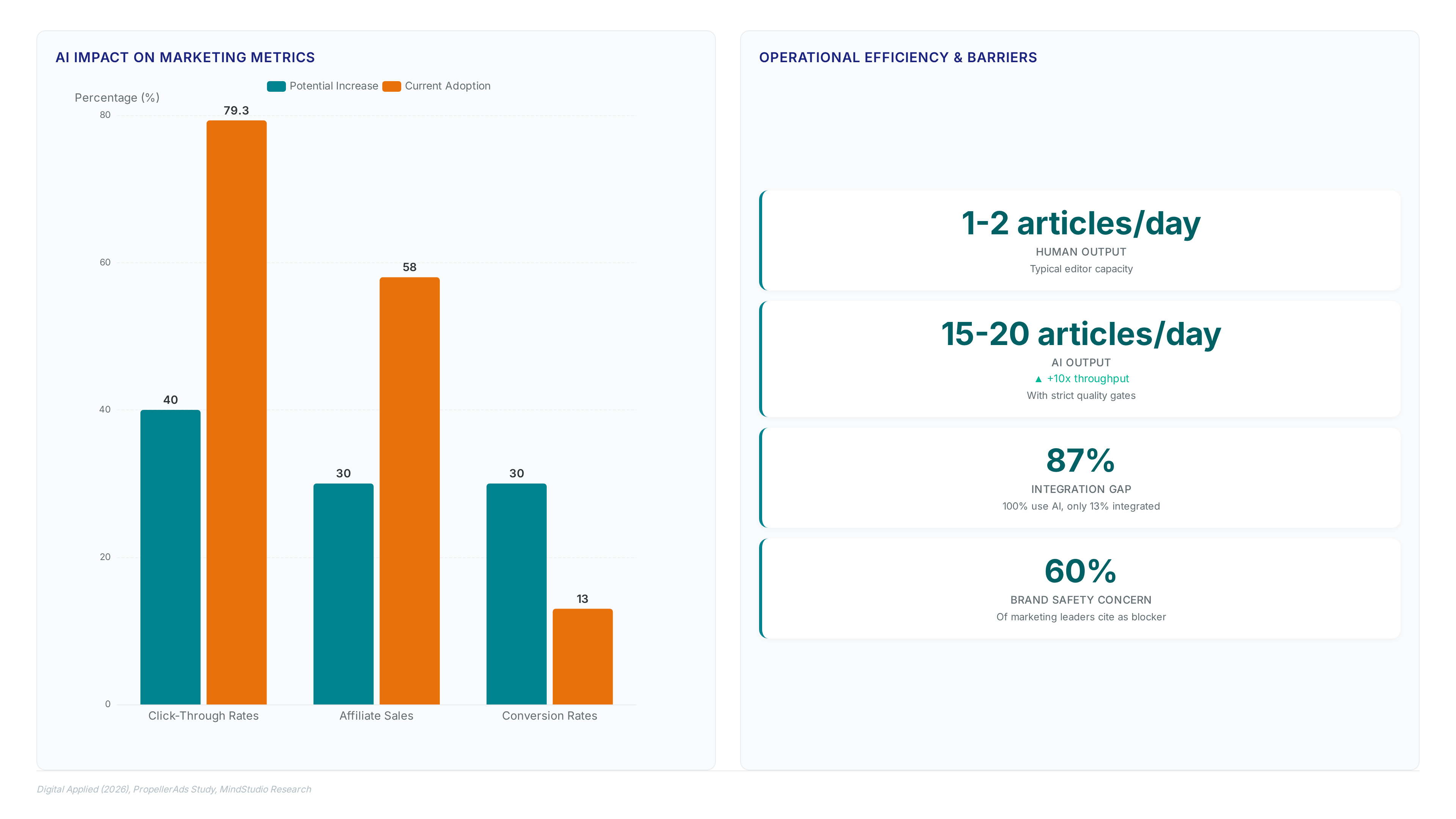
Human editors typically produce 1, 2 articles daily. AI-assisted workflows push this throughput to 15, 20 articles. Such volume demands strict quality gates targeting zero malformed articles via type-safe architectures. Operators address the hesitation of the 60% of marketing leaders who cite brand safety as their primary blocker by implementing mandatory human-in-the-loop checkpoints. These technical controls prevent speed from compromising editorial standards or convertibility.
Architectural complexity is the cost; teams build specialized agents instead of relying on generic chat interfaces. Enterium recommends deploying distinct planning and routing agents to maintain balance between scale and precision. Systems lacking these specialized roles risk generating high volumes of unusable text. Configure content collections to reject any draft missing a valid creative brief JSON file immediately.
Strategic Lessons from the 45-Article Monthly Experiment
Specialized agent architectures replace generic tools by enforcing collaborative planning to solve low-conversion copy. The vpn-saas and jucelinux niches demonstrate that dialogue-based briefs eliminate the "bland corporate tone" typical of off-the-shelf generators. The Planning Agent negotiates scope before drafting begins, ensuring every output adheres to a unique creative brief. This shift directly addresses the gap where 100% of marketers use AI but only 13% achieve core operational integration. Revenue targets of R$50, 200/month rely on this precision rather than volume alone.
Production speed reaches 15, 20 articles daily, yet the system mandates human-in-the-loop checkpoints to prevent content farm traps. Campaigns using such optimized routing see clickthrough rates increase by up to a significant margin. Increased orchestration complexity is the limitation; operators must manage eight distinct agent files rather than one monolithic prompt. This friction ensures that Routing Agents select high-converting paths like /coupons/ over generic reviews based on live benchmarks.
Success depends on this collaborative friction for those asking should I use AI agents for content. The system enforces a data-driven routing logic that generic tools lack. Scale degrades quality without specialized agents coordinating through JSON artifacts. Enterium recommends implementing strict role separation to maintain editorial integrity at volume.
Operational Risks: Agent Synchronization and Hallucination Control
Agent synchronization failures occur when the Routing Agent selects a URL path before the Research Agent validates product pricing. Disjointed content results. This race condition produces hallucinations where the system invents features to match an unverified premise. Operators must enforce strict sequential locking, ensuring the Research Agent completes data extraction before the Content Agent begins drafting. The pipeline increases errors rather than correcting them without this guardrail.
Reliance on third-party benchmarks introduces another vulnerability if the external data source shifts methodology without notice. Current implementations of agentic affiliate marketing still require human-in-the-loop checkpoints to verify niche-specific claims against live vendor pages despite promises of autonomy. Skipping this validation causes a loss of reader trust that no amount of SEO optimization can recover.
Several capabilities remain absent from the current architecture, including the Analytics-agent, automatic internal linking, and A/B testing for creative briefs. These missing components prevent the system from closing the feedback loop required for self-correction. Operators must manually audit output for drift until these features deploy. Enterium recommends treating the current stack as a force multiplier for editors, not a replacement for editorial judgment.
About
Arjun Patel is an Applied LLM Engineer who specializes in benchmarking LLM providers and RAG architectures for high-volume content workloads. His daily work involves rigorous, vendor-neutral evaluation of inference economics, directly informing the technical decisions required to scale content production without sacrificing quality. In this case study, Patel applies his expertise in model selection and pipeline architecture to solve a specific challenge: generating 45 authentic articles monthly for AffiliateOS. Unlike generic AI tools that often yield bland results, Patel's approach uses eight specialized agents to mimic a human marketing team, ensuring distinct voice and editorial rigor. This aligns with Enterium's mission to document how modern teams build reproducible content pipelines using LLMs. By focusing on concrete trade-offs between cost, latency, and output quality, Patel provides a practical blueprint for B2B leaders seeking to automate operations while maintaining strict quality gates.
Conclusion
Scaling AI agents reveals that synchronization failures create a hidden operational tax where speed cannibalizes accuracy. When routing logic outpaces data validation, the resulting hallucinations erode reader trust quicker than any algorithm can recover it. The shift toward agent-mediated commerce demands that operators treat autonomy as a spectrum rather than a binary switch. You must enforce strict sequential locking between research and drafting phases to prevent the system from inventing features to match unverified premises. Treat the current architecture as a force multiplier for editors, not a replacement for editorial judgment, until automatic internal linking and self-correcting analytics mature.
Implement a mandatory human-in-the-loop checkpoint this week to verify niche-specific claims against live vendor pages before publication. This single step prevents the drift that occurs when third-party benchmarks shift without notice. The goal is a sustainable 90% automation ratio where human review targets high-risk assertions rather than rewriting entire drafts. By prioritizing data integrity over raw output volume, you secure the long-term viability of your content pipeline against the noise of generic generation.
Frequently Asked Questions
Generic tools often create bland content, whereas eight specialized agents maintain unique editorial voices. This architecture supports producing 45 articles monthly while avoiding the shallow output typical of single-prompt systems.
The automated deployment process completes in just 20 to 35 minutes per article. This speed represents a massive reduction from the traditional 46 hours usually required for manual execution of similar tasks.
The most effective workflow operates at 90% automated generation with only 10% human review. This ratio ensures high velocity while keeping total execution time between 20 and 35 minutes per piece.
Campaigns utilizing AI-powered optimization see clickthrough rates increase by up to 40%. This significant gain is primarily driven by matching content forms specifically to user intent and niche benchmarks.
A PropellerAds study indicates that a portion of affiliate marketers already utilize AI tools. However, most lack the structural rigor of specialized agents needed to truly convert that speed into revenue.
References