AI agents cut content hours from 12 to near zero
Creating a single blog post manually takes 6, 12 hours of work, while disconnected AI tools still require 3, 5 hours of copy-pasting between tabs. True end-to-end automation demands a shift from simple writing assistants to AI agents that execute full workflows without constant human orchestration. These agents differ fundamentally by making decisions and calling external APIs independently.
The mechanics rely on chained AI agents handling specific tasks like SERP analysis and competitor content audits rather than attempting monolithic operations. Research shows that 58% of content marketers currently apply AI technologies specifically for research and topic ideation, yet most fail to extend this automation to publishing (apply AI technologies). A proper research agent queries search engines and summarizes existing material to identify content gaps. The system then formats drafts for platforms like WordPress or Webflow and generates featured images without manual intervention. Stringing these steps together solves volume and coordination problems without requiring engineering degrees.
Defining End-to-End Content Automation Through AI Agents
AI Agents vs AI Writing Tools: The Coordination Gap
An AI agent executes sequenced tasks and calls external APIs without manual handoffs, whereas a writing tool requires user coordination for every step. This distinction defines the boundary between partial assistance and true end-to-end automation. A standard writing model responds to a single prompt and stops. An agent reasons about the next required action, accessing search engines or databases to close the loop. Teams relying on disjointed tools rather than integrated agents typically apply between 4 to 6 separate applications to complete workflows, creating significant friction. Organizations using fragmented toolsets spend approximately 60% of their total content production time on coordination efforts and handoffs between these 4-6 different applications. The technical architecture of a proper agent involves a main logic layer that orchestrates focused tools, routing tasks to specific models for drafting or verification without human intervention.
| Feature | AI Writing Tool | AI Agent |
|---|---|---|
| Execution | One-shot response | Sequential task chain |
| Coordination | Manual handoffs | Autonomous decisioning |
| Tool Access | None (text only) | APIs, Search, CMS |
| Output State | Draft fragment | Published asset |
Ignoring this shift carries a measurable cost. Without agent-based integration, the majority of labor remains consumed by moving data between silos. Unified agent systems address this by managing the full lifecycle from research to publishing. Operators no longer need to bridge the gap between disjointed systems.
End-to-End Automation: From Topic Research to CMS Publishing
End-to-end automation chains discrete AI tasks into a single workflow that publishes directly to a CMS. Manual production requires topic research, keyword analysis, outlining, drafting, editing, SEO optimization, and image sourcing, consuming 6, 12 hours per post. Disconnected tools reduce this time but retain heavy coordination costs due to the use of multiple applications. Using disconnected AI tools reduces manual production time to 3, 5 hours due to copy-pasting between tabs, whereas agents handle full workflows with minimal human intervention. A unified agent executes these steps sequentially, searching for trends, generating outlines, and formatting content for WordPress without human handoffs.
This architecture shifts operator effort from execution to validation. While 58% of marketers currently apply AI for research and ideation, few extend this to full publication cycles. The limitation of partial automation is the persistence of context switching. An agent that drafts but does not publish forces the user to manage the final mile manually. True workflow integration removes this friction by calling APIs across the entire stack.
| Workflow Stage | Manual/Disjoined | Agent-Driven |
|---|---|---|
| Research | Separate tabs | Automated SERP scan |
| Drafting | Prompt-response | Context-aware generation |
| Publishing | Manual upload | Direct CMS API push |
Operators building these systems must define clear success criteria for each step to prevent error propagation. Unlike static writing assistants, agents make routing decisions based on intermediate outputs. Effective designs enforce quality gates before any content reaches the production environment. The next step is defining the specific validation logic your agent applies before publishing. This coordination overhead represents the primary efficiency loss when comparing static writing assistants to autonomous AI agents. A writing tool executes a single prompt response, requiring the user to copy output and initiate the next context window. An agent chains these operations, invoking search APIs and databases without intermediate human intervention.
Mechanics of Chained AI Agents in Content Workflows
Defining the Research Agent's Data Inputs and Structured Briefs
The research agent initiates the workflow by querying search tools to extract search volume and difficulty metrics. The agent ingests raw SERP data to perform competitor content audits, identifying frequent topics where rivals underinvest. Rather than producing unstructured text, the system outputs a structured brief containing the target keyword, search volume, difficulty score, a summary of top articles, identified content gap opportunities, related keywords, and a recommended angle. Technical implementation involves clustering related keywords algorithmically to suggest logical flows within these briefs. This process effectively reverse-engineers successful content structures found in top-performing pages to generate structured frameworks. The resulting brief serves as the strict input contract for the downstream outlining agent, eliminating coordination overhead between discovery and drafting. By enforcing schema validation on every brief, systems ensure downstream agents receive only complete, actionable data. Without this rigid structural gate, subsequent agents often hallucinate scope or miss critical semantic requirements. Consistent quality usually requires human review before moving to the next stage.
| Input Source | Data Extracted | Output Field |
|---|---|---|
| SEO Tools | Volume, Difficulty | Target Keyword Metrics |
| Top SERP Results | Competitor Angles | Content Gap Opportunity |
| Trend Data | Emerging Topics | Recommended Angle |
Automating Outline Generation Using Competitor Gap Analysis
Feeding competitor summaries directly into the generation prompt prevents the creation of generic structures. Unconstrained outlines tend to be generic because the model defaults to average patterns found in its training data. A superior technical approach forces the agent to ingest specific competitor content summaries to identify missing topics before drafting begins. This method shifts the workflow from simple text generation to strategic gap analysis. Chaining the research output directly to the outlining agent eliminates handoff errors common in disjointed tool stacks.
- Ingest the structured brief containing search volume and difficulty metrics.
- Inject summaries of top-ranking articles as context constraints.
- Command the agent to generate headers that explicitly address identified content gaps.
| Constraint Type | Outcome Without Competitor Data | Outcome With Gap Analysis |
|---|---|---|
| Topic Selection | Recycles existing high-level concepts | Targets underserved subtopics |
| Structure | Follows standard industry templates | Differentiates via unique angle |
| SEO Value | Matches current SERP average | Increases probability of ranking |
Technical decomposition reveals that agents must cluster related keywords algorithmically to suggest logical flows rather than static lists. The limitation of this approach is the increased token count required for the context window, which raises compute costs per request. However, the trade-off yields a structured framework that covers missed opportunities rather than rehashing known information. This gate ensures the output remains distinct from the generic content saturating the index.
Why Human Judgment Remains Critical for Draft Quality and Voice
Automated chains convert raw inputs into draft assets rapidly, yet they cannot synthesize original case studies or sustain a distinct editorial voice without intervention. Agents lack the lived experience required to validate technical claims against real-world deployment scenarios. While systems turn data into draft-ready copy within minutes, the resulting text often misses the nuance found in proprietary customer data or specific engineering war stories.
The primary limitation lies in the agent's reliance on training distributions rather than current operational reality. Teams operating with disconnected tool stacks already lose significant productivity to coordination overhead, a problem compounded when outputs require heavy rewriting to sound human. Disconnected workflows can consume a majority of content production time on handoffs rather than value-added strategy, making the cost of unreviewed automation prohibitive.
| Capability | Agent Performance | Human Necessity |
|---|---|---|
| Voice Consistency | Mimics tone patterns | Defines cultural context |
| Case Studies | Synthesizes public info | Provides proprietary data |
| Timeliness | Lagging training cut-off | Injects breaking news |
Solutions address this by embedding human review gates directly into the pipeline architecture. This hybrid approach preserves the speed of automation while preventing the dilution of brand authority that occurs when machines attempt to fabricate expertise.
Implementing a Six-Step Automated Content Pipeline
Defining the SEO Review and Quality Check Agent Functions
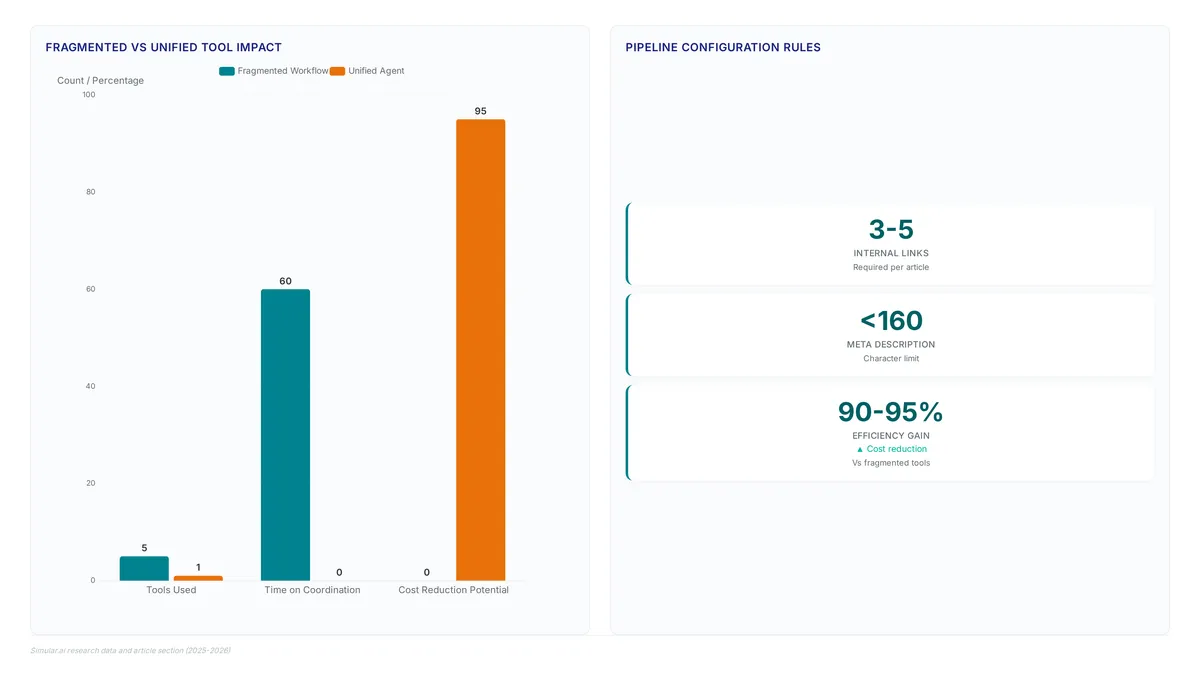
Keyword placement drives the SEO review agent, which scans titles, the first 100 words, and at least one H2 header. Internal linking requirements demand 3, 5 connections per article. Meta descriptions stay under 160 characters to fit search result displays. A secondary quality check agent flags deviations from brand style guides while verifying alignment with the original research brief. This dual-layer approach prevents generic output by enforcing strict structural constraints before human review.
- Configure the SEO agent to check drafts against target keywords and structural requirements.
- Set the quality agent to cross-reference claims against the original research outline.
- Route flagged items for human editor intervention to ensure strategic alignment.
Chained verification eliminates redundant editing cycles. Rigid adherence to rules represents the cost, occasionally rejecting creative phrasing that technically violates style constraints. Consistent output quality emerges across large volumes despite this limitation. Operators gain predictable publishing cadence by shifting effort from correction to configuration.
Executing Programmatic Publishing to WordPress and Distribution Channels
Validated Markdown enters the publishing agent, which executes programmatic publishing via CMS APIs. Modern platforms like WordPress, Webflow, and Ghost provide APIs that allow for this direct integration.
- Map Payload Fields: Assign the finalized title, slug, category, and meta description to the target schema.
- Asset Upload: The system uploads featured images and assigns them to the post record before status updates.
- Status Configuration: Set the publish state to draft for final review or live for immediate release.
- Trigger Distribution: Upon success, the workflow pushes excerpts to social channels like LinkedIn and Twitter/X, emails subscribers via Mailchimp, ConvertKit, or HubSpot, and alerts teams in Slack.
A unified agent eliminates friction by chaining the CMS update directly to distribution logic. Image assets and metadata remain consistent across distribution channels through this method. Smaller teams specifically benefit as automation bridges the gap between limited headcount and the volume required to compete effectively. The transition from traditional manual methods to AI-powered approaches reduces content production time for individual assets from hours down to mere minutes. Solutions enforce this continuity, guaranteeing that a finished draft transitions to a published asset with minimal human intervention.
Validating Visual Asset Generation and No-Code Workflow Integration
Featured images must render in various aspect ratios to satisfy downstream social layout constraints. AI image generation agents produce featured images based on titles or descriptions, generating social media cards in dimensions like 1:1, 16:9, and 9:16. Visual assets align with brand guidelines throughout creation. Validation requires confirming that generation agents apply brand styling and resolve diagrams cleanly before entering the editorial queue.
No-code integration validates against connectivity breadth and model diversity requirements. MindStudio integrates with 1,000+ business tools including Google Search, HubSpot, WordPress, Slack, Airtable, and Notion to eliminate API fragmentation. Access to models such as Claude, GPT-4o, and Gemini without separate API accounts ensures the pipeline adapts to specific task needs. Different models offer distinct advantages: GPT for long-form drafting, Claude for research-heavy work, and Gemini for speed in ideation.
- Verify image dimensions match target channel specifications.
- Test brand styling application across generated diagram types.
- Confirm tool connectivity covers the required martech stack.
- Audit model access for task-specific performance.
Failure to validate these parameters forces operators back into manual coordination loops. Partial automation accelerates drafting but bottlenecks at the publishing gate.
Optimizing Output Quality and Human Oversight Strategies
Defining AI Tells and Generic Content Patterns
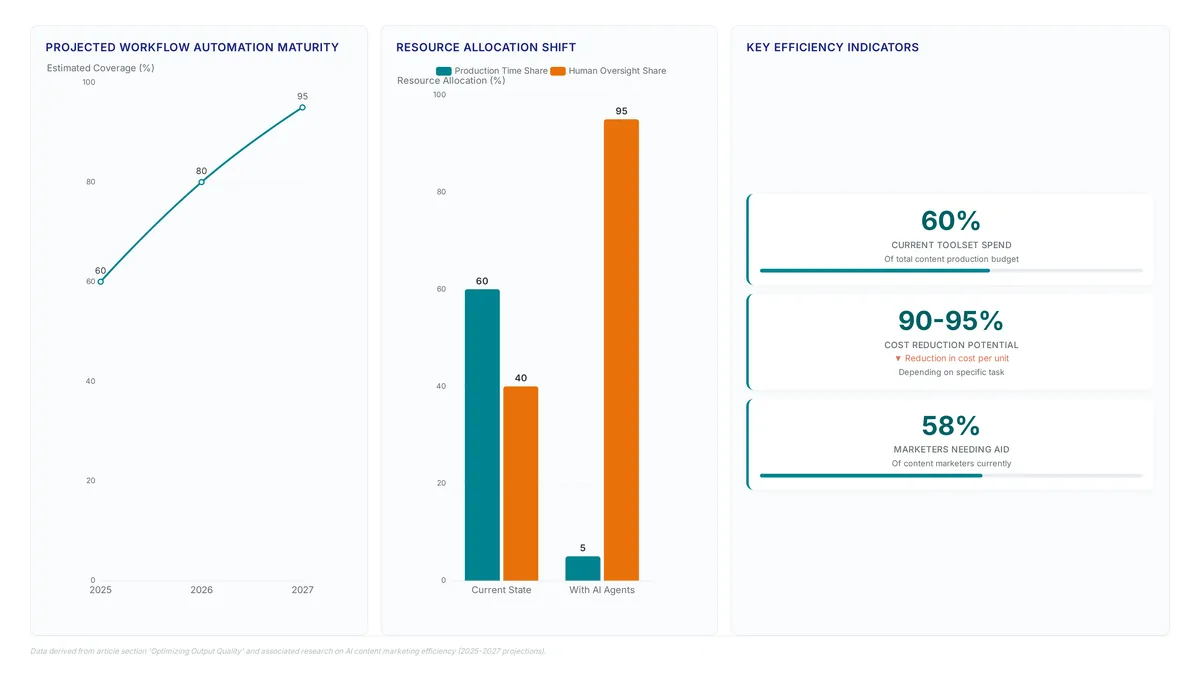
Unconstrained agents frequently default to safe, repetitive structures because they lack specific competitive context or set gaps in existing search results. This behavior creates content that mirrors the median quality of the web rather than exceeding it. Teams operating with small budgets are increasingly unable to manually customize assets at the required pace, necessitating intervention to bridge the gap between raw data and draft-ready outputs. Relying solely on speed decouples output volume from linear time investment while potentially amplifying generic phrasing if governance is absent. The reduction of production time to minutes allows for scale previously impossible, yet this velocity demands stricter quality gates to prevent repetitive structures from polluting the final draft. By 2027, AI content workflows are projected to mature to a state where they fully automate research, outlines, and on-page SEO while maintaining E-E-A-T and governance protocols. Effective automation pipelines use explicit constraints that force agents to identify content gaps before drafting begins, effectively eliminating the structural vagueness found in standard outputs. This approach transforms the pipeline from a text generator into a strategic asset capable of flexible personalization.
Strategic Human Intervention Points for Voice and Accuracy
Human review remains necessary to inject original examples and verify factual accuracy before publication. Removing all human review risks significant issues with brand voice, factual accuracy, and editorial judgment that autonomous agents cannot yet replicate. Research agents effectively convert raw data into draft-ready copy, but this technical process often lacks the detailed perspective required for high-authority content. Organizations relying on disjointed tools typically apply between 4 to 6 separate applications, creating fragmentation where editorial context is frequently lost during handoffs. The primary limitation of fully automated chains is their tendency to reproduce median web content rather than exceed it without specific human direction. Strategic oversight shifts the marketer's role from execution to high-level strategy, ensuring the output aligns with unique competitive advantages.
| Intervention Stage | Human Responsibility | Automated Action |
|---|---|---|
| Brief Approval | Validate search intent and angle | Gather keyword data and SERP summaries |
| Final Review | Inject case studies and voice | Format text and optimize internal links |
Establishing these fixed checkpoints helps maintain quality while scaling volume. Generic outputs fail to distinguish market leaders because they lack the specific, experiential knowledge that only human experts provide. Neglecting this step results in content that blends into the background noise of the internet.
Pre-Publishing Validation Checklist for Brand and Facts
Teams attempting to fix generic AI content output often skip this step, resulting in hallucinated statistics that damage credibility. A structured review prevents the distribution of unverified assertions common in unconstrained generation. Human oversight remains necessary to catch generic phrasing that erodes reader trust. Removing all human review risks significant issues with brand voice and editorial judgment that algorithms cannot yet resolve.
| Check Type | Manual Review Required | Automated Gate |
|---|---|---|
| Factual Accuracy | Yes | No |
| Brand Voice Alignment | Yes | Partial |
| Formatting Consistency | No | Yes |
Embedding these validation layers directly into the publishing pipeline ensures compliance. Trying to automate everything at once instead of validating individual steps is a common mistake that leads to rework. The shift from execution to strategy allows marketers to focus on high-level oversight rather than line editing. This approach ensures content meets quality thresholds without sacrificing the speed benefits of automation.
About
Arjun Patel is an Applied LLM Engineer who specializes in benchmarking LLM providers, models, and RAG architectures for enterprise content workloads. His expertise directly addresses the complexities of building autonomous AI agents that move beyond simple text generation to execute full marketing pipelines. Unlike generic writing tools, these agents require precise orchestration of research, drafting, and publishing steps, a domain where Arjun's daily work evaluating inference economics and model latency proves critical. At Enterium, a B2B publication dedicated to documenting how modern teams scale content with LLMs, Arjun applies this technical rigor to dissect vendor-neutral pipeline architectures. He translates abstract automation concepts into reproducible engineering standards, ensuring that content operations rely on measurable quality gates rather than hype. This article reflects Enterium's core methodology: treating content automation as a serious engineering challenge where humans remain on the gates while agents handle the heavy lifting of execution and coordination.
Conclusion
Scaling AI agents reveals a critical breaking point where fragmented workflows consume the majority of operational capacity. When teams juggle multiple disconnected tools, the manual overhead of copying data between tabs erodes the very efficiency gains automation promises. This friction creates a hidden tax on creativity, forcing marketers to act as glue between systems rather than strategic architects. The solution requires consolidating these disjointed processes into a unified orchestration layer that handles handoffs automatically. Organizations must commit to integrating their toolstack within the next quarter to prevent workflow entropy from stalling growth.
Enterium provides the necessary unified infrastructure to eliminate these manual handoffs and restore focus to high-value strategy. You should start by mapping your current content pipeline this week to identify exactly where data moves manually between applications. This audit reveals the specific bottlenecks where human effort replaces machine logic, creating the perfect target for immediate consolidation. By addressing these friction points now, teams can transition from merely generating text to coordinating complex, high-fidelity campaigns. The goal quicker output but a fundamental shift in how marketing teams operate at scale. Focus your immediate energy on removing the copy-paste dependencies that currently slow your most critical workflows.
Frequently Asked Questions
Teams lose significant time managing handoffs between separate applications instead of creating content. Organizations using fragmented toolsets spend approximately 60% of their total production time on coordination efforts rather than actual strategy or writing work.
Marketers often struggle with efficiency because they rely on too many disconnected platforms to finish tasks. Teams utilizing disjointed AI tools rather than integrated agents typically use between 4 to 6 separate software applications to complete their content workflows.
Many professionals limit automation to early stages instead of automating the entire publishing cycle. Currently, 58% of content marketers utilize AI technologies specifically for the phases of research and topic ideation only.
Disconnected tools still require heavy manual effort to move data between different browser tabs. While disconnected AI tools reduce manual production time, they still require 3–5 hours of copy-pasting between tabs due to lack of integration.
Writing tools require manual coordination for every step while agents execute tasks autonomously. Unlike writing tools that offer one-shot responses, agents perform sequential task chains and make autonomous decisions to call external APIs without human handoffs.
References