Prompt version control stops 43% brand voice drift
When 43% of AI product descriptions violated banned tone guidelines, the lack of an AI prompt version-control system was the sole culprit. This failure proves that without strict governance, brand voice erosion is mathematically inevitable rather than accidental. Teams will learn how untracked edits in Slack threads cause this drift, what four components define a functional canonical library, and why rollback capability is critical for scale.
The original article details how a mid-size retail brand faced this exact crisis when nobody owned the decision to change prompts. As noted in the research, prompts function as living instruction sets that get tweaked by freelancers and junior strategists until a brand sounding confident in Q1 becomes generic by Q3. This chaos occurs because output varies wildly between different AI models and prompt versions without a tracking system to enforce consistency.
Software engineers solved similar tracking issues decades ago with Git, yet marketing teams often lack this discipline for non-technical assets. A reliable solution requires a single source of truth with version numbers instead of files named "final_v2." By implementing change logs with attribution and output sampling per version, organizations can compare tone shifts side by side. Most importantly, teams need immediate rollback capability to revert to previous versions when new iterations generate off-brand copy.
The Mechanics of Brand Voice Drift and AI Content Governance
Defining Brand Voice Drift as Uncontrolled Prompt Erosion
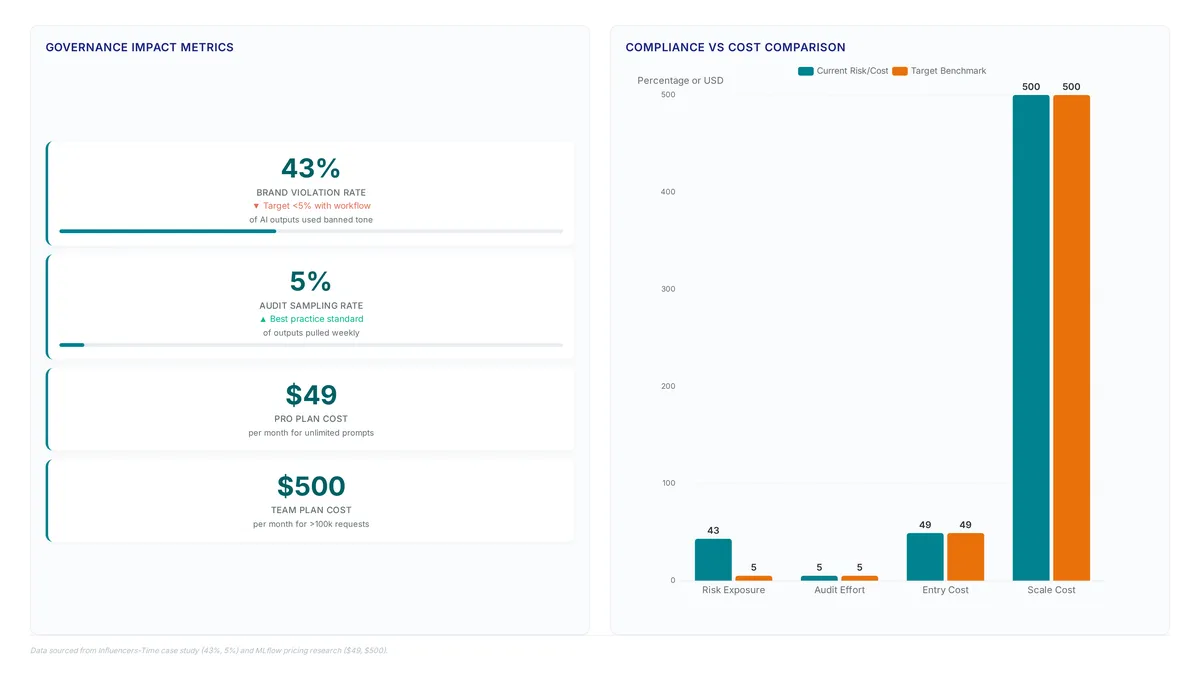
Brand voice drift is the gradual, often invisible erosion of tone, vocabulary, and personality that nobody explicitly approved. This degradation occurs when unlogged prompt edits circulate through Slack threads and personal notes rather than a canonical repository. The mechanism is simple: freelancers tweak instructions and strategists "improve" phrasing without attribution, leaving the team with no audit trail to identify the divergence point. Evidence of this systemic failure appears in recent operational data where a mid-size retail brand discovered that 43% of its AI-generated product descriptions used a tone explicitly banned by their brand guidelines two quarters earlier. The root cause was not a policy change but an untracked modification to a living instruction set.
Defining brand voice requires replacing subjective adjectives with quantifiable metrics like sentence length variance and banned phrase frequency. Vague directives fail because they lack the binary pass-fail states necessary for automated governance. Operators must establish a measurable rubric that scores outputs against specific rhythmic and lexical constraints rather than general tone. Industry best practice recommends pulling 5% of outputs from each prompt version weekly to score against these brand voice rubrics. This sampling method detects anomalies before they scale into campaign-wide inconsistencies.
| Metric | Measurement Target | Governance Action |
|---|---|---|
| Sentence Length Variance | Coefficient of variation > 0.5 | Reject monotone blocks |
| Banned Phrase Frequency | Zero occurrences | Auto-rewrite or flag |
| Reading Grade Level | Match baseline (e.g. 8th) | Adjust complexity |
The limitation of this approach is the computational overhead required to score every generation in real-time. High-volume pipelines may experience latency if the scoring model runs synchronously with content generation. Enterium solves this by deploying asynchronous Content Guardian Agents that evaluate batches without blocking the production stream. The implication for network operators and content leads is clear: without these numerical guardrails, drift remains invisible until brand damage occurs. Teams relying on manual review cannot sustain the velocity of modern AI workflows. Precision in definition enables automation in enforcement.
Risk of Silent Model Updates from OpenAI and Anthropic Altering Prompt Interpretation
Provider-side model updates from OpenAI, Anthropic, and Google can silently shift how an unchanged prompt is interpreted. This mechanism creates silent drift where the instruction set remains static while the underlying inference engine changes its token probability distributions. Unlike user-induced errors, this variation occurs without any logged edit to the prompt library, rendering standard change-tracking ineffective.
| Drift Source | Detection Signal | Governance Gap |
|---|---|---|
| User Prompt Edit | Version log update | Covered by version control |
| Silent Model Update | Output quality variance | Requires output sampling |
Businesses increasingly realize the risk of unmanaged prompts, making the role of the prompt engineer more valuable when armed with version control tools to prevent issues like brand voice drift. The critical limitation is that providers rarely publish detailed changelogs for every weight adjustment, leaving operators blind to the specific semantic shift. Consequently, a prompt tuned for "warmth" in January may generate "generic" output in March solely due to backend model iteration. Enterium addresses this by enforcing automated audit trails that pair specific model versions with prompt hashes, ensuring that any output deviation triggers an immediate alert rather than a slow brand erosion. Operators must treat the model itself as a mutable variable in their governance equation.
Core Components of a Prompt Version-Control System
Defining the Canonical Prompt Library and Change Log Architecture
A functional system requires a canonical prompt library acting as the single source of truth to prevent identity erosion. Without this central repository, teams risk scenarios where generated assets violate established tone guidelines due to untracked edits. This architecture pairs the library with change logs that record attribution data for every modification. Such logs change vague editing histories into precise audit trails necessary for legal compliance and operational clarity. These version control systems serve as the central nervous system for managing both prompt engineering and data lineage across autonomous agents.
Storage implementations often rely on databases with timestamps, though teams may use Notion, Airtable, or dedicated prompt-management layers depending on their needs. The critical distinction lies in linking specific prompt versions to their corresponding output samples. This pairing allows operators to isolate whether a tone shift resulted from a prompt edit or a model update.
| Component | Function | Risk if Absent |
|---|---|---|
| Canonical Library | Single source of truth | Fragmented instructions |
| Change Logs | Attribution and timing | Untraceable errors |
| Output Sampling | Tone comparison baseline | Invisible drift |
| Rollback Capability | Rapid reversion | Extended outage |
Practitioners recommend establishing these four pillars before scaling generation volume. The limitation of simple database storage is the lack of native diffing views found in specialized tools. However, the governance value remains in the disciplined recording of state changes rather than the specific container. Operators must treat prompts as mutable code assets requiring strict lineage tracking. Without this structure, brand inconsistency can propagate quicker than manual review can detect.
Implementing Output Sampling and Rollback for High-Volume Auditing
Manual review is feasible for a brand generating 15 pieces of content a week but becomes impractical for a brand generating 300 pieces a week across social captions, ad variations, email subject lines, and product copy. Teams using AI report production volumes 3-5x higher than pre-AI baselines, rendering 100% human inspection a fantasy at scale. A mid-size retail brand discovered that significant portions of their catalog violated tone guidelines due to undetected prompt drift. This approach isolates systemic errors without requiring exhaustive line-by-line checks.
Automated logging captures the specific prompt version and model iteration responsible for every generated asset. When scoring reveals anomalies, rollback capability allows teams to revert to a previous prompt version in minutes, rather than rebuilding it from scratch. This mechanism prevents the compounding of errors across thousands of assets.
| Audit Strategy | Feasible Volume | Detection Latency |
|---|---|---|
| Manual Review | ~15 assets/week | Real-time |
Purpose-built workflows and managed services offer visual diffing and role-based access controls specifically for prompts, ensuring that every generation traces back to a specific, approved, dated prompt version. This ensures that even if a model update shifts tone, the system can flag the deviation against the stored baseline immediately. Without this coupling, output sampling merely measures noise rather than signal.
Manual Review Versus Statistical Sampling for Prompt Governance
Manual review collapses as a governance strategy when weekly output exceeds fifteen pieces, necessitating statistical sampling for scale. Teams using AI report production volumes rising three to five times higher than pre-AI baselines, rendering one hundred percent human inspection operationally impossible. A single flawed prompt can produce hundreds of off-brand assets before detection occurs without automated sampling.
| Feature | Manual Review | Statistical Sampling |
|---|---|---|
| Feasibility | Viable under 15 units/week | Required for 300+ units/week |
| Detection Speed | Slow, linear lag | Rapid, systemic identification |
| Cost Model | High variable labor | Fixed automation overhead |
| Risk Profile | High false-negative rate | Quantifiable confidence interval |
The recommended approach involves pulling a fraction of outputs from each prompt version weekly to score against a brand voice rubric. This methodology follows the statistical logic used in manufacturing quality control to catch systemic problems. Operators flag anomalies based on measurable criteria rather than subjective impression. While manual checks offer deep context, they fail to detect model-induced drift where the prompt remains static but the underlying engine changes.
Dedicated versioning tools and full AI development platforms are converging to provide evaluation infrastructure alongside version tracking. These systems integrate directly into developer workflows, ensuring every batch receives consistent scrutiny regardless of volume. Relying solely on human review introduces a latency gap where brand damage accumulates before correction. Statistical sampling closes this gap by providing continuous, real-time feedback loops. Teams must prioritize measurable rubrics over vague guidelines to enable this automation effectively. For individual practitioners or small teams seeking structured versioning, MLflow's Pro plan starts at a monthly fee and offers unlimited prompts.
Strategic Tool Selection and Governance Frameworks for Scale
Defining the Maturity Stack: From Notion to Custom API Tooling
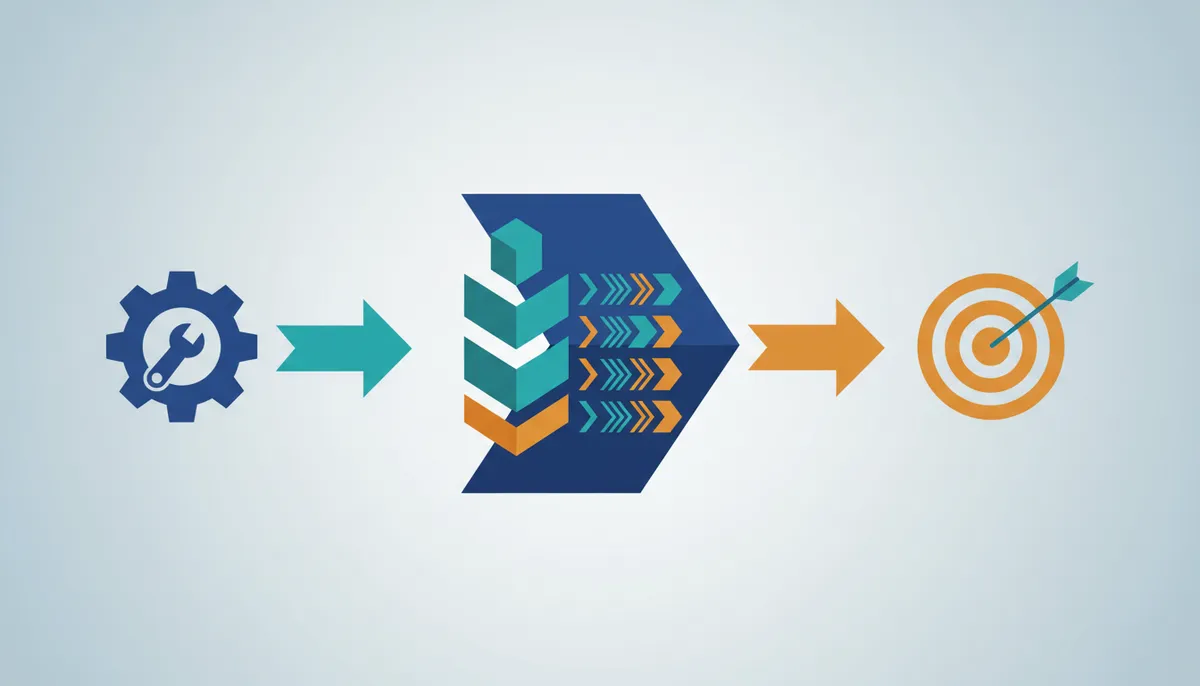
Teams generating under 50 content pieces weekly should manage prompts via shared Notion or Airtable databases with manual review cycles. This approach relies on human oversight to catch brand voice drift before publication, which remains feasible at low volumes. Pure document databases lack the structured logging required for forensic audit trails when compliance questions arise later. Operations scaling to between 50 and 300 generations per week require dedicated tools like PromptLayer or Vellum to enforce automated logging of prompt-output pairs. These platforms address the gap where dedicated versioning tools often lack full evaluation infrastructure, forcing a choice between strict tracking and performance analysis.
Tool selection must align with generation velocity to prevent unmanageable governance gaps. Effective governance maps specific prompt modifications to distinct approval authorities based on risk exposure. Minor adjustments involving tone tweaks or length modifications require content lead authorization and automatic logging within the version control system. Structural changes altering core instructions demand review by a brand director to prevent semantic drift. High-risk modifications generating health claims or compliance language necessitate legal sign-off because the FTC states AI-generated marketing claims carry identical liability to human-written content. A DTC skincare brand producing four captions per product weekly across Instagram, TikTok, and Pinterest easily exceeds 150+ generations weekly, creating substantial exposure without strict gating.
Implementing automated rubric scoring helps flag deviations before human review occurs. By pulling a statistical sample of outputs to score against a brand voice rubric, teams can catch systemic problems early without inspecting every unit. This quantitative gate prevents the gradual erosion of brand identity that often goes unnoticed in high-volume workflows. The operational tension lies between velocity and safety; quicker approval cycles increase the probability of brand voice drift going undetected until significant damage occurs. Teams must prioritize audit trail integrity over speed for high-risk categories while maintaining rapid iteration for low-risk creative variations. Strong governance ensures every generation traces back to an approved prompt version with full attribution.
Quantifying Brand Voice Drift Through Tone Score Deviation Thresholds
Unmanaged prompt iteration silently erodes brand identity until tone score deviation metrics trigger automated alerts. Independent copywriters frequently produce divergent brand voices within a single month without strict versioning, confusing audiences who prioritize consistency. Consumers explicitly cite authenticity as a primary trust driver, making unmonitored drift a direct revenue risk rather than a stylistic quibble. A retail audit revealed that nearly half of generated descriptions violated banned tone guidelines established two quarters prior due to missing lineage tracking. This lag demonstrates why manual reviews fail at scale; the damage accumulates long before detection. Configuring systems to flag anomalies through weekly sampling allows teams to score outputs against brand voice rubrics and identify deviations early. Relying on memory for prompt history invites catastrophic failure where banned language resurfaces months later. Model updates can shift output interpretation even when prompts remain static, requiring constant re-validation. Drift often originates from the model provider changing underlying weights, not human error. Establishing these thresholds transforms subjective quality concerns into actionable governance data. Operators must treat prompt versioning as a continuous measurement loop, not a one-time setup task.
Implementing a Tiered Approval Workflow for Prompt Changes
Tiered Approval Logic for Minor Edits Versus High-Risk Claims
Route minor prompt edits like tone adjustments through a content lead, while directing structural changes affecting claims to legal review. The FTC has stated that AI-generated marketing claims carry the same liability as human-written ones per FTC guidance on advertising and endorsement. This regulatory reality demands a strict tiered approval framework where risk dictates the sign-off authority. Refining sentence rhythm or swapping synonyms typically requires validation from a content lead, whereas modifications introducing new performance assertions or altering compliance language trigger a mandatory legal review. Without this separation, organizations risk generating unauthorized liabilities at scale.
- Classify the proposed change as either minor (stylistic) or high-risk (factual).
- Route minor edits to the content lead for rapid validation.
- Direct high-risk structural shifts to legal counsel for liability assessment.
- Log the decision path in a canonical prompt library for auditability.
Teams implementing this logic prevent the silent erosion of brand integrity. Embedding these rules directly into your generation pipeline enforces governance automatically. The cost of skipping this step is measurable brand damage that compounds with every generated asset.
Deploying Canonical Libraries with Attribution and Rollback Capability
Establish a single canonical library where every approved prompt resides with a unique version identifier. Teams often implement this discipline using Notion databases to centralize access and prevent scattered edits. Every modification requires a logged attribution entry detailing the author, timestamp, and specific rationale for the change. This audit trail becomes critical when investigating tone deviations, such as the instance where a retail brand discovered that a significant portion of its output violated guidelines established two quarters prior due to untracked prompt edits.
Operational stability depends on coupling versioning with automated sampling protocols. This statistical sampling detects drift before it scales into a brand crisis.
- Assign a unique version number to every prompt.
- Require approval signatures based on change risk levels.
- Archive sample outputs for every version to enable comparison.
- Maintain immediate rollback capability to revert to the last known good state.
The following configuration illustrates the metadata structure required for effective tracking:
Solving this requires embedding approval gates directly into the generation pipeline, ensuring no prompt executes without passing the configured tiered approval workflow. The cost of skipping this infrastructure is the silent erosion of brand equity across thousands of generated assets.
Validating Prompt Versions Against Sentence Length and Grade Level Rubrics
Score every prompt version against a measurable rubric before deployment to prevent undetected voice degradation. A measurable rubric must quantify sentence length variance to match established rhythm and enforce a specific reading grade level, ensuring output aligns with brand accessibility standards rather than drifting into complex jargon. Teams should pull a weekly sample of outputs to score against these metrics, flagging anomalies where the banned word frequency exceeds tolerance or tone deviates from the baseline.
This validation acts as a gate before any content reaches production, catching drift that manual review misses at scale. The limitation is latency; automated scoring adds steps to the pipeline, but the cost of unmanaged drift, where nearly half of generated assets violate tone guidelines, is far higher.
Validate versions using this operational checklist:
| Metric | Validation Target | Action on Failure |
|---|---|---|
| Sentence Variance | Match baseline rhythm | Reject and revert |
| Grade Level | Adhere to 8th-grade or 12th-grade spec | Flag for rewrite |
| Banned Terms | Zero tolerance for restricted phrases | Block deployment |
| Protected Labels | Verify version stability status | Halt modification |
Configure your system to enforce these gates automatically:
Protected labels prevent unauthorized deletion of approved versions, ensuring a stable rollback target remains available when anomalies occur. Integrating these checks directly into the deployment pipeline enforces governance without manual intervention.
About
Arjun Patel is an Applied LLM Engineer who specializes in benchmarking LLM providers and RAG architectures for high-volume content workloads. His daily work involves rigorous, vendor-neutral evaluation of inference economics, where he constantly observes how untracked prompt iterations cause brand voice drift across production pipelines. This article addresses prompt version control because Arjun's engineering practice reveals that without strict lineage, prompt tweaks by various team members silently degrade output quality. At Enterium, a B2B publication dedicated to documenting scalable AI content automation, Arjun applies these findings to build reliable content operations frameworks. Unlike generic AI tools that often encourage ad-hoc prompting, Enterium's methodology emphasizes reproducible systems where prompts are treated as code. By connecting his hands-on experience with model latency and quality trade-offs to governance challenges, Arjun provides the technical grounding necessary for marketing-ops teams to implement effective version-control systems that preserve brand integrity at scale.
Conclusion
Scaling generative AI without rigid version control invites silent brand erosion that manual review cannot catch. When nearly half of automated outputs drift from core guidelines, the operational cost shifts from creation to constant remediation. Teams must recognize that governance infrastructure is not optional overhead but a prerequisite for sustainable volume. Relying on ad-hoc tracking or external tools alone fails to address the specific latency and compliance needs of enterprise deployment.
Organizations should mandate tiered approval workflows embedded directly within their generation pipelines before Q4 planning cycles begin. This approach ensures every prompt variant passes measurable rubrics for sentence variance and reading grade level prior to execution. Do not wait for a crisis of confidence to implement these guards; the window to establish trust through consistent output is narrowing as competitors automate quicker.
Start this week by defining a measurable rubric that quantifies your current baseline rhythm and banned term frequency. Map these metrics to an automated rejection rule in your existing workflow to block non-compliant drafts immediately. Enterium offers specialized solutions to embed these exact validation gates directly into your generation pipeline, ensuring protected labels and stability without the friction of third-party patchworks. Secure your brand voice by making validation the gatekeeper, not an afterthought.
Frequently Asked Questions
Untracked prompts can cause 43% of outputs to violate banned tone guidelines. This massive failure rate proves that manual review cannot catch drift before it damages brand equity at scale.
Teams should sample 5% of outputs weekly to score against brand rubrics. This specific sampling rate allows operators to flag tone shifts early without requiring impossible 100% human inspection rates.
This low entry cost prevents the chaos seen when larger teams lack any structured system for tracking prompt changes.
High volumes make 100% human inspection a fantasy for most modern marketing teams. Without automated versioning, a single unlogged edit can corrupt hundreds of assets before anyone notices the pattern.
Implementing a canonical library stops the silent erosion of brand voice immediately. Without this single source of truth, teams face mathematically inevitable inconsistency across all generated content channels.
References