Prompt volume metrics that drive AI search revenue
A 50% increase in demos from AI Search proves that tracking prompt volume directly drives revenue. This isn't theoretical. It's the new baseline for measurable ROI.
OpenAI's May 7, 2026, shift to inline branded hyperlinks caused daily referrals to jump from 158,000 to 249,000 across measured sites. Traffic followed visibility. Yet most organizations still lack the tools to quantify this exposure. AthenaHQ addresses this gap with a Query Volume Estimation Model designed to track prompts that actually matter to your brand. The platform helps companies become the brand AI trusts by identifying trending queries within specific verticals.
Real-world deployments validate this approach. Rootly utilized these insights to achieve a 10x increase in citation rate and capture significant incremental equivalent media value. Similarly, Lago saw an 11x growth in AI Overview impressions, moving from 3% to 33% coverage. Guesswork doesn't yield these numbers. Precise data does. The following sections detail how prompt volume optimization turns abstract algorithms into concrete business outcomes.
The Strategic Role of Prompt Volume in Modern AI Search
Defining Prompt Volume as an Enterprise Metric
Prompt volume quantifies the frequency of specific user queries directed at generative AI models. It serves as a definitive metric for enterprise brand visibility. Unlike traditional search volume derived from clickstreams, this metric estimates intent within closed-loop systems where organic traffic often vanishes. Advanced platforms address this gap by using proprietary machine learning models to approximate these hidden interactions through the analysis of tens of millions of real prompts collected monthly from double-opt-in consumer panels. This approach allows brands to track prompts that actually matter to their vertical, identifying emerging patterns before competitors detect shifts in AI behavior. Define brand trust in this context as the measurable probability of a model citing a specific source when the prompt occurs. Organizations ignoring this metric risk optimizing for legacy search engines while losing share of voice in the very interfaces solving user problems.
Applying Prompt Volume to Brand Trust Strategies
Data enables enterprises to calibrate content for the specific queries driving AI trust. Brands must move beyond generic visibility metrics to understand citation rate in AI overviews through granular vertical analysis. Tools allowing teams to identify trending prompts reveal emerging patterns before competitors detect shifts in user intent. This capability is critical because AI search evolution rapidly alters which sources models prioritize for answers. Following OpenAI's May 7, 2026, shift to inline branded hyperlinks, average daily referrals from OpenAI platforms increased from approximately 158,000 to 249,000, highlighting the tangible impact of interface changes on traffic.
Prompt volume estimation diverges between raw frequency counts and normalized industry scores. Absolute models quantify total query instances, yet lack context regarding sector-specific baseline activity. Conversely, relative demand scoring assigns a value from 1 to 5, where 1 indicates very low search volume relative to an industry and 5 implies the highest relative demand. This normalization allows enterprises to benchmark performance against vertical peers rather than global aggregates.
| Metric Type | Primary Utility | Limitation |
|---|---|---|
| Absolute Counts | Tracking total brand exposure volume | Obscures low vertical baselines |
| Relative Score | Benchmarking industry share of voice | Hides total market contraction |
Operators must correlate both metrics to distinguish between losing share and a shrinking category.
Inside Prompt Volume Estimation and Region-Based Analysis Mechanics
Proprietary Machine Learning for Prompt Volume Estimation
The Query Volume Estimation Model discards simple count aggregation. Proprietary machine learning infers actual prompt frequency instead. Standard keyword tools report static search volume, yet this engine processes agent interactions and AI crawler behavior to normalize data across varying model outputs. The mechanism operates through a specific pipeline:
- Ingesting unstructured query logs from diverse LLM endpoints.
- Applying clustering algorithms to group semantically identical prompts.
- Generating a scaled score rather than a direct integer count.
This approach mirrors the relative demand scoring found in Peec.ai documentation, which assigns values from 1 to 5 based on industry-specific search interest instead of absolute numbers.
Deploying Region-Based Analysis to Spot Vertical Trends
Noise from global prompts often drowns out local signals. Region-based analysis filters this interference to isolate vertical-specific signals before competitors detect them. Organizations apply this by segmenting query logs geographically, revealing distinct emerging AI patterns that aggregate data obscures. The process requires mapping prompt clusters to specific metros rather than relying on national averages.
- Ingest raw prompt streams and tag each entry with geolocation metadata.
- Apply vertical filtering to exclude unrelated industry queries within the target region.
- Cross-reference local spikes against cross-platform prompt analysis to validate trend persistence across engines.
Validating Prompt Data Sources and Consumer Panel Integrity
Confirmation that estimates originate from double-opt-in consumer panels rather than synthetic generation is necessary for validating prompt data integrity. Enterprises must verify that their chosen platform scrubs personal information before applying statistical corrections for demographic bias. Synthetic API responses often fail to capture the nuance of actual user behavior in production environments.
| Data Source Type | Verification Method | Reliability Risk |
|---|---|---|
| Real User Panels | Double-opt-in consent | Low |
| Synthetic API | Algorithmic extrapolation | High |
| Scraped UI Logs | Direct observation | Medium |
Organizations should audit whether their provider analyzes agent interactions alongside raw text to ensure market representativeness.
Measurable ROI from Prompt Volume Optimization in Enterprise Deployments
Application: Defining Measurable ROI in Prompt Volume Optimization
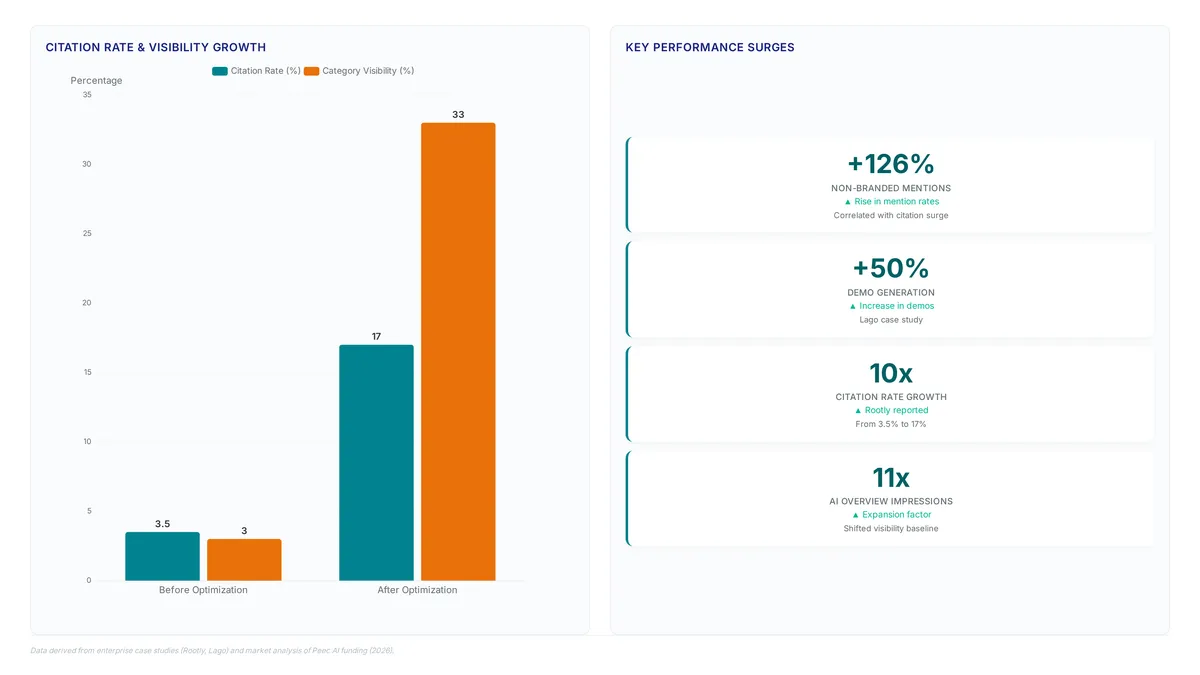
Defining measurable ROI requires shifting focus from raw traffic to citation rate growth and mention rates on non-branded prompts. Enterprise operators now quantify success through incremental equivalent media value rather than traditional click-through metrics. Rootly reported a 10x Increase in Citation Rate, transforming AI search into an executive-level operating channel. This surge correlated with a 126% rise in non-branded mention rates. These figures establish a baseline where tracking prompt volume moves from experimental to necessary. The integration of such visibility tools into core stacks drives adoption among commercial businesses seeking documented case studies of growth.
However, relying solely on aggregate volume ignores the quality of the citation source. A brand might dominate prompt frequency yet fail to capture equivalent media value if the context remains generic or unlinked. Organizations should invest in AI search monitoring to isolate these specific attribution signals.
Lago secured a 50% Increase in Demos by correlating prompt volume spikes directly to sales pipeline velocity. This outcome followed an 11x expansion in AI Overview impressions, shifting the brand's visibility from 3% to 33% of total category queries. The operational shift required treating citation rate growth as a primary leading indicator rather than a lagging vanity metric. Rootly similarly captured a meaningful amount in Incremental Equivalent Media Value after engineering content specifically for non-branded prompt patterns. These deployments illustrate that best practices for brand visibility in AI demand rigorous tracking of unbranded query clusters.
Improving share of voice in AI overviews requires isolating high-volume prompts where competitor citations remain thin. Optimization strategies focus on entity resolution to ensure content aligns with specific query intents. The cost of this approach is increased content production overhead to maintain specificity across diverse query intents. Enterprises must balance breadth with depth to sustain ranking positions. Enterium provides the architectural framework to execute this balance through precise prompt attribution and content mapping. Organizations should audit their current non-branded mention rates to establish a baseline for optimization.
Validating Enterprise Readiness for AI Search Investment
Enterprises should invest in AI search monitoring when baseline citation rates fall below double-digit thresholds while targeting aggressive growth. Lago improved their citation rate from 3.5% to 17%, representing a 2x growth factor that justified platform adoption. OpenAI platform daily referrals increased from approximately 158,000 to 249,000 following the shift to inline branded hyperlinks, signaling that visibility drives direct traffic. However, the cost of entry remains substantial; competitors like Peec AI have secured over significant funding in funding, suggesting accurate datasets require significant capital investment reflected in enterprise pricing.
| Metric | Baseline Signal | Investment Trigger |
| Citation Rate | High citation rate | |
| Non-Branded Prompts | Category questions | Increase citation rate baseline |
| Region-Specific | Local intent signals | Align prompt volume estimates |
The limitation is that proprietary models vary in training data, requiring validation against actual referral traffic. Organizations fix low mention rates in AI search by first quantifying the specific deficit type.
Executing Non-Branded Prompt Optimization Tactics
Shift focus from branded queries to region-specific non-branded prompts to capture incremental media value. Teams must isolate query intent gaps where generic visibility lags behind category averages. The optimization cycle begins with region-based analysis to spot emerging AI patterns before competitors react. Enterium practitioners configure content agents to target these high-volume, low-competition verticals specifically.
- Deploy Query Volume Estimation models to identify trending prompts within specific geographies.
- Adjust content templates to answer question-led queries directly, prioritizing clarity over keyword density.
- Monitor mention rate shifts weekly to validate tactical adjustments against baseline performance.
Validate prompt volume accuracy by confirming the tool employs a proprietary machine learning model rather than extrapolated guesses. Critics note that reported figures often rely on narrow databases, creating a divide between tools using real panel data versus pseudo-accuracy. Enterium practitioners must verify this distinction to avoid optimizing against noise.
- Confirm the Query Volume Estimation logic uses proprietary modeling, similar to the approach taken by AthenaHQ.
- Cross-reference identified trends against known citation frequency patterns to spot emerging vertical shifts.
- Ensure the system detects anomaly alerts for brand safety, a capability distinct from standard visual AI monitoring.
Relying on unverified volume metrics risks misallocating content budgets toward phantom demand. A guide to increasing citation rate in AI search fails if the underlying volume data lacks fidelity. Teams fix low mention rates by trusting only verified signals over inflated estimates.
About
Arjun Patel is an Applied LLM Engineer at Enterium, where he benchmarks LLM providers and RAG architectures for production content workloads. His daily work involves rigorously evaluating inference economics, latency, and output quality across diverse models, making him uniquely qualified to dissect prompt volume as a critical metric for enterprise AI strategy. While emerging tools like AthenaHQ introduce proprietary estimation models to track brand-specific queries, Patel's expertise lies in translating these abstract signals into actionable pipeline adjustments. At Enterium, a B2B publication dedicated to vendor-neutral content automation, he focuses on how teams can architect reliable systems that withstand shifting AI search patterns without relying on single-vendor black boxes. This article uses his hands-on experience building scalable content operations to explain why understanding prompt velocity matters for governance and resource allocation. Readers will gain a clear framework for integrating volume analysis into their existing measurement stacks, ensuring their content engines remain resilient as AI search evolves.
Conclusion
Scaling prompt volume strategies exposes a critical fracture: operational complexity spikes when brands fail to separate branded precision from non-branded discovery workflows. While competitors chase inflated estimates, the real cost lies in misallocating content budgets against phantom demand rather than verified signals. Organizations must stop treating all AI queries as identical inputs and start engineering distinct pathways for each vector to prevent metric cross-contamination. The window to correct this closes as answer engines increasingly penalize broad, intent-misaligned content with total invisibility.
Enterium advises teams to immediately decouple their content agents by query type before the next planning cycle begins. This separation ensures that high-volume, low-conversion prompts do not dilute the specific citation rates required for revenue-generating interactions. Do not rely on tools that extrapolate data from narrow panels; demand proof of proprietary modeling logic to ensure fidelity.
Start this week by auditing your current Query Volume Estimation source against known citation frequency patterns to identify discrepancies. If your tool cannot distinguish between real panel data and guessed figures, pause any substantial content shifts until you verify the underlying logic. Trusting unverified volume metrics is a strategic error that compounds quickly in AI search environments. Secure your visibility by validating your data foundation before expanding your footprint.
Frequently Asked Questions
Optimizing prompt volume can directly drive a 50% increase in demos for your business. This surge correlates with shifting brand visibility from 3% to 33% of total category queries, proving that tracking these metrics converts algorithmic presence into tangible sales pipeline growth immediately.
This financial gain often accompanies a 126% rise in nonbranded mention rates, demonstrating that fixing citation gaps transforms hidden algorithmic interactions into measurable economic returns for the enterprise.
A successful strategy often improves citation rates from 3.5% to 17%, representing a 2x growth factor. This specific improvement helps shift a brand's visibility significantly, moving them from obscurity to dominating a substantial portion of total category queries within their specific vertical market.
Leading brands often secure a 20% onpage citation rate locally versus a 4% category average. This fivefold difference highlights massive gaps where competitors fail to appear, offering a clear opportunity for enterprises to dominate local algorithmic answers and capture unmatched share of voice.
Brands can shift visibility from 3% to 33% of total category queries by correlating prompts. This dramatic expansion ensures your content appears where users actually ask questions, turning passive data points into an active channel that drives a 50% increase in demos generated directly from AI search.
References