LLM pricing traps: Stop burning monthly
A customer support bot answering the same 30 questions daily generated a shocking $14,000 OpenAI bill in just two months. This financial hemorrhage proves that intelligence costs remain static regardless of query complexity, forcing engineers to adopt LLM cost optimization strategies immediately. By implementing specific architectural changes, organizations can reduce API spend by 70% to 85% without degrading output quality.
You will learn the mechanics of token-based pricing and why standard API charges punish inefficient design. Finally, we explore deploying model distillation and smart routing to direct traffic to the most cost-effective endpoints. Research indicates that implementing model routing alone can slash total API costs by 40% to 70%. These techniques change AI from a money pit into a scalable asset.
The Mechanics of Token-Based Pricing and API Charges
Why Intelligence Costs the Same for Simple and Hard LLM Queries
Token volume drives every charge on LLM API invoices. Computational difficulty plays no role in the final bill. The fundamental pricing formula calculates cost as (input tokens × input price) + (output tokens × output price), making token count the sole driver of expense rather than reasoning depth. A basic greeting consumes the same price-per-token as a complex coding solution if their token lengths match. This rigid economic model forces engineers to manage efficiency externally.
A startup customer support bot illustrates this structural flaw clearly. The system answered the same 30 questions every day. Yet the monthly OpenAI bill reached $14,000 because the architecture lacked cost controls. Nobody considered how LLMs charge money, so dumb questions cost the same as hard ones. Intelligence costs the same regardless of necessity. Deploying a large model for trivial retrieval tasks burns budget at the same rate as solving novel problems. Simple queries bleed capital linearly without context compaction or caching layers. Providers do not discount easy prompts. The burden falls on the engineer to route traffic appropriately. Reducing prompt length offers a direct, linear impact on the bottom line since the ratio of input to output tokens dictates total spend. Operators must treat every token as a financial transaction.
Semantic caching intercepts repeated simple queries before they hit the API. This financial drain occurs because the fundamental pricing formula sums input and output tokens multiplied by their each rates. High-volume deployments without optimization face similar risks, with some configurations reaching $7,500 per month for 10,000 daily conversations. The core failure mode is architectural: systems treat every request as unique. They bypass opportunities to cache static responses. Unlike compute-bound tasks where difficulty scales price, LLM APIs charge strictly for data volume transmitted. A simple "What are your hours?" query consumes the same budget per token as a complex troubleshooting thread if the token counts match.
Redundant queries represent pure waste in this pricing model. Without an interception layer to serve cached answers for the repeating 30 questions, the system continuously pays full price for previously solved problems. The remedy involves implementing a caching strategy before the API call. Repeated inputs never reach the billing counter. Deploying a semantic cache to intercept these requests can potentially reduce spend on repetitive patterns by up to 90%.
The Hidden Risk of Unchecked LLM Spending on Static Prompts
Identical token-based pricing applies to static prompts regardless of computational simplicity. Unchecked spend arises when architectures lack mechanisms to intercept redundant calls before they reach expensive models. The hidden risk involves auxiliary services. Vector databases and agent tool calls often scale linearly with request volume. These factors compound the base model expenses. Every repeated static prompt incurs full price without semantic caching. Latency versus savings presents a clear constraint. Cache lookups add milliseconds while preventing massive budget drains. High-volume static interactions become financial liabilities when these gates are absent. Auditing prompt repetition rates helps quantify exposure.
Architectural Strategies for Reducing Redundant API Calls
How Caching Intercepts Redundant LLM API
A caching layer sits between the application and provider to intercept duplicate queries before they incur token charges. The architecture identifies semantically similar requests rather than exact string matches, achieving hit rates around 68% for many workloads. This approach prevents auxiliary services like vector databases from scaling linearly with request volume, addressing hidden infrastructure expenses. However, semantic caching introduces latency overhead during the initial hash comparison and requires careful tuning to avoid false positives on slightly varied inputs.
Enterium recommends implementing strict TTL (Time To Live) policies to ensure cached data does not become stale in flexible environments. The trade-off is memory consumption; storing high-volume conversation histories demands significant RAM, potentially offsetting API savings if not managed. Organizations must balance the immediacy of cache hits against the freshness required for their specific data domains. This architecture intercepts queries before they reach the model, comparing incoming prompts against a vector store of previous responses. Unlike exact string matching, this method identifies semantically similar requests to serve stored answers instantly.
| Layer Type | Latency Impact | Cost Reduction |
|---|---|---|
| Exact Match | Minimal | High (Exact Duplicates) |
| Semantic Cache | Low | Moderate-High (Similar Intent) |
| No Cache | High (Model Latency) | None |
Operators must deploy this layer to stop paying for redundant intelligence on static knowledge. Without it, every repeated question incurs full token charges regardless of complexity. Most teams overlook that cache invalidation logic requires the same rigor as prompt engineering to prevent hallucinated leftovers from persisting. Enterium recommends starting with a time-to-live policy of 24 hours for flexible topics and indefinite storage for immutable facts. This approach balances accuracy with the need to reduce LLM bills immediately. The technical requirement is a vector database capable of low-latency similarity search alongside the primary application logic.
- Ingest historical Q&A pairs into a vector index.
- Set similarity thresholds to filter weak matches automatically.
- Monitor hit rates to tune embedding models for domain specificity.
Neglecting this step leaves significant budget leakage in high-volume production environments.
Caching vs No Caching: Efficiency Gains in Token Consumption
Uncached requests charge full token rates for repetitive queries, wasting budget on identical computations. A caching layer intercepts these calls to serve stored responses, transforming variable API expenses into fixed infrastructure costs. This mechanism analyzes query intent rather than matching exact strings, identifying semantically similar requests to return answers instantly.
| Strategy | Token Efficiency | Latency Profile |
|---|---|---|
| No Caching | Low (all new calls) | High (Model dependent) |
| Semantic Cache | High (a minority of new calls) | Minimal (Memory lookup) |
| Exact Match | Moderate | Lowest |
The primary trade-off involves memory overhead versus compute savings; maintaining a vector store for similarity checks consumes resources but prevents redundant API charges. Without this gate, every user question triggers a fresh generation cycle regardless of prior history. Organizations ignoring this architecture face compounding costs as scale increases, since intelligence pricing remains flat even for trivial, repeated inputs. Deploying semantic caching ensures that only unique queries consume expensive model capacity while duplicates resolve locally. Enterium recommends implementing this layer before scaling user volumes to prevent uncontrolled spend growth.
Deploying Model Distillation and Smart Routing for Maximum Efficiency
Model Distillation and Quantization Mechanics
Model distillation trains a compact student network to replicate the output distribution of a larger teacher model, effectively compressing reasoning capabilities into a smaller memory footprint. This approach allows operators to deploy specialized models that require fewer computational resources while maintaining comparable performance for narrow tasks. Quantization complements this by reducing the precision of model weights, often converting 32-bit floating-point numbers to 8-bit integers to drastically lower latency. Together, these methods form the backbone of efficient model routing architecture, which dynamically directs requests to different models based on complexity.
This article aims to explain what occurs inside every API call and which techniques to apply based on specific situations. While the author notes that few discuss these methods, mastering them is necessary for optimizing deployment strategies. The operational cost of distillation is significant upfront compute time and the risk of capability collapse if the student model is too small to mimic the teacher's nuance. Unlike prompt engineering, fine-tuning requires a dedicated dataset and validation pipeline, creating a barrier for teams without established MLOps workflows. For organizations scaling rapidly, ignoring this creates a fragile cost structure.
Flexible Routing Logic for Small vs Large LLMs
Route requests to specific models based on query complexity to avoid over-paying for simple tasks. The core mechanism involves a classification layer that evaluates input difficulty before dispatch. Simple factual retrievals target distilled models, while complex reasoning triggers larger engines. This model routing architecture dynamically directs requests to different models based on complexity, achieving substantial savings on total API costs. Operators must define clear thresholds for switching to a smaller LLM. If a query lacks multi-step dependency or requires no external knowledge synthesis, the system defaults to the compact tier.
Incorrect routing decisions can lead to quality issues or unnecessary expenditure on larger models for trivial questions. The challenge lies in balancing confidence thresholds to maintain both latency and budget efficiency. Implementing a fallback protocol where low-confidence outputs from small models automatically escalate to larger counterparts ensures quality remains stable while capturing efficiency gains on the majority of traffic. This cascading pattern shifts operations from static API endpoints to flexible dispatcher logic within the application layer.
Validation Checklist for AI Application Efficiency
Operators must confirm that context compaction reduces input tokens without losing semantic meaning, as the economic model for production AI depends heavily on this input-to-output ratio. The effort-to-savings ratio varies notably; prompt tweaks offer quick wins while complex cascading requires substantial engineering time. Fine-tuning serves as a targeted alternative where upfront costs are offset by reduced token usage in specific domains. A common oversight occurs when operators optimize for cost but neglect latency budgets, causing user-facing delays during model selection.
Executing a Thorough Plan to Cut AI Spend by 70 Percent
Defining the Thorough LLM Cost Optimization Workflow
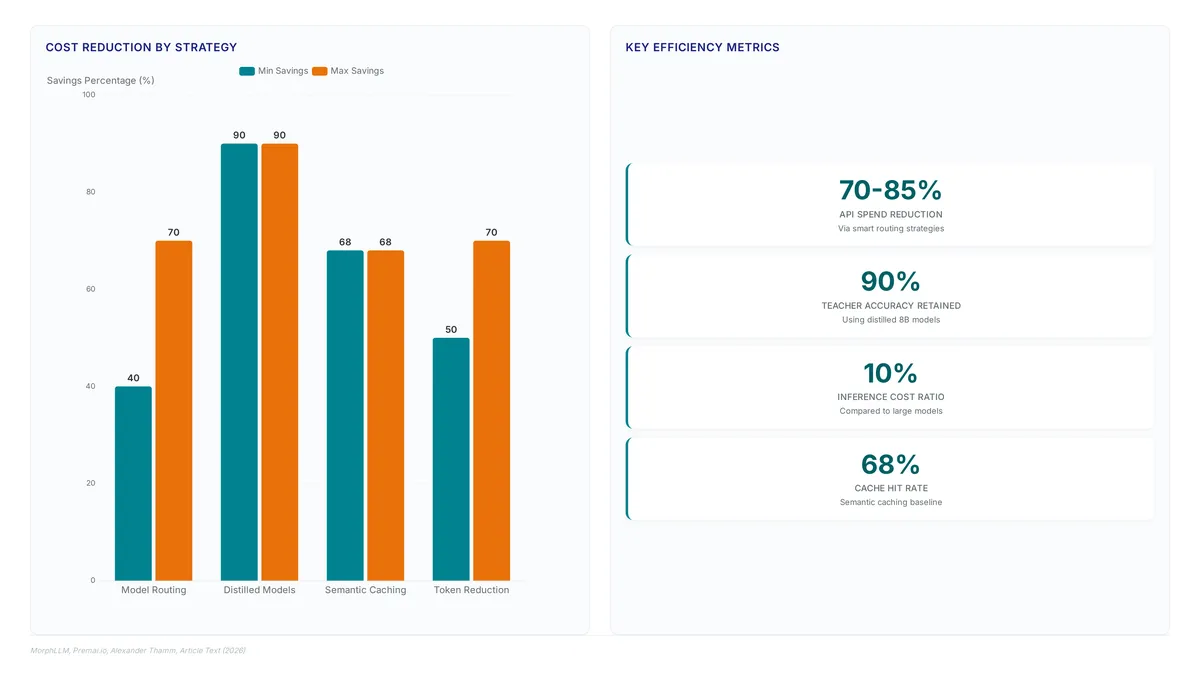
Divy Yadav's analysis reveals why LLM bills frequently exceed projections, detailing the mechanics within every API call to identify applicable reduction techniques. A unified optimization workflow merges monitoring, prompt engineering, and routing into one operational strategy instead of relying on isolated tactics. This perspective treats LLM cost optimization as an architectural constraint where extra components like vector database searches and external API calls silently inflate total costs as request volume expands. Token volume and model selection compound quietly across features without coordinated controls. Few industry voices address these specific methods, rendering this examination vital for operators.
Implementing this plan requires several distinct actions:
- Establish real-time tracking to visualize spend across teams and models.
- Deploy semantic caching to intercept repetitive queries before they reach the API.
- Configure intelligent routing to direct simple tasks to smaller, cheaper models.
- Enforce hard budget caps to prevent runaway expenditure during development.
Caching mechanisms slash expenses for requests triggering cache hits. Strategies combining these levers turn massive monthly bills into manageable figures. Optimization levers target different variables since model routing addresses price-per-token while context compaction manages volume. Operators balance freshness against savings by defining appropriate time-to-live values. Monthly or quarterly reviews let teams study usage patterns and adjust thresholds dynamically.
Executing Context Compaction and Token Management Strategies
Apply context compaction to reduce input token volume before the LLM processes a request. Stripping redundant history from the prompt window directly lowers the variable cost base. Production systems depend on this ratio because shorter prompts create a linear impact on the bottom line.
- Identify Redundant Context: Scan conversation logs for repeated user intents or static system instructions that consume tokens without adding value.
- Summarize History: Reduce token consumption by condensing conversation history, using strategies capable of lowering usage notably.
- Enforce Token Limits: Implement strict truncation rules in your orchestration layer to discard old messages automatically.
Compressed context must still support accurate reasoning for complex agentic workflows. Model routing handles price-per-token whereas compaction targets the volume variable. This multi-dimensional approach prevents output quality degradation while managing spend aggressively.
Operational Checklist for Cutting OpenAI and Cloud AI Costs
Verify cache hit rates immediately to stop redundant queries before they incur API charges. Caching achieves massive reductions for requests resulting in cache hits, standing as the highest-impact single technique. Audit model routing logic next so flexible queries do not default to expensive large models unnecessarily. Various optimization levers target different aspects of the cost structure, so route simple tasks to smaller models while reserving complex reasoning for larger ones. Confirm token limits are enforced strictly at the orchestration layer to prevent context bloat. Migration paths to open-source models offer an alternative to proprietary API pricing structures from substantial vendors like OpenAI and Anthropic. The "effort-to-savings" ratio varies notably by technique, so prioritize prompt optimization for immediate wins before attempting complex model cascading.
| Technique | Target Metric | Implementation Effort |
|---|---|---|
| Semantic Caching | Request Volume | Low |
| Model Routing | Price Per Token | Medium |
| Prompt Optimization | Token Count | Low |
| Open-Source Migration | Infrastructure Cost | High |
Best practices suggest making LLM cost reviews a regular part of the workflow on a monthly or quarterly basis to effectively analyze usage patterns. Teams ignoring flexible routing miss the opportunity to reduce costs from substantial providers notably while maintaining quality.
About
Daniel Reyes, Head of Content Engineering, bridges the gap between theoretical LLM capabilities and the harsh economics of production systems. With over a decade in data and ML platform engineering, Reyes specializes in architecting end-to-end AI content pipelines where every token counts. His daily work involves rigorous optimization of RAG systems, vector stores, and orchestration layers, directly confronting the runaway API costs that plague scaling teams. This practical experience makes him uniquely qualified to dissect cost-saving techniques, as he routinely implements the very quality gates and evaluation harnesses discussed in this article. At Enterium, a brand dedicated to vendor-neutral methodologies for B2B content automation, Reyes ensures that strategic advice is grounded in reproducible engineering realities rather than hype. The data confirms that relying solely on raw API throughput is unsustainable when simple architectural tweaks like caching can eliminate nearly two-thirds of redundant spend. Organizations must shift from viewing these expenses as fixed infrastructure costs to treating them as variable optimization targets. Ignoring flexible routing mechanisms effectively subsidizes inefficiency, forcing teams to pay premium rates for tasks that smaller, cheaper models could handle with equal proficiency.
You should implement a tiered model routing strategy within the next thirty days to ensure high-complexity reasoning does not default to expensive large models unnecessarily. This approach balances performance needs against fiscal reality, preventing the kind of runaway bills that plague unchecked deployments. Start this week by auditing your current request logs to identify repetitive patterns suitable for semantic caching implementation. This single action targets the root cause of waste by stopping identical queries before they trigger external API calls. Prioritizing these low-effort, high-yield adjustments creates immediate financial breathing room while you plan deeper infrastructure migrations.
Frequently Asked Questions
Model routing can slash total API costs by 40% to 70%. This strategy directs traffic to cheaper endpoints, preventing expensive models from handling simple tasks that drain your budget unnecessarily.
Semantic caching reduces spend on repetitive patterns by up to 90%. By intercepting duplicate queries before they reach the API, you stop paying full price for answers you have already generated previously.
The bot reached a $14,000 monthly bill because it lacked cost controls for repeating questions. Without caching, the system paid full price for the same thirty answers every single day.
Some configurations reach $7,500 per month for 10,000 daily conversations. This high cost occurs when architectures treat every request as unique instead of using caching to block redundant API calls.
Organizations can reduce API spend by 70% to 85% using specific architectural changes. Implementing these optimizations allows you to maintain output quality while drastically cutting unnecessary token consumption costs.
References