LLM API pricing: $0.44 to $30 rates
LLM API pricing in 2026 spans from a minimal cost per million input tokens to a premium rate per million output tokens according to OpenRouter API data. This massive disparity defines the core economics of modern artificial intelligence deployment, where selecting the wrong tier can inflate operational costs by orders of magnitude without delivering proportional value. The market no longer offers a single standard rate, but rather a fragmented environment where budget options like GPT-4.1 Nano sit alongside premium reasoning engines that charge exorbitant fees for marginal quality gains.
Readers will learn how to navigate these pricing models by analyzing the specific cost structures of over 305 APIs from substantial providers including OpenAI, Anthropic, and Google. The analysis exposes how token-based pricing penalizes heavy output generation, particularly for frontier models where output costs can reach a steep rate per million tokens.
The article projects monthly spend across various usage tiers, demonstrating how small changes in model selection impact the bottom line. By comparing specific entries like the $0.44 input cost for DeepSeek V4 Pro against the $30 input rate for GPT-5.5 Pro, we illustrate the tangible financial consequences of architectural choices. Understanding these comparative tiers is necessary for any organization aiming to optimize their LLM API expenditure without sacrificing critical performance benchmarks.
Core Economics of Token-Based Pricing Models
Input vs Output Token Cost Mechanics in LLM APIs
Reading data costs providers less than writing it. Input pricing ranges from $0.10 per million tokens for budget tiers to $30.00 for frontier reasoning models. Consequently, expanding the context window increases the number of input tokens processed, directly impacting the base cost of every subsequent query. Output generation demands iterative computation that drains notably more GPU cycles than the initial forward pass required for input ingestion. This structural asymmetry means generating text is fundamentally more expensive than reading it. High-end models command steep rates per million output tokens compared to input because each token requires a full pass through billions of parameters. Selecting the most powerful engine for simple extraction tasks ignores diminishing returns where expensive tiers offer marginal gains over cheaper alternatives. Operators must recognize that optimizing prompt length yields immediate savings, yet excessive compression can degrade model performance and increase error rates. Implementing strict token budgets at the gateway layer helps prevent unbounded cost escalation during long-context operations.
Calculating Value Scores with Claude Opus 4.6 and DeepSeek V3.2
A value score divides independent quality benchmarks by output token cost to reveal true economic efficiency. Claude Opus 4.6 achieves a quality rating of 100 and charges $25 per million output tokens, creating a baseline for high-fidelity reasoning tasks. Conversely, DeepSeek V3.2 delivers a quality score of 79 at just $0.28 per million tokens, drastically altering the cost-benefit equation for volume-heavy workflows. This comparison highlights that minimizing headline rates often sacrifices necessary capability, while maximizing raw performance ignores diminishing returns on simpler tasks. Developers increasingly consult leaderboards tracking hallucination rates to validate whether a specific use case justifies the premium for frontier models. The mathematical reality forces a choice between paying for marginal quality gains or accepting lower fidelity for massive scale. Optimizing prompt length remains the single most effective lever for reducing total spend regardless of the selected tier. Enterprises must calculate the specific dollar value of a correct answer before routing traffic to expensive endpoints. Blindly selecting the highest-scoring model inflates operational costs without guaranteeing proportional business value. Strategic routing requires matching task complexity to the specific economic profile of each engine.
Nano Budget vs Frontier Reasoning Model Pricing Tiers
Market segmentation now defines three distinct tiers: Nano/Budget, Standard/Premium, and Frontier/Reasoning, each with unique price-performance profiles. Selecting the lowest token rate often increases total spend if the model requires multiple retries to complete a task. The cheapest model per token is not always the most cost-effective per completed task. Teams must evaluate hallucination rates alongside raw pricing to ensure task success justifies the expenditure. Retries necessitated by model errors effectively increase the unit cost before accounting for latency penalties. Caching strategies and batch processing combined can reduce the effective per-call cost to roughly 25% of standard rates. Routing complex logic to frontier models only when simpler tiers fail quality gates balances compute economics against output reliability without inflating the monthly bill. Smart architecture separates trivial queries from heavy reasoning workloads to maximize budget efficiency across the entire stack.
Comparative Analysis of Frontier and Budget Model Tiers
Defining Value Scores via Output Cost Efficiency
Value score quantifies quality points per $1 of output cost, prioritizing efficiency over raw performance ceilings. This metric separates budget-friendly options from expensive predecessors by normalizing quality against specific output cost figures. The top-ranked inclusionAI: Ling-2.6-flash achieves the #1 rank with a Quality of 43, Output cost of $0.03, and Value Score of 1433.3. Such extreme variance highlights why tokenization metrics require task-based modeling rather than simple price comparisons. Frontier models often deliver diminishing returns for routine tasks despite their higher absolute quality ratings. Budget tiers handle simple queries effectively. High-end engines reserve their power for complex deduction.
| Model Tier | Example Model | Output Cost ($/1M) | Quality Score | Value Score |
| Budget | inclusionAI: Ling-2.6-flash | $0.03 | 43 | 1433.3 |
| MidRange | xai/grok4.3 | $2.50 | 88 | 35.2 |
| Frontier | openai/gpt5.5-pro | $180.00 | 100 | 0.6 |
Selecting a frontier model like (openai/gpt-5.5-pro) incurs an output cost of $180.00 per 1M tokens, drastically reducing the value score to 0.6. The GPT-5.5 Pro offers a perfect quality score of 100. The significant price differential compared to lower-tier models necessitates careful workload matching. Complex reasoning tasks may still justify the premium despite the poor cost efficiency ratio. Effective intelligent model routing can reduce total API spend by a significant portion to 60% while maintaining necessary output standards. The optimal strategy involves routing simple queries to high-value models and reserving expensive calls for difficult problems. Industry analysis suggests that flexible routing policies evaluating query complexity before selecting an endpoint are key to optimizing spend. Four distinct routing rules often suffice for most architectures.
Selecting High-Context Models for Million-Token Workloads
Architects select high-context models like (openai/gpt-5.5) when document analysis requirements exceed the capacity of standard tiers, such as the 200K context limit found in models like (anthropic/claude-opus-4). The 1.1M context window enables single-pass processing of entire codebases or legal repositories without lossy summarization heuristics. However, frontier reasoning models command input prices reaching $30 per million tokens, creating a steep cost curve for bulk ingestion tasks. Developers increasingly consult leaderboards tracking hallucination rates to verify that quality justifies this premium over budget alternatives. The limitation is clear: raw capacity does not guarantee cost-effective reasoning if the task does not require the full window.
Frontier Tier Trade-offs: GPT-5.5 Pro vs Claude Opus 4.7
Choosing between (openai/gpt-5.5-pro) and (anthropic/claude-opus-4.7) involves trading marginal quality gains for drastic cost increases. This disparity creates a Value score of 0.6 for the OpenAI model compared to 3.8 for the Anthropic alternative. The substantial premium for GPT-5.5 Pro reflects its positioning for specialized reasoning workloads where maximum performance is critical. The limitation of the cheaper tier is often stricter rate limits or slightly lower performance on niche coding benchmarks compared to the most expensive frontier reasoning models. For most enterprises, the 5-point quality difference yields diminishing returns when scaled across millions of tokens. Route general synthesis and document analysis to the Claude Opus 4.7 to preserve capital. Implementing a router that directs the majority of traffic to the cost-efficient tier while reserving the premium tier for verified failure cases is a recommended optimization strategy. Five configuration steps define this hybrid setup.
Projecting Monthly Spend Across Usage Tiers
Defining Monthly Spend Tiers for LLM Operations

Operational cost projection begins by mapping request volume to distinct spending categories, starting with the Hobby / Prototyping tier. This entry level costs between $0 and $10 per month, uses free tier models, and handles fewer than 1,000 requests per day for testing and development. Moving up, the Startup / MVP phase involves spending between $50 and $300 per month on mid-tier models like Sonnet and GPT-4.1 to handle 5,000 to 20,000 requests daily. A significant inflection point occurs at the Growth tier, where spend increases to accommodate higher volumes by mixing premium outputs with budget alternatives. The Enterprise tier exceeds standard budgets to handle massive scale, costing over $2,000 per month to support more than 100,000 daily requests with premium models for quality-critical tasks and model fallback chains. The hidden risk in tier selection is assuming linear cost scaling; without granular model segmentation, operators often deploy expensive frontier models for simple queries, inflating the effective cost per unit of work. Defining strict quality thresholds before selecting a spending tier helps prevent budget leakage.
Mapping Use Cases to Model Tiers by Budget
Assigning specific workloads to model tiers prevents budget overruns caused by using frontier reasoning models for simple summarization tasks. Code generation demands specialized architectures that understand syntax trees improved than general chatbots. Bulk content processing achieves economic viability only when routed to budget options where input costs drop significantly, creating a stark contrast to premium tiers. Frontier reasoning models can cost significantly more per million input tokens than nano-tier alternatives, creating a large price disparity. Startups operating within the Startup / MVP bracket often deploy mid-range models to balance quality for user-facing features while reserving premium capacity for complex logic. A critical tension exists between latency and cost; high-throughput pipelines frequently apply asynchronous batch processing to access discounted API rates. Operators ignoring this segmentation risk exhausting monthly caps on high-value endpoints before completing necessary background jobs. Value scoring metrics help identify when a model with a lower quality rating delivers sufficient accuracy for a fraction of the price. Auditing current token consumption patterns helps detect misaligned model assignments before scaling infrastructure.
Latency and Compliance Risks in Low-Cost Tiers
Production architectures must decouple synchronous requirements from batchable workloads, as batch processing standards often enforce discounts in exchange for higher latency tolerance. LLM APIs are not ideal for real-time applications needing sub-100ms latency due to inherent processing delays. A separate compliance risk emerges when handling sensitive data; operators must ensure chosen tiers support the specific policy checks required for regulated industries through explicit configuration. Technical infrastructure known as model routing layers can mitigate spend but introduces complexity in maintaining SLA compliance across heterogeneous providers. While prompt caching mechanisms from substantial providers reduce effective per-call costs, they do not resolve the fundamental latency floor of cold starts.
Implementing Cost Reduction via Caching and Model Routing
Model Cascade Routing and Prompt Caching Mechanics
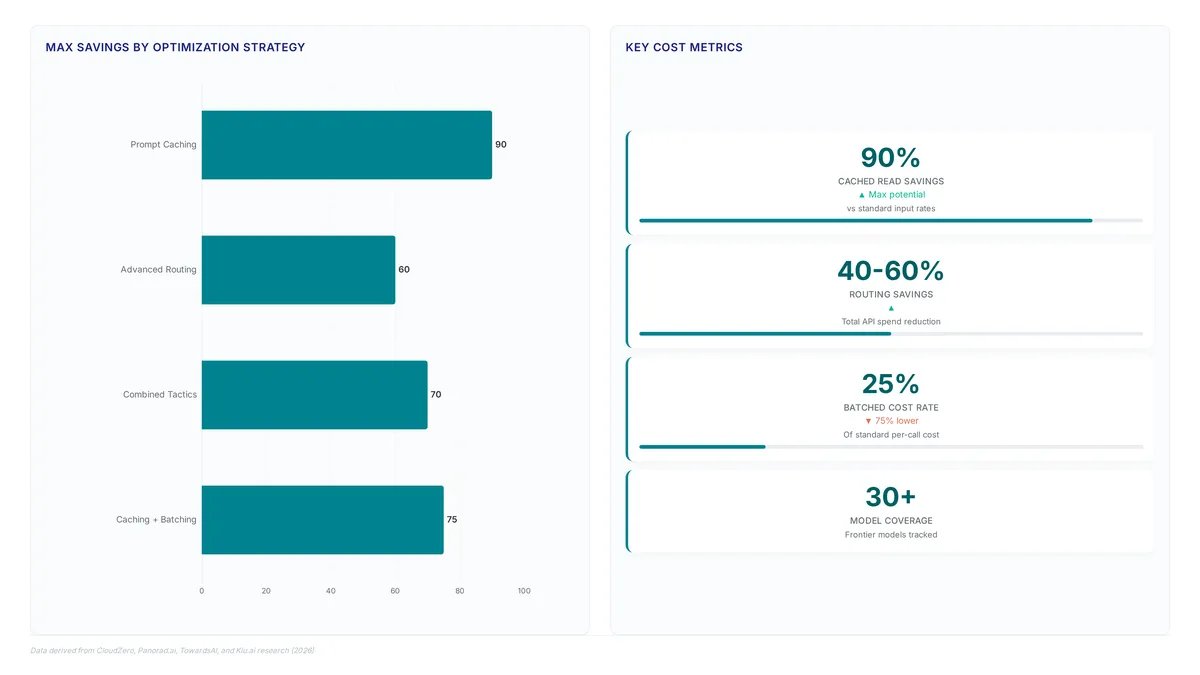
Route trivial queries to low-cost models before escalating complex tasks to premium tiers. Deploying prompt caching transforms the economics of repetitive agent loops by storing context snapshots in high-speed memory. Implementations allow cached input tokens to be billed at a fraction of the standard rate, achieving savings of up to 90% on repeated reads. While caching significantly lowers effective per-call costs, the primary technical consideration involves managing the balance between real-time requirements and batchable workloads to maximize these discounts.
The operational trade-off involves classification accuracy; misrouting a complex query to a cheap model wastes the initial inference cost and requires a retry. Teams must monitor performance continuously, as model capabilities and pricing tiers shift frequently. For high-volume integrations, data suggests prioritizing providers with transparent caching mechanics over those with opaque rate limits. Next, configure your gateway to log cache hit rates per endpoint to validate savings.
Executing 50% Input Savings via Prompt Length Optimization
Stripping non-necessary tokens from prompts yields immediate, linear reductions in input billing. Operators must audit system instructions and few-shot examples to remove verbose formatting or redundant context that inflates token counts without improving output quality. This optimization requires pre-processing logic to truncate historical context windows before they reach the API gateway, ensuring that only necessary tokens are transmitted.
Sustaining these savings demands granular visibility into consumption patterns across different use cases. Teams should track costs per model and use case to identify downgrading opportunities where high-fidelity models process trivial tasks.
Verify cost efficiency by prioritizing value scores over raw token rates to avoid hidden quality penalties. The cheapest model per token is not the cheapest model per task when retry rates and context overhead inflate total spend. Teams should validate their pipeline against this operational matrix before finalizing deployment configurations. Audit output quality metrics against the value score column rather than sorting by input price alone, as the cheapest model is not always the best value.
- Route asynchronous jobs like document summarization through batch endpoints to trigger lower billing tiers where latency tolerance allows.
- Implement a gateway check that flags eligible requests for batch processing before they hit the primary router.
- Monitor the ratio of cached tokens to total throughput to ensure caching policies are active.
Ignoring the distinction between token price and task cost creates a false economy where cheap models increase total spend through repetition. Hardening these validation gates in the CI/CD pipeline helps prevent unoptimized code from reaching production. This structural check ensures that cost optimization strategies remain effective as model pricing tables fluctuate quarterly.
About
Sofia Marchetti is a B2B Content Strategist specializing in how automated content systems drive pipeline through topical authority and durable distribution. With over a decade of experience in B2B SaaS demand generation, she is uniquely qualified to dissect LLM API pricing because her daily work requires balancing model quality against strict unit economics. This article's granular comparison of 305+ APIs directly reflects the operational reality of building scalable content pipelines where a $0.07/M token difference impacts overall ROI. At Enterium, a brand dedicated to vendor-neutral content automation methodologies, Sofia applies this exact data to help teams architect efficient workflows. Her analysis moves beyond theoretical costs to practical value scores, ensuring that content engineers and marketing operators can make informed decisions about which models fit their production budgets. By grounding these findings in live OpenRouter data, she provides the concrete metrics necessary for teams ready to optimize their LLM spend without sacrificing output quality.
Conclusion
Scaling LLM operations reveals that raw token pricing is a poor predictor of actual spend efficiency. When high-volume traffic hits premium endpoints for simple logic, the operational cost balloons regardless of the base rate. The real break point occurs when teams fail to distinguish between input density and output quality, leading to scenarios where cheap models inflate total spend through excessive retries and context overhead. You must prioritize value scores over unit pricing to capture genuine efficiency, as a model costing pennies per token can become the most expensive option if its quality rating forces constant re-prompting.
Implement a strict routing policy this week that segregates asynchronous jobs from real-time user interactions. Direct all non-urgent tasks like document summarization to batch endpoints, which often trigger lower billing tiers without impacting user experience. This structural shift ensures that cost optimization survives quarterly pricing fluctuations and prevents cheap models from consuming budget on complex reasoning tasks they cannot handle. Start by auditing your current logs to identify any synchronous calls that tolerate latency, then immediately migrate ten percent of that traffic to a batch processor to validate the savings potential before full deployment.
Frequently Asked Questions
Input costs start at $0.10 while output fees reach $30 per million tokens. This wide gap means reading data is cheap but generating text drains budgets quickly, forcing teams to strictly limit response lengths.
Budget options cost $0.10 per million tokens versus $30.00 for frontier models. Choosing the expensive tier for simple tasks wastes money since cheaper alternatives often handle basic extraction without needing complex reasoning capabilities.
Combining caching with batch processing cuts effective per-call costs to roughly 25% of standard rates. This drastic reduction allows high-volume applications to scale operations without proportional increases in monthly infrastructure expenditure.
Value scores reveal efficiency by dividing quality by cost, showing some cheap models outperform expensive ones. A model costing $0.28 may deliver better financial returns than a $25 option for high-volume, low-complexity workflows.
Strategic routing techniques can reduce total API spend by 40% to 60% while maintaining quality. Matching task complexity to specific model tiers prevents overpaying for simple queries that do not require top-tier reasoning power.
References