LLM cost compounding: Stop the 35x budget spike
A single coding agent session on Claude Opus 4.6 can burn through $7 if it makes 200 API calls. This isn't a bug; it's the math of agentic systems. Unlike a chatbot that answers once, an agent loops, re-reading its entire history on every turn. Expenses compound. The solution isn't to stop building agents, but to stop treating them like single-turn chatbots. By stacking five specific optimization levers, you can slash API spend by 70-85% while keeping output quality intact.
The problem is cost compounding. In a 20-turn session, you pay for the first message 20 times. Minor inefficiencies in token usage explode into massive monthly bills. Teams often find their actual spend is 3-5x their prototype budget once they hit production volume. Intelligent model routing alone can recover 40-70% of this waste by sending trivial tasks to cheaper tiers like Haiku 4.5 or Sonnet 4.6.
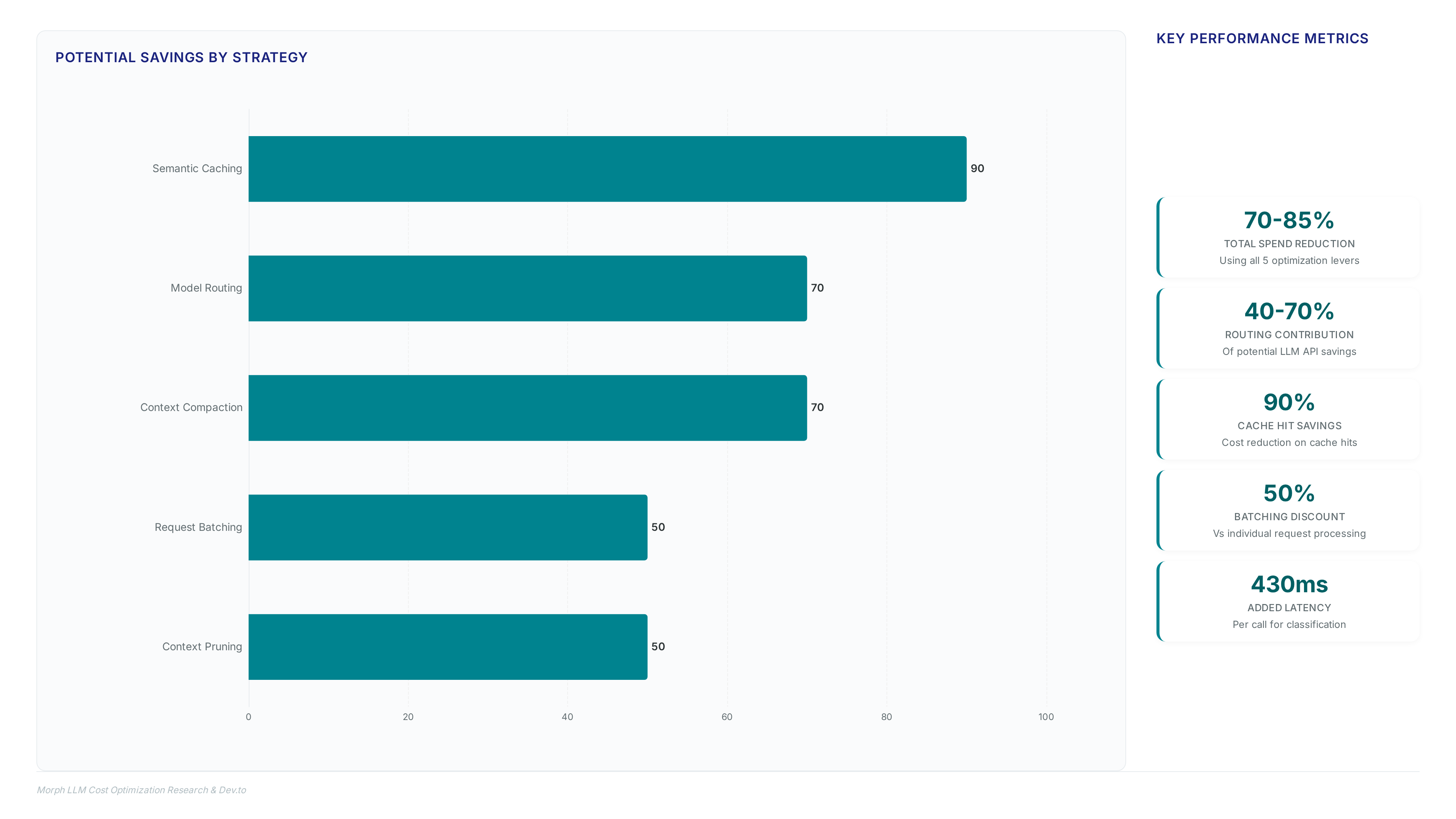
We also need to talk about context compaction. You can strip 50-70% of redundant tokens without inducing hallucinations. Finally, we'll look at implementing a multi-layer optimization stack with Morph to automate these fixes. The goal is simple: stop re-sending full conversation histories and start architecting for cost efficiency before the invoice arrives.
The Mechanics of LLM Cost Compounding in Agentic Workflows
LLM Cost Compounding and Token Pricing Mechanics
LLM cost compounding happens when linear API pricing meets exponential context regurgitation. The pricing formula is unforgiving: you pay for every single token sent. > (input tokens × input price) + (output tokens × output price)
Standard usage scales linearly, but agents multiply costs. They re-transmit full conversation history on every call. A coding agent making 200 calls per session on Claude Opus 4.6 ($5/M input, $25/M output) hits $7+ per session before anyone notices. Most teams realize their monthly spend is 3-5x their budget only after prototyping ends.
The math exposes the trap. A 2,000-token system prompt sent across a 200-call session consumes 400,000 input tokens just for repetition. Every unnecessary token in turn one gets paid for again in turn thirty. Across 1,000 sessions daily, 100 wasted tokens per session adds $450/month in pure overhead. Teams must implement strict token limits or pruning strategies immediately upon deploying multi-turn agents. This linear accumulation becomes exponential waste when a 2,000-token system prompt repeats across every turn, consuming 400,000 input tokens solely for redundant context transmission. For a 20-developer team running 50 sessions daily, this architectural inefficiency drives monthly expenditure to a significant amount, a figure that excludes the compounding latency of processing repeated data.
Financial leakage stems from how agents handle conversation state. Unlike single-turn queries, agentic loops re-transmit full history, meaning early tokens are paid for repeatedly. Reducing the initial payload by 50% does not save one call; it halves the token count for the entire 200-call chain. The operational fix requires treating context length as a strict budget constraint rather than an infinite buffer. Enterium recommends enforcing hard limits on system prompt repetition to prevent these silent cost escalations from destabilizing project economics.
Context Accumulation Risks in 20-Turn Agentic Sessions
Context accumulation forces agents to re-transmit full conversation history on every API call within a session. Early messages are paid for repeatedly as the session lengthens, creating a compounding cost structure invisible to linear budgeting. The primary driver of exploding bills in 2026 is usage volume rather than price increases, as frontier-class token prices have actually decreased notably. A typical coding agent session involves 20-50 tool calls, with each call transmitting 10,000 to 100,000 tokens of accumulated context. This architectural pattern means a single 20-turn interaction multiplies the cost of initial instructions by the total turn count.
Aggressive pruning risks removing semantic nuance required for complex reasoning tasks later in the chain. Teams must implement strict token budgets per turn to prevent silent budget exhaustion before task completion. Enterium recommends enforcing hard limits on context window utilization to maintain predictable unit economics.
Architecture of Intelligent Model Routing and Context Compaction
Model Routing Classification and Context Compaction Mechanics
Model routing sorts prompts by difficulty to assign the cheapest capable model, directly addressing redundant context costs. This mechanism maps ambiguity and task complexity to specific tiers so routine edits hit Haiku while architectural reasoning reaches Opus. The primary trade-off is the added latency of the classification step, which consumes approximately 430ms per request. Without this gate, agents default to expensive models for trivial formatting tasks, inflating the weighted average cost per session unnecessarily.
Context compaction employs verbatim deletion to strip low-signal tokens while keeping surviving sentences character-for-character identical. Compacting early saves tokens on every subsequent call in a session, compounding the savings. Deletion removes nuance though; if the compaction logic lacks domain awareness, it may discard edge-case constraints required for later turns.
Applying Difficulty Matrices to Haiku Sonnet and Opus Tiers
Mapping task ambiguity to specific model tiers prevents over-provisioning on routine coding requests. A structured difficulty matrix directs trivial edits and formatting tasks to Haiku at $1/M, reserving Sonnet at $3/M for standard feature work. Applying compaction early in a session yields disproportionate savings compared to late-stage optimization. The limitation involves added classification latency, typically around 430ms per request, which operators must balance against token savings. Without this gating mechanism, agents default to the most capable model for every interaction, wasting budget on tasks requiring minimal cognition. Enterium recommends implementing a router with a 0.95 confidence threshold to ensure accurate tier assignment before scaling.
Implementing a Multi-Layer Optimization Stack with Morph
Morph Router Classification and Cost Mechanics
Morph Router assigns prompt difficulty to specific model tiers using a classifier trained on millions of coding prompts. The system evaluates incoming requests and sorts them into four categories: easy, medium, hard, and needs_info.
- Easy tasks route to Haiku for trivial edits.
- Medium complexity work uses Sonnet.
- Hard architectural problems engage Opus.
- Needs info prompts trigger clarification loops.
The operational tradeoff involves adding 430ms of latency to every call to secure long-term budget efficiency. Most coding agent requests are routine, yet default configurations often send them to frontier models unnecessarily. Paying premium rates for formatting and boilerplate generation drains budgets quickly. The Morph Router ensures that only complex reasoning tasks consume high-cost tokens. Enterium recommends deploying this classification layer before scaling agent concurrency. Volume growth directly translates to linear cost increases rather than optimized spend without this gate. Configuring the difficulty matrix to match your specific codebase complexity is the immediate next step. Operators must first apply verbatim deletion to remove low-signal history segments while keeping surviving sentences character-for-character identical. This approach guarantees zero hallucination, unlike summarization which rewrites context and risks semantic drift. System prompts require trimming to necessary instructions before every API call. A 2,000-token system prompt sent across 200 calls consumes 400,000 input tokens unnecessarily. Third, implement prefix caching for repeated static content.
- Run context compaction on conversation history exceeding eight turns.
- Strip non-necessary directives from the system prompt header.
- Enable prefix caching for static boilerplate text.
Aggressive trimming risks losing detailed constraints required for complex debugging tasks. Teams should validate output quality after reducing prompt size to confirm critical directives remain intact. Achieving this requires exact hash matching followed by vector similarity searches above a 0.95 threshold to capture semantic equivalents without redundant API calls. Operators should validate stack integration using this checklist:
- Confirm prefix caching activates only on static prompt headers.
- Verify context compaction runs before the router evaluates difficulty.
- Ensure model routing does not bypass the cache layer for repeated queries.
Teams must compact flexible history while preserving the static prefix intact to maintain cache hits. Applying five specific optimization levers together can cut total API spend by 70-85% without altering the agent's output quality guide. Enterium recommends auditing cache hit logs weekly to ensure compaction logic does not inadvertently flush valid prefixes. This theoretical ceiling emerges when operators stack model routing, context compaction, prompt optimization, caching, and batching rather than applying them in isolation.
Enterium recommends validating these figures against your specific token counts, as context growth rates vary by workflow complexity. Operators max out savings by combining batch submission with prefix caching on repeated content, achieving 95% reductions on those specific request streams.
| Mode | Latency Target | Cost Modifier | Ideal Workload |
|---|---|---|---|
| Real-Time | Sub-second | Baseline | Interactive chat, live coding assistance |
| Batch Async | 1, 24 hours | Half Price | Nightly reports, bulk test generation |
Decoupling the request path from the response handler defines the architectural trade-off, since batched jobs do not return immediate results to the user session. Teams must route these background tasks through a separate queue to access the lower price tier without stalling the main application thread. This separation prevents latency-sensitive user experiences from degrading while capturing cost benefits for non-critical processing. Forcing all traffic onto expensive real-time infrastructure unnecessarily inflates the operational budget. Enterium recommends auditing agent logs to isolate deferred tasks suitable for this optimization lever.
About
Arjun Patel is an applied machine-learning engineer who specializes in benchmarking LLM providers and RAG architectures for high-volume content workloads. His daily work involves rigorous, vendor-neutral evaluation of inference economics, making him uniquely qualified to dissect the compounding costs of LLM API calls. At Enterium, a B2B publication dedicated to documenting how teams scale content pipelines, Arjun analyzes the specific trade-offs between cost, latency, and quality that engineering teams face in production. This article's focus on reducing API spend by optimizing token usage directly mirrors his core responsibility: translating raw performance data into reproducible, decision-useful strategies for content operations. By using his hands-on experience with substantial providers, Arjun provides the concrete numbers and architectural insights necessary for teams to move beyond prototyping without blowing their budgets. His analysis ensures that content leaders can implement sustainable automation grounded in real-world inference constraints rather than theoretical estimates.
Conclusion
Scaling LLM agents reveals that minor token inefficiencies rapidly change into prohibitive operational overhead. While individual sessions appear inexpensive, the aggregate cost of wasted tokens creates a financial drain that outpaces value generation. Teams must recognize that optimizing prompt length or switching models in isolation yields diminishing returns if the underlying architecture forces every task through high-cost, real-time endpoints. The real use lies in systematically decoupling workloads based on latency requirements rather than treating all API calls as urgent.
Organizations should immediately implement a routing layer that directs non-critical background tasks to asynchronous batch queues. This architectural shift allows teams to access significantly lower price tiers for roughly half the cost without degrading user experience for interactive features. Do not wait for quarterly budget reviews to address this; the compounding nature of token waste demands immediate intervention. Start by reviewing your agent logs this week to identify repetitive formatting or data extraction jobs that can be moved to a batch processing queue. This single action isolates deferred workloads and establishes the foundation for a tiered cost structure. By separating real-time needs from background processing, you secure sustainable margins while maintaining system responsiveness.
Frequently Asked Questions
Model routing can cut costs by 40-70% by directing simple tasks to cheaper models. This strategy reserves expensive models for complex work, preventing unnecessary spending on routine operations like formatting or basic edits.
Just 100 wasted tokens per session adds $450 monthly across 1,000 daily sessions. Teams must prune redundant context immediately because every extra token gets paid for repeatedly throughout the entire conversation chain.
Applying all five levers together reduces total API spend by 70-85%. This approach lowers a typical $6 session cost to between $0.90 and $1.80 without degrading the quality of the agent output.
Semantic caching achieves a 90% cost reduction on cache hits by stopping redundant calls. This prevents the system from paying full price for repeated prefixes or identical requests common in agentic workflows.
Context compaction strategies reduce input token usage by 50-70% by removing redundant data. This ensures early messages are not paid for multiple times as the conversation history grows during long sessions.
References