HubSpot workflow logic: fix enrollment triggers fast
HubSpot supports four primary object types for workflow creation across your database. You will learn how workflow automation functions within the workflow editor, why re-enrollment settings often cause logic failures, and when to apply workflow templates versus building from scratch.
The architecture of HubSpot workflows relies on distinct paths for contact-based, company-based, deal-based, and custom object-based executions (workflow). Ignoring these structural limits while configuring set enrollment triggers leads to broken logic loops that minimap navigation cannot fix. Many teams waste time tweaking actions to HubSpot workflows when the root cause lies in undefined re-enrollment triggers.
We dissect the operational differences between AI workflow creation tools like Breeze Assistant and traditional manual configuration. Understanding workflow permissions ensures that publish workflows in HubSpot does not accidentally expose sensitive data flows. The goal is precise workflow automation that scales without constant manual intervention or manual enrol errors.
The Role of Workflows in Modern HubSpot Automation
Defining HubSpot Workflow Enrollment Triggers and Object Types
Execution logic runs against specific database records inside a centralized automation engine known as a HubSpot workflow. Primary object types structure this system, specifically contacts, companies, and deals. Enrollment determines exactly when a record enters this logic stream. Users building a workflow from scratch select enrollment triggers to define the precise initiation moment. Options include manual enrollment, frequency-based triggering, or selection from specific enrollment triggers. Linking these triggers to specific object types allows teams to create workflows that automate processes across marketing, sales, and service functions.
Re-enrollment dictates whether a single record can trigger the same workflow multiple times after meeting criteria again. This setting prevents duplicate actions in static lists while enabling recurring engagement for flexible segments. A hard architectural constraint exists: when creating a workflow from scratch, you must select the enrollment triggers you want to use, then select the corresponding object type. Mapping data relationships before selecting triggers helps the workflow architecture support the intended business process without requiring structural rework.
Configuring Deal Stage Automation and Re-enrollment Settings
Branch logic executes within deal stage automation when a deal property changes, allowing teams to manage pipeline status automatically. This mechanism shifts pipeline management from manual auditing to automated state verification so opportunities trigger specific follow-up sequences without operator intervention. The workflow editor enables precise configuration of re-enrollment and unenrollment settings to control how records cycle through these logical branches. Operators must distinguish between enrollment triggers, which initiate the process, and workflow actions, which execute the subsequent tasks. Enabling re-enrollment allows continuous monitoring of changing deal properties yet risks creating infinite loops if exit criteria are not explicitly set. This architecture requires explicit unenrollment rules to terminate the automation once a deal moves to a closed status, unlike simple linear scripts.
Defining static exit conditions before activating time-based triggers prevents redundant database writes. The system does not implicitly stop processing a record just because a stage changes; the logic must explicitly remove the deal from the workflow scope. Repeated action execution inflates task counts and corrupts engagement history when these gates fail configuration. Properly scoped thresholds keep the automation a scalable utility rather than a source of data noise.
Navigating Folder Hierarchy Limits and Manual Enrollment Risks
Structural constraints directly dictate operational scalability because a HubSpot workflow functions as a centralized automation engine. Operators can only establish a one-parent and one-child relationship for workflow folders, a hard limit that prevents deep subfolder hierarchies within the automation dashboard. This flat architecture forces teams to adopt broad naming conventions rather than nested organizational structures, creating friction when auditing complex logic across large portfolios. Cross-functional teams cannot easily isolate specific campaign variants without cluttering the root directory due to this restriction.
Records can be enrolled manually as an alternative, bypassing the precision of filter-based or event-driven triggers. Relying on human initiation introduces variance in process execution timing and consistency. Manual entry depends entirely on user action to initiate the workflow sequence, unlike scheduled or event-based enrollment. This approach shifts the failure mode from system logic errors to human omission, a risk profile that grows linearly with team size. Production systems should prioritize trigger-based architectures to maintain audit trails and ensure uniform application of business rules.
Inside the Workflow Editor Architecture and Data Flow
How the Workflow Minimap Panel Aids Navigation
The workflow minimap provides quicker viewing of architecture and quicker navigation in larger workflows. Operators managing complex sequences rely on this visual overview to bypass linear scrolling through dozens of actions. The interface supports direct manipulation to reduce the cognitive load required to maintain context within deep logic trees. This minimap navigation feature enables movement but cannot substitute for modular design practices.
| Interaction | Function | Output |
|---|---|---|
| View | Orientation | Displays workflow structure |
| Navigate | Traversal | Pans canvas to section |
A critical limitation exists: the minimap aids orientation but does not resolve underlying structural complexity. Teams often mistake visual accessibility for architectural simplicity, leading to dense workflows that remain difficult to audit despite easy navigation.
Configuring Re-enrollment Triggers and Completion Logic
Once activated, users select specific triggers that dictate when a record qualifies for re-entry into the automation sequence. This configuration ensures that records can re-enter the workflow based on set criteria, such as property changes or time delays, but only after meeting completion requirements.
- Access the Settings area within the workflow editor interface.
- Enable the Re-enroll option.
- Select the specific property changes or time delays that serve as triggers.
A common architectural error involves assuming immediate re-triggering upon property updates during an active run. This design prevents infinite loops but introduces latency in high-velocity data environments where properties update multiple times within a single processing window. Teams building create workflows for rapid iteration must account for this completion dependency to avoid gaps in coverage.
| Configuration State | Record Status | Action |
|---|---|---|
| Option Off | Completed | No Action |
| Option On | Running | Wait for Completion |
| Option On | Completed | Re-enroll |
Risks of Locked Actions and Enrollment State Conflicts
The workflow editor includes validation mechanisms to ensure logic is sound before deployment. A link appears within the editor to review necessary changes, forcing immediate remediation of the configuration error. Ignoring this gate risks creating workflows that enroll records but execute no downstream actions.
This state constraint creates a hidden bottleneck where high-velocity leads stall if the initial run time exceeds the re-enrollment trigger frequency. The system strictly enforces this completion logic to prevent infinite loops or race conditions on a single object ID. Operators assuming immediate re-entry will find their automation gaps where data updates occur during an active session.
| State Condition | System Behavior | Operational Risk |
|---|---|---|
| Changes Required | Action locked | Deployment blocked |
| Record Active | Re-enrollment paused | Data staleness |
| Cycle Complete | Trigger evaluation | None |
Enterium advises validating unenrollment criteria to minimize active duration and reduce state conflicts.
Comparing AI Generation Templates and Manual Workflow Creation
Defining the Three HubSpot Workflow Creation Methods
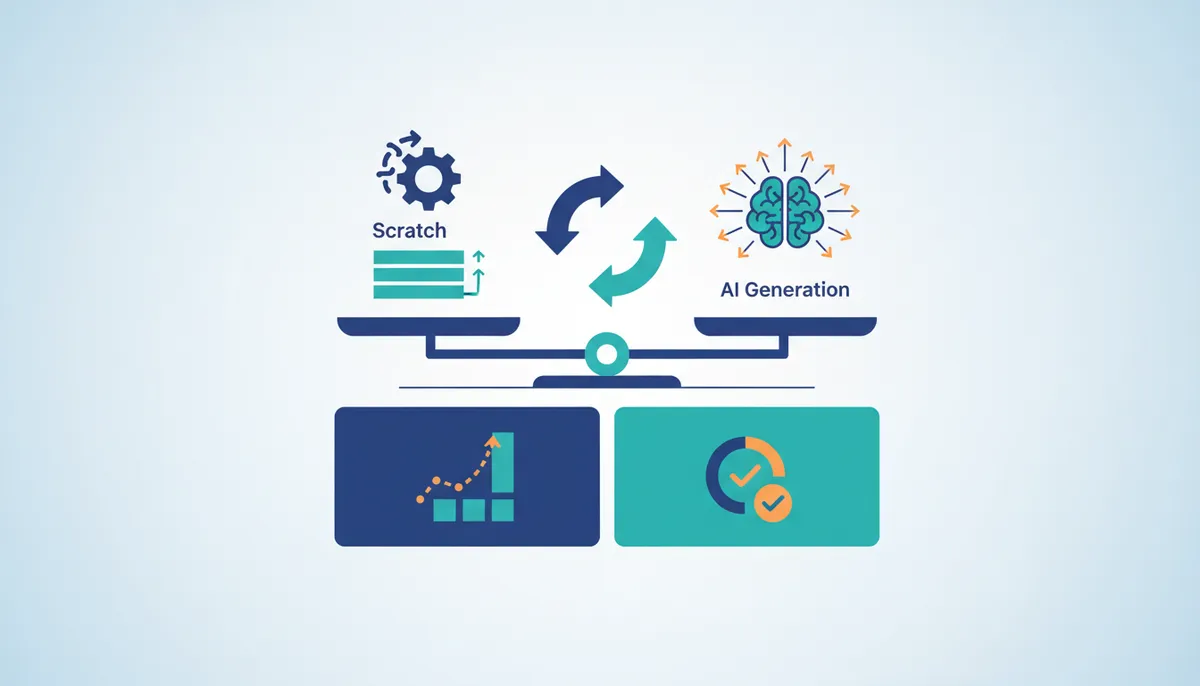
Speed, standardization, or granular control dictates which enrollment triggers an operator selects.
Building from scratch requires choosing specific enrollment triggers alongside a corresponding object type. This path supports complex logic by letting teams define manual enrollment, time-based frequencies, or property-based conditions exactly as needed.
Workflow templates offer an alternative with pre-configured structures for common sales and marketing scenarios. These assets cut initial setup time by providing vetted objectives and predefined actions, although details shift depending on the template author and total install count.
A third option employs Breeze Assistant to generate workflow logic via natural language prompts. The tool constructs workflows containing both enrollment triggers and actions, speeding up drafting for marketing, sales, and service processes alike.
| Method | Primary Advantage | Operational Limitation |
|---|---|---|
| From Scratch | Full logical customization | High initial time cost |
| Templates | Rapid deployment for standard use cases | Requires adaptation for custom fields |
| AI Generation | Fastest draft creation | Output needs validation for edge cases |
Teams generate workflows using Breeze Assistant to include specific enrollment triggers and actions immediately. Some groups start with templates for standard onboarding while others build from scratch for unique billing sequences based on their process requirements.
Applying Breeze Assistant and Template Libraries to Business Processes
Breeze Assistant lets operators draft logic rapidly through natural language prompts. This method works best when defining standard enrollment triggers for common object types without manual configuration steps. Selecting from the community workflow library provides vetted structures that include detailed author information and install counts. These pre-built assets reduce initial setup time for standard sales and marketing scenarios yet often need modification to align with unique data schemas.
| Dimension | Breeze Assistant Generation | Community Template Library |
|---|---|---|
| Setup Speed | Immediate draft creation | Fast implementation |
| Customization | High variable control | Moderate adaptation needed |
| Logic Precision | Requires prompt refinement | Pre-validated structure |
AI-generated drafts serve as a starting point that operators refine to match specific business rules. Templates offer a known baseline but constrain users to existing action sequences that might not fit specific rules without adjustment. Configuring workflow permissions correctly across departments post-creation becomes a substantial consideration when scaling. Teams often use AI generation for prototyping phases while deploying community templates for production-ready, repeatable processes. This hybrid approach balances speed with the structural integrity needed for enterprise-grade automation. Operators should validate all generated actions against current schema requirements before publishing to avoid execution errors.
Speed and Customization: AI Generation vs Manual Scratch Building
Explicit selection of enrollment triggers and object types defines manual workflow construction, whereas AI methods prioritize rapid drafting over structural precision.
Building from scratch allows operators to define complex conditional branches that templates cannot accommodate without significant rework. This approach supports unique business logic but requires rigorous validation to prevent execution errors. Generating a workflow using Breeze Assistant accelerates initial setup for standard processes. AI-generated logic often lacks the granular control needed for advanced enterprise requirements.
Subscription tiers further constrain these choices. The number of workflows a user can create depends on their account's subscriptions, limiting scale for lower-tier accounts regardless of the creation method. Certain workflows, such as quote or contract based workflows, require specific subscription types that may not be available to all users.
| Feature | Manual Construction | AI Generation |
|---|---|---|
| Logic Control | High | Low |
| Setup Time | High | Low |
| Constraint | Human Error | Subscription Limits |
Speed often sacrifices the ability to handle edge cases inherent in custom data schemas. A hasty AI deployment might bypass necessary validation steps that a manual build would catch. Teams often reserve AI generation for simple, high-volume tasks while retaining manual construction for critical financial or contractual processes. This hybrid strategy balances throughput with the reliability required for complex operations.
Executing Reliable Workflow Deployments in Five Steps
Defining Action Placeholders and Permission Requirements
Sequential steps construct the automation behavior for each stage of a workflow. The editor requires users to add enrollment triggers while configuring re-enrollment and unenrollment settings to establish the logic flow. Distinct permission tiers divide the creation lifecycle to control access. Drafting logic and configuring parameters within the interface demands appropriate workflow permissions from the user. Mapping these roles explicitly before initiating large-scale automation projects prevents deployment delays.
- Select the option to create a workflow from scratch.
- Insert required actions into the workflow sequence.
Applying AI Generation and Variable Insertion in Workflow Actions
Operators initiate automation by selecting manual construction or using AI assistants to generate logic structures instantly. Actions arise from AI generation or manual selection based on specific workflow needs. This choice dictates the initial configuration state, determining whether the system requires full parameter definition or merely validation of proposed steps. Users append specific actions like task creation once the framework exists. Flexible data insertion becomes critical for personalization here. The mechanism relies on mapping object sources to action fields so contact properties populate task details without static text. A significant consideration exists between enrolling existing records versus future contacts. Enrollment triggers decide the action that initiates the workflow, such as when a contact subscribes to a newsletter.
- Navigate to Automation and select the option to create workflows from scratch.
This validation step prevents failures where tasks generate with blank subjects or incorrect assignees.
Risks of Undo Limitations and Locked Action Upgrades
Verify workflow configurations before publishing because logic errors discovered post-deployment may require manual reconstruction rather than simple reversion. Permanent alteration points can emerge within the automation chain if testing does not occur prior to activation.
Complex modifications lack a reliable safety net, making the initial build the primary quality gate. Steps for adding actions must include a license verification step to prevent deployment failures mid-sequence. Documenting these permission boundaries during the design phase avoids workflow stagnation.
About
Arjun Patel is an Applied LLM Engineer who benchmarks LLM providers and RAG architectures for content workloads. While his primary focus lies in evaluating inference economics and model performance, the principles of reliable automation logic he applies to AI pipelines directly translate to optimizing CRM workflows. In building reproducible content systems, Patel identifies that enrollment triggers and re-enrollment settings often create bottlenecks similar to poorly gated AI generation steps. His daily work involves dissecting complex pipeline architectures where a single misconfigured condition can derail an entire operation, making the precision required for HubSpot workflow logic a familiar challenge. At Enterium, a brand dedicated to documenting how teams scale content with vendor-neutral methodologies, Patel emphasizes that whether automating article generation or lead nurturing, the foundation remains strict conditional logic and clear permissions. This analysis distills his engineering rigor into actionable steps for fixing trigger errors, ensuring practitioners can stabilize their operations without relying on vendor-specific hype.
Conclusion
Scaling automation reveals that permanent alteration points emerge when logic errors bypass pre-deployment testing, forcing teams to manually reconstruct chains rather than simply reverting changes. The integration of AI agents like Breeze Assistant shifts the operational bottleneck from building structures to validating flexible data mapping, as generated workflows often lack the specific property connections required for personalized task execution. Relying on automated generation without immediate license verification creates a fragile foundation where mid-sequence failures become inevitable. Teams must treat the initial build as the primary quality gate because complex modifications later lack a reliable safety net.
Organizations should mandate a validation-first protocol for any AI-generated workflow before it touches live records. This approach ensures that enrollment triggers align perfectly with object sources, preventing tasks from generating with blank subjects or incorrect assignees. Do not deploy any automation sequence that has not undergone a license boundary check during the design phase. Start this week by auditing your most critical active workflow to confirm that every action field maps dynamically to a verified contact property rather than static text. This single step secures the integrity of your data flow and prevents the stagnation caused by permission errors.
Frequently Asked Questions
HubSpot supports four primary object types for workflow creation. This structural limit means you must align your automation strategy with contact, company, deal, or custom object data to ensure valid execution paths.
Users can only establish a one-parent and one-child relationship for workflow folders. This flat architecture prevents deep subfolder hierarchies, forcing teams to use broad naming conventions instead of nested organizational structures.
Deal stage automation can trigger actions when a property like Time in Stage exceeds 14 days. Configuring this threshold shifts pipeline management from manual auditing to automated state verification for better efficiency.
The workflow editor allows configuration of re-enrollment settings to manage record interaction. Without explicit exit criteria, enabling this feature risks creating infinite loops that corrupt engagement history and inflate task counts.
Manual enrollment bypasses the precision of filter-based or event-driven triggers. Relying on this method often leads to broken logic loops because it ignores the specific enrollment triggers required for consistent automation performance.
References