Automated content workflow: six steps to scale
Over 204,008 marketers already run automated content workflow systems. Manual drafting is dead. This guide details the technical architecture for an AI-driven pipeline and a six-step plan for end-to-end automation.
Speed isn't the only prize. Owning the data layer that dictates brand visibility is. While current content workflow automation tools slash time from brief to publication, most ignore AI visibility tracking. Independent systems let you execute content gap analysis and monitor AI brand mention tracking with precision third-party platforms obscure.
A reliable content workflow setup demands specialized AI agents for prompt tracking for SEO and content indexing automation. The goal is a self-sustaining engine where automated content workflow logic handles production and distribution heavy lifting.
The Strategic Role of Automated Content Workflows in Modern Marketing
Automated Content Workflows vs Manual Bottlenecks
Manual production models fracture output quality. Teams juggle keyword research, drafting, editing, and tracking across disconnected tools, forcing operators to manage state manually between stages. This introduces latency and version errors. When human intervention is required at every step, output volume becomes unpredictable, causing scaling efforts to fail under demand. Automated workflows reduce manual effort and revisions, letting teams operate within the same budget while increasing volume.
Templates and intelligent agents accelerate creation and delivery, cutting repetitive revisions. Organizations scale quality production by auditing processes to find bottlenecks AI can optimize. Specialized agents handle generation and indexing, fusing separate functions into a cohesive system. A manual process stalls during editing or misses indexing triggers; an automated pipeline connects these stages without pause. This shift transforms content production from a sporadic, effort-heavy task into a consistent, high-volume operation.
Removing manual friction lets teams focus on strategic refinement rather than logistical coordination. Scaling without integration risks prioritizing volume over value, as editors must still set direction to prevent automation drift. A structured approach where AI assists and manages parts of the lifecycle resolves the conflict between volume and consistency. Teams then focus on strategy, storytelling, and strengthening E-E-A-T signals.
Tracking AI Brand Mentions Across Generative Engines
Quantifying visibility in generative answer engines differs sharply from tracking traditional blue-link rankings. Founders must automate this tracking because AI synthesis iteration outpaces manual verification. Digital leaders plan to increase investment in answer engine optimization, yet manual checks create blind spots in brand perception. The proposed system generates SEO and GEO-optimized articles and tracks brand appearance across traditional search and AI platforms like ChatGPT, Claude, and Perplexity.
Coverage breadth often conflicts with verification depth. Broad scans miss detailed context shifts where a brand appears alongside competitors, while deep contextual analysis lacks the frequency required for timely intervention. Automated workflows resolve this by continuously polling model responses to specific queries and flagging sentiment deviations instantly.
| Monitoring Dimension | Manual Process | Automated Workflow |
|---|---|---|
| Detection Latency | Delayed by staff availability | Continuous polling |
| Context Capture | Surface-level only | Full conversational thread |
| Scalability | Limited by staff hours | Unlimited query volume |
Specialized agents execute these continuous checks so teams capture every instance where their brand is cited or omitted in favor of a competitor. This approach transforms raw mention data into actionable intelligence for prompt engineering and content gap fills. Without such systems, organizations remain unaware of how external algorithms reconstruct their narrative until traffic losses become irreversible. Content is revised, redistributed, reshaped, and measured constantly; delayed awareness of narrative shifts is a significant threat to visibility.
Quality Gates and Content Gap Analysis
Defining the delta between existing inventory and user intent prevents low-quality saturation. Search algorithms increasingly filter AI-generated content that fails specific quality thresholds. This rejection rate stems from inconsistent output where automation prioritizes volume over semantic depth. Systems produce generic text that search engines devalue rather than index without rigorous quality gates. The operational risk is not just lost traffic but the active penalization of domains hosting thin, automated layers.
Embedding validation logic directly into the generation pipeline addresses these failures. Platforms enforce structural standards before publication, ensuring every asset meets topical authority requirements. Manual intervention at this scale introduces latency that defeats the purpose of automation. The solution requires a shift from post-hoc editing to pre-emptive constraint modeling, using lint rules to enforce density limits and heading validators to ensure formatting compliance.
Treating content gap analysis as a continuous feedback loop rather than a one-time audit is necessary. Sporadic human review cannot match the iteration speed of modern search algorithms. Automated workflows must include self-correction mechanisms, such as requiring citation tags and fact-check tasks, to maintain integrity. Building SEO checks into the workflow ensures that drafting time drops first, then rankings improve as quality compounds. Optimization becomes part of the process instead of a separate step.
Architecture of an AI-Driven Content Generation Pipeline
Defining the AI Content Intelligence Layer and Prompt Tracking
Specific prompts and queries from a target audience, such as "what's the best tool for tracking AI brand mentions?", drive the intelligence layer. This mechanism establishes the baseline signal for automated systems to monitor brand references across large language model platforms. Traditional SEO tools often miss the real-time visibility data captured by this prompt tracking architecture. Operators must treat prompt definitions as living configurations rather than one-time setup parameters. The intelligence layer acts as the primary filter for downstream generation agents. Inaccurate query monitoring causes subsequent automation stages to increase noise instead of value. Auditing current prompt libraries against live model responses verifies coverage immediately.
Configuring Specialized Agents for GEO Optimization and Brand Voice
GEO optimization requires structuring content with clear factual claims and direct answers so AI models cite it, which differs from traditional SEO. Teams configure specialized agents to execute this structure instead of relying on generic generation. Hallucination rates increase when models attempt to satisfy stylistic and informational constraints simultaneously without this separation. Workflows should require citation tags and include a dedicated fact-check task to address this issue. Configuration proceeds by connecting different parts of the workflow into a cohesive system:
- Populate content briefs automatically from gaps identified in prior analysis, including target prompts.
- Define competing citations the agent must acknowledge or refute based on current data.
- Enforce density limits and style checks through lint rules and embedding comparisons.
| Configuration Layer | Function | Risk if Omitted |
| Factual Retrieval | Sources direct answers | Model hallucination |
| Voice Embedding | Enforces tone consistency | Brand dilution |
| Gap Injection | Targets missing queries | Irrelevant output |
Effective workflows implement automated population of briefs that isolate these variables. The methodology for prompt tracking for SEO ensures agents target specific query formulations without compromising the directness search algorithms require. Deploying this architecture prevents the common failure mode where generated content sounds correct but cites no sources.
Necessary Checkpoints for Human Editorial Review and Gap Analysis
This mechanism prevents the propagation of hallucinated claims that automated systems might generate during high-volume production cycles. Content gap assessment identifies topics where competitors are cited but the brand has no content. This process requires comparing current output against a competitor citation map to find missing narrative threads. Pipelines risk optimizing for volume while ignoring critical informational voids that drive audience engagement without this manual oversight.
| Review Focus | Automated Check | Human Requirement |
|---|---|---|
| Factual Accuracy | Source matching | Context verification |
| Brand Voice | Embedding distance | Strategic alignment |
| Gap Coverage | Keyword presence | Narrative completeness |
Operators should implement a mandatory human sign-off stage where editors approve briefs derived from identified gaps. Content briefs get populated with target prompts and competing citations that machines might misinterpret during this step. Skipping this gate results in a repository of technically correct but strategically irrelevant articles. Structuring this review as a distinct pipeline phase rather than an afterthought helps maintain quality at scale.
Executing a Six-Step Implementation Plan for End-to-End Automation
Categorizing Tasks: Fully Automatable vs Human-Required Steps
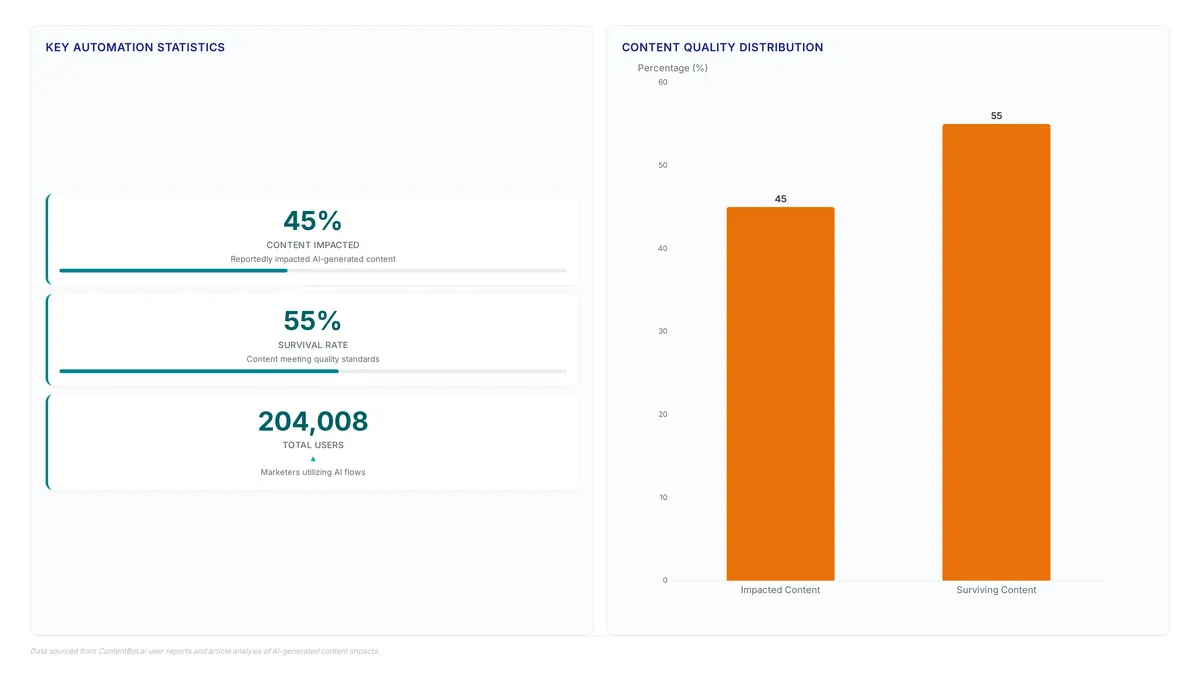
Workflow auditing begins by sorting operations to identify bottlenecks and repetitive tasks that AI can optimize. This classification prevents the common error of attempting to automate strategic judgment while leaving repetitive formatting manual.
- Systems handle keyword clustering and semantic optimization while humans retain control over angle and voice.
The most successful teams start by auditing their current content production processes before deploying agents. The cost of misclassification is measurable; automating strategy introduces brand risk, while manually executing formatting wastes capital.
The limitation here is technical capability versus strategic necessity; just because a task can be automated does not mean it should be. Effective solutions enforce these guardrails by default to maintain editorial standards at scale.
Configuring Auto-Publishing Rules and IndexNow Integration
This mechanism replaces manual deployment scripts with event-driven architecture, ensuring that a successful quality gate status immediately transitions an article from draft to live. The evidence for this approach lies in the definition of success: an article moving from draft to live with zero manual steps beyond editorial approval. However, relying solely on sitemap updates for discovery creates a latency window where content remains invisible to crawlers despite being published. The cost of this delay is measurable; without immediate notification, search engines may take days to detect new URLs through standard crawling cycles. This integration transforms the indexing phase from a passive waiting period into an active push notification system.
The implication for high-volume publishers is a reduction in the "silent period" where traffic potential is lost to delayed discovery. Skipping this validation risks publishing content that remains unindexed for days, negating the speed gains achieved during generation.
Validation Checklist for Performance Tracking and Workflow Refinement
This dual-metric approach identifies whether ranking drops stem from algorithmic shifts or brand omission in generative models.
Neglecting prompt updates allows model drift to degrade content relevance over time, a silent failure mode distinct from traffic volatility. The following table contrasts the required monitoring frequencies for operational stability.
| Metric Category | Review Frequency | Action Trigger |
|---|---|---|
| Organic Traffic | Weekly | Investigate ranking anomalies |
| AI Visibility | Weekly | Adjust brand context window |
| Prompt Library | Quarterly | Refine system instructions |
| Pipeline Latency | Daily | Optimize webhook handlers |
Teams fix slow content publishing cycles by treating the workflow as a continuous integration pipeline rather than a linear path.
Sustained growth requires treating content operations as a flexible system where data inputs constantly recalibrate generation logic.
Measuring ROI and Operational Gains from Automated Publishing Systems
Defining ROI Metrics for Automated Publishing Systems
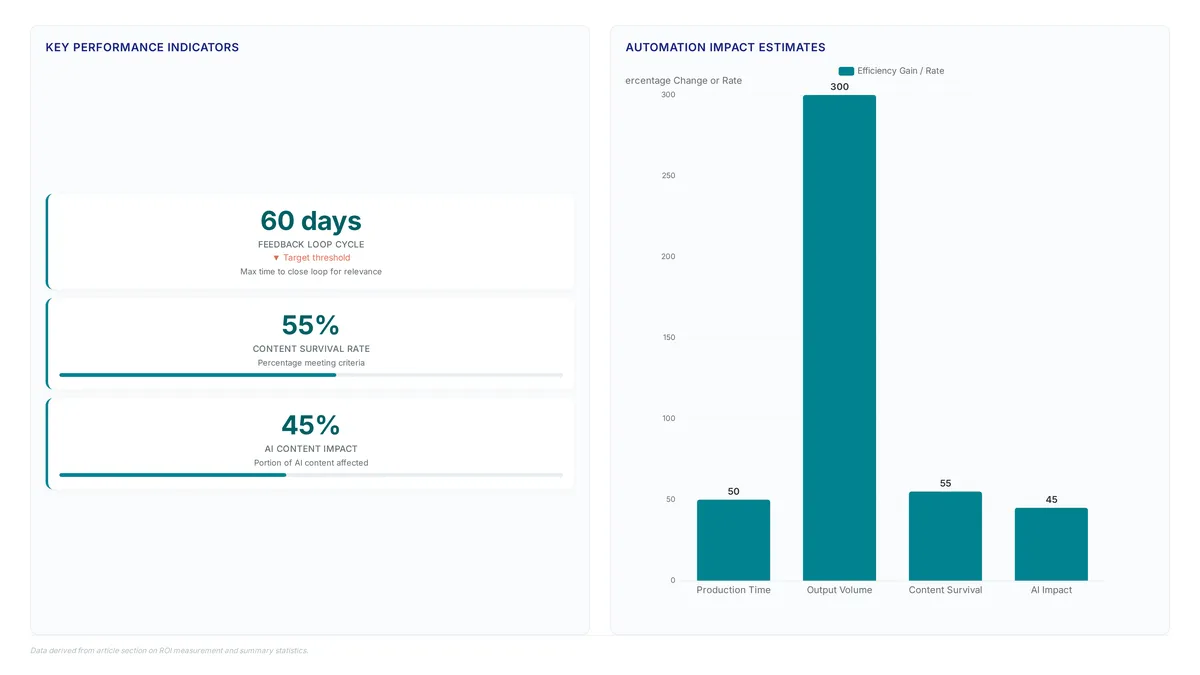
Operational ROI in publishing requires measuring mention frequency and sentiment alongside standard traffic data. Traditional SEO metrics capture indexation velocity and keyword ranking shifts. AI visibility metrics include mention frequency, sentiment, and specific prompts triggering citations. High organic traffic does not guarantee brand retrieval in generative models.
| Metric Category | Primary Signal | Operational Target |
|---|---|---|
| Traditional SEO | Index Coverage | Crawl Budget Efficiency |
| AI Visibility | Citation Rate | Prompt Trigger Accuracy |
Without this dual-axis tracking, operators risk optimizing for human readers while losing algorithmic relevance. The cost of ignoring AI visibility is measurable in lost referral contexts. The immediate step is configuring dashboards that ingest citation logs alongside analytics data.
Applying Performance Data to Refine Generation Parameters
Operational loops require encoding successful structures as default templates to stabilize output. The mechanism involves mapping high-performing content structures back into the generation prompt library.
| Data Signal | Parameter Adjustment | Operational Outcome |
|---|---|---|
| High Bounce Rate | Tighten topic constraints | Improved relevance |
| Low Citation Count | Expand entity coverage | Increased retrieval |
| Poor Sentiment | Adjust tone guidelines | Improved brand alignment |
Unlike rigid pipelines, this approach treats the workflow as a flexible system where generation parameters evolve based on empirical data rather than fixed rules. This ensures the system learns from correct examples before full autonomy. The next step is configuring your pipeline to ingest performance metrics directly into the prompt engineering layer.
Checklist for Adaptive Reporting and Prompt Library Reviews
Weekly digests replace manual monthly reports to capture drift in generation parameters before quality degrades. Teams asking should I automate my content process must validate that feedback loops close within 60 days of publication to maintain relevance. Static prompt libraries fail when model behaviors shift, requiring quarterly reviews to encode successful structures as default templates.
| Review Frequency | Scope | Operational Risk |
|---|---|---|
| Weekly | Digest metrics | Missed anomalies |
| Quarterly | Prompt library | Model drift |
| Annual | Architecture | Obsolescence |
Aligning reporting cadence with the speed at which 80% of marketers now use AI tools for content and media creation is necessary. The cost of ignoring this cycle is measurable: unrefined systems produce high volumes of irrelevant drafts that inflate crawl budgets without improving visibility. Automation without adaptive reporting merely accelerates the production of obsolete content.
| Checkpoint | Action | Owner |
|---|---|---|
| Data freshness | Verify weekly digest | Ops Lead |
| Prompt efficacy | Audit top 10 templates | Content Lead |
| Loop closure | Confirm 60-day cycle | Engineer |
Neglecting these reviews turns a scalable operating system into a rigid liability.
About
Hannah Brooks, Marketing Operations Lead at Enterium, specializes in the architecture of automated content workflows that scale without sacrificing governance. Her daily work involves auditing martech stacks, evaluating LLM providers, and orchestrating the precise handoffs between ideation, generation, and publishing systems. This operational depth makes her uniquely qualified to analyze how teams can build sovereign pipelines that reduce time-from-brief while maintaining strict quality gates. At Enterium, a B2B publication dedicated to documenting reproducible AI content methodologies, Hannah applies this same rigor to every analysis, focusing on measurable ROI rather than hype. She connects theoretical pipeline designs to the practical realities of content engineering, ensuring that automation strategies are grounded in actual production constraints. By using Enterium's vendor-neutral framework, she helps technical marketers and content leaders navigate complex tooling choices to construct resilient, data-driven content operations that function reliably in enterprise environments.
Conclusion
Scaling automated content workflows reveals a critical breaking point: static prompt libraries cannot survive model drift without quarterly architectural reviews. While background execution removes manual friction, it simultaneously hides the degradation of output quality until brand relevance suffers. The operational cost here is wasted compute, but worse is the accumulation of high-volume, low-value assets that dilute search visibility. Teams must shift from viewing automation as a set-and-forget utility to treating it as a flexible system requiring constant parameter tuning based on empirical data signals like bounce rates and citation counts.
Organizations should mandate that all generative pipelines ingest performance metrics directly into the prompt engineering layer, ensuring feedback loops close within the verified 60-day window to maintain market relevance. This approach prevents the workflow from becoming a rigid liability that accelerates the production of obsolete drafts. For immediate implementation this week, the Content Lead must audit the top ten prompt templates against current performance digests to identify where tone or entity coverage has drifted from brand guidelines.
Sustainable scale requires content workflow automation that evolves alongside model behaviors rather than relying on fixed rules. By anchoring your strategy in adaptive reporting, you ensure the system learns from correct examples before granting full autonomy.
Frequently Asked Questions
Manual steps create bottlenecks that cause scaling efforts to fail under demand. Automated workflows reduce revisions, allowing teams to increase output volume while staying within budget constraints effectively.
Continuous polling by specialized agents eliminates the detection latency found in manual processes. This ensures teams capture every instance where a brand is cited or omitted instantly without delay.
Founders must automate tracking because AI synthesis iteration speed outpaces manual verification methods. Relying on human checks creates blind spots in brand perception across generative answer engines.
Fragmentation forces operators to manage state manually, introducing latency and increasing version error risks. Output volume becomes unpredictable when human intervention is required at every single step.
Adopting a structured approach where AI manages parts of the lifecycle resolves the tension between volume and consistency. Teams then focus on strategy and strengthening E-E-A-T signals.
References