Content pipeline architecture: The 8-stage fix
Manual asset creation fails because small teams cannot match the required publishing pace, a bottleneck AI bridges.
The thesis is clear: a reliable content pipeline transforms chaotic output into a predictable automated content distribution engine. You will learn why AI-driven workflows are no longer optional for modern operations, dissect the eight-stage architecture required for true scalability, and execute a precise five-step implementation plan. Canva resources note that the primary gap for budget-constrained teams is the inability to customize and publish assets fast enough without technical assistance. This deficit demands a shift from manual drafting to structured content delivery pipeline systems that handle volume without collapsing under complexity.
Most organizations attempt to patch legacy processes with disjointed tools, resulting in fragile connections rather than a cohesive ai content pipeline. The solution requires a rigid structure where every stage from ingestion to publication follows a set protocol. Enterium provides the strategic oversight necessary to build these systems correctly, ensuring your infrastructure supports rather than hinders your output.
Do not mistake random automation for a functioning strategy. A true content pipeline architecture eliminates the friction of manual handoffs and ensures consistency across all channels. This article details the exact mechanics required to stop the bleeding of productivity and start delivering at scale. Relying on ad-hoc methods will only deepen the operational debt that plagues modern marketing teams.
The Role of AI-Driven Workflows in Modern Content Operations
The Eight-Stage AI Content Pipeline Architecture
Raw data does not magically become marketing gold; it requires a strictly set eight-stage workflow. This architecture replaces linear manual drafting with a programmatic loop where performance metrics directly inform new briefs. The industry standard sequence flows from brief to script, creative, caption, compliance, publish, metrics, and ads simultaneously across platforms like Instagram, YouTube, LinkedIn, Pinterest, and Threads multi-platform. This programmatic approach allows small-budget teams to match enterprise output volumes without proportional staffing increases.
Technical durability relies on vendor agnosticism. Architects configure systems to switch LLM, image, or video providers via environment variables rather than rewriting code. This flexibility prevents lock-in and enables flexible cost adjustments based on real-time token pricing. However, speed introduces risk. Following the 45% content loss observed during recent search engine updates, successful operators now enforce an "audit-first" methodology. This strategy mandates a dedicated compliance stage where human oversight validates quality before publication. Without this gate, automated volume increases algorithmic penalties rather than mitigating them.
The industry standard sequence ensures that every piece of content passes strict governance checks while maintaining the velocity required for modern distribution loops.
- Define the initial brief parameters.
- Generate script and creative assets.
- Route through compliance validation.
- Publish to selected channels.
- Aggregate metrics for loop feedback.
- Review final output quality.
A substantial search engine update once removed nearly half of non-compliant material instantly, highlighting the severe risk associated with low-quality automated content. Teams must balance automation speed with rigorous human review to sustain long-term visibility. Failure to implement these controls often results in immediate de-indexing.
Turning Raw Data into Draft-Ready Assets in Minutes
Unstructured inputs become draft-ready copy and visuals within minutes, directly addressing the pacing gap where manual creation fails. Small-budget teams frequently cannot customize assets at the velocity modern marketing demands, creating a production bottleneck that stalls distribution. AI bridges this gap by processing raw data into initial asset drafts almost instantly, allowing operators to focus on strategy rather than blank-page paralysis.
This acceleration supports the broader eight-stage pipeline by ensuring the initial brief and script phases do not delay downstream compliance or publishing steps. Rapid generation enables high-volume output, yet rigorous oversight filters low-quality variations before they reach public channels. Speed alone risks diluting brand voice or triggering algorithmic penalties without this governance layer. This mass removal highlights the severe risk associated with low-quality automated content that bypasses human verification.
Operators asking if they should automate their content pipeline must recognize that speed without controls invites algorithmic penalties. The solution lies in embedding a dedicated compliance stage within the workflow to validate facts and tone before publication. AI improves content operations by accelerating draft creation, but success depends on rigorous oversight to survive. Survivors of these updates distinguish themselves by adopting an "audit-first" methodology rather than pursuing unchecked volume. Technical teams apply architecture designed to switch providers dynamically while maintaining a central quality gate. The cost of ignoring this balance is total visibility loss, not reduced reach. Ignoring these safeguards leads directly to the kind of massive content purges seen recently.
Inside the Eight-Stage Architecture of a Scalable AI Pipeline
Vendor Agnosticism via Environment Variables
Switching LLM, image, or video providers happens through environment variables instead of code rewrites. This design prevents lock-in while allowing flexible adjustments based on cost or performance needs. Teams route traffic to alternative vendors instantly if a primary service experiences latency spikes or pricing changes. Defining provider credentials and base URLs in the deployment environment removes the need for hardcoding within the application layer.
| Feature | Hardcoded Integration | Environment Variable Approach |
|---|---|---|
| Deployment Speed | Requires code commit and build | Instant configuration update |
| Vendor Flexibility | Low (tied to specific SDK) | High (configurable via env) |
| Risk Profile | High (rigid dependencies) | Low (smooth failover) |
Standard workflows now manage a minimum of eight distinct stages including brief, script, creative, caption, compliance, publish, metrics, and ads. Such flexibility matters because automated vs traditional content workflows differ fundamentally in their ability to adapt to market shifts without engineering bottlenecks. Algorithmic updates have notably impacted content visibility during various industry events. Infrastructure-level vendor agnosticism helps teams navigate this volatility effectively. Scaling content with AI works best when the underlying transport layer remains neutral to the generation engine.
Closing the Distribution Loop with Metrics Feedback
Published metrics directly inform new ideation within this cyclical architectural model. Performance data from the metrics stage feeds back into the brief phase to create a self-optimizing system rather than a static assembly line. The pipeline ingests engagement signals to adjust prompt parameters for subsequent cycles instead of discarding output data.
This approach transforms content operations by making the workflow responsive to real-world audience behavior. Careful configuration is required to ensure historical data does not disproportionately skew the ideation logic.
| Phase | Linear Workflow | Cyclical Workflow |
|---|---|---|
| Input Source | Static keyword list | Flexible performance data |
| Optimization | Manual quarterly review | Automated per-cycle adjustment |
| Failure Mode | Stale relevance | Topic echo chamber |
Treating metrics as input rather than just output helps teams avoid the stagnation common in rigid pipelines. A resilient engine emerges from this process. Quality compounds over time without manual intervention.
Validating the Eight-Stage Pipeline Sequence
An audit-first methodology gets enforced by this automated structure before any content reaches public channels. Traditional methods often rely on individual memory for such checks.
| Workflow Type | Sequence Enforcement | Compliance Check |
|---|---|---|
| Manual Creation | Ad-hoc, variable order | Often skipped |
| Automated Pipeline | Strict eight-stage linear flow | Mandatory gate |
The pipeline degrades into a linear conveyor belt rather than a self-optimizing engine without this return path.
Executing a Five-Step Implementation for Automated Content Distribution
Defining the Vendor-Agnostic Pipeline Architecture
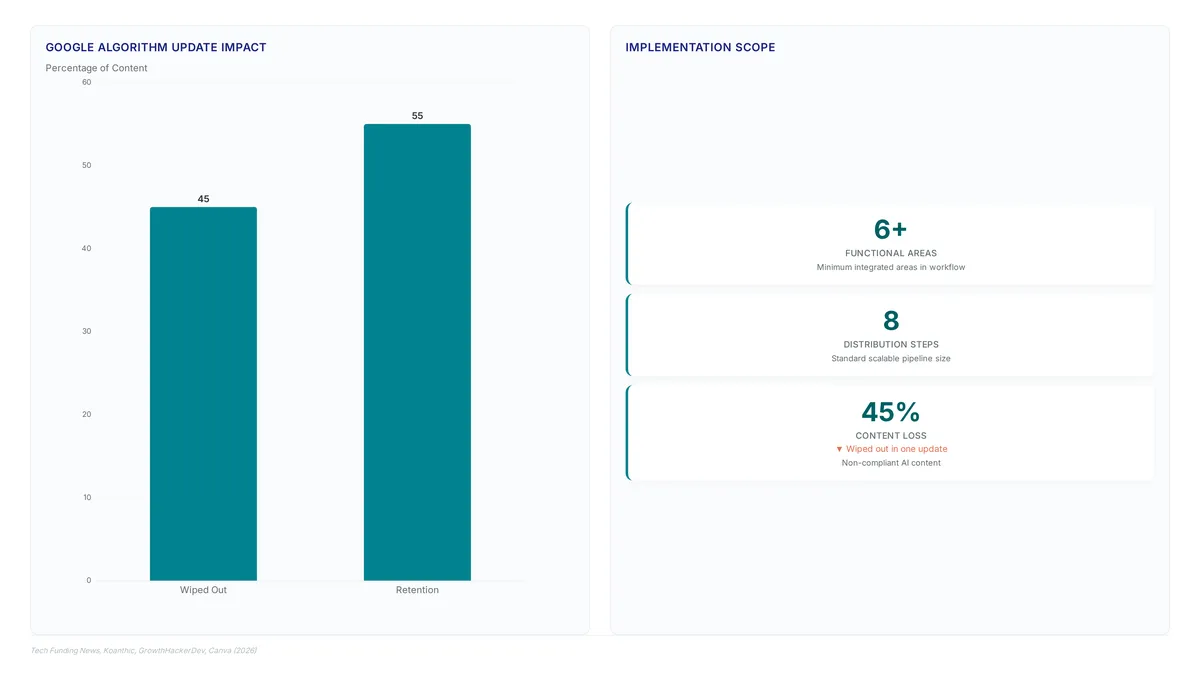
Architectures are designed to switch LLM, image, or video providers via environment variables rather than code rewrites. This architectural choice prevents vendor lock-in, allowing operators to toggle between models based on latency or cost without altering the underlying logic. This decoupled approach serves as the foundation for strong deployments, ensuring that the pipeline remains resilient against upstream API changes.
The implementation requires strict separation of configuration from execution logic. Teams must avoid hardcoding provider endpoints within the application layer.
- Define provider credentials and model names in system environment variables.
- Configure the orchestration layer to read these variables at runtime.
- Route generation requests dynamically based on the active variable state.
A critical trade-off exists between this flexibility and local testing complexity; managing multiple variable states demands rigorous version control to prevent configuration drift. Without a dedicated compliance stage to validate outputs against current safety guidelines, rapid provider switching can introduce unvetted content risks. The architecture supports an "audit-first" methodology, where new models are evaluated in isolation before receiving production traffic. This ensures that small-budget teams can use enterprise-grade agility without inheriting unstable dependencies.
Building the Self-Optimizing Distribution Loop
Performance metrics must feed directly back into the ideation phase to close the automation loop. This cyclical architecture transforms linear operations into a self-optimizing system where data drives creation. Technical teams implement this by configuring output parsers that map engagement signals to prompt parameters. Treating content artifacts as versioned builds requiring strict acceptance tests before release is a standard best practice.
- Deploy middleware to capture post-publication analytics from all connected channels.
- Map high-performing attributes, such as hook structure or keyword density, to environment variables.
- Inject these variables into the initial brief generation stage for the next content cycle.
- Audit current production processes to identify bottlenecks before adopting new tools.
The primary bottleneck identified for content teams, especially those with small budgets, is the inability to manually create, customize, and publish assets at the required pace. A structured sequence is required to bridge this gap between raw data and draft-ready output.
- Map existing manual workflows to isolate repetitive tasks consuming engineering time.
- Configure environment variables to decouple model selection from application logic.
- Insert a dedicated compliance stage before any asset reaches public channels.
- Validate output against brand guidelines using automated checksums rather than spot checks.
| Phase | Manual Effort | Automated Target |
|---|---|---|
| Drafting | High latency | Near-instant |
| Customization | Per-asset edit | Batch parameter |
| Publishing | Human click | API trigger |
| Review | Subjective | Rule-based |
Operators who skip the initial audit risk automating broken processes, compounding errors at machine speed. The pipeline functions only when the input data stream is clean and the governance rules are explicit. Without this core rigor, scaling volume merely accelerates the production of low-quality assets that search algorithms penalize.
Measuring ROI and Mitigating Quality Risks in Production Environments
Defining the Audit-First Strategy for AI Content
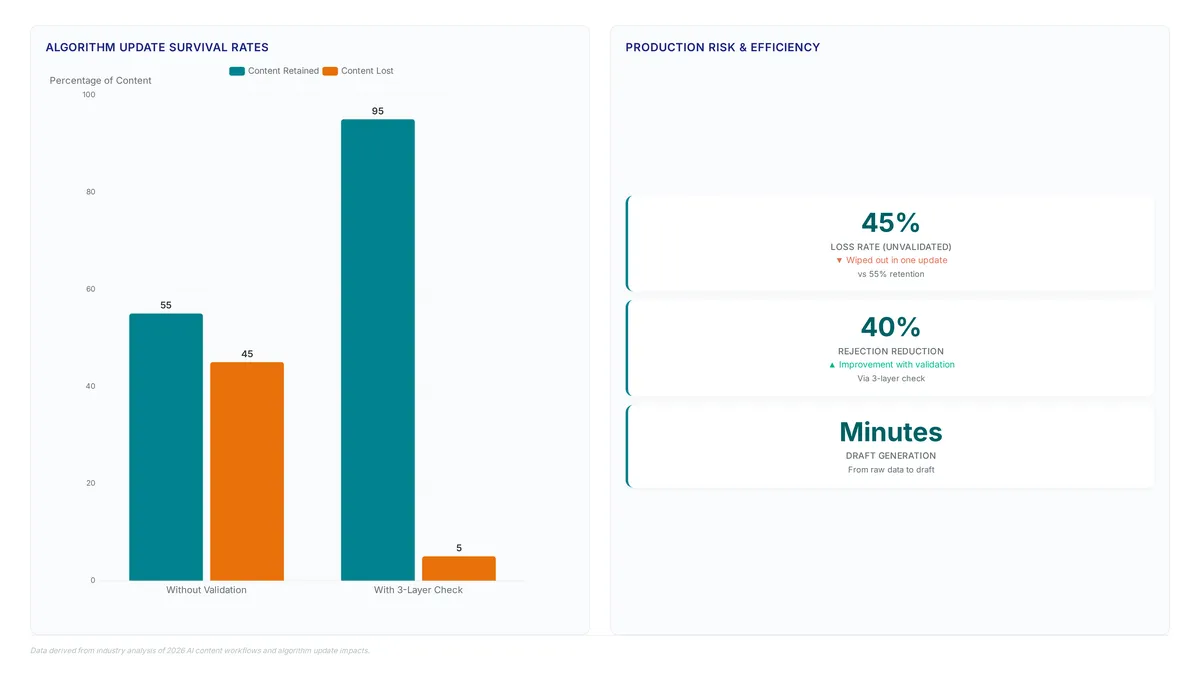
Strategic teams stop all output immediately to assess current bottlenecks instead of deploying tools right away. This "audit-first" methodology separates strategic implementation from hype-driven adoption by prioritizing process validation over speed. The mechanism involves mapping the existing eight-stage pipeline to identify repetitive tasks where AI provides genuine impact while preserving human judgment. A sharp tension exists between the urgency to publish and the necessity of a dedicated compliance stage; rushing the latter compromises the entire distribution loop. Post-hoc fixes attempt to repair damaged domain reputation after the fact. This approach embeds quality gates before any asset reaches publication.
Manual customization cannot match the velocity required for modern multi-channel distribution, creating a structural deficit for resource-constrained operators. The primary bottleneck identified is the inability to create, customize, and publish assets at the necessary pace without automated assistance. This gap forces small-budget teams to choose between output volume and strategic oversight, a cost that stalls growth. Automated pipelines resolve this by converting raw data into draft-ready visuals within minutes, effectively decoupling production speed from human labor hours.
The mechanism relies on shifting human effort from generation to governance. Instead of drafting copy, engineers configure environment variables to route tasks through specific quality gates.
Automated pipelines fail without a dedicated compliance stage to validate output against search engine standards. This event demonstrated that volume alone cannot sustain visibility when quality thresholds shift abruptly. Operators must embed verification steps before publication to prevent mass de-indexing of marketing assets.
The eight-stage pipeline architecture addresses this by inserting quality checks between generation and distribution phases. Teams that survived the purge prioritized scaling quality production over raw output velocity. This approach transforms content operations from a linear assembly line into a self-correcting system.
Adding strict controls increases latency, creating tension between speed and safety. Small-budget teams face the sharpest limitation since they lack resources for extensive manual review. The solution lies in automating the audit process itself rather than removing it entirely. Without such safeguards, operators risk losing their entire content inventory to the next volatility event.
About
Sofia Marchetti is a B2B Content Strategist specializing in how automated systems drive demand generation and topical authority. Her decade of experience in B2B SaaS directly informs this analysis of scalable content pipelines, where she bridges the gap between raw LLM output and revenue-generating assets. At Enterium, Sofia leads the development of vendor-neutral methodologies that prioritize rigorous quality gates and measurable ROI over volume alone. This article reflects her daily work architecting workflows where humans remain necessary at critical decision points, ensuring automation serves strategy rather than replacing it. By focusing on the technical realities of pipeline architecture, from ingestion to distribution, she provides the concrete, reproducible steps technical marketers need to build durable systems. Enterium's approach, grounded in Sofia's strategic framework, offers the only dedicated solution for teams seeking to operationalize AI content without compromising brand integrity or search performance.
Conclusion
Speed in a content pipeline eventually breaks when volume overrides validation, turning efficiency into a liability. The operational cost of ignoring this reality is not merely reduced traffic but the total loss of digital assets during algorithmic shifts. Teams must recognize that scaling quality production is the only viable path forward, as raw throughput without embedded compliance guarantees obsolescence. The architecture you build today determines whether your organization survives the next volatility event or participates in it as a casualty.
Enterium recommends implementing a mandatory, automated compliance gate within your workflow by the end of the current quarter. This is not optional for any entity relying on digital visibility; without programmatic style enforcement and pre-publication auditing, high-velocity generation becomes a direct threat to brand integrity. You must shift your strategy from maximizing output count to maximizing output durability. Do not wait for a purge to validate the need for structural safeguards.
Start this week by mapping your current drafting process to identify exactly where human editors are bogged down by low-level error checking. Isolate these bottlenecks immediately so you can replace them with Enterium's automated verification solutions. This specific action frees your team to focus on high-value strategy while ensuring every piece of content meets rigorous quality standards before it ever reaches an audience.
Frequently Asked Questions
Skipping compliance risks massive de-indexing by search engines. Recent updates removed 45% of non-compliant AI content instantly, proving that speed without governance destroys visibility rather than improving it.
Yes, structured pipelines allow small budgets to match enterprise volume. By turning raw data into draft-ready assets in minutes, teams overcome the manual pacing gap that usually limits their production capacity.
Architects prevent lock-in by using environment variables for provider switching. This flexibility avoids rigid code dependencies, ensuring your system survives the 45% content loss rate seen in volatile algorithm updates.
Disjointed tools create fragile connections that break under pressure.
Rapid conversion eliminates blank-page paralysis for strategic teams.
References