Content automation workflows that hit 24x speed
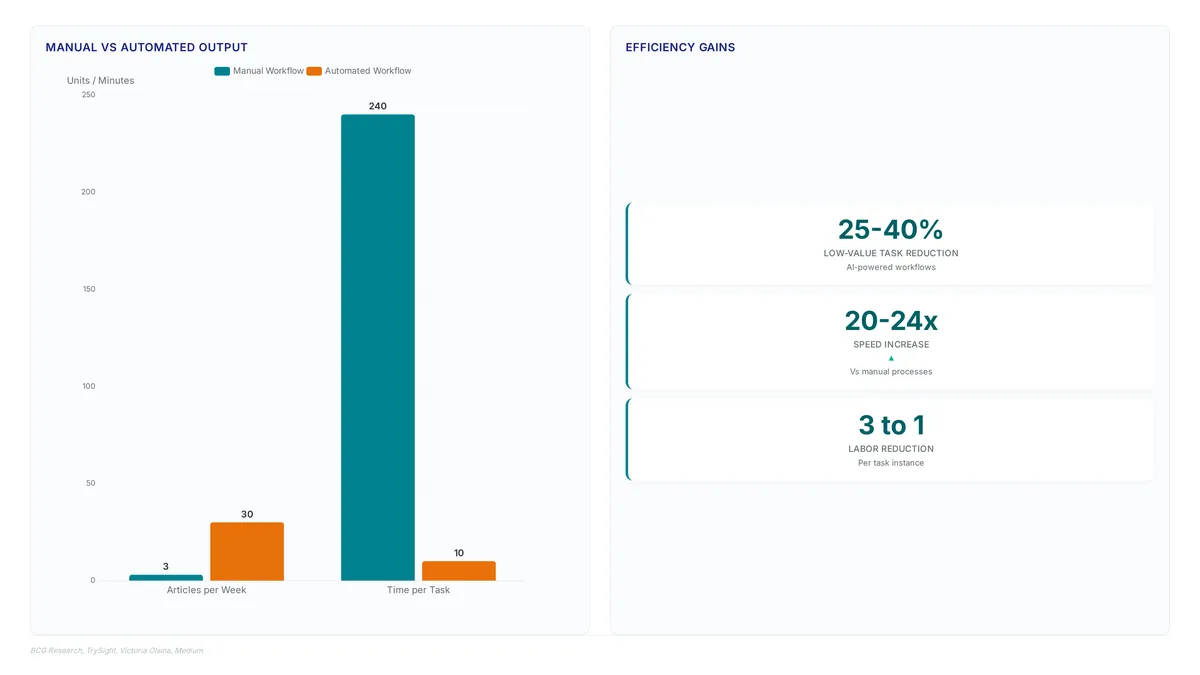
AI-assisted workflows achieve documented speed gains of 20, 24x compared to manual processes. This isn't just about typing faster; it's a fundamental shift from drafting to architectural oversight. The math is unforgiving: organizations that fail to integrate format-specific AI agents into their core strategy will cede topical authority to competitors who move quicker and smarter.
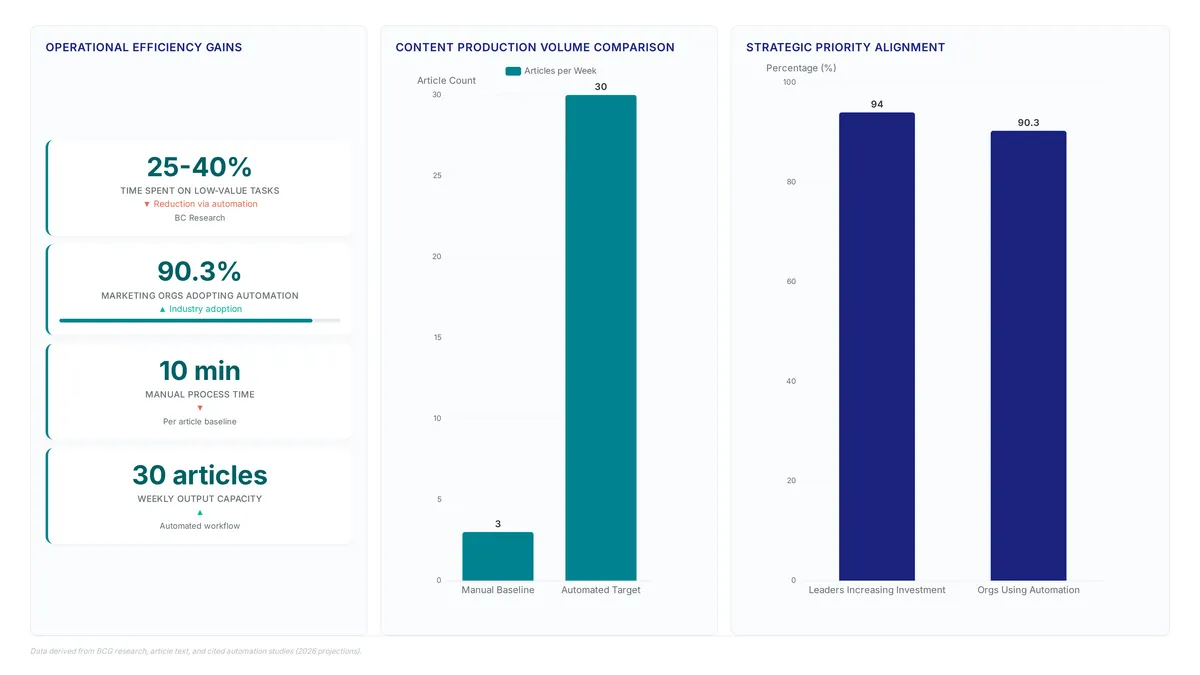
BCG research indicates that these AI-powered workflows reduce time spent on low-value tasks by 25-40%, freeing teams to focus on strategic alignment rather than rote execution. This efficiency is measurable. It comes from deploying content automation workflow structures that prioritize semantic precision over volume. The market has moved past simple text generation. It now demands automated internal linking and GEO optimization that signal deep relevance to answer engines.
You need to construct automated content briefs that guide AI output without stifling nuance. The framework below calculates ROI when transitioning from manual editing to AI content generation systems that deliver consistent, data-backed results.
The Role of Content Automation in Modern SEO Operations
Content Automation as an Operational Necessity for SEO Teams
Content automation replaces manual brief creation with systematized workflows required to match search velocity. This distinguishes the practice from simple AI text generation by emphasizing architectural consistency over output volume. For teams asking what is content automation for SEO, the answer lies in pipeline reliability rather than draft speed. Topical authority shifts under this model; it becomes a function of structured data density and internal link precision that manual processes cannot sustain at scale.
This widespread integration indicates that AI-assisted workflows are no longer an experimental lever but a baseline requirement for market participation. The mechanism connects different parts of the workflow into a cohesive system: tools identify topics, generate drafts based on keywords, and schedule finished pieces for publication.
Velocity creates risk. Automated systems amplify errors as efficiently as they propagate correct data if quality gates remain absent. Teams implementing these workflows must install strict validation layers to prevent semantic drift. Without human oversight on strategy and brand alignment, automation degrades trust signals rather than building them. Operators must treat automation as a force multiplier for disciplined editors, not a replacement for editorial judgment. Prioritizing workflow integration over raw generation speed is necessary to secure long-term visibility.
Layered Implementation Roadmap for Indexing and Internal Linking
Automation handles repetitive tasks like keyword clustering, semantic optimization, and formatting while humans focus on angle, voice, and editorial standards. This sequence prevents systems from amplifying unreachable content. Teams asking should I automate my SEO content workflow receive a conditional affirmative based on this specific architectural ordering. Generic AI generation without prior structural control creates noise rather than authority.
Structured indexing workflows establish the necessary signal-to-noise ratio for downstream operations. AI-powered workflows in content automation reduce time spent on low-value tasks by 25-40%. This efficiency gain allows engineers to focus on schema validation and crawl budget optimization instead of manual submission logs.
This drastic reduction in labor hours validates the shift toward agent-driven operations. However, deploying these agents before stabilizing the indexing layer risks propagating errors across the site hierarchy.
Operators should implement a strict gate where format-specific agents only activate after successful indexation verification. This dependency ensures that every generated link points to a live, recognized resource. Validating this chain through server logs before scaling brief generation ensures the system delivers structured growth rather than chaotic volume.
Failure Modes Including Thin Content and Zero AI Discoverability
Poorly executed automation generates thin content and keyword stuffing that erodes topical depth. This approach fails because generic models lack the specific constraints required for SEO content quality. When teams ask what is content automation for SEO, the distinction lies in structured workflows versus raw text generation. Without format-specific agents, output often misses the semantic density needed for authority.
A critical tension exists between publishing velocity and AI discoverability. Teams winning organic traffic in 2026 are publishing smarter and quicker with visibility into performance across traditional search engines and AI models. Conversely, systems that prioritize speed over structure create unindexed noise. This volume without value leads to zero presence in AI-generated responses.
The consequence is a measurable loss of relevance despite high output counts. Operators must track mentions in AI responses to validate topical authority signals. Relying solely on keyword volume ignores how modern algorithms assess depth.
- Automation without briefs creates shallow articles.
- Generic agents miss semantic internal linking opportunities.
- Missing AI tracking blinds teams to new discovery paths.
Implementing strict quality gates before any publication step is critical. Teams must verify that their automated content briefs enforce depth requirements. Only then does the pipeline secure lasting visibility rather than temporary noise.
Inside the Architecture of Format-Specific AI Agents and Brief Automation
How Format-Specific AI Agents Differ from Generic Models
Format-specific AI agents ingest structural constraints for a single content type while generic models apply uniform logic across all formats. Automation delivers the strongest ROI for high-volume teams with repeatable content needs. A format-specific AI agent receives training or prompting set by the strict topical requirements of one output style, such as a product comparison table or a technical changelog. Generic systems lack this specialized context, leading to output that requires heavy manual rewriting to align with business needs. Structured workflows and clear review checkpoints help teams scale without losing quality.
| Feature | Generic Model | Format-Specific Agent |
|---|---|---|
| Logic Scope | Uniform across types | Constrained to one format |
| Structure | Variable, often inconsistent | Enforced via template |
| Topical Depth | Broad and shallow | Deep within vertical |
Maintaining separate agents increases pipeline complexity compared to a single multi-purpose model. Operators must manage distinct prompt libraries for each content vertical. Specialization enables the system to create topics for new content that genuinely expand a site's topical authority. Automated briefs often miss the detailed depth required for high-value pages without format specificity. Operational overhead is the cost in exchange for higher initial quality and reduced editorial rework. Teams should deploy these agents when scaling volume compromises structural consistency. Isolating agents by content format helps maintain strict quality gates.
Automating Content Briefs via SERP Analysis and Templates
Automating content briefs replaces manual research with an agent that extracts target keywords, surfaces related entities, and maps common SERP structures into a production-ready template. This workflow shifts the human role from researcher to reviewer, ensuring structural alignment before drafting begins. Unlike generic models that apply uniform logic, a format-specific AI agent ingests the specific constraints of a single content type to generate precise instructions. Documented cases of AI-assisted content workflows show speed gains of 20, 24x compared to manual processes, primarily by eliminating the initial data gathering phase. The system functions by querying search results to identify recurring semantic patterns and entity relationships that define topical authority.
- The system processes search queries to spot gaps and track intent shifts.
- It identifies common SERP structures and entity clusters.
- The system outputs a brief template ready for production.
Efficiency introduces a constraint: without strict format conventions, automated briefs may prioritize volume over the detailed depth required for complex technical topics. Generic writing tools often fail here because they lack the specialized context needed to distinguish between a high-level overview and a deep-dive specification. An agent trained only on surface-level headers might miss the underlying topical requirements necessary for genuine expertise.
| Feature | Manual Briefs | Automated Briefs |
|---|---|---|
| Data Source | Human sampling | Full SERP scrape |
| Entity Coverage | Variable | Thorough |
| Speed | Hours per brief | Seconds per brief |
Teams adopting this model must treat the output as a flexible scaffold rather than a final directive. Validating the entity coverage of generated briefs against known gaps in your existing corpus ensures alignment. The immediate next step is to configure your agent to extract recurring question headers from SERP data to maintain focus.
Listicle vs Comparison Page Agent Structural Logic
Specialized agents diverge from generic models by enforcing distinct output schemas rather than applying uniform logic across formats. A listicle agent generates labeled items where each entry requires a clear identifier, brief explanation, and practical takeaway. Conversely, a comparison agent organizes data around feature matrices, specific use cases, and decision criteria. This structural separation prevents the formatting errors common when generic tools attempt diverse content types without specific constraints.
| Feature | Listicle Agent | Comparison Agent |
|---|---|---|
| Primary Unit | Labeled Item | Feature Matrix |
| Data Focus | Practical Takeaway | Decision Criteria |
| Structure | Linear Sequence | Cross-Tabulated |
Sight AI uses this approach with 13+ specialized AI agents, each tuned for a specific content format and optimized for both SEO and GEO signals. Prompt complexity creates operational tension; listicle agents need narrative flow constraints, while comparison agents require strict data normalization to function. Teams using generic models often face heavy rewriting costs because the output lacks these inherent structural guardrails. Deploying format-specific agents is recommended when volume exceeds manual editing capacity. Maintaining separate agent configurations increases initial setup time compared to single-prompt workflows. The reduction in post-generation editing yields net efficiency gains for high-volume production environments. Structural fidelity drives ranking performance more than raw text generation speed alone.
Measurable ROI from Automated Internal Linking and GEO Optimization
Semantic Similarity and Entity Clarity in Automated Linking
Crawlers scan content libraries to find connections using semantic similarity, keyword overlap, and topical cluster relationships. These systems replace manual mapping by parsing entity definitions across the entire corpus so that connections reflect conceptual proximity rather than simple string matching. Structural rigor determines whether AI models parse and cite content accurately for Generative Engine Optimization. Content must possess entity clarity and a citation-friendly structure to become discoverable by answer engines.
Balancing depth with precision drives successful implementation. Automated systems speed up production by handling repetitive tasks while humans guide strategy and quality, yet they still require review to ensure alignment with business needs. Aggressive linking for crawl depth often conflicts with maintaining a clean user experience.
Reduced visibility in AI-generated responses occurs when teams ignore GEO optimization principles. Structured data and clear entity definitions directly impact how often content surfaces as a source for teams implementing these workflows. Visit the SEO automation guide to understand how keyword clustering expands topical authority. Practitioners should audit existing link structures for semantic relevance before deploying agents to avoid propagating legacy errors.
Configuring Decay Thresholds and Refresh Workflows
Connecting content inventory to analytics and rank tracking data starts the implementation process. Teams set automated performance monitoring for metrics including ranking position, organic traffic, click-through rate, and impressions. The system triggers a refresh workflow rather than waiting for manual audits when data crosses set boundaries. This approach addresses thin content from AI generation by flagging underperforming assets for immediate structural repair or entity expansion.
Automating internal linking steps involves crawling existing libraries to insert context-aware anchors before republishing updated drafts. Flexible semantic matching replaces static URL maps and adjusts as the corpus grows. Aggressive automation risks creating circular link structures if the initial entity graph lacks sufficient diversity.
| Trigger Condition | Action | Target Metric |
|---|---|---|
| Ranking drop (30-day) | Regenerate brief | Position recovery |
| Traffic decline (Q/Q) | Expand entities | Session duration |
| CTR below baseline | Rewrite headlines | Click volume |
Increased computational overhead during peak indexing windows represents the cost of this precision. Since 94% of digital leaders plan to increase investment in AEO in 2026, the window for manual intervention narrows notably as discovery shifts to AI-generated answers. Establishing these decay parameters before scaling production volume is necessary for maintaining efficiency.
GEO Review Checkpoints and Citation-Friendly Structure
Updating content brief templates to mandate direct answer formatting begins the establishment of a citation-friendly structure. This structural shift ensures AI models parse entity clarity without ambiguity, directly affecting whether answer engines surface the content. Generated drafts often lack the semantic density required for AI discoverability without explicit formatting rules in the brief.
Distinct review checkpoints must exist within a rigorous audit workflow before publication approval.
- Confirm headers use noun-heavy phrasing to match query intent.
- Check that format-specific AI agents followed the assigned schema.
- Validate that internal anchors connect to semantically similar clusters.
| Review Stage | Manual Check | Automated Gate |
|---|---|---|
| Entity Definition | Author intuition | NLP extraction |
| Citation Format | Visual scan | Regex validation |
| Link Depth | Spot check | Graph analysis |
Content lacking direct answers fails to populate rich snippets, rendering high-volume production useless for visibility. Automation handles repetitive tasks like semantic optimization, yet human oversight remains the only variable ensuring angle and voice align with brand standards. Teams that implement these steps for automating internal linking see compounding returns as the knowledge graph expands. Content remains invisible to generative interfaces regardless of keyword density when the structural requirement for citation-friendly formatting is ignored. Integrating these checkpoints into your current CMS publishing workflow is the immediate next step.
Action Target Metric : : : Ranking drop 30day Regenerate brief Position recovery Traf.
Ead during peak indexing windows. Since 94% of digital leaders plan to increase inv.
Deploying a Scalable SEO Content Workflow in Five Steps
IndexNow Protocol Mechanics for CMS Integration
IndexNow replaces delayed crawl discovery with immediate, event-driven URL submission triggers. Traditional crawl-based discovery can leave new content undiscovered for days or weeks, creating latency gaps in search visibility. The IndexNow protocol, documented by Microsoft Bing and Yandex, enables websites to proactively notify search engines of new or updated content the moment publication occurs. This mechanism shifts the burden of discovery from the search engine's scheduler to the publisher's CMS integration layer. Implementing this requires configuring the web server to emit a secure key and sending a HTTPS POST request upon every publish event.
- Generate a cryptographic key and host it at the assigned well-known URI path.
- Configure the content automation system to trigger a submission payload immediately after database commits.
- Verify acceptance via HTTP 200 status codes to confirm queue entry.
Increased outbound traffic volume represents the primary constraint; every draft save or minor edit risks triggering a submission if not throttled by logic gates. Operators must debounce these events to avoid overwhelming the ingestion API during high-volume publishing windows. For teams deploying format-specific AI agents, this immediacy ensures that niche, time-sensitive topics enter the index before generic competitors' crawlers arrive. Relying solely on passive crawling leaves revenue-generating updates invisible during peak news cycles. Integrating proactive submission closes the window between publication and potential ranking. The Enterium recommendation is to treat URL submission as a transactional dependency, not a background task, ensuring zero-latency visibility for critical assets.
Executing the Five-Step Automation Roadmap
Execute the indexing workflow first to eliminate crawl latency before layering complex generation logic. Traditional discovery leaves new pages invisible for days, so immediate notification via the IndexNow protocol forces instant visibility. The second step deploys automated internal linking to connect these fresh URLs into existing semantic clusters. Without this structural glue, isolated pages fail to inherit topical authority from established domains. Third, introduce AI-assisted brief generation to standardize inputs for human writers. This stage converts raw SERP data into structured templates, ensuring consistent coverage across hundreds of articles. Finally, apply GEO optimization layers to tune content for answer engine consumption. This specific sequence prevents teams from generating high-volume drafts that search engines cannot find or understand.
A common failure mode involves building sophisticated briefs for pages that remain unindexed for weeks. The operational cost of re-processing unlinked content exceeds the initial setup time for proper workflow orchestration.
- Automate indexing triggers on publish events.
- Run semantic linking algorithms against the corpus.
- Generate structured briefs from live SERP data.
- Apply generative engine formatting rules.
Teams skipping the indexing foundation often see publishing volume rise while organic traffic remains flat. The bottleneck shifts from creation to discovery, rendering subsequent automation layers ineffective.
Validating Indexing Triggers and AI Visibility Metrics
Confirm webhook support in your CMS to trigger immediate indexing notifications upon publication. Without event-driven hooks, teams rely on scheduled scans that introduce unavoidable latency into the visibility window.
- Configure the CMS integration to emit a secure key and send an HTTPS POST request for every publish event.
- Monitor indexing status daily within Google Search Console and Bing Webmaster Tools to verify ingestion.
- Track whether content earns mentions inside AI-generated responses on platforms like ChatGPT, Claude, or Perplexity.
| Trigger Type | Detection Latency | Verification Method |
|---|---|---|
| Crawl-Based | Days to weeks | Manual URL inspection |
| Event-Driven | Seconds to minutes | Server log analysis |
| AI-Generated | Variable | Prompt-based audit |
Operators often neglect that AI visibility requires distinct validation separate from traditional SERP ranking. A page can be indexed yet remain invisible to generative engines if semantic signals are weak. Monitoring AI mentions demands manual prompt engineering or specialized observation tools rather than standard analytics dashboards. Most teams fail to close this loop, leaving high-performing content unverified in the very systems rewriting search behavior. Enterium recommends prioritizing the automation of these indexing workflows before scaling content volume. Teams that skip this validation step risk publishing thousands of articles that never enter the topical authority graph. The immediate consequence is wasted compute resources on content that generates zero organic return. Secure the pipeline first, then scale the output.
About
Sofia Marchetti is a B2B Content Strategist specializing in how automated content systems drive pipeline through topical authority and durable distribution. With over a decade of experience in B2B SaaS demand generation, she is uniquely qualified to analyze content automation systems that promise 24x speed gains without sacrificing SEO integrity. Her daily work involves architecting SEO workflows where AI-generated content meets rigorous quality gates, directly mirroring the article's focus on format-specific AI agents and automated internal linking. As the strategic voice behind Enterium, a brand dedicated to documenting how modern teams scale content pipelines with LLMs, Sofia bridges the gap between theoretical AI content generation and production reality. She evaluates automated content briefs and semantic linking strategies not as abstract concepts, but as reproducible engineering challenges. This piece reflects her practitioner-led approach to building topical authority where humans remain necessary on the governance gates, ensuring AI discoverability aligns with long-term revenue goals.
Conclusion
Scaling content output without securing the indexing pipeline creates a critical failure point where publishing volume actively dilutes organic performance. As the industry pivots from simple writing assistants to autonomous AI Agents that manage the full lifecycle, the operational cost shifts from generation to verification. Teams that ignore event-driven triggers face a compounding debt of unindexed assets, rendering their content automation workflow ineffective regardless of throughput speed. The bottleneck is no longer creation capacity but the latency between publication and discovery by both search crawlers and generative models.
You must implement webhook-based indexing triggers immediately to eliminate the delay inherent in scheduled scans. Do not attempt to scale your content automation system beyond current levels until you can verify that every published piece emits an immediate ingestion signal. This distinction separates functional pipelines from resource drains. Start this week by auditing your current CMS configuration to confirm it supports secure HTTPS POST requests for every publish event, replacing any manual or cron-based verification methods that introduce days of latency.
This performance leap shifts operations from manual drafting to high-velocity architectural oversight, requiring teams to prioritize semantic precision over simple volume generation.
Q: How much time do teams save on low-value tasks using automation?
A: AI-powered workflows reduce time spent on low-value tasks by 25-40% according to research.
Q: What happens if format-specific agents activate before indexation verification?
A: Deploying agents before stabilizing the indexing layer risks propagating errors across the site hierarchy. Operators must implement a strict gate where these agents only activate after successful indexation verification to ensure every generated link points to a live resource.
Q: Can automation replace the need for human editorial judgment entirely?
A: Automation acts as a force multiplier for disciplined editors rather than a replacement for editorial judgment. Without human oversight on strategy and brand alignment, automation degrades trust signals rather than building them, leading to potential semantic drift.
Q: How does automation impact the scale of content production teams?
A: Teams using automation report the ability to scale content production significantly while reducing manual workload. This drastic reduction in labor hours validates the shift toward agent-driven operations that prioritize structured growth rather than chaotic volume.
Frequently Asked Questions
AI-assisted workflows achieve documented speed gains of 20–24x compared to manual processes. This performance leap shifts operations from manual drafting to high-velocity architectural oversight, requiring teams to prioritize semantic precision over simple volume generation.
AI-powered workflows reduce time spent on low-value tasks by 25-40% according to research. This efficiency gain allows engineers to focus on schema validation and crawl budget optimization instead of managing manual submission logs.
Deploying agents before stabilizing the indexing layer risks propagating errors across the site hierarchy. Operators must implement a strict gate where these agents only activate after successful indexation verification to ensure every generated link points to a live resource.
Automation acts as a force multiplier for disciplined editors rather than a replacement for editorial judgment. Without human oversight on strategy and brand alignment, automation degrades trust signals rather than building them, leading to potential semantic drift.
Teams utilizing automation report the ability to scale content production significantly while reducing manual workload. This drastic reduction in labor hours validates the shift toward agent-driven operations that prioritize structured growth rather than chaotic volume.
References