Content operations framework: fix broken workflows
45% of B2B marketers admit they lack a scalable creation model. Without a system, brilliant plans dissolve into missed deadlines and chaotic approvals. Content operations provides the missing execution layer.
This framework defines exactly who owns each step and what quality standards apply before publication. It establishes the five pillars required to build repeatable production workflows, stopping teams from reinventing the wheel for every new asset. Most critically, it implements lightweight governance to eliminate the approval bottlenecks plaguing lean marketing teams.
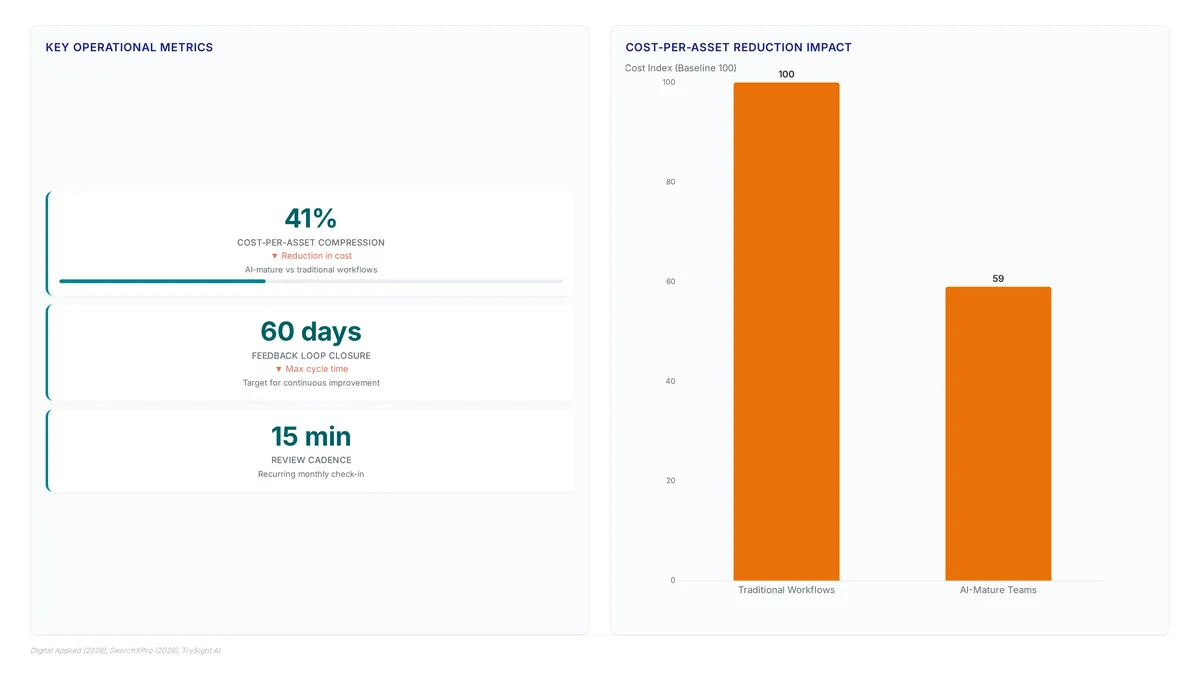
The stakes are quantifiable. Only 35% of organizations currently claim to have a scalable model, according to Content Marketing Institute research. Conversely, teams that mature their operations and integrate AI tools have seen a 41% compression in cost-per-asset compared to traditional methods. Fixing the process is as critical as devising the plan.
Content Operations Set as the Execution Layer Beneath Strategy
Content Operations as the Execution System Beneath Strategy
Content operations is the repeatable system executing the plan. It is distinct from the strategic definition of audience or goals. Strategy answers why content exists. Operations defines the production process, ownership, and quality gates required to ship work consistently.
Currently, 45% of B2B marketers report lacking a scalable model for content creation, leaving strategy documents disconnected from actual output. Teams default to ad hoc execution, reinventing workflows for every asset rather than relying on established repeatable workflows that reduce cognitive load and error rates. Operational maturity requires separating the planning layer from the execution layer to prevent approval bottlenecks. Without this separation, organizations struggle to close feedback loops within the recommended 60 days post-publication, slowing iteration and misaligning output with market signals. High-performing strategies fail during implementation due to unclear roles and missing tool configurations when a set system is absent.
| Concept | Function | Output |
|---|---|---|
| Content Strategy | Defines audience and goals | The Plan |
| Content Operations | Executes via tools and roles | The System |
| Ad Hoc Work | Relies on individual memory | Chaos |
Content governance is not a committee; it is a set of enforced constraints within the workflow itself. Ignoring this layer causes measurable stagnation. Teams remain stuck in "just doing the work" mode where no asset builds on previous learning. Scaling requires shifting focus from individual heroics to system reliability.
Content Strategy Plans Versus Content Operations Systems
Content strategy defines audience and goals, whereas content operations constructs the repeatable workflows required for execution. Strategy answers the "why" behind an editorial calendar. Operations establish the automated quality gates that validate output before publication.
Teams without set systems default to ad hoc production. They reinvent processes for every asset rather than using established protocols.
| Feature | Content Strategy | Content Operations |
|---|---|---|
| Primary Function | Audience definition and goal setting | Workflow execution and ownership |
| Output | Strategic plan and topic maps | Published assets and quality reports |
| Failure Mode | Misaligned messaging | Missed deadlines and inconsistent quality |
| Timeline | Quarterly or annual planning cycles | Continuous, daily production loops |
Operational frameworks rely on feedback loops closing within 60 days to ensure continuous alignment with strategic intent. Organizations struggle to maintain velocity while adhering to quality standards without this structural separation. Lost productivity and delayed time-to-market for critical campaigns measure the cost of ignoring this layer. Effective systems apply tools like Grammarly as technical filters to reduce manual review hours. Teams must build the plumbing before expecting the water to flow consistently.
Applying Content Operations to Fix Bottlenecks Without New Hires
Small teams fix bottlenecks by carving time to build systems rather than hiring more writers. Content operations transforms chaotic execution into a scalable model without expanding headcount. Strategy defines the audience. Operations constructs the repeatable workflows that turn plans into shipped assets.
Teams implementing these frameworks report a 41% compression in cost-per-asset compared to traditional, linear workflows. This efficiency gain allows lean groups to maintain output velocity despite limited resources. Distinguishing between content ops and marketing ops clarifies the operational scope. Marketing operations manages the broader tech stack and lead data. Content operations focuses strictly on the editorial supply chain. Successful implementation requires closing performance feedback loops within 60 days of publication to ensure continuous strategy alignment. Practitioners achieve this velocity by using tools like Google Search Console to validate topics against real traffic data quickly.
| Aspect | Content Operations | Marketing Operations |
|---|---|---|
| Primary Scope | Editorial production and quality gates | Lead data and campaign tech stack |
| Key Output | Published, compliant assets | Clean pipeline and attribution |
| Feedback Loop | Topic validation post-publication | Lead scoring optimization |
The solution lies in lightweight governance rules that catch failures without blocking every draft. Teams that delay systematizing this layer often find their strategic goals outpace their ability to execute them. Operational maturity means building the machine that does the work, not doing the work itself.
The Five Pillars Driving Repeatable Content Production Workflows
Defining the Five Pillars of Content Operations
A functional content production process requires five distinct operational pillars to convert static strategy into shipped assets. Strategy and goals must narrow focus to two or three metrics that directly correlate with business outcomes, ignoring vanity data that obscures performance signals. People and roles demands explicit documentation of ownership for every step, ensuring every box says your name even in solo operations to enable future scaling. Process and governance relies on concise, one-page checklists rather than 40-page manuals, embedding repeatable workflows that standardize quality without administrative bloat. Technology and tools should solve specific bottlenecks like version control, avoiding premature implementation of complex stacks with three integration layers before necessity dictates. Finally, Measurement closes the loop by analyzing performance data within strict timeframes to validate tactical adjustments.
| Pillar | Primary Function | Operational Risk |
|---|---|---|
| Strategy | Defines success metrics | Tracking too many KPIs dilutes focus |
| People | Assigns clear ownership | Undocumented steps create single points of failure |
| Process | Standardizes execution | Over-governance slows production velocity |
| Technology | Automates repetitive tasks | Tool sprawl increases maintenance overhead |
| Measurement | Validates output value | Delayed feedback prevents course correction |
Teams implementing these structured pillars alongside pillar-and-cluster architecture can close performance feedback loops within 60 days, accelerating optimization cycles significantly. However, rigid adherence to all five pillars simultaneously often stalls early momentum; operators should prioritize documenting people and process before expanding technology stacks. The immediate constraint for most lean teams is not a lack of tools, but the absence of set handoff protocols that allow content to move without constant intervention. Enterium recommends auditing current workflow documentation this week to identify where knowledge remains trapped in individual memory rather than explicit system rules.
Implementing Lightweight Documentation for Solo Teams
Documenting ownership steps for a team of one requires writing down procedures even when every box says your name. This practice converts implicit knowledge into transferable assets, preventing total operational collapse when the primary operator leaves. Without this baseline, scaling requires rebuilding institutional memory from scratch rather than delegating tasks. The People and roles pillar functions as a placeholder for future capacity, not current assignment.
Operational rules should fit on a single page to guarantee adherence during high-pressure cycles. A one-page checklist beats a 40-page governance doc every time because brevity enables execution while volume invites ignorance. Complex manuals often sit unread, leading to inconsistent output quality despite elaborate theoretical standards. Teams implementing templatized workflows with embedded checkpoints maintain quality standards while increasing production velocity.
| Documentation Style | Adoption Rate | Scaling Friction |
|---|---|---|
| One-Page Checklist | High | Low |
| Multi-Page Manual | Low | High |
The Process and governance layer must remain lightweight to avoid becoming the bottleneck it aims to solve. Heavy documentation creates false security, whereas concise guides expose gaps in the actual workflow. Operators who rely on memory for routine steps introduce variable error rates that compound over time. Enterium recommends defining these steps explicitly before adding new tools or personnel to the stack.
Focusing on repeatable workflows allows solo practitioners to close feedback loops quicker than larger, uncoordinated teams. The limitation here is that static documents decay; they require monthly review to remain current to tool stacks. Ignoring this maintenance turns a living guide into obsolete clutter that hinders rather than helps.
Validating Workflow Efficiency via Cost-Per-Asset Metrics
Validate workflow repeatability by measuring cost-per-asset compression rather than raw output volume. Investment strategies now decouple production scale from personnel costs, directing spend toward automated quality gates that filter drafts before human review. This architectural shift reduces manual labor hours spent on post-production editing and compliance checks.
| Metric Focus | Legacy Workflow | Automated Workflow |
|---|---|---|
| Primary Driver | Headcount expansion | Tooling allocation |
| Quality Control | Final stage review | Pre-flight filtering |
| Labor Ratio | High manual edit | Strategic oversight |
Operators verify efficiency through a four-step validation cycle:
- Define two or three success metrics tied to business revenue.
- Implement technical filters to enforce standards prior to editor assignment.
- Measure labor hours against asset count weekly to detect bloat.
- Close performance response loops within 60 days to adjust parameters.
The primary risk involves over-automation, where rigid gates stifle necessary creative variance in early draft stages. Enterium recommends calibrating threshold sensitivity weekly during the first quarter of deployment. Without this tuning, operators may reject viable content, artificially inflating the cost per published piece while maintaining low quality bars. True scalability emerges only when the system lowers variable costs without degrading the final signal.
Implementing Lightweight Governance to Resolve Approval Bottlenecks
Distinguishing Project Management from Content Operations Systems
A project manager executes a single initiative from start to finish, whereas a content operations manager constructs the repeatable system of templates, workflows, and governance that scales production. Running one campaign does not build the infrastructure required for consistent output. Modern teams are rebuilding entire production pipelines to center around automation rather than relying solely on human-first drafting models rebuilding production pipelines. Without this structural shift, organizations revert to ad-hoc execution whenever volume increases.
- Define repeatable workflows as the core metric for scaling strategy effectively repeatable workflows.
- Embed SEO checkpoints directly into production templates instead of treating optimization as a final step embedded optimization.
- Allocate an hour a week to build system components rather than hiring a dedicated manager immediately.
Consequently, small teams often mistake task completion for operational maturity. Ignoring this trade-off forces marketers to reinvent the process for every new piece of content. Enterium recommends separating these roles explicitly, even if one person fills both titles on different days. Only by distinguishing the single run from the repeatable machine can lean teams achieve sustainable scale.
Executing the Four-Week Implementation Sequence for Solo Teams
Week 1 requires a full audit of published, performing, and outdated assets to establish a baseline. Teams skipping this step often automate broken processes, compounding errors rather than fixing them. Week 2 involves writing a one-page process document detailing exactly who does what and in what order. This separation of roles clarifies that a project manager runs initiatives while a content operations manager builds the repeatable system. Week 3 focuses on fixing one specific tool bottleneck, such as inconsistent review cycles in HubSpot. Week 4 sets a recurring 15-minute monthly check-in to review performance metrics against goals.
- Audit all existing content inventory for gaps.
- Draft the single-page workflow document.
- Resolve the primary tooling friction point.
- Schedule the recurring performance review.
The constraint here is time; carving out an hour a week is the minimum viable investment to prevent total system collapse. Without this dedicated operational layer, even high-volume teams revert to chaotic execution. Implementing these steps allows teams to close performance comment loops within 60 days when combined with automated quality gates repeatable workflows. The result is not more content, but a predictable production engine.
Validating Lightweight Governance Through Cost-Per-Asset Compression
Validating lightweight governance requires measuring whether cost-per-asset declines while feedback loops close within 60 days. Teams must track specific operational metrics rather than relying on output volume alone to confirm system efficacy.
- Audit current production hours against published assets to establish a baseline for operational efficiency.
- Implement automated quality gates using tools like Grammarly to reduce manual editing time significantly.
- Verify that performance data flows back to strategy planning within the mandated two-month window.
Enterium recommends focusing on the compression of labor hours per unit as the primary success indicator. AI-mature teams have demonstrated substantial reductions in production costs by prioritizing repeatable workflows over ad-hoc creation. The following comparison highlights the divergence between traditional and optimized operational models.
| Metric | Traditional Workflow | Optimized Operations |
|---|---|---|
| Feedback Loop | Open-ended | 60 Days |
| Quality Control | Manual Review | Automated Gates |
| Cost Trend | Linear Growth | Compressed |
However, aggressive cost compression can degrade quality if automated quality gates lack precise configuration rules. Operators must balance speed with strict adherence to technical standards to avoid publishing errors. The ultimate test of this framework is not quicker production, but the ability to sustain output without proportional resource increases.
Measurable ROI from Operationalizing Content in Lean B2B Environments
How Automated Quality Gates Drive Cost-Per-Asset Compression
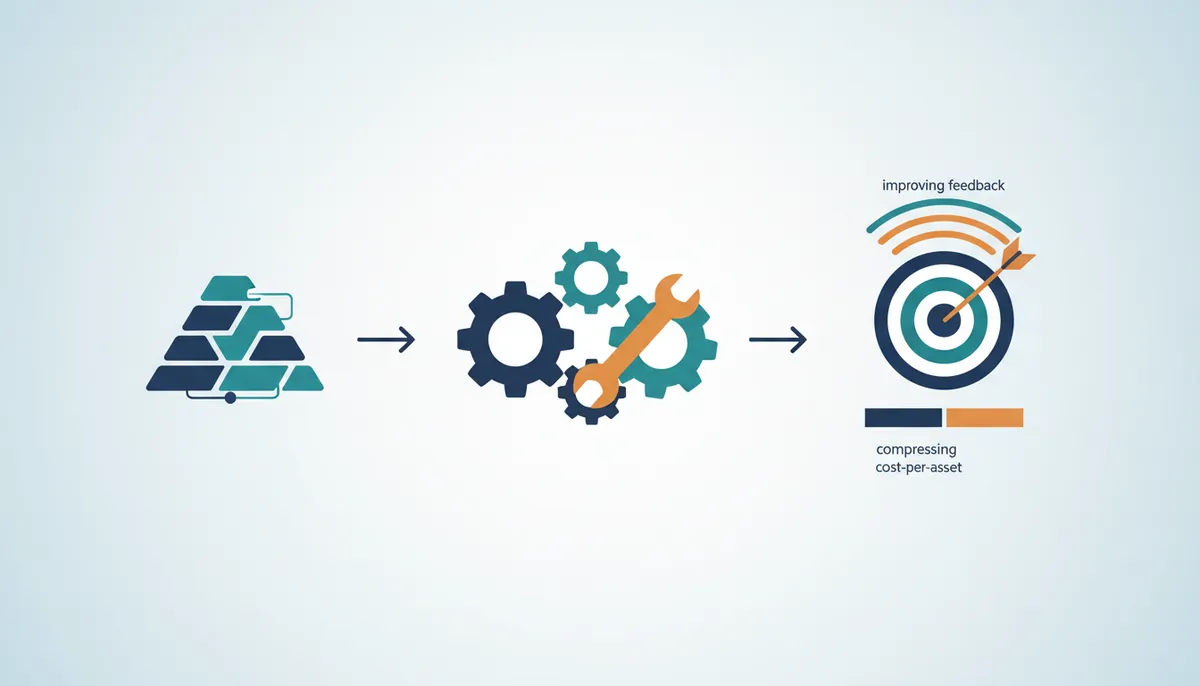
Technical filters known as automated quality gates validate content against predefined standards before human reviewers ever see the draft. These systems slash the manual labor hours traditionally burned on repetitive editing and compliance checks, effectively decoupling output volume from personnel costs. Organizations no longer need to expand headcount linearly to match production targets. Instead, budget allocation shifts toward tooling and workflow automation that scales independently of staff size. This architectural shift alters the variable cost per piece, allowing lean teams to compress expenses while maintaining consistency. High-cost human expertise moves from initial drafting to strategic oversight.
Application: Executing the Four-Week Implementation Sequence for Solo Teams
Success comes from building a small, boring, repeatable system rather than chasing complex frameworks. Week 1 requires auditing existing assets to identify published, performing, and outdated content. This inventory prevents redundant work and clarifies where templatized workflows will yield the highest immediate return. Week 2 involves writing a one-page process document detailing specific ownership and sequence. Without this constraint, ad hoc execution consumes disproportionate energy on routine decisions. Week 3 requires fixing one tool bottleneck to unblock the primary friction point. Many operators select tools like Grammarly as an automated quality gate to enforce writing standards before human review. This targeted fix reduces variable costs per piece more effectively than broad platform overhauls. Week 4 establishes a recurring 15-minute monthly check-in to review performance data against strategic goals. This cadence supports the feedback loops necessary for continuous improvement, ensuring the system evolves with market demands.
Strict discipline limits this approach. Without a repeatable process, teams default to creating every piece of content from scratch, which is exhausting and causes good ideas to die. Solo practitioners often underestimate the time required for the initial audit, yet lacking a system that remembers past work leads to redundant efforts. Implementing a basic version of this framework is one of the highest-use things a solo or two-person marketing team can do to convert chaotic output into a governed asset.
Validating ROI Through 60-Day Feedback Loops and ARR Alignment
Closing feedback loops within 60 days of publication ensures continuous improvement and strict strategy alignment. This cadence forces teams to iterate on performance data before context decays, preventing the accumulation of unused analytics. Investment patterns now favor decoupling output volume from personnel costs rather than scaling headcount linearly with Annual Recurring Revenue. Team headcount still scales with ARR at roughly the same rate as in 2023, yet daily operational tasks have fundamentally changed to support higher output per capita.
Teams successfully separating volume from cost allocate spend toward infrastructure that sustains production without proportional hiring increases. Delaying analysis creates operational risk. Effective content operations frameworks mandate closing these loops within the 60-day window to maintain strategy alignment. This constraint exposes workflow fragility early, requiring strong governance rules to handle rapid iteration cycles without collapsing approval chains. The result is a system where content velocity remains stable even as strategic directives shift, using specialized AI agents and visual workflows to maintain quality without coding knowledge.
About
Hannah Brooks, Marketing Operations Lead at Enterium, brings direct, hands-on expertise to the complexities of building a content operations framework. Her daily work revolves around reviewing AI content tooling stacks and orchestrating the precise workflow automation required to turn strategy into shipped assets. Unlike theoretical strategists, Brooks focuses on the plumbing behind the process: designing governance models, evaluating vendor-neutral tool choices, and defining the metrics that prove content ROI. At Enterium, a brand dedicated to documenting how modern teams scale content pipelines with LLMs, she applies this rigorous, practitioner-led methodology to every piece of analysis. This article distills her experience in martech stack design into a reproducible guide for B2B teams. By connecting the abstract need for consistency with the concrete reality of workflow orchestration, Brooks provides the actionable architecture lean teams need to ship quality content without reinventing the wheel every cycle.
Conclusion
Scaling content production breaks when human review becomes the bottleneck, turning what should be a scalable asset into a linear labor cost. The operational expense here is time, but the compounding debt of unverified data that fails to inform future sprints. Teams must shift from viewing frameworks as static documentation to treating them as flexible infrastructure that demands regular calibration. Relying on ad-hoc reviews guarantees that strategic drift occurs long before leadership notices the divergence.
Organizations should mandate that all content operations foundation implementations include a hard stop for data review exactly two months post-publication. This timeline is critical because waiting longer allows market context to decay, rendering the insights useless for immediate course correction. Do not attempt to scale output volume until this specific review cadence is automated and enforced across every channel.
Start by auditing your current analytics dashboard this week to identify any assets published sixty days ago that lack a documented performance review. Tag these orphaned pieces and schedule a dedicated thirty-minute session to close the loop on their data before planning new campaigns. This single action prevents the accumulation of blind spots that eventually cripple decision-making speed.
Frequently Asked Questions
Teams without scalable models face chaotic execution and missed deadlines. This issue affects 45% of B2B marketers who lack a defined system. Implementing content operations resolves this by establishing repeatable workflows.
Mature operations significantly lower production expenses through efficient, repeatable workflows. Teams integrating AI tools achieve a 41% compression in cost-per-asset compared to traditional methods. This savings validates investing in a structured content operations foundation.
Teams must close feedback loops within 60 days to ensure strategic alignment. Delaying beyond this window slows iteration and misaligns output with market signals. Fast cycles enable continuous improvement for your content operations framework.
Strategies fail due to unclear roles and missing tool configurations during execution. Without a system, 35% of organizations struggle to scale effectively. A defined operations layer prevents these breakdowns by clarifying ownership and quality gates.
Small teams fix bottlenecks by building systems rather than hiring more writers. Operational maturity allows teams to scale output without expanding headcount. This approach transforms chaotic execution into a reliable, scalable model for consistent content delivery.
References